The Volkswagen Polo III Classic 1.8 (90 Hp): A Practical Sedan for Global Markets
The Volkswagen Polo III Classic 1.8 (90 Hp), produced between 1997 and 2000, represents a significant chapter in the history of Volkswagen’s compact offerings, particularly in markets outside of North America. As a sedan variant of the highly successful third-generation Polo hatchback (Type 6N), the Polo III Classic was specifically designed to cater to consumer preferences in regions where a traditional three-box sedan body style was favored over a hatchback, such as parts of Europe, Asia, and Latin America. This iteration of the Polo combined the reliability and engineering prowess of Volkswagen with a practical, family-oriented design, offering an economical yet capable vehicle in the competitive compact segment.
Positioned as an affordable and dependable family car, the Volkswagen Polo III Classic 1.8 (90 Hp) offered a blend of compact dimensions for urban maneuverability and sufficient interior and cargo space for daily use. It was part of Volkswagen’s broader strategy to offer a diverse range of body styles under the Polo nameplate, ensuring its appeal across a wider demographic and geographical spread. While the hatchback Polo was a common sight across Western Europe, the Classic sedan found its niche in markets looking for a more formal and spacious alternative within the compact class.
Engine and Performance Characteristics of the Volkswagen Polo III Classic
At the heart of the Volkswagen Polo III Classic 1.8 (90 Hp) was a robust and well-proven 1.8-liter (1781 cm³) naturally aspirated inline-four engine. This powertrain, known by engine codes ADD and ADZ, was a familiar workhorse within the Volkswagen Group, celebrated for its durability and straightforward maintenance. Delivering a respectable 90 horsepower at 5500 revolutions per minute, the engine provided adequate power for its segment, ensuring competent performance for both city driving and highway cruising.
Torque output was a significant highlight for this engine, peaking at 145 Nm (106.95 lb-ft) across a broad range from 2700 to 2900 rpm. This flat torque curve contributed to the car’s flexible driving characteristics, minimizing the need for constant gear changes in traffic and providing decent pulling power. Power was transmitted to the front wheels via a standard 5-speed manual transmission, a common and reliable setup for compact cars of this era, emphasizing driver engagement and efficiency.
In terms of acceleration, the Polo III Classic 1.8 (90 Hp) could reach 60 mph from a standstill in an estimated 10.5 seconds, while the 0-100 km/h sprint took 11.1 seconds. Its maximum speed was approximately 111.85 mph (180 km/h), making it capable of sustained highway speeds. Fuel economy was also a key selling point for this model. In urban driving conditions, it achieved around 28.3 US mpg (8.3 l/100 km), improving to an impressive 37.3 US mpg (6.3 l/100 km) in extra-urban cycles. These figures underscored its economical nature, making it an attractive option for budget-conscious buyers and those prioritizing low running costs.
The engine featured a multi-port manifold injection system and a DOHC (Double Overhead Camshaft) valvetrain with 2 valves per cylinder, a configuration that balanced performance with efficiency and reliability. With a compression ratio of 10:1 and an engine oil capacity of 4.02 US quarts, the 1.8-liter unit was a testament to Volkswagen’s engineering philosophy of creating dependable and efficient powertrains for its mass-market vehicles.
Design and Features of the Volkswagen Polo III Classic
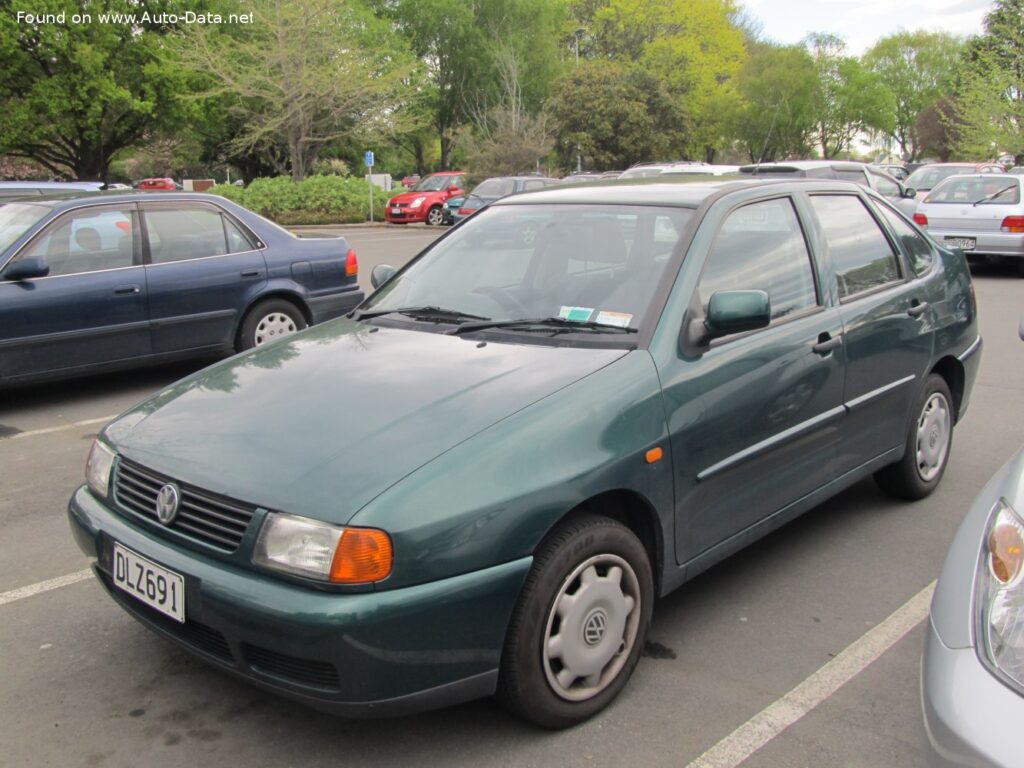
The Volkswagen Polo III Classic adopted a traditional four-door sedan body style, distinguishing it from its hatchback sibling. Measuring 163.94 inches (4164 mm) in length, 64.57 inches (1640 mm) in width, and 55.67 inches (1414 mm) in height, it was a compact vehicle that offered surprising interior space for its class. The wheelbase of 96.1 inches (2441 mm) contributed to a stable ride and a reasonably spacious cabin for five occupants.
Designed with practicality in mind, the Polo Classic featured a generous trunk capacity, which was a major differentiator from the hatchback. With a minimum cargo volume of 16.07 cubic feet (455 liters) and expandable to 26.84 cubic feet (760 liters) with the rear seats folded, it offered ample space for luggage, groceries, or family essentials. This made it a particularly appealing choice for families or individuals who required more dedicated cargo space without opting for a larger, more expensive vehicle.
Standard features for the era included hydraulic power steering, making low-speed maneuvers and parking significantly easier. The braking system comprised disc brakes at the front and drum brakes at the rear, complemented by an Anti-lock Braking System (ABS) as an assisting system. ABS was a crucial safety feature for the late 1990s, enhancing vehicle control during emergency braking situations. The car rode on 185/60 R14 tires mounted on 6J x 14-inch wheel rims, providing a comfortable and stable ride quality typical of Volkswagen vehicles.
The interior design was functional and ergonomic, characterized by durable materials and a straightforward layout. While not luxurious, the cabin was built to withstand the rigors of daily use, focusing on practicality and ease of operation. The emphasis was on providing a comfortable and safe environment for its occupants, reflecting Volkswagen’s reputation for solid build quality even in its more entry-level offerings.
Technical Specifications
| Category | Specification |
|---|---|
General Information |
|
| Brand | Volkswagen |
| Model | Polo |
| Generation | Polo III Classic |
| Type (Engine) | 1.8 (90 Hp) |
| Start of Production | 1997 |
| End of Production | 2000 |
| Powertrain Architecture | Internal Combustion Engine |
| Body Type | Sedan |
| Seats | 5 |
| Doors | 4 |
Performance Specs |
|
| Fuel Consumption (City) | 8.3 l/100 km (28.3 US mpg) |
| Fuel Consumption (Highway) | 6.3 l/100 km (37.3 US mpg) |
| Fuel Type | Petrol (Gasoline) |
| Acceleration 0 – 60 mph | 10.5 sec |
| Acceleration 0 – 100 km/h | 11.1 sec |
| Maximum Speed | 180 km/h (111.85 mph) |
| Weight-to-Power Ratio | 12.2 kg/Hp (26.9 lbs/Hp), 81.8 Hp/tonne |
| Weight-to-Torque Ratio | 7.6 kg/Nm (16.8 lbs/Nm), 131.8 Nm/tonne |
Engine Specs |
|
| Power | 90 Hp @ 5500 rpm |
| Power per Liter | 50.5 Hp/l |
| Torque | 145 Nm @ 2700-2900 rpm (106.95 lb-ft @ 2700-2900 rpm) |
| Engine Layout | Front, Transverse |
| Engine Model/Code | ADD, ADZ |
| Engine Displacement | 1781 cm³ (1.8 liters / 108.68 cu. in.) |
| Number of Cylinders | 4 |
| Engine Configuration | Inline |
| Cylinder Bore | 81 mm (3.19 in.) |
| Piston Stroke | 86.4 mm (3.4 in.) |
| Compression Ratio | 10:1 |
| Number of Valves per Cylinder | 2 |
| Fuel Injection System | Multi-port manifold injection |
| Engine Aspiration | Naturally aspirated engine |
| Valvetrain | DOHC |
| Engine Oil Capacity | 3.8 l (4.02 US qt) |
Space, Volume and Weights |
|
| Kerb Weight | 1100 kg (2425.08 lbs) |
| Trunk (Boot) Space – Minimum | 455 l (16.07 cu. ft.) |
| Trunk (Boot) Space – Maximum | 760 l (26.84 cu. ft.) |
| Fuel Tank Capacity | 45 l (11.89 US gal) |
Dimensions |
|
| Length | 4164 mm (163.94 in.) |
| Width | 1640 mm (64.57 in.) |
| Height | 1414 mm (55.67 in.) |
| Wheelbase | 2441 mm (96.1 in.) |
| Front Track | 1429 mm (56.26 in.) |
| Rear Track | 1410 mm (55.51 in.) |
Drivetrain, Brakes and Suspension Specs |
|
| Drivetrain Architecture | Front-wheel drive; Internal Combustion Engine drives the front wheels |
| Drive Wheel | Front-wheel drive |
| Number of Gears and Type of Gearbox | 5 gears, manual transmission |
| Front Suspension | Wishbone |
| Rear Suspension | Suspension with traction connecting levers |
| Front Brakes | Disc |
| Rear Brakes | Drum |
| Assisting Systems | ABS (Anti-lock Braking System) |
| Steering Type | Steering rack and pinion |
| Power Steering | Hydraulic Steering |
| Tires Size | 185/60 R14 |
| Wheel Rims Size | 6J x 14 |
Legacy and Market Impact of the Volkswagen Polo III Classic
The Volkswagen Polo III Classic 1.8 (90 Hp), despite not being a mainstream model in the United States, played a crucial role in Volkswagen’s global strategy during the late 1990s. Its primary market impact was felt in regions where compact sedans were highly valued for their practicality, perceived prestige over hatchbacks, and suitability for family use. In these markets, the Polo Classic was often seen as a step up from smaller city cars, offering more space and comfort without the higher running costs of a larger vehicle.
Its reputation was built on Volkswagen’s core values: reliability, robust engineering, and a no-nonsense approach to automotive design. The 1.8-liter engine, while not a powerhouse, was known for its longevity and ease of maintenance, making the car a popular choice for both private owners and fleet operators. Competitors in its segment varied by region but typically included other compact sedans from European, Japanese, and Korean manufacturers, such as the Ford Fiesta sedan variants, Opel Corsa-based sedans (e.g., Vauxhall Corsa saloon), and models like the Toyota Corolla or Hyundai Accent in certain markets. The Polo Classic distinguished itself with its solid build quality and a driving experience that felt more substantial than some of its rivals.
The significance of the Polo III Classic lies in its contribution to Volkswagen’s global sales volume and its ability to adapt the successful Polo platform to diverse market demands. It demonstrated Volkswagen’s understanding of regional preferences, offering a versatile product lineup. While the hatchback Polo was celebrated for its agility and urban charm, the Classic sedan provided a more traditional, practical, and often more affordable entry into the compact sedan segment, solidifying Volkswagen’s presence in a wide array of international automotive landscapes. Its legacy is one of understated utility, reliable performance, and a testament to the enduring appeal of a well-engineered compact sedan.