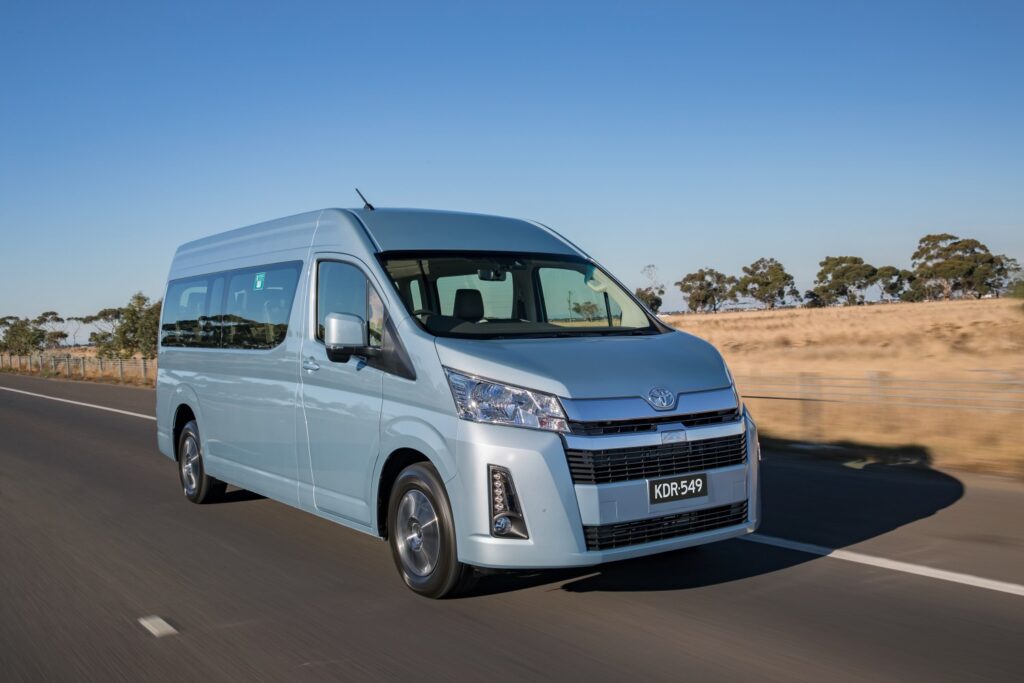
Toyota HiAce VI (H300) Commuter L2H2 2.8 D-4D (156 Hp)
The Toyota HiAce VI (H300) Commuter L2H2 2.8 D-4D (156 Hp) represents the sixth generation of Toyota’s globally renowned light commercial vehicle, a lineage celebrated for its unwavering reliability and versatility. Introduced in 2019, this particular variant, the Commuter L2H2, is specifically designed as a long-wheelbase, high-roof passenger van, catering to a diverse range of needs from public transport to private shuttle services across its primary markets in Asia, Oceania, Africa, Latin America, and select European regions. Unlike many of Toyota’s passenger car offerings, the HiAce has never been a significant presence in the North American market, where other commercial van platforms dominate. Instead, it has carved out a formidable reputation as an indispensable workhorse in regions demanding robust, high-capacity, and fuel-efficient transportation solutions. This H300 generation marked a significant departure from its predecessors by adopting a semi-bonneted design, moving the engine forward from beneath the driver’s seat, a change that profoundly impacted safety, comfort, and serviceability.
Positioned firmly in the commercial van segment, the Toyota HiAce VI (H300) Commuter L2H2 2.8 D-4D (156 Hp) is engineered for endurance and practicality. Its design prioritizes maximizing interior space for passengers and cargo, while its powertrain focuses on delivering consistent performance and economy, crucial for its demanding operational environments. The “L2H2” designation signifies its specific body configuration: “L2” typically denotes a long wheelbase, and “H2” indicates a high roof, making it ideal for accommodating between 10 to 17 passengers comfortably, depending on the seating arrangement. This modern iteration of the HiAce continues Toyota’s legacy of building vehicles that are not just modes of transport but vital tools for businesses and communities worldwide, embodying the brand’s commitment to quality, durability, and reliability (QDR).
Engine and Performance of the Toyota HiAce VI (H300) Commuter L2H2 2.8 D-4D (156 Hp)
At the heart of the Toyota HiAce VI (H300) Commuter L2H2 2.8 D-4D (156 Hp) lies the robust 1GD-FTV diesel engine, a powerplant synonymous with Toyota’s modern light commercial and SUV offerings. This 2.8-liter (2755 cm³ or 168.12 cu. in.) inline four-cylinder engine is configured longitudinally at the front of the vehicle, driving the rear wheels, a traditional and highly effective setup for commercial vehicles that often carry significant loads. The engine benefits from a sophisticated Commonrail direct fuel injection system, ensuring precise fuel delivery and optimal combustion efficiency.
Performance-wise, the 1GD-FTV engine generates a respectable 156 horsepower at 3600 rpm. More critically for a commercial vehicle of this type, it delivers a substantial 420 Nm (309.78 lb.-ft.) of torque, available across a broad and usable rev range from 1600 to 2200 rpm. This low-end torque is paramount for effortless acceleration, climbing steep inclines, and maintaining momentum when fully loaded with passengers or cargo. The engine’s aspiration system features a turbocharger combined with an intercooler, which significantly boosts power output and efficiency by compressing and cooling the intake air.
Further enhancing its mechanical prowess, the engine utilizes a Double Overhead Camshaft (DOHC) valvetrain with four valves per cylinder, optimizing airflow for better performance and fuel economy. With a compression ratio of 15.6:1, it is designed for the high efficiency characteristic of modern diesel engines. Power is channeled through a durable 6-speed manual transmission, offering drivers precise control and the ability to extract maximum efficiency or power as needed. This powertrain combination ensures that the HiAce VI is not only capable of handling its substantial curb weight of 5456.44 to 5820.2 lbs. but also its impressive maximum payload capacity of 2601.45 to 2965.22 lbs., making it a true workhorse in every sense. The engine’s design, including its relatively low power-to-weight ratio of 63 Hp/tonne, underscores its focus on durability and sustained performance rather than outright speed, which aligns perfectly with its intended commercial applications.
Design & Features
The design of the Toyota HiAce VI (H300) Commuter L2H2 is a testament to functional aesthetics and robust engineering, tailored specifically for its role as a high-capacity passenger and commercial shuttle. Its van body type, with four doors and seating capacity ranging from 10 to 17 passengers, defines its primary utility. The L2H2 designation highlights its extended length and raised roof, dimensions critical for passenger comfort and cargo volume. Measuring an imposing 232.87 inches in length, 76.77 inches in width, and 89.76 inches in height, with a substantial 151.97-inch wheelbase, this HiAce variant commands a significant road presence and offers a cavernous interior.
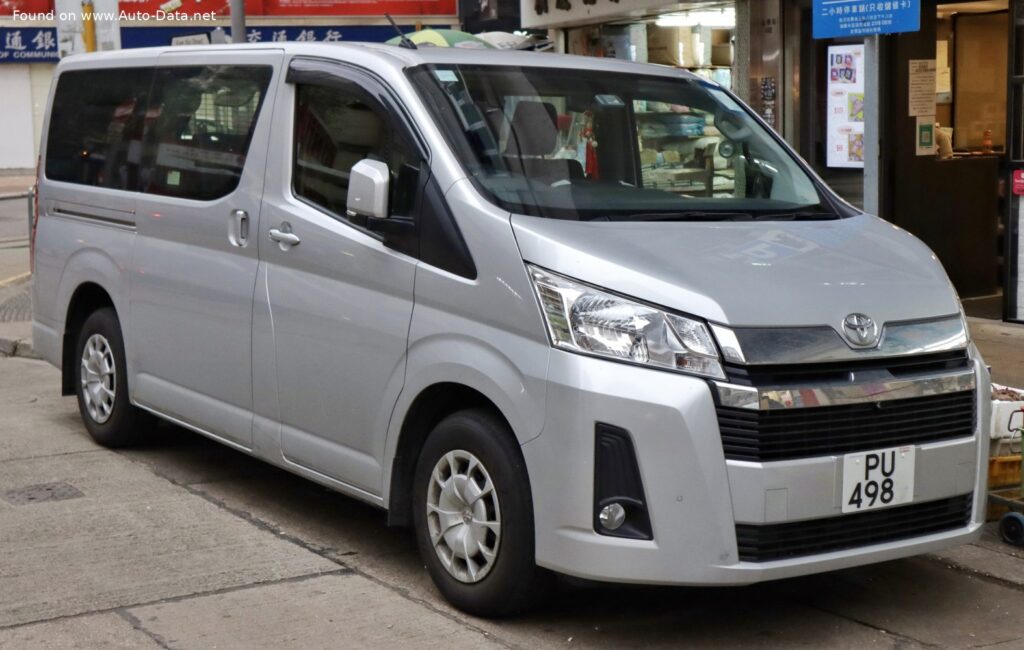
From an exterior perspective, the H300 generation introduced a “semi-bonnet” design, a significant evolution from the traditional cab-over configurations of previous HiAce models. This design shifts the engine forward, providing a more conventional front-end appearance and enhancing crumple zones for improved occupant safety. Large windows along the sides ensure ample natural light and excellent visibility for passengers, a key feature for shuttle services. The vehicle’s practical design extends to its large, easy-access sliding side door and a wide-opening rear tailgate, facilitating quick loading and unloading of passengers and luggage.
Inside, the HiAce Commuter prioritizes durability, practicality, and passenger comfort. Seating arrangements are highly flexible, allowing operators to configure the interior to suit specific business needs, from densely packed shuttle services to more spacious executive transport. Materials used are chosen for their resilience to heavy daily use and ease of cleaning. While specific luxury features are not its primary focus, modern amenities expected in a 2019 vehicle, such as air conditioning for all occupants, basic infotainment options, and power windows, are typically present to enhance the passenger experience.
The chassis and suspension components are engineered for heavy-duty applications. The front suspension employs an independent McPherson strut setup with coil springs and an anti-roll bar, offering a balance of comfort and stability. The rear features a rigid axle suspension with robust leaf springs, a time-tested design for handling substantial loads and enduring challenging road conditions. Braking is handled by ventilated discs at both the front and rear, providing reliable stopping power for a vehicle of its size and capacity, augmented by an Anti-lock Braking System (ABS) for enhanced safety during emergency braking. The hydraulic power steering system, coupled with a steering rack and pinion, ensures manageable maneuverability despite the vehicle’s large dimensions, reflected in its reasonable 41.99 ft. minimum turning circle. Standard tire size is 235/65 R16 on 16-inch wheel rims, providing a good balance of load-carrying capacity and ride comfort.
Technical Specifications
| Category | Specification |
|---|---|
| Brand | Toyota |
| Model | HiAce |
| Generation | HiAce VI (H300) Commuter L2H2 |
| Engine Type | 2.8 D-4D (156 Hp) |
| Start of Production | 2019 year |
| Powertrain Architecture | Internal Combustion engine |
| Body Type | Van |
| Seats | 10-17 |
| Doors | 4 |
| Performance Specs | |
| Fuel Type | Diesel |
| Weight-to-Power Ratio | 15.9 kg/Hp, 63 Hp/tonne |
| Weight-to-Torque Ratio | 5.9 kg/Nm, 169.7 Nm/tonne |
| Engine Specs | |
| Power | 156 Hp @ 3600 rpm |
| Power per liter | 56.6 Hp/l |
| Torque | 420 Nm @ 1600-2200 rpm (309.78 lb.-ft.) |
| Engine Layout | Front, Longitudinal |
| Engine Model/Code | 1GD-FTV |
| Engine Displacement | 2755 cm³ (168.12 cu. in.) |
| Number of Cylinders | 4 |
| Engine Configuration | Inline |
| Cylinder Bore | 92 mm (3.62 in.) |
| Piston Stroke | 103.6 mm (4.08 in.) |
| Compression Ratio | 15.6:1 |
| Number of Valves per Cylinder | 4 |
| Fuel Injection System | Diesel Commonrail |
| Engine Aspiration | Turbocharger, Intercooler |
| Valvetrain | DOHC |
| Engine Oil Capacity | 7.1 l (7.5 US qt) |
| Coolant Capacity | 9.3 l (9.83 US qt) |
| Space, Volume and Weights | |
| Kerb Weight | 2475-2640 kg (5456.44 – 5820.2 lbs.) |
| Max. Weight (GVWR) | 3820 kg (8421.66 lbs.) |
| Max Load | 1180-1345 kg (2601.45 – 2965.22 lbs.) |
| Fuel Tank Capacity | 70 l (18.49 US gal) |
| Dimensions | |
| Length | 5915 mm (232.87 in.) |
| Width | 1950 mm (76.77 in.) |
| Height | 2280 mm (89.76 in.) |
| Wheelbase | 3860 mm (151.97 in.) |
| Front Track | 1675 mm (65.94 in.) |
| Rear Track | 1670 mm (65.75 in.) |
| Front Overhang | 950 mm (37.4 in.) |
| Rear Overhang | 1105 mm (43.5 in.) |
| Ride Height (Ground Clearance) | 185 mm (7.28 in.) |
| Minimum Turning Circle | 12.8 m (41.99 ft.) |
| Drivetrain, Brakes and Suspension Specs | |
| Drivetrain Architecture | Rear wheel drive |
| Drive Wheel | Rear wheel drive |
| Number of Gears & Type of Gearbox | 6 gears, manual transmission |
| Front Suspension | Independent, McPherson with coil spring and anti-roll bar |
| Rear Suspension | Rigid axle suspension, Leaf spring |
| Front Brakes | Ventilated discs |
| Rear Brakes | Ventilated discs |
| Assisting Systems | ABS (Anti-lock braking system) |
| Steering Type | Steering rack and pinion |
| Power Steering | Hydraulic Steering |
| Tires Size | 235/65 R16 |
| Wheel Rims Size | 16 inches |
Legacy & Market Impact
The Toyota HiAce series has cultivated an unparalleled legacy as a global commercial vehicle icon, and the HiAce VI (H300) Commuter L2H2 2.8 D-4D (156 Hp) continues this tradition with significant market impact, particularly in its target regions. Toyota’s reputation for building vehicles of exceptional quality, durability, and reliability (QDR) is perhaps nowhere more evident than in the HiAce. This steadfast dependability is the cornerstone of its success, making it the vehicle of choice for countless businesses, public transport operators, and government agencies across Asia, Africa, Oceania, and Latin America. In these markets, where infrastructure can be challenging and maintenance resources sometimes scarce, a vehicle that can consistently perform under demanding conditions is invaluable.
The H300 generation, with its semi-bonneted design, marked a strategic evolution, not just in aesthetics but also in addressing modern safety standards and driver comfort. By moving the engine forward, Toyota significantly improved frontal impact protection, a crucial enhancement for a vehicle that often carries many passengers. This design also reduced cabin noise and heat, making long journeys more comfortable for both driver and passengers. The adoption of the 1GD-FTV diesel engine, known for its efficiency and strong torque delivery, further cemented its appeal by offering lower running costs through improved fuel economy and reduced emissions, a vital consideration for commercial fleets.
In its primary markets, the Toyota HiAce VI (H300) faces competition from a range of other global commercial van offerings, including vehicles like the Ford Transit Custom (in some markets), Hyundai H350, Nissan NV350 Caravan, and various models from Chinese and local manufacturers. However, the HiAce often maintains a competitive edge due to its established network for parts and service, high resale value, and the deeply ingrained trust in the Toyota brand. Its versatility, available in multiple body styles and configurations beyond the Commuter L2H2, allows it to serve a vast array of niche applications, from cargo delivery and refrigerated transport to emergency services and luxury shuttles.
The historical significance of the HiAce lies in its consistent role as a backbone of commerce and public transport in developing economies and beyond. For decades, it has facilitated economic growth by reliably moving goods and people, supporting everything from small businesses to large-scale public transportation networks. The HiAce VI (H300) Commuter L2H2 2.8 D-4D (156 Hp) builds upon this legacy, integrating modern technology and safety features without sacrificing the core tenets of robustness and practicality that define the HiAce nameplate. It remains a testament to Toyota’s philosophy of producing fit-for-purpose vehicles that genuinely serve the needs of their users, ensuring its continued relevance and strong market presence for years to come.