
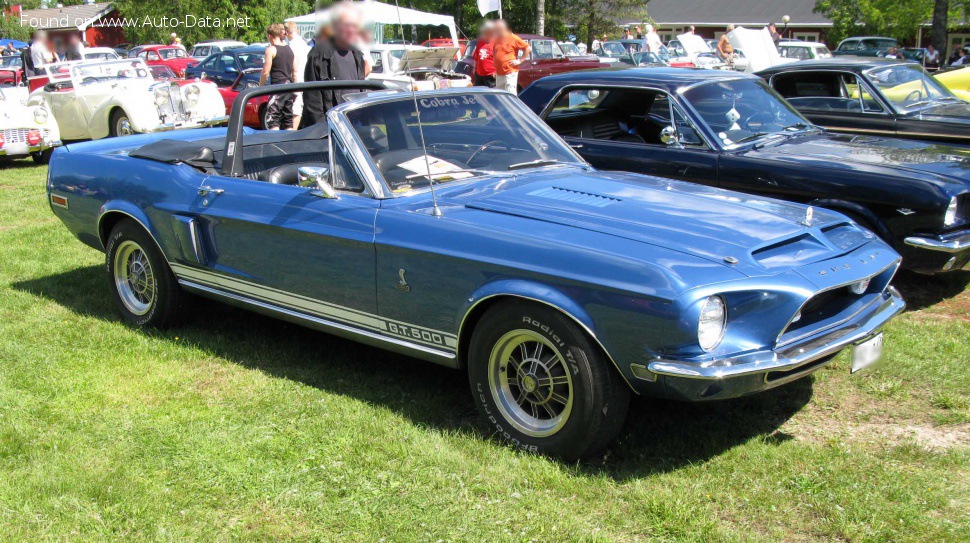
The Ford Shelby I Cabrio GT 500 7.0 V8 (340 Hp): A Legend of American Muscle
The Ford Shelby I Cabrio GT 500 7.0 V8 (340 Hp), produced for the 1969 and 1970 model years, stands as an iconic testament to the golden era of American muscle cars. This particular generation, often referred to as the “Shelby I Cabrio,” represented the pinnacle of performance and style born from the legendary collaboration between Ford Motor Company and the automotive visionary Carroll Shelby. Positioned at the very top of the Mustang-derived performance hierarchy, the GT 500 Cabriolet was a high-performance grand tourer, blending raw power with the exhilarating experience of open-air motoring. It was designed to dominate both drag strips and winding back roads, offering an unmatched combination of brute force and distinctive design.
Unlike some of its more bare-bones muscle car contemporaries, the Shelby GT 500 aimed for a more refined, albeit still intensely performance-oriented, market segment. It appealed to enthusiasts who desired not just speed, but also exclusivity and a certain level of sophistication in their high-horsepower machines. With its massive 7.0-liter V8 engine, this convertible was more than just a car; it was a statement, a symbol of American automotive prowess and unbridled passion.
Engine & Performance: The Heart of the Ford Shelby I Cabrio GT 500 7.0 V8
At the core of the 1969-1970 Ford Shelby I Cabrio GT 500 lay its formidable powertrain, a marvel of American engineering for its time. The car was powered by a longitudinally mounted, front-engine, naturally aspirated 7.0-liter (6997 cm³ or 426.98 cubic inches) V8 engine. This colossal eight-cylinder unit, configured in a classic ‘V’ shape, was a direct descendant of Ford’s racing heritage, designed to deliver immense power and torque across a broad RPM range.
The engine generated a robust 340 horsepower at 5200 rpm, a figure that, while impressive, was widely believed to be underrated by Ford for insurance and regulatory reasons. The true measure of its might, however, came from its torque output: a staggering 597 Nm (440.32 lb-ft) delivered at a relatively low 3400 rpm. This immense torque meant that the GT 500 Cabriolet had instant, tire-shredding acceleration from almost any speed, making it a formidable contender on the street and strip. Each of its eight cylinders featured two valves, contributing to efficient breathing, and the fuel mixture was precisely managed by a period-correct carburetor system, a hallmark of high-performance engines of that era.
Power was channeled to the rear wheels via a robust 4-speed manual transmission, offering drivers direct and engaging control over the GT 500’s prodigious output. This drivetrain architecture, combined with a curb weight of 3939.66 lbs (1787 kg), resulted in a compelling weight-to-power ratio of 5.3 kg per horsepower (190.3 Hp per tonne) and an even more impressive weight-to-torque ratio of 3 kg per Nm (334.1 Nm per tonne). These figures underscore the car’s ability to translate its engine’s power into visceral acceleration. The GT 500 was not just fast in a straight line; its overall mechanical package was engineered for dynamic driving, pushing the boundaries of what a production car could achieve in the late 1960s.
Design & Features of the Ford Shelby I Cabrio
The design of the 1969-1970 Ford Shelby I Cabrio GT 500 was a masterful blend of Ford’s Mustang platform with Carroll Shelby’s aggressive, performance-oriented styling cues. As a two-door cabriolet, it offered the thrilling experience of open-air motoring, adding an extra layer of desirability and exclusivity. The car’s overall dimensions – a length of 185.98 inches (4724 mm), a width of 71.3 inches (1811 mm), and a height of 51.3 inches (1303 mm) – gave it a commanding presence, low-slung and wide, hinting at its performance capabilities.
Visually, the Shelby GT 500 distinguished itself from its standard Mustang siblings with a host of unique features. The front fascia was redesigned, featuring a prominent grille, often with additional driving lights, and a distinctive front spoiler that improved aerodynamics and cooling. Functional hood scoops were integrated to feed the hungry V8, while side scoops provided cooling for the rear brakes, a nod to its racing pedigree. The car’s flanks were adorned with iconic Shelby badging, and the rear featured a unique decklid spoiler and sequential turn signals, a signature Mustang feature that added a touch of flair.
The interior, designed to accommodate four occupants, offered a sportier ambiance than a regular Mustang, with bucket seats and a performance-oriented dashboard layout. While luxury features by today’s standards were minimal, for its era, the Shelby GT 500 provided a comfortable and engaging driving environment. Safety features were characteristic of the period, including basic seat belts and a robust chassis. The convertible top, when retracted, transformed the car into an ultimate cruising machine, allowing occupants to fully immerse themselves in the sound and sensation of its powerful V8.
The substantial wheelbase of 107.99 inches (2743 mm) contributed to the car’s stability at high speeds, while the identical front and rear track widths of 58.5 inches (1486 mm) ensured balanced handling. Stopping power for this potent machine was provided by disc brakes at the front, offering superior heat dissipation and fade resistance, complemented by drum brakes at the rear. This combination was considered advanced for a production car of its time, reflecting the Shelby team’s commitment to balanced performance.
Technical Specifications: Ford Shelby I Cabrio GT 500 7.0 V8 (340 Hp)
| Category | Specification |
|---|---|
| General Information | |
| Brand | Ford |
| Model | Shelby |
| Generation | Shelby I Cabrio |
| Type (Engine) | GT 500 7.0 V8 (340 Hp) |
| Start of Production | 1969 year |
| End of Production | 1970 year |
| Powertrain Architecture | Internal Combustion engine |
| Body Type | Cabriolet |
| Seats | 4 |
| Doors | 2 |
| Performance Specs | |
| Fuel Type | Petrol (Gasoline) |
| Power | 340 Hp @ 5200 rpm |
| Power per Liter | 48.6 Hp/l |
| Torque | 597 Nm (440.32 lb.-ft.) @ 3400 rpm |
| Weight-to-power ratio | 5.3 kg/Hp (190.3 Hp/tonne) |
| Weight-to-torque ratio | 3 kg/Nm (334.1 Nm/tonne) |
| Engine Specs | |
| Engine Layout | Front, Longitudinal |
| Engine Displacement | 6997 cm³ (7.0 liters / 426.98 cu. in.) |
| Number of Cylinders | 8 |
| Engine Configuration | V-engine |
| Cylinder Bore | 104.9 mm (4.13 in.) |
| Piston Stroke | 101.19 mm (3.98 in.) |
| Compression Ratio | 10.6:1 |
| Number of Valves per Cylinder | 2 |
| Fuel Injection System | Carburetor |
| Engine Aspiration | Naturally aspirated engine |
| Space, Volume and Weights | |
| Kerb Weight | 1787 kg (3939.66 lbs) |
| Fuel Tank Capacity | 76 liters (20.08 US gal) |
| Dimensions | |
| Length | 4724 mm (185.98 in.) |
| Width | 1811 mm (71.3 in.) |
| Height | 1303 mm (51.3 in.) |
| Wheelbase | 2743 mm (107.99 in.) |
| Front Track | 1486 mm (58.5 in.) |
| Rear (Back) Track | 1486 mm (58.5 in.) |
| Minimum Turning Circle | 11.46 m (37.6 ft.) |
| Drivetrain, Brakes and Suspension Specs | |
| Drivetrain Architecture | The Internal combustion engine (ICE) drives the rear wheels of the vehicle. |
| Drive Wheel | Rear wheel drive |
| Number of Gears and Type of Gearbox | 4 gears, manual transmission |
| Front Brakes | Disc |
| Rear Brakes | Drum |
Legacy & Market Impact of the Ford Shelby I Cabrio GT 500 7.0 V8
The Ford Shelby I Cabrio GT 500 7.0 V8 carved out an indelible niche in automotive history, solidifying its status as one of the most revered American muscle cars. Its short production run from 1969 to 1970, particularly for the convertible variant, contributed to its rarity and desirability, making it a highly sought-after collector’s item today. The GT 500’s reputation was built on its uncompromising performance, stunning aesthetics, and the legendary name of Carroll Shelby, whose touch transformed an already popular pony car into an automotive icon.
In its heyday, the Shelby GT 500 Cabriolet competed directly with other titans of the muscle car era. Its primary rivals included the Chevrolet Corvette, particularly the big-block variants, the Pontiac GTO, Plymouth Hemi ‘Cuda, and the Dodge Challenger R/T. What set the Shelby apart was its unique blend of Mustang familiarity with Shelby’s race-bred enhancements, offering a more refined and exclusive package than many of its competitors. The collaboration between Ford and Shelby demonstrated how a major automaker could leverage a specialized performance builder to push boundaries and create halo cars that elevated the brand’s image.
The 1969-1970 Shelby models were arguably the most dramatically styled, featuring unique body panels that distinguished them significantly from the standard Mustang. This aggressive styling, combined with the potent 428 Cobra Jet engine (often associated with the 7.0L displacement of this era’s GT500), ensured that the car was as much a visual spectacle as it was a performance powerhouse. Its enduring appeal is evident in popular culture, where it frequently appears in films, television shows, and video games, cementing its place as a symbol of American automotive freedom and power.
Today, the Ford Shelby I Cabrio GT 500 7.0 V8 is more than just a classic car; it’s a piece of living history. Its legacy continues to influence modern performance vehicles, proving that brute force, when combined with thoughtful design and a passionate vision, can create an automotive legend that transcends generations. The roar of its big-block V8, the feel of its manual transmission, and the wind in the hair from its convertible top offer an authentic, unfiltered driving experience that remains highly coveted by enthusiasts worldwide.
