
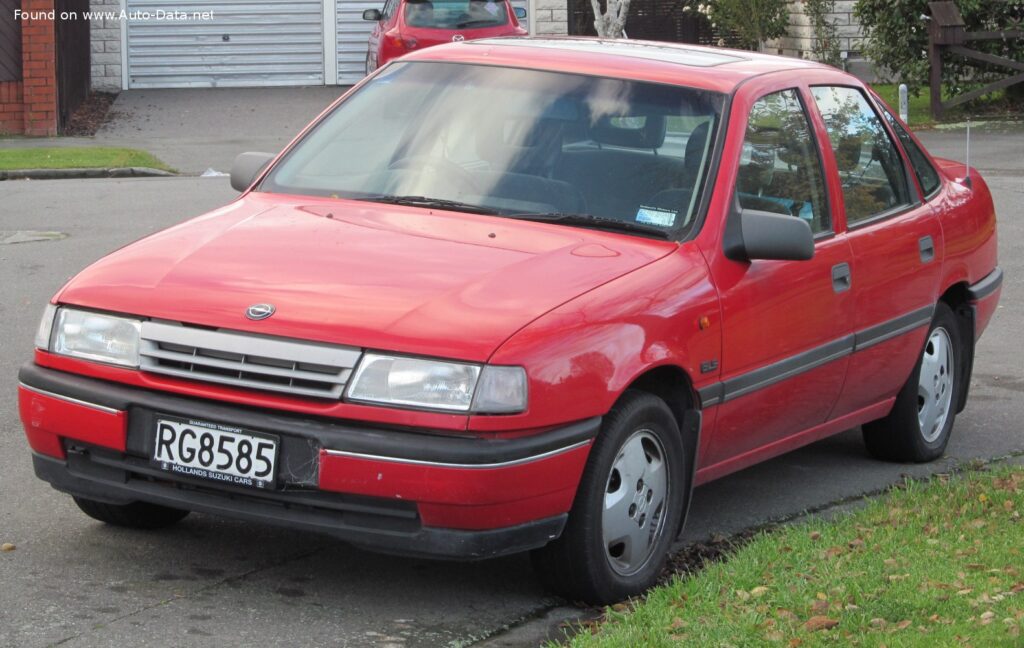
The Opel Vectra A 1.6 S: A European Mainstay of the Late 20th Century
The Opel Vectra A 1.6 S represents a significant chapter in Opel’s history, serving as a cornerstone of the European mid-size family car segment during its production run from 1988 to 1992. As the successor to the long-running Ascona, the Vectra A was tasked with bringing Opel into a new era of design, aerodynamics, and front-wheel-drive efficiency. While the Opel brand, and by extension the Vectra, was never officially sold in the United States under its original badge, its platform and design philosophy often mirrored technologies found in contemporary General Motors products globally. In its primary European market, the Vectra A quickly established itself as a popular choice for families and fleet buyers alike, lauded for its practicality, robust engineering, and competitive pricing. This particular variant, the 1.6 S, offered an accessible entry point into the Vectra lineup, balancing adequate performance with commendable fuel economy for its time.
Engine and Performance of the Opel Vectra A 1.6 S
At the heart of the Opel Vectra A 1.6 S lay the 16SV engine, a naturally aspirated inline-four gasoline (petrol) unit designed for reliability and everyday usability. With a displacement of 1,598 cubic centimeters (97.52 cubic inches), this overhead camshaft (OHC) engine featured two valves per cylinder and a compression ratio of 10:1. In an era transitioning rapidly towards fuel injection, the 1.6 S maintained a conventional carburetor fuel injection system, a common and cost-effective solution for entry-level models of the period. This setup delivered a respectable 82 horsepower at 5,200 revolutions per minute (rpm) and a peak torque of 130 Newton-meters (95.88 lb.-ft.) at a relatively low 2,600 rpm. The low-end torque characteristic made the Vectra 1.6 S a tractable and manageable car for city driving and highway cruising, despite its modest power output.
Paired with a five-speed manual transmission, the 1.6 S directed its power to the front wheels, a configuration that had become standard for family sedans prioritizing interior space and efficient packaging. Performance figures, while not exhilarating by modern standards, were entirely competitive for its segment in the late 1980s. The Vectra A 1.6 S could accelerate from 0 to 60 miles per hour in approximately 13.3 seconds and reach a maximum speed of 110.6 miles per hour. Fuel economy was a strong selling point, with a combined cycle rating of 34.6 US mpg (6.8 l/100 km), demonstrating its efficiency for long-distance travel and daily commutes. The vehicle’s weight-to-power ratio stood at 12.4 kg/Hp, or roughly 80.4 Hp per tonne, further underscoring its focus on economical and practical transportation rather than outright speed.
Design and Features of the Opel Vectra A
The design of the Opel Vectra A marked a significant departure from its more angular predecessor, the Ascona. Opel embraced a sleek, aerodynamic aesthetic, evidenced by its remarkably low drag coefficient (Cd) of just 0.29. This figure was class-leading at the time and contributed significantly to both fuel efficiency and reduced wind noise at higher speeds. The 1.6 S variant, like many Vectra A models, was offered as a four-door sedan, a body style that resonated strongly with European consumers seeking a practical and spacious family car. Its dimensions – a length of 174.49 inches, a width of 67.17 inches, and a wheelbase of 102.36 inches – provided a comfortable and accommodating cabin for five occupants.
Inside, the Vectra A offered a functional and ergonomic interior. While the 1.6 S was an entry-level model, it still provided a well-laid-out dashboard and comfortable seating. Practicality was a hallmark, with a generous trunk capacity ranging from 18.72 cubic feet with the rear seats up to an impressive 29.66 cubic feet when folded, making it highly versatile for family trips or hauling cargo. From a safety perspective, the Vectra A was forward-thinking for its era, offering an Anti-lock Braking System (ABS) as an assisting system, a feature that was still considered advanced for a mass-market family car in the late 1980s. The hydraulic power steering ensured ease of maneuverability, and the suspension setup, featuring coil springs at both the front and rear, aimed to provide a comfortable ride while maintaining stable handling.
Technical Specifications
| Category | Specification |
|---|---|
| Brand | Opel |
| Model | Vectra A |
| Type (Engine) | 1.6 S (82 Hp) |
| Start of Production | 1988 year |
| End of Production | 1992 year |
| Powertrain Architecture | Internal Combustion engine |
| Body Type | Sedan |
| Seats | 5 |
| Doors | 4 |
| Performance Specs | |
| Fuel Consumption (Economy) – Urban | 8.9 l/100 km (26.4 US mpg) |
| Fuel Consumption (Economy) – Extra Urban | 5.2 l/100 km (45.2 US mpg) |
| Fuel Consumption (Economy) – Combined | 6.8 l/100 km (34.6 US mpg) |
| Fuel Type | Petrol (Gasoline) |
| Acceleration 0 – 62 mph (0 – 100 km/h) | 14 sec |
| Acceleration 0 – 60 mph (Calculated) | 13.3 sec |
| Maximum Speed | 178 km/h (110.6 mph) |
| Weight-to-Power Ratio | 12.4 kg/Hp (80.4 Hp/tonne) |
| Weight-to-Torque Ratio | 7.8 kg/Nm (127.5 Nm/tonne) |
| Engine Specs | |
| Power | 82 Hp @ 5200 rpm |
| Power per Liter | 51.3 Hp/l |
| Torque | 130 Nm @ 2600 rpm (95.88 lb.-ft. @ 2600 rpm) |
| Engine Layout | Front, Transverse |
| Engine Model/Code | 16SV |
| Engine Displacement | 1598 cm3 (97.52 cu. in.) |
| Number of Cylinders | 4 |
| Engine Configuration | Inline |
| Cylinder Bore | 79 mm (3.11 in.) |
| Piston Stroke | 81.5 mm (3.21 in.) |
| Compression Ratio | 10:1 |
| Number of Valves per Cylinder | 2 |
| Fuel Injection System | Carburetor |
| Engine Aspiration | Naturally aspirated engine |
| Valvetrain | OHC |
| Engine Oil Capacity | 3.5 l (3.7 US qt) |
| Engine Oil Specification | Not available |
| Coolant Capacity | 5.8 l (6.13 US qt) |
| Space, Volume and Weights | |
| Kerb Weight | 1020 kg (2248.72 lbs) |
| Max. Weight | 1550 kg (3417.17 lbs) |
| Max Load | 530 kg (1168.45 lbs) |
| Trunk (Boot) Space – Minimum | 530 l (18.72 cu. ft.) |
| Trunk (Boot) Space – Maximum | 840 l (29.66 cu. ft.) |
| Fuel Tank Capacity | 61 l (16.11 US gal) |
| Dimensions | |
| Length | 4432 mm (174.49 in.) |
| Width | 1706 mm (67.17 in.) |
| Height | 1400 mm (55.12 in.) |
| Wheelbase | 2600 mm (102.36 in.) |
| Front Track | 1426 mm (56.14 in.) |
| Rear (Back) Track | 1423 mm (56.02 in.) |
| Drag Coefficient (Cd) | 0.29 |
| Drivetrain, Brakes and Suspension Specs | |
| Drivetrain Architecture | Front-wheel drive, Internal Combustion engine |
| Drive Wheel | Front wheel drive |
| Number of Gears and Type of Gearbox | 5 gears, manual transmission |
| Front Suspension | Coil spring |
| Rear Suspension | Coil spring |
| Front Brakes | Disc |
| Rear Brakes | Drum |
| Assisting Systems | ABS (Anti-lock braking system) |
| Power Steering | Hydraulic Steering |
| Tires Size | 175/70 R14 |
| Wheel Rims Size | 14 |
Legacy and Market Impact of the Opel Vectra A
The Opel Vectra A, particularly in its practical and economical 1.6 S guise, carved out a significant niche in the highly competitive European mid-size segment. It directly competed with stalwarts like the Ford Sierra (and later the Mondeo), the Volkswagen Passat, and to some extent, the Peugeot 405 and Renault 21. Opel’s strategy with the Vectra A was to offer a modern, aerodynamic, and reliable vehicle that appealed to a broad spectrum of buyers, from private individuals to large corporate fleets. The 1.6 S variant, with its efficient carburetor engine, represented the sensible choice for those prioritizing low running costs and proven technology.
Its robust construction and straightforward mechanicals contributed to a reputation for durability, making it a common sight on European roads for many years after its production ceased. The Vectra A also played a crucial role in establishing the “Vectra” nameplate as a successor to the venerable Ascona, carrying forward Opel’s tradition of offering solid, no-nonsense family transportation. While it may not have been the most exciting car in its class, its blend of aerodynamic styling, spacious interior, respectable fuel economy, and the availability of features like ABS made it a highly competent and influential vehicle for its time. The Vectra A laid the groundwork for future generations of Opel’s mid-size offerings, solidifying its place as a quintessential European family car of the late 20th century.
