Introduction to the Skoda Octavia IV 1.0 TSI EVO e-TEC (110 Hp) Mild Hybrid DSG
The Skoda Octavia IV 1.0 TSI EVO e-TEC (110 Hp) Mild Hybrid DSG represents a crucial iteration in the storied history of Skoda’s flagship compact family car. Launched in October 2020 as part of the fourth-generation Octavia lineup, this particular variant emphasizes efficiency, modern technology, and the brand’s well-established commitment to practicality. While the Skoda brand is not officially sold in the United States, the Octavia is a cornerstone model for the Czech automaker, a prominent member of the Volkswagen Group, dominating sales charts across Europe and other global markets. It competes fiercely in the highly competitive C-segment, offering a compelling blend of space, value, and sophisticated engineering derived from its VW Group siblings.
This specific model, produced until March 2023, features a mild-hybrid powertrain architecture, designated MHEV (Mild Hybrid Electric Vehicle), which incorporates a power-assist battery system to augment the internal combustion engine. This technology aims to reduce fuel consumption and lower emissions, making it an attractive option for environmentally conscious drivers within its primary markets. The liftback body style, a signature of the Octavia, combines the sleek profile of a sedan with the immense practicality of a hatchback, delivering exceptional cargo capacity and versatile utility.
Powertrain and Performance of the Skoda Octavia IV 1.0 TSI EVO e-TEC (110 Hp) Mild Hybrid DSG
Engine Technology and Efficiency
At the heart of the Skoda Octavia IV 1.0 TSI EVO e-TEC (110 Hp) Mild Hybrid DSG is a highly efficient 1.0-liter (999 cm³) inline three-cylinder gasoline engine, identified by the engine code DLAA. This turbocharged unit, featuring direct fuel injection and an intercooler, delivers a respectable 110 horsepower at 5500 rpm. The power-per-liter figure of 110.1 Hp/l underscores its advanced design and engineering prowess. Torque output stands at 147.51 lb.-ft., available across a broad rev range from 2000 to 3000 rpm, ensuring responsive acceleration and flexible performance in everyday driving scenarios.
The “e-TEC” designation signifies its mild-hybrid nature. The MHEV system, comprising a 48-volt starter-generator and a small lithium-ion battery, assists the gasoline engine during acceleration, allows for extended coasting with the engine off, and enables a smoother, quicker restart of the engine via the Start & Stop System. This integration is key to the vehicle’s impressive fuel economy and reduced CO2 emissions. The powertrain architecture dictates that both the internal combustion engine and the electric motor drive the front wheels, working in a mixed mode to optimize efficiency.
Power is channeled to the front wheels via a sophisticated 7-speed automatic DSG (Direct Shift Gearbox) transmission. This dual-clutch unit is renowned for its rapid and seamless gear changes, contributing significantly to both the vehicle’s performance feel and its fuel efficiency. The Octavia IV 1.0 TSI EVO e-TEC achieves a combined fuel consumption of 47 US mpg (5.0 l/100 km) under the WLTP cycle, with CO2 emissions rated at 114 g/km, meeting the stringent Euro 6 Ap emission standard. Its urban fuel consumption (NEDC) is an equally impressive 47 US mpg, highlighting its suitability for city driving where the mild-hybrid system can frequently engage.
Driving Dynamics
Despite its focus on economy, the Octavia IV 1.0 TSI EVO e-TEC delivers competent performance. It accelerates from 0 to 60 mph in approximately 10 seconds, with a top speed of 129.25 mph. While not a performance car, these figures are more than adequate for typical highway cruising and urban maneuvers. The vehicle’s weight-to-power ratio is 11.5 kg/Hp, or 86.9 Hp/tonne, indicating a well-balanced power delivery for its segment.
The chassis setup contributes to a comfortable and composed ride. It features an independent McPherson strut front suspension with coil springs and an anti-roll bar, paired with an independent multi-link spring suspension at the rear, also equipped with a stabilizer. This combination provides a good balance between ride comfort and handling stability. Stopping power is provided by ventilated disc brakes at the front and disc brakes at the rear, complemented by an Anti-lock Braking System (ABS) for enhanced safety. Electric power steering, a steering rack and pinion type, offers light and precise control, making it easy to maneuver in tight spaces, as evidenced by its minimum turning circle of 34.12 feet.
Design, Interior, and Features
Exterior Aesthetics and Practicality
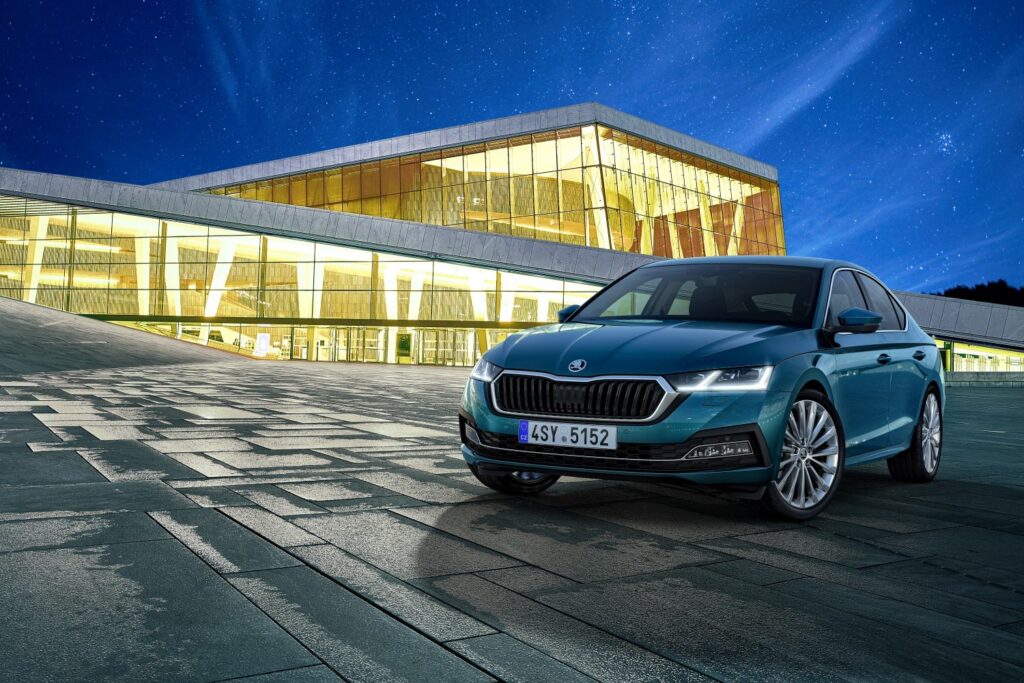
The Skoda Octavia IV continues the brand’s evolution in design, presenting a sharp, modern, and sophisticated aesthetic. Its liftback body style, a hallmark of the Octavia, stretches 184.61 inches in length, 72.01 inches in width (78.86 inches including mirrors), and stands 57.87 inches tall. The wheelbase measures 105.75 inches, contributing to a spacious cabin. The design is not merely for show; it’s highly functional, boasting an impressive drag coefficient (Cd) of 0.243, which aids in both fuel efficiency and reduced wind noise at higher speeds. The sleek lines, distinctive grille, and contemporary lighting elements give the Octavia a refined and upscale appearance, positioning it competitively against more premium offerings.
From a practical standpoint, the liftback configuration is a significant advantage. The large rear hatch opens to reveal a cavernous trunk with a minimum capacity of 21.19 cubic feet. With the rear seats folded down, this expands to an astounding 54.91 cubic feet, rivaling many larger SUVs and wagons. This makes the Octavia an incredibly versatile vehicle, capable of handling everything from weekly grocery runs to substantial luggage for family vacations. The maximum roof load capacity of 165.35 lbs further enhances its utility for carrying bicycles or roof boxes.
Interior Comfort and Technology
Inside, the Skoda Octavia IV offers seating for five occupants in a well-appointed and ergonomically designed cabin. Skoda is renowned for its “Simply Clever” features, and the Octavia IV likely incorporates many of these thoughtful touches, though specific details are not provided in the technical data. These often include umbrella compartments, ice scrapers in the fuel filler flap, and various storage solutions designed to enhance user convenience.
The focus for a modern car like the Octavia IV is on connectivity, comfort, and safety. While the data primarily highlights mechanical aspects, it’s safe to assume that the interior features a modern infotainment system with connectivity options, comfortable seating, and a driver-focused cockpit. Standard safety features include ABS, and a particulate filter is integrated into the engine system to meet emission regulations. The overall design prioritizes passenger comfort and driver ease, making the Octavia IV a pleasant place to be, whether on short commutes or long journeys.
Comprehensive Technical Specifications
| Category | Specification | Value |
|---|---|---|
| General Information | ||
| Brand | Skoda | |
| Model | Octavia | |
| Generation | Octavia IV | |
| Type (Engine) | 1.0 TSI EVO e-TEC (110 Hp) Mild Hybrid DSG | |
| Start of Production | October, 2020 | |
| End of Production | March, 2023 | |
| Powertrain Architecture | MHEV (Mild Hybrid Electric Vehicle) | |
| Body type | Liftback | |
| Seats | 5 | |
| Doors | 5 | |
| Performance Specifications | ||
| Fuel Consumption (WLTP) – Low speed | 6.4 l/100 km (36.8 US mpg) | |
| Fuel Consumption (WLTP) – Medium speed | 4.9 l/100 km (48 US mpg) | |
| Fuel Consumption (WLTP) – High speed | 4.4 l/100 km (53.5 US mpg) | |
| Fuel Consumption (WLTP) – Very High speed | 5.1 l/100 km (46.1 US mpg) | |
| Combined Fuel Consumption (WLTP) | 5.0 l/100 km (47 US mpg) | |
| CO2 Emissions (WLTP) | 114 g/km | |
| Fuel Consumption (NEDC) – Urban | 5.0 l/100 km (47 US mpg) | |
| Fuel Consumption (NEDC) – Extra Urban | 3.7 l/100 km (63.6 US mpg) | |
| Fuel Consumption (NEDC) – Combined | 4.2 l/100 km (56 US mpg) | |
| CO2 Emissions (NEDC) | 96 g/km | |
| Fuel Type | Gasoline | |
| Acceleration 0 – 60 mph | 10 seconds | |
| Maximum Speed | 129.25 mph (208 km/h) | |
| Emission Standard | Euro 6 Ap | |
| Weight-to-power ratio | 11.5 kg/Hp (86.9 Hp/tonne) | |
| Weight-to-torque ratio | 6.3 kg/Nm (158 Nm/tonne) | |
| Engine Specifications | ||
| Power | 110 Hp @ 5500 rpm | |
| Power per liter | 110.1 Hp/l | |
| Torque | 147.51 lb.-ft. (200 Nm) @ 2000-3000 rpm | |
| Engine layout | Front, Transverse | |
| Engine Model/Code | DLAA | |
| Engine displacement | 1.0 L (999 cm³, 60.96 cu. in.) | |
| Number of cylinders | 3 | |
| Engine configuration | Inline | |
| Cylinder Bore | 2.93 in. (74.5 mm) | |
| Piston Stroke | 3.01 in. (76.4 mm) | |
| Compression ratio | 11.5:1 | |
| Fuel injection system | Direct injection | |
| Engine aspiration | Turbocharger, Intercooler | |
| Valvetrain | DOHC | |
| Engine oil capacity | 4.23 US qt (4 l) | |
| Engine oil specification | (Not specified in data) | |
| Coolant | 8.45 US qt (8 l) | |
| Engine systems | Start & Stop System, Particulate filter | |
| Space, Volume and Weights | ||
| Kerb Weight | 2791.05 – 3154.81 lbs. (1266-1431 kg) | |
| Max. weight (GVWR) | 4188.78 lbs. (1900 kg) | |
| Max load | 1033.97 – 1397.73 lbs. (469-634 kg) | |
| Trunk (boot) space – minimum | 21.19 cu. ft. (600 l) | |
| Trunk (boot) space – maximum | 54.91 cu. ft. (1555 l) | |
| Fuel tank capacity | 11.89 US gal (45 l) | |
| Max. roof load | 165.35 lbs. (75 kg) | |
| Permitted trailer load with brakes (8%) | 2866.01 lbs. (1300 kg) | |
| Permitted trailer load with brakes (12%) | 2866.01 lbs. (1300 kg) | |
| Permitted trailer load without brakes | 1477.1 lbs. (670 kg) | |
| Permitted towbar download | 176.37 lbs. (80 kg) | |
| Dimensions | ||
| Length | 184.61 in. (4689 mm) | |
| Width | 72.01 in. (1829 mm) | |
| Width including mirrors | 78.86 in. (2003 mm) | |
| Height | 57.87 in. (1470 mm) | |
| Wheelbase | 105.75 in. (2686 mm) | |
| Front track | 60.75 in. (1543 mm) | |
| Rear (Back) track | 60.43 in. (1535 mm) | |
| Front overhang | 35.83 in. (910 mm) | |
| Rear overhang | 43.07 in. (1094 mm) | |
| Ride height (ground clearance) | 5.63 in. (143 mm) | |
| Drag coefficient (Cd) | 0.243 | |