The Renault Megane III Coupe RS Trophy-R: A Front-Wheel-Drive Performance Icon
The Renault Megane III Coupe RS Trophy-R 2.0 (273 Hp), specifically the Phase III model launched in 2014, represents the zenith of front-wheel-drive (FWD) performance engineering from Renault Sport. This highly specialized variant of the third-generation Megane Coupe was not merely a cosmetic upgrade but a meticulously re-engineered machine designed for ultimate track prowess and driving engagement. Produced from 2014 to 2016, the Trophy-R carved out a significant niche in the highly competitive European hot hatch segment, distinguishing itself through its aggressive weight reduction, enhanced chassis dynamics, and formidable powertrain. While never officially sold in the United States, its reputation as a benchmark for FWD performance cars resonated globally among automotive enthusiasts and experts.
Engine and Performance: The Heart of the Renault Megane III Coupe RS Trophy-R
At the core of the Renault Megane III Coupe RS Trophy-R is a potent 2.0-liter (1998 cm3) inline-four engine, designated by the code F4R 874. This robust powerplant features a DOHC (Double Overhead Camshaft) valvetrain with four valves per cylinder, a configuration optimized for efficient airflow and high-revving performance. The engine’s aspiration is significantly bolstered by a turbocharger and an intercooler, which work in tandem to force-feed air into the cylinders, dramatically increasing power output. Fuel is delivered via a multi-port manifold injection system, ensuring precise fuel-air mixture control.
This sophisticated setup enables the engine to produce an impressive 273 horsepower at 5500 rpm, translating to a specific output of 136.6 horsepower per liter – a remarkable figure for its time. Torque delivery is equally compelling, peaking at 265.52 lb.-ft. (360 Nm) across a broad rev range from 3000 to 5000 rpm. This wide torque band contributes significantly to the car’s responsiveness and usable power across various driving scenarios, whether on a challenging circuit or a winding country road.
Mated exclusively to a precise 6-speed manual transmission, the engine drives the front wheels, upholding Renault Sport’s commitment to the FWD performance philosophy. This drivetrain architecture, combined with the car’s relatively light curb weight of 2859.4 lbs. (1297 kg), results in an exceptional power-to-weight ratio of 4.8 kg/Hp, or 210.5 Hp per tonne. Such figures translate directly into exhilarating acceleration: the Trophy-R can sprint from 0 to 60 mph in a mere 5.5 seconds, and from 0 to 100 km/h in 5.8 seconds. Its top speed is electronically limited to 158.45 mph (255 km/h), a testament to its aerodynamic efficiency and raw power.
Despite its performance focus, Renault Sport engineers also paid attention to efficiency within its class. The combined fuel consumption is rated at 31.4 US mpg (7.5 l/100 km), with urban figures at 24 US mpg (9.8 l/100 km) and extra-urban at 37.9 US mpg (6.2 l/100 km). CO2 emissions stand at 174 g/km, meeting the Euro 5 emission standard. The engine oil capacity is 5.4 liters (5.71 US qt), and the cooling system holds 6.5 liters (6.87 US qt) of coolant, ensuring optimal thermal management during spirited driving.
Design and Features: Form Follows Function
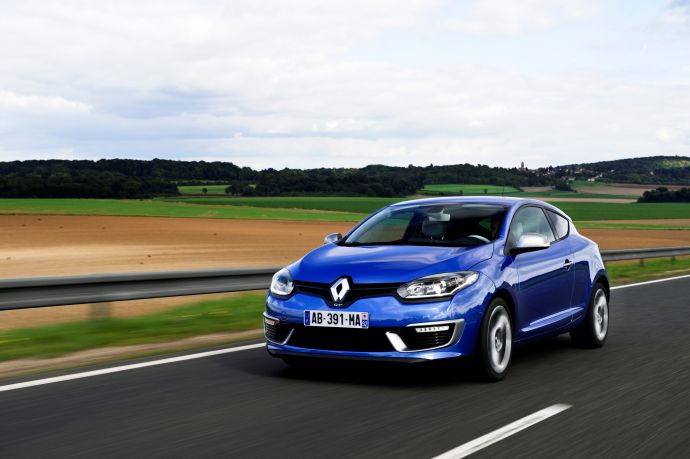
The Renault Megane III Coupe RS Trophy-R embodies a design philosophy where form unequivocally follows function. As a 3-door coupe with a distinct performance orientation, its aggressive stance and aerodynamic profile are immediately apparent. The “Trophy-R” designation signifies a radical approach to weight reduction and chassis optimization. A key feature of this model is its two-seat configuration; the rear seats are deliberately removed to shed weight, underscoring its track-focused intent.
Visually, the Trophy-R distinguishes itself with unique styling cues that enhance both aesthetics and performance. Its overall length measures 169.25 inches (4299 mm), a width of 72.76 inches (1848 mm), and a height of 56.5 inches (1435 mm), giving it a compact yet muscular presence. The wheelbase of 103.78 inches (2636 mm) contributes to its stable handling characteristics. The front and rear tracks are 62.52 inches (1588 mm) and 60.83 inches (1545 mm), respectively, providing a wide footprint for enhanced grip. The ground clearance of 4.72 inches (120 mm) hints at its lowered, performance-tuned suspension.
Inside, the cabin is a minimalist, driver-centric environment. The absence of rear seats is complemented by the inclusion of lightweight, high-performance front seats, often Sparco-branded, designed to provide exceptional lateral support during high-G maneuvers. Red accents and an Alcantara-wrapped steering wheel typically enhance the sporty ambiance, emphasizing the car’s raw, unfiltered driving experience. Despite its track focus, the car retains practical elements such as a respectable trunk space, ranging from 12.15 cu. ft. (344 L) to 35 cu. ft. (991 L) with the pass-through area, and a 15.85 US gallon (60 L) fuel tank capacity.
The chassis and braking systems are significantly upgraded to handle the increased performance. The Trophy-R is equipped with large ventilated disc brakes on both the front and rear axles, ensuring potent stopping power and fade resistance. An Anti-lock Braking System (ABS) comes standard, enhancing safety under hard braking. Steering is managed by a rack and pinion system with electric power steering, offering precise feedback and effort. The car rides on specific 19-inch wheel rims wrapped in high-performance 235/35 R19 91Y tires, crucial for maximizing grip and handling precision. The drag coefficient (Cd) of 0.34 indicates a relatively aerodynamic body shape for a performance coupe of its type.
Technical Specifications
The following table provides a detailed breakdown of the Renault Megane III Coupe RS Trophy-R 2.0 (273 Hp) specifications:
| Category | Specification | Value |
|---|---|---|
| General Information | ||
| Brand | Renault | |
| Model | Megane | |
| Generation | Megane III Coupe (Phase III, 2014) | |
| Type (Engine) | RS Trophy-R 2.0 (273 Hp) | |
| Start of Production | 2014 year | |
| End of Production | 2016 year | |
| Powertrain Architecture | Internal Combustion engine | |
| Body Type | Coupe | 3 Doors |
| Seats | 2 | |
| Performance Specs | ||
| Fuel Consumption (Urban) | 24 US mpg (9.8 l/100 km) | |
| Fuel Consumption (Extra Urban) | 37.9 US mpg (6.2 l/100 km) | |
| Fuel Consumption (Combined) | 31.4 US mpg (7.5 l/100 km) | |
| CO2 Emissions | 174 g/km | |
| Fuel Type | Petrol (Gasoline) | |
| Acceleration 0 – 60 mph | 5.5 sec | |
| Acceleration 0 – 100 km/h | 5.8 sec | |
| Maximum Speed | 158.45 mph (255 km/h) | |
| Emission Standard | Euro 5 | |
| Weight-to-Power Ratio | 4.8 kg/Hp (210.5 Hp/tonne) | |
| Weight-to-Torque Ratio | 3.6 kg/Nm (277.6 Nm/tonne) | |
| Engine Specs | ||
| Power | 273 Hp @ 5500 rpm | |
| Power per Liter | 136.6 Hp/l | |
| Torque | 265.52 lb.-ft. (360 Nm) @ 3000-5000 rpm | |
| Engine Layout | Front, Transverse | |
| Engine Model/Code | F4R 874 | |
| Engine Displacement | 2.0 l (1998 cm3, 121.93 cu. in.) | |
| Number of Cylinders | 4 | |
| Engine Configuration | Inline | |
| Cylinder Bore | 3.26 in. (82.7 mm) | |
| Piston Stroke | 3.66 in. (93 mm) | |
| Compression Ratio | 8.6:1 | |
| Number of Valves per Cylinder | 4 | |
| Fuel Injection System | Multi-port manifold injection | |
| Engine Aspiration | Turbocharger, Intercooler | |
| Valvetrain | DOHC | |
| Engine Oil Capacity | 5.71 US qt (5.4 l) | |
| Coolant Capacity | 6.87 US qt (6.5 l) | |
| Space, Volume and Weights | ||
| Kerb Weight | 2859.4 lbs. (1297 kg) | |
| Trunk (Boot) Space – Minimum | 12.15 cu. ft. (344 l) | |
| Trunk (Boot) Space – Maximum | 35 cu. ft. (991 l) | |
| Fuel Tank Capacity | 15.85 US gal (60 l) | |
| Dimensions | ||
| Length | 169.25 in. (4299 mm) | |
| Width | 72.76 in. (1848 mm) | |
| Width Including Mirrors | 80.2 in. (2037 mm) | |
| Height | 56.5 in. (1435 mm) | |
| Wheelbase | 103.78 in. (2636 mm) | |
| Front Track | 62.52 in. (1588 mm) | |
| Rear (Back) Track | 60.83 in. (1545 mm) | |
| Front Overhang | 33.86 in. (860 mm) | |
| Rear Overhang | 31.61 in. (803 mm) | |
| Ride Height (Ground Clearance) | 4.72 in. (120 mm) | |
| Drag Coefficient (Cd) | 0.34 | |
| Minimum Turning Circle | 37.24 ft. (11.35 m) | |
| Drivetrain, Brakes and Suspension Specs | ||
| Drivetrain Architecture | The Internal combustion engine (ICE) drives the front wheels of the vehicle. | |
| Drive Wheel | Front wheel drive | |
| Number of Gears and Type of Gearbox | 6 gears, manual transmission | |
| Front Brakes | Ventilated discs | |
| Rear Brakes | Ventilated discs | |
| Assisting Systems | ABS (Anti-lock braking system) | |
| Steering Type | Steering rack and pinion | |
| Power Steering | Electric Steering | |
| Tires Size | 235/35 R19 91Y | |
| Wheel Rims Size | 19 inches | |
Legacy and Market Impact of the Renault Megane III Coupe RS Trophy-R
The Renault Megane III Coupe RS Trophy-R cemented Renault Sport’s reputation as a master of front-wheel-drive performance. Its most significant legacy is undoubtedly its impressive track record, particularly at the legendary Nürburgring Nordschleife. This specific model, with its 273 horsepower and extreme lightweighting, shattered the front-wheel-drive lap record at the “Green Hell,” completing a lap in 7 minutes and 54.36 seconds in 2014. This achievement was a powerful statement, proving that FWD vehicles could deliver supercar-baiting performance on the world’s most demanding circuits.
In its primary European market, the Trophy-R was a direct competitor to other high-performance front-wheel-drive machines, such as the Honda Civic Type R (FK2 generation), the SEAT Leon Cupra, and to some extent, the Ford Focus ST. While some rivals offered more conventional practicality or all-wheel-drive options, the Megane RS Trophy-R stood out for its uncompromised focus on raw, engaging driving dynamics. It wasn’t designed for comfort or daily commuting; it was built for enthusiasts who prioritized track performance and a visceral connection to the road.
Its limited production run and specialized nature contributed to its cult status. The removal of rear seats, the specific chassis tuning, and the aggressive styling were all indicators of a car engineered without compromise. This approach resonated deeply with a niche market segment that valued mechanical purity and driver involvement above all else. The Trophy-R demonstrated Renault Sport’s engineering prowess, showcasing their ability to extract maximum performance from a FWD platform while maintaining a reputation for reliability and robust construction.
Today, the Renault Megane III Coupe RS Trophy-R is considered a highly desirable collector’s item among hot hatch aficionados. It represents a pivotal moment in the evolution of performance cars, especially in the FWD category, setting new standards and challenging perceptions of what such a vehicle could achieve. Its impact extends beyond sales figures, influencing subsequent generations of hot hatches and reinforcing the idea that a truly driver-focused car can still be incredibly engaging and competitive, even without the added complexity of all-wheel drive. Its legacy is one of daring engineering, record-breaking performance, and an enduring appeal to those who cherish the art of driving.