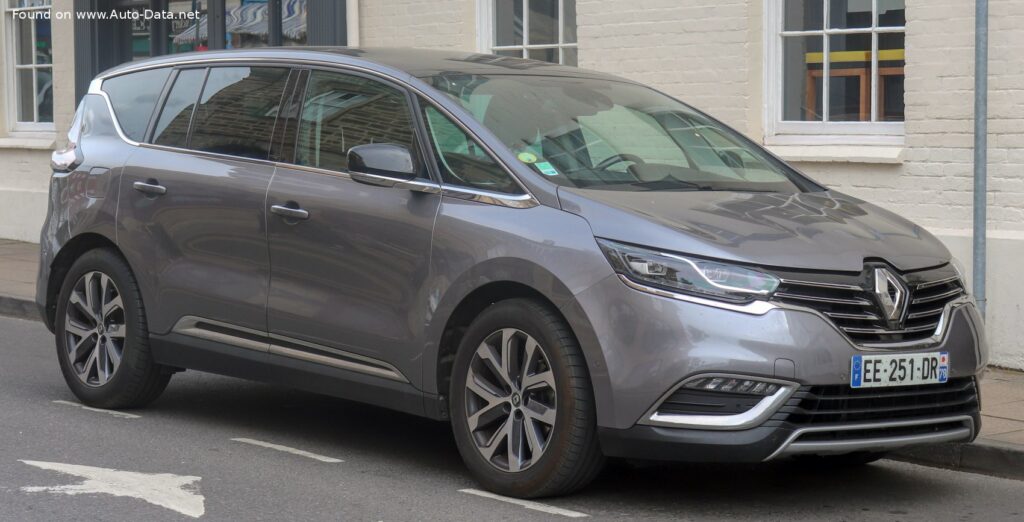
As an international automotive expert, I present a detailed analysis of the Renault Espace V 1.8 Energy TCe (225 Hp) EDC 7 Seat.
The Renault Espace V 1.8 Energy TCe (225 Hp) EDC 7 Seat: A European Crossover Reinvention
The Renault Espace, a name synonymous with the European Multi-Purpose Vehicle (MPV) segment for decades, underwent a significant transformation with its fifth generation, launched in 2015. The model in focus, the Renault Espace V 1.8 Energy TCe (225 Hp) EDC 7 Seat, represents a particular iteration produced between 2017 and 2018, marking a pivotal shift from its traditional minivan roots towards a more crossover-inspired design. While never officially sold in the United States, the Espace V played a crucial role in Renault’s strategy to revitalize its family-oriented vehicle lineup in Europe and other international markets, blending MPV practicality with the increasingly popular SUV aesthetic. This generation aimed to offer a more dynamic and stylish alternative to conventional people carriers, catering to families seeking versatility without sacrificing design appeal or driving engagement.
Positioned as a premium offering within the mainstream D-segment, the Espace V challenged perceptions of what a family vehicle could be. It combined a spacious and adaptable interior with a striking exterior design, elevated ground clearance, and sophisticated technological features. The 1.8 Energy TCe variant, specifically, offered a compelling blend of performance and efficiency, making it an attractive option for discerning European buyers who prioritized both power and fuel economy in their daily driving and long-distance travel.
Engine and Performance: Powering the Renault Espace V
At the heart of the Renault Espace V 1.8 Energy TCe (225 Hp) EDC 7 Seat lies a robust and modern powertrain designed for a balance of spirited performance and refined efficiency. This particular Espace is equipped with a 1.8-liter (1798 cm³ or 109.72 cu. in.) inline four-cylinder engine, designated by the code M5P. Utilizing a turbocharger and intercooler, this gasoline engine delivers an impressive 225 horsepower at 5600 rpm, translating to a power-per-liter output of 125.1 Hp/l – a testament to its advanced engineering.
Torque delivery is equally compelling, with 300 Nm (221.27 lb.-ft.) available from a low 1750 rpm. This broad torque band ensures strong acceleration and flexible in-gear performance, crucial for a vehicle of its size and passenger capacity. Power is efficiently managed by a 7-speed EDC (Efficient Dual Clutch) automatic transmission, which provides smooth and rapid gear changes, contributing to both driving pleasure and fuel economy. The drivetrain architecture is front-wheel drive, with the engine mounted transversely at the front.
Performance figures for the Espace V 1.8 Energy TCe are quite respectable for a family crossover. It can accelerate from 0 to 60 mph in an estimated 7.2 seconds (0-100 km/h in 7.6 seconds), and reach a maximum speed of 139.19 mph (224 km/h). The vehicle’s weight-to-power ratio stands at 7.2 kg/Hp (139.8 Hp/tonne), indicating a well-matched powertrain for its curb weight of 3549.44 lbs (1610 kg).
Fuel efficiency, a key consideration for European buyers, is also competitive. The combined fuel consumption is rated at 6.8 l/100 km, which translates to approximately 34.6 US mpg. Urban consumption is 8.7 l/100 km (27 US mpg), while extra-urban driving yields 5.6 l/100 km (42 US mpg). With CO2 emissions of 152 g/km, the vehicle complies with the Euro 6 b emission standard, reflecting its commitment to environmental performance within its class.
Design and Features: Blending Versatility with Style
The Renault Espace V represented a radical departure from its predecessors, adopting a distinctive “Minivan, Crossover” body type. This strategic shift aimed to capitalize on the booming SUV market while retaining the core practicality and spaciousness of an MPV. Its exterior design is characterized by a bold front fascia, prominent grille, and sleek LED lighting, giving it a more assertive and contemporary presence than a traditional minivan. The raised ride height of 6.3 inches (160 mm) further contributes to its crossover appeal, offering a commanding view of the road.
Measuring 191.22 inches (4857 mm) in length, 74.33 inches (1888 mm) in width (83.78 inches or 2128 mm including mirrors), and 66.02 inches (1677 mm) in height, the Espace V is a substantial vehicle, providing ample interior space. The generous 113.54-inch (2884 mm) wheelbase ensures a comfortable ride and excellent stability. The vehicle offers 7 seats spread across three rows, making it a highly versatile option for larger families or those requiring flexible cargo and passenger configurations. The trunk space ranges from a minimum of 8.72 cu. ft. (247 liters) with all seats in use, expanding to a cavernous 71.87 cu. ft. (2035 liters) with the rear seats folded, showcasing its adaptability for various needs.
Inside, the Espace V features a modern and upscale cabin, often incorporating premium materials and advanced technology. Key features of a vehicle from this era would typically include a large touchscreen infotainment system, digital instrument cluster, multi-zone climate control, and a host of driver-assistance systems. While specific details beyond ABS are not provided, it’s safe to assume modern safety features like multiple airbags, stability control, and potentially advanced driver aids like adaptive cruise control or lane departure warning were available, either standard or as options, in line with European market expectations for a family vehicle.
The Espace V’s suspension setup includes an independent McPherson strut system with coil springs and an anti-roll bar at the front, paired with a semi-independent coil spring rear suspension. This configuration aims to deliver a comfortable yet composed ride. Braking duties are handled by ventilated discs at the front and solid discs at the rear, complemented by an Anti-lock Braking System (ABS) for enhanced safety. The electric power steering system provides ease of maneuverability, particularly in urban environments, with a minimum turning circle of 40.68 ft (12.4 m).
Technical Specifications
| Category | Specification | US Equivalent / Notes |
|---|---|---|
| General Information | ||
| Brand | Renault | |
| Model | Espace | |
| Generation | Espace V | |
| Type (Engine) | 1.8 Energy TCe (225 Hp) EDC 7 Seat | |
| Start of production | 2017 year | |
| End of production | 2018 year | |
| Powertrain Architecture | Internal Combustion engine | |
| Body type | Minivan, Crossover | |
| Seats | 7 | |
| Doors | 5 | |
| Performance Specs | ||
| Fuel consumption (economy) – urban | 8.7 l/100 km | 27 US mpg |
| Fuel consumption (economy) – extra urban | 5.6 l/100 km | 42 US mpg |
| Fuel consumption (economy) – combined | 6.8 l/100 km | 34.6 US mpg |
| CO2 emissions | 152 g/km | |
| Fuel Type | Petrol (Gasoline) | Gasoline |
| Acceleration 0 – 100 km/h | 7.6 sec | |
| Acceleration 0 – 62 mph | 7.6 sec | |
| Acceleration 0 – 60 mph (Calculated) | 7.2 sec | |
| Maximum speed | 224 km/h | 139.19 mph |
| Emission standard | Euro 6 b | |
| Weight-to-power ratio | 7.2 kg/Hp | 139.8 Hp/tonne |
| Weight-to-torque ratio | 5.4 kg/Nm | 186.3 Nm/tonne |
| Engine Specs | ||
| Power | 225 Hp @ 5600 rpm | |
| Power per liter | 125.1 Hp/l | |
| Torque | 300 Nm @ 1750 rpm | 221.27 lb.-ft. @ 1750 rpm |
| Engine layout | Front, Transverse | |
| Engine Model/Code | M5P | |
| Engine displacement | 1798 cm3 | 1.8 Liters / 109.72 cu. in. |
| Number of cylinders | 4 | |
| Engine configuration | Inline | |
| Cylinder Bore | 79.7 mm | 3.14 in. |
| Piston Stroke | 90.1 mm | 3.55 in. |
| Number of valves per cylinder | 4 | |
| Fuel injection system | Multi-port manifold injection | |
| Engine aspiration | Turbocharger, Intercooler | |
| Engine oil capacity | 4.1 l | 4.33 US qt |
| Space, Volume and Weights | ||
| Kerb Weight | 1610 kg | 3549.44 lbs. |
| Max. weight | 2393 kg | 5275.66 lbs. |
| Max load | 783 kg | 1726.22 lbs. |
| Trunk (boot) space – minimum | 247 l | 8.72 cu. ft. |
| Trunk (boot) space – maximum | 2035 l | 71.87 cu. ft. |
| Fuel tank capacity | 58 l | 15.32 US gal |
| Permitted trailer load with brakes (12%) | 2000 kg | 4409.25 lbs. |
| Permitted trailer load without brakes | 750 kg | 1653.47 lbs. |
| Dimensions | ||
| Length | 4857 mm | 191.22 in. |
| Width | 1888 mm | 74.33 in. |
| Width with mirrors folded | 1914 mm | 75.35 in. |
| Width including mirrors | 2128 mm | 83.78 in. |
| Height | 1677 mm | 66.02 in. |
| Wheelbase | 2884 mm | 113.54 in. |
| Front track | 1630 mm | 64.17 in. |
| Rear (Back) track | 1621 mm | 63.82 in. |
| Front overhang | 1034 mm | 40.71 in. |
| Rear overhang | 939 mm | 36.97 in. |
| Ride height (ground clearance) | 160 mm | 6.3 in. |
| Minimum turning circle (turning diameter) | 12.4 m | 40.68 ft. |
| Drivetrain, Brakes and Suspension Specs | ||
| Drivetrain Architecture | The Internal combustion engine (ICE) drives the front wheels of the vehicle. | Front-wheel drive |
| Drive wheel | Front wheel drive | |
| Number of gears and type of gearbox | 7 gears, automatic transmission EDC | |
| Front suspension | Independent, type McPherson with coil spring and anti-roll bar | |
| Rear suspension | Semi-independent, coil spring | |
| Front brakes | Ventilated discs | |
| Rear brakes | Disc | |
| Assisting systems | ABS (Anti-lock braking system) | |
| Steering type | Steering rack and pinion | |
| Power steering | Electric Steering | |
| Tires size | 235/60 R18 | |
| Wheel rims size | 18 | |
Legacy and Market Impact of the Renault Espace V
The fifth-generation Renault Espace, including the 1.8 Energy TCe (225 Hp) EDC 7 Seat variant, represented a bold and somewhat risky move for Renault. For over three decades, the Espace had defined the European MPV segment, known for its modularity and spaciousness. However, with the relentless rise of SUVs and crossovers, the traditional MPV market was shrinking. Renault’s decision to transform the Espace into a more dynamically styled, quasi-crossover was a direct response to these market shifts, aiming to inject new life into a segment that many perceived as stagnant.
In its primary European market, the Espace V faced competition from a diverse range of vehicles. Traditional MPV rivals like the Ford S-Max, Volkswagen Sharan, and SEAT Alhambra continued to offer pure practicality, while a growing number of large SUVs such as the Skoda Kodiaq, Peugeot 5008, and even Renault’s own Koleos, vied for family buyers. The Espace V carved out a niche by offering a distinctive blend: the interior flexibility and seven-seat capacity of an MPV, combined with the elevated driving position, rugged styling cues, and perceived prestige of an SUV. This unique proposition appealed to customers who desired the best of both worlds, avoiding the perceived “soccer mom” stigma often associated with minivans while still needing ample space.
The 1.8 Energy TCe (225 Hp) engine, in particular, provided a strong performance offering that elevated the Espace V beyond mere utility. Its potent output and efficient dual-clutch transmission made it a more engaging drive than many of its competitors, appealing to those who didn’t want to compromise on driving dynamics. This engine positioned the Espace as a more premium and sophisticated option, capable of comfortable long-distance cruising with a full complement of passengers and luggage.
While the Espace V didn’t revolutionize the entire automotive landscape, its impact was significant within its segment. It demonstrated that family vehicles could be stylish and aspirational, pushing other manufacturers to reconsider their own MPV designs or lean further into crossover strategies. It helped pave the way for a new generation of family-oriented vehicles that blurred traditional segment lines. The Espace V’s legacy is one of adaptation and innovation, a testament to Renault’s willingness to reinvent an icon to remain relevant in an ever-evolving automotive market, even if its ultimate production run for this generation was relatively short, transitioning to new models that continued this crossover-focused philosophy.