The Renault Megane III Grandtour 1.5 dCi (106 Hp) FAP: A European Workhorse
The Renault Megane III Grandtour 1.5 dCi (106 Hp) FAP represents a significant offering from the French automaker Renault within the highly competitive European C-segment. Produced between 2010 and 2012, this particular variant of the third-generation Megane was designed as a versatile and economical station wagon (known as an “estate” in many European markets). While the Renault Megane series has enjoyed considerable success across Europe, Asia, and other global markets, it was not officially sold in the United States. Its primary role was to provide families and businesses with a practical, fuel-efficient, and comfortable vehicle capable of handling diverse daily demands, from urban commutes to long-distance travel. With its diesel powertrain and spacious interior, the Megane III Grandtour carved out a niche as a sensible and appealing choice for consumers prioritizing utility and low running costs in its home markets.
Engine and Performance: The Efficient 1.5 dCi Heartbeat
At the core of the 2010-2012 Renault Megane III Grandtour 1.5 dCi (106 Hp) FAP lies a remarkably efficient and widely used diesel engine: the K9K 832. This 1.5-liter (1461 cm3 or 89.16 cu. in.) inline four-cylinder turbodiesel unit, featuring a common rail fuel injection system, was engineered for optimal fuel economy and respectable torque delivery. It generated a peak power output of 106 horsepower at 4000 rpm, which, while not designed for outright speed, was more than adequate for the vehicle’s intended purpose. More importantly for a vehicle of this type, the engine produced a robust 177 lb.-ft. of torque at a low 1750 rpm, providing excellent low-end grunt for confident acceleration and effortless cruising, even when fully loaded.
Power was sent to the front wheels via a smooth-shifting 6-speed manual transmission, a common and preferred choice in European markets for its blend of engagement and efficiency. The vehicle’s performance figures reflect its practical orientation: it could accelerate from 0 to 60 mph in a respectable 10.6 seconds, reaching a top speed of 118.06 mph. These metrics positioned it well within its class, offering enough dynamism for safe overtaking and comfortable highway speeds.
Fuel efficiency was a standout feature, a hallmark of European diesel engines of this era. The Megane III Grandtour 1.5 dCi achieved an impressive combined fuel economy of 53.5 US mpg (4.4 liters per 100 km). Urban driving returned 46.1 US mpg (5.1 l/100 km), while extra-urban cycles saw it reach an exceptional 58.8 US mpg (4.0 l/100 km). This made it a highly economical choice for both daily commutes and longer journeys. Furthermore, the engine was equipped with a Diesel Particulate Filter (FAP) and met the stringent Euro 5 emission standards, signifying Renault’s commitment to reducing environmental impact at the time, with CO2 emissions rated at 114 g/km.
Design and Features: Practicality Meets European Style
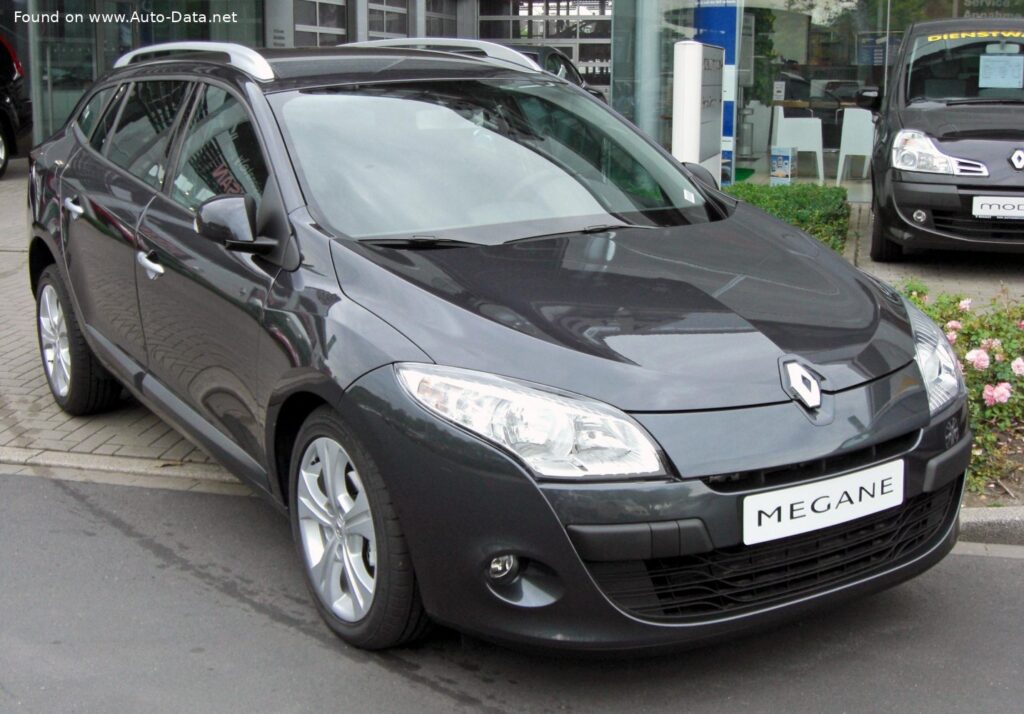
The Renault Megane III Grandtour adopted a sleek and modern aesthetic for its time, distinguishing itself from its more polarizing predecessor. As a five-door station wagon, or “estate,” its design prioritized practicality without sacrificing visual appeal. The exterior featured clean lines, a distinctive front fascia, and an extended roofline that gracefully tapered towards the rear, integrating neatly with the rear tailgate. With a length of 179.49 inches (4559 mm), a width of 69.53 inches (1766 mm), and a height of 57.52 inches (1461 mm), the Grandtour offered a substantial road presence while remaining maneuverable in urban environments. The 106.42-inch (2703 mm) wheelbase contributed to a stable ride and generous interior space.
Inside, the Megane III Grandtour was configured for five occupants across two rows, offering a comfortable and ergonomic cabin. The focus was on functionality and user-friendliness, with intuitive controls and quality materials typical of its segment. However, the true strength of the Grandtour lay in its cargo capacity. With the rear seats in place, it offered a substantial 18.5 cubic feet (524 liters) of trunk space, which could be expanded to a cavernous 56.33 cubic feet (1595 liters) when the rear seats were folded down. This made it an ideal choice for families, tradespeople, or anyone requiring significant hauling capabilities.
Key features for this generation included a robust drivetrain architecture with front-wheel drive, a McPherson independent front suspension, and a torsion beam rear suspension, providing a balanced ride and handling. Braking was handled by ventilated discs at the front and solid discs at the rear, complemented by an Anti-lock Braking System (ABS) for enhanced safety. The electric power steering system, a rack and pinion setup, offered ease of maneuverability, particularly in tight parking situations. The car rode on 195/65 R15 tires, mounted on 15-inch wheel rims, offering a good balance of comfort and grip. Additional practical touches included a maximum roof load of 176.37 lbs. (80 kg) and a respectable towing capacity of 2866.01 lbs. (1300 kg) with brakes, further underscoring its utility.
Technical Specifications: Renault Megane III Grandtour 1.5 dCi (106 Hp) FAP
| Category | Specification |
|---|---|
| General Information | |
| Brand | Renault |
| Model | Megane |
| Generation | Megane III Grandtour |
| Type (Engine) | 1.5 dCi (106 Hp) FAP |
| Start of Production | 2010 year |
| End of Production | 2012 year |
| Powertrain Architecture | Internal Combustion engine |
| Body Type | Station wagon (estate) |
| Seats | 5 |
| Doors | 5 |
| Performance Specs | |
| Fuel Consumption (Urban) | 5.1 l/100 km (46.1 US mpg) |
| Fuel Consumption (Extra Urban) | 4.0 l/100 km (58.8 US mpg) |
| Fuel Consumption (Combined) | 4.4 l/100 km (53.5 US mpg) |
| CO2 Emissions | 114 g/km |
| Fuel Type | Diesel |
| Acceleration 0 – 60 mph | 10.6 sec |
| Acceleration 0 – 100 km/h | 11.2 sec |
| Maximum Speed | 190 km/h (118.06 mph) |
| Emission Standard | Euro 5 |
| Weight-to-Power Ratio | 11.9 kg/Hp (83.8 Hp/tonne) |
| Weight-to-Torque Ratio | 5.3 kg/Nm (189.7 Nm/tonne) |
| Engine Specs | |
| Power | 106 Hp @ 4000 rpm |
| Power per Liter | 72.6 Hp/l |
| Torque | 240 Nm @ 1750 rpm (177.01 lb.-ft. @ 1750 rpm) |
| Engine Layout | Front, Transverse |
| Engine Model/Code | K9K 832 |
| Engine Displacement | 1461 cm3 (89.16 cu. in.) |
| Number of Cylinders | 4 |
| Engine Configuration | Inline |
| Cylinder Bore | 76 mm (2.99 in.) |
| Piston Stroke | 80.5 mm (3.17 in.) |
| Compression Ratio | 15:1 |
| Number of Valves per Cylinder | 2 |
| Fuel Injection System | Diesel Commonrail |
| Engine Aspiration | Turbocharger, Intercooler |
| Engine Oil Capacity | 4.5 l (4.76 US qt) |
| Engine Oil Specification | Not available |
| Coolant Capacity | 6.5 l (6.87 US qt) |
| Engine Systems | Particulate filter |
| Space, Volume and Weights | |
| Kerb Weight | 1265 kg (2788.85 lbs.) |
| Max. Weight | 1825 kg (4023.44 lbs.) |
| Max Load | 560 kg (1234.59 lbs.) |
| Trunk (boot) Space – Minimum | 524 l (18.5 cu. ft.) |
| Trunk (boot) Space – Maximum | 1595 l (56.33 cu. ft.) |
| Fuel Tank Capacity | 60 l (15.85 US gal) |
| Max. Roof Load | 80 kg (176.37 lbs.) |
| Permitted Trailer Load with Brakes (12%) | 1300 kg (2866.01 lbs.) |
| Permitted Trailer Load without Brakes | 680 kg (1499.14 lbs.) |
| Permitted Towbar Download | 75 kg (165.35 lbs.) |
| Dimensions | |
| Length | 4559 mm (179.49 in.) |
| Width | 1766 mm (69.53 in.) |
| Height | 1461 mm (57.52 in.) |
| Wheelbase | 2703 mm (106.42 in.) |
| Front Track | 1546 mm (60.87 in.) |
| Rear (Back) Track | 1547 mm (60.91 in.) |
| Front Overhang | 862 mm (33.94 in.) |
| Rear Overhang | 994 mm (39.13 in.) |
| Ride Height (Ground Clearance) | 120 mm (4.72 in.) |
| Drag Coefficient (Cd) | 0.32 |
| Minimum Turning Circle | 11.05 m (36.25 ft.) |
| Drivetrain, Brakes and Suspension Specs | |
| Drivetrain Architecture | The Internal Combustion engine (ICE) drives the front wheels of the vehicle. |
| Drive Wheel | Front wheel drive |
| Number of Gears and Type of Gearbox | 6 gears, manual transmission |
| Front Suspension | Independent type McPherson |
| Rear Suspension | Torsion |
| Front Brakes | Ventilated discs |
| Rear Brakes | Disc |
| Assisting Systems | ABS (Anti-lock braking system) |
| Steering Type | Steering rack and pinion |
| Power Steering | Electric Steering |
| Tires Size | 195/65 R15 |
| Wheel Rims Size | 15 inches |
Legacy and Market Impact in Europe
The Renault Megane III Grandtour 1.5 dCi (106 Hp) FAP played a crucial role in Renault’s portfolio within the European market. During its production years from 2010 to 2012, diesel engines were at the peak of their popularity in Europe, driven by their superior fuel economy and lower CO2 emissions compared to gasoline counterparts. The Megane Grandtour capitalized on this trend, offering a compelling package for a wide range of buyers. It was a favorite among families needing ample space for children and luggage, as well as fleet operators and small businesses that valued its low running costs and practical cargo solutions.
In its competitive C-segment, the Megane Grandtour faced formidable rivals such as the Volkswagen Golf Variant, Ford Focus Estate, Opel Astra Sports Tourer, and Peugeot 308 SW. To stand out, Renault emphasized its comfortable ride, distinctive French styling, and the proven reliability and efficiency of its dCi diesel engines. The 1.5 dCi, in particular, was lauded for its balance of performance and economy, making it a pragmatic choice for drivers covering significant mileage.
Renault’s reputation for building comfortable, safe, and innovative vehicles was further cemented by the Megane III. While perhaps not as dynamically engaging as some of its German rivals, it offered a more relaxed and compliant ride, which was often preferred on Europe’s diverse road networks. The inclusion of a Diesel Particulate Filter (FAP) and compliance with Euro 5 emissions standards highlighted Renault’s efforts to meet evolving environmental regulations, positioning the Megane as a relatively clean diesel option for its time.
Today, the Renault Megane III Grandtour 1.5 dCi (106 Hp) FAP remains a popular choice in the used car markets across Europe. Its enduring appeal stems from its robust build quality, continued fuel efficiency, and the sheer practicality of its station wagon body style. It represents a period where diesel technology was considered a viable and environmentally conscious solution for mainstream motoring. The Megane III Grandtour stands as a testament to Renault’s expertise in creating mass-market vehicles that skillfully blend utility, economy, and a distinct European character, continuing to serve as a reliable and spacious option for budget-conscious buyers.