The Peugeot 307 Station Wagon 1.6 HDI (109 Hp): A European Family Workhorse
The
Peugeot 307 Station Wagon 1.6 HDI (109 Hp)
represents a significant chapter in the European automotive landscape, serving as a practical and efficient family vehicle during the mid-2000s. Introduced as part of the highly successful Peugeot 307 generation, this particular variant, produced from 2004 to 2005, epitomized the growing demand for versatile, fuel-efficient diesel wagons across the continent. While never officially sold in the United States, the 307 Station Wagon was a ubiquitous sight on European roads, prized for its blend of spaciousness, comfortable ride, and economical operation, particularly with the advanced High-Pressure Direct Injection (HDI) diesel engine. It carved out a strong niche in the compact family car segment, offering an appealing alternative to traditional sedans and hatchbacks for those requiring greater cargo capacity and passenger flexibility.
The 307 series itself, launched in 2001, was a critical model for Peugeot, building on the success of its 306 predecessor. The station wagon, or “estate” as it’s known in Europe, extended the 307’s appeal by offering a significantly larger and more practical body style. The 1.6 HDI engine variant, appearing later in the 307’s production cycle, brought a new level of refinement and efficiency to the range, aligning perfectly with European market trends favoring diesel powertrains for their low running costs and robust torque delivery. This model cemented Peugeot’s reputation for producing well-engineered, comfortable, and family-friendly vehicles.
Engine & Performance: The Heart of the
Peugeot 307 Station Wagon 1.6 HDI (109 Hp)
At the core of the
Peugeot 307 Station Wagon 1.6 HDI (109 Hp)
lies its sophisticated 1.6-liter (1560 cm3 or 95.2 cubic inches) HDI diesel engine, identified by the engine code 9HZ DV6TED4. This inline four-cylinder unit, positioned transversely at the front, was a product of the PSA Group’s (Peugeot Citroën) expertise in diesel technology. It generated a respectable 109 horsepower at 4000 rpm, a figure that, while not overtly sporty, was more than adequate for daily driving and highway cruising, especially considering the vehicle’s family-oriented purpose.
Crucially, the engine’s strength lay in its torque output: a robust 260 Nm (191.77 lb.-ft.) delivered at a low 1750 rpm. This characteristic low-end torque was a hallmark of modern diesel engines and made the 307 Station Wagon feel responsive and effortless in urban traffic and during overtaking maneuvers on European motorways. The engine benefited from a sophisticated Diesel Commonrail fuel injection system, which precisely controlled fuel delivery for optimal combustion, contributing to both power and efficiency. Furthermore, the inclusion of a turbocharger with an intercooler ensured a steady supply of dense, cool air to the engine, maximizing performance and reducing turbo lag.
Power was transmitted to the front wheels via a smooth-shifting 5-speed manual transmission, a common and reliable setup for vehicles in this class. Performance figures for the 307 Station Wagon 1.6 HDI were pragmatic rather than exhilarating. It could accelerate from 0 to 60 mph in a calculated 11.4 seconds (0-100 km/h in 12 seconds) and reach a top speed of 113.71 mph (183 km/h). These numbers placed it squarely in the competitive landscape of family wagons, offering sufficient capability for its intended use.
Fuel economy was a major selling point for this diesel variant. The combined cycle fuel consumption was an impressive 5 liters per 100 kilometers, translating to approximately 47 US miles per gallon. Urban driving yielded about 37.9 US mpg, while extra-urban (highway) driving could achieve an excellent 53.5 US mpg. This efficiency, combined with a 15.85 US gallon (60-liter) fuel tank, provided a substantial cruising range, a highly desirable trait for European drivers. The vehicle also met Euro 4 emission standards, signifying its relatively clean operation for its time, with CO2 emissions of 131 g/km.
Design & Features: Practicality Meets European Style
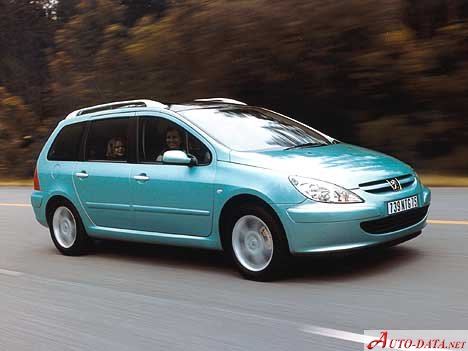
The Peugeot 307 Station Wagon, with its five doors and seating for five occupants, was designed with practicality and family life firmly in mind. Measuring 173.98 inches (4419 mm) in length, 69.17 inches (1757 mm) in width, and 60.79 inches (1544 mm) in height, the 307 Station Wagon offered generous interior dimensions for its class. Its extended wheelbase of 106.61 inches (2708 mm) was key to providing improved rear passenger legroom and a stable ride quality compared to its hatchback sibling.
The exterior design followed Peugeot’s contemporary aesthetic, characterized by large, swept-back headlights and a prominent grille, giving the car a friendly yet purposeful face. The station wagon body style integrated seamlessly into the 307’s overall design, avoiding the “add-on” look sometimes seen in wagon conversions. The roofline extended gracefully to the rear, culminating in a large tailgate that facilitated easy loading and unloading of cargo.
Interior versatility was a strong suit. The trunk (boot) offered a minimum of 12.01 cubic feet (340 liters) of space, which could expand to a substantial 54.38 cubic feet (1540 liters) with the rear seats folded down. This flexible cargo area made the 307 Station Wagon an ideal choice for families, tradespeople, or anyone needing to transport bulky items. Standard features for the era included a hydraulic power steering system, ensuring light and responsive steering, particularly in urban environments. Safety was also addressed with an Anti-lock Braking System (ABS) as standard, providing enhanced control under heavy braking. The braking system itself comprised ventilated discs at the front and solid discs at the rear, a capable setup for a vehicle of this weight and performance.
The suspension setup featured McPherson struts at the front and a torsion beam at the rear, a common and cost-effective arrangement that provided a comfortable ride while maintaining predictable handling. The vehicle rode on 195/65 R15 tires, mounted on 15-inch wheel rims, offering a good balance of comfort and grip. With a curb weight of 3090.88 lbs (1402 kg) and a maximum permissible weight of 4519.48 lbs (2050 kg), the 307 Station Wagon was a robust and capable load-hauler, further underscored by its ability to tow a braked trailer up to 2645.55 lbs (1200 kg).
Technical Specifications for the Peugeot 307 Station Wagon 1.6 HDI (109 Hp)
| Category | Specification |
|---|---|
| Brand | Peugeot |
| Model | 307 |
| Generation | 307 Station Wagon |
| Type (Engine) | 1.6 HDI (109 Hp) |
| Production Start | 2004 |
| Production End | 2005 |
| Body type | Station Wagon (Estate) |
| Seats | 5 |
| Doors | 5 |
|
Performance Specs |
|
| Fuel Consumption (Urban) | 6.2 l/100 km (37.9 US mpg) |
| Fuel Consumption (Extra Urban) | 4.4 l/100 km (53.5 US mpg) |
| Fuel Consumption (Combined) | 5 l/100 km (47 US mpg) |
| CO2 Emissions | 131 g/km |
| Fuel Type | Diesel |
| Acceleration 0-60 mph | 11.4 sec |
| Maximum Speed | 113.71 mph (183 km/h) |
| Emission Standard | Euro 4 |
| Weight-to-power ratio | 12.9 kg/Hp (77.7 Hp/tonne) |
| Weight-to-torque ratio | 5.4 kg/Nm (185.4 Nm/tonne) |
|
Engine Specs |
|
| Power | 109 Hp @ 4000 rpm |
| Power per liter | 69.9 Hp/l |
| Torque | 260 Nm (191.77 lb.-ft.) @ 1750 rpm |
| Engine Layout | Front, Transverse |
| Engine Model/Code | 9HZ DV6TED4 |
| Engine Displacement | 1560 cm3 (95.2 cu. in.) |
| Number of Cylinders | 4 |
| Engine Configuration | Inline |
| Cylinder Bore | 75 mm (2.95 in.) |
| Piston Stroke | 88.3 mm (3.48 in.) |
| Compression Ratio | 17.6:1 |
| Valves per Cylinder | 4 |
| Fuel Injection System | Diesel Commonrail |
| Engine Aspiration | Turbocharger, Intercooler |
| Valvetrain | DOHC |
| Engine Oil Capacity | 3.8 l (4.02 US qt) |
| Coolant Capacity | 6.5 l (6.87 US qt) |
|
Space, Volume & Weights |
|
| Kerb Weight | 1402 kg (3090.88 lbs) |
| Max. Weight | 2050 kg (4519.48 lbs) |
| Max Load | 648 kg (1428.6 lbs) |
| Trunk Space (Minimum) | 340 l (12.01 cu. ft.) |
| Trunk Space (Maximum) | 1540 l (54.38 cu. ft.) |
| Fuel Tank Capacity | 60 l (15.85 US gal) |
| Permitted Trailer Load (with brakes) | 1200 kg (2645.55 lbs) |
| Permitted Trailer Load (without brakes) | 700 kg (1543.24 lbs) |
|
Dimensions |
|
| Length | 4419 mm (173.98 in.) |
| Width | 1757 mm (69.17 in.) |
| Height | 1544 mm (60.79 in.) |
| Wheelbase | 2708 mm (106.61 in.) |
| Front Track | 1505 mm (59.25 in.) |
| Rear Track | 1510 mm (59.45 in.) |
| Front Overhang | 878 mm (34.57 in.) |
| Rear Overhang | 833 mm (32.8 in.) |
|
Drivetrain, Brakes & Suspension |
|
| Drivetrain Architecture | Internal Combustion engine drives the front wheels |
| Drive Wheel | Front wheel drive |
| Gearbox | 5 gears, manual transmission |
| Front Suspension | Spring Strut |
| Rear Suspension | Torsion |
| Front Brakes | Ventilated discs |
| Rear Brakes | Disc |
| Assisting Systems | ABS (Anti-lock braking system) |
| Steering Type | Steering rack and pinion |
| Power Steering | Hydraulic Steering |
| Tire Size | 195/65 R15 |
| Wheel Rims Size | 15 inches |
Legacy & Market Impact in Europe
The Peugeot 307 series, including the Station Wagon variant, enjoyed significant commercial success in Europe. It was a strong contender in the highly competitive C-segment, vying for market share against rivals such as the Ford Focus Wagon, Opel Astra Caravan (Vauxhall Astra Estate in the UK), Renault Mégane Estate, and Volkswagen Golf Variant. The
Peugeot 307 Station Wagon 1.6 HDI (109 Hp)
specifically stood out for its compelling combination of space, comfort, and the increasingly popular diesel powertrain.
The 1.6 HDI engine itself was a critical factor in the 307’s appeal. During the mid-2000s, diesel engines dominated the European market due to their superior fuel economy and lower CO2 emissions compared to gasoline equivalents, often supported by favorable tax structures. The 1.6 HDI (DV6TED4) was a highly regarded engine, known for its refinement, reliability, and excellent real-world fuel efficiency. It cemented Peugeot’s reputation as a leader in diesel engine technology, a legacy that continued for many years.
The 307 Station Wagon’s reputation was built on its practicality and versatility. Its generous cargo volume and comfortable seating made it an ideal choice for growing families, small businesses, and those who frequently embarked on long journeys. The robust build quality and comfortable ride characteristic of Peugeot vehicles further enhanced its appeal. While the 307 generation faced some initial quality concerns, particularly with early models, later variants like the 2004-2005 1.6 HDI benefited from continuous improvements, solidifying its standing as a dependable workhorse.
In terms of historical significance, the Peugeot 307 Station Wagon contributed to the broader trend of compact and mid-size wagons becoming the go-to family vehicles in Europe before the widespread advent of SUVs and crossovers. It demonstrated that a car could be practical, efficient, and comfortable without sacrificing a degree of driving enjoyment. Its legacy is one of a highly capable and economical family car that perfectly met the needs of the European market during its production run, leaving a lasting impression as a well-rounded and sensible choice for countless drivers.