The Volkswagen Transporter (T6) Kombi: A European Workhorse
The Volkswagen Transporter, a name synonymous with versatility and reliability across global markets, particularly in Europe, continued its storied legacy with the introduction of the T6 generation in 2015. The specific variant under review, the Volkswagen Transporter (T6) Kombi 2.0 TDI (102 Hp) L2H2, represents a highly practical and efficient iteration designed to cater to a broad spectrum of commercial and passenger transport needs. While not officially sold in the United States due to various market and regulatory factors, the Transporter series holds an iconic status internationally, evolving from its humble beginnings as the “Bus” or “Microbus” to a sophisticated modern light commercial vehicle.
Produced from 2015 to 2019, the T6 Kombi L2H2 was engineered as a robust and adaptable van, offering a compelling blend of cargo capacity, passenger comfort, and fuel efficiency. The “Kombi” designation highlights its dual-purpose nature, allowing for flexible seating configurations from four to nine occupants, alongside substantial cargo space. The “L2H2” suffix denotes its long wheelbase and high roof, maximizing interior volume for both people and goods. This particular model, powered by a 2.0-liter TDI diesel engine, was positioned as an entry-level workhorse, prioritizing economy and durability for businesses and families alike in its primary European and international markets.
Engine and Performance: Efficient Diesel Power
At the heart of the Volkswagen Transporter (T6) Kombi 2.0 TDI (102 Hp) L2H2 lies a well-proven 2.0-liter (1968 cm³ or 120.09 cu. in.) inline four-cylinder TDI (Turbocharged Direct Injection) diesel engine. This powerplant, identified by the EA288 / CXGB code, is a testament to Volkswagen’s commitment to diesel efficiency and robust performance. Despite its modest 102 horsepower output, achieved between 3000 and 3750 rpm, the engine is optimized for torque, delivering a substantial 184.39 lb.-ft. (250 Nm) across a broad and accessible rev range of 1500 to 2750 rpm. This low-end torque is crucial for a commercial vehicle, providing ample pulling power for heavy loads and maintaining momentum without constantly needing to downshift.
The engine incorporates modern diesel technology, including a common rail fuel injection system, a turbocharger, and an intercooler, all working in concert to optimize combustion and fuel economy. Its DOHC (Double Overhead Cam) valvetrain with four valves per cylinder ensures efficient airflow. Power is delivered to the front wheels via a durable 5-speed manual transmission, a common choice for its reliability and cost-effectiveness in this segment.
Performance figures reflect its utilitarian purpose rather than outright speed. The Transporter (T6) Kombi 2.0 TDI accelerates from 0 to 60 mph in a calculated 15.7 seconds (0-100 km/h in 16.5 seconds) and reaches a maximum speed of 94.45 mph (152 km/h). While these numbers might seem leisurely, they are entirely adequate for urban deliveries and highway cruising with a full load.
Fuel efficiency is a strong suit, especially for a vehicle of its size and capacity. The combined NEDC fuel consumption stands at an impressive 31.8 to 39.9 US mpg (5.9-7.4 l/100 km), with extra-urban figures reaching up to 45.2 US mpg (5.2 l/100 km). These figures underscore its economic appeal for businesses where running costs are paramount. The engine also meets stringent Euro 6 emission standards, featuring a Start & Stop system and a particulate filter to reduce environmental impact, reflecting contemporary automotive environmental consciousness.
Design, Utility, and Features
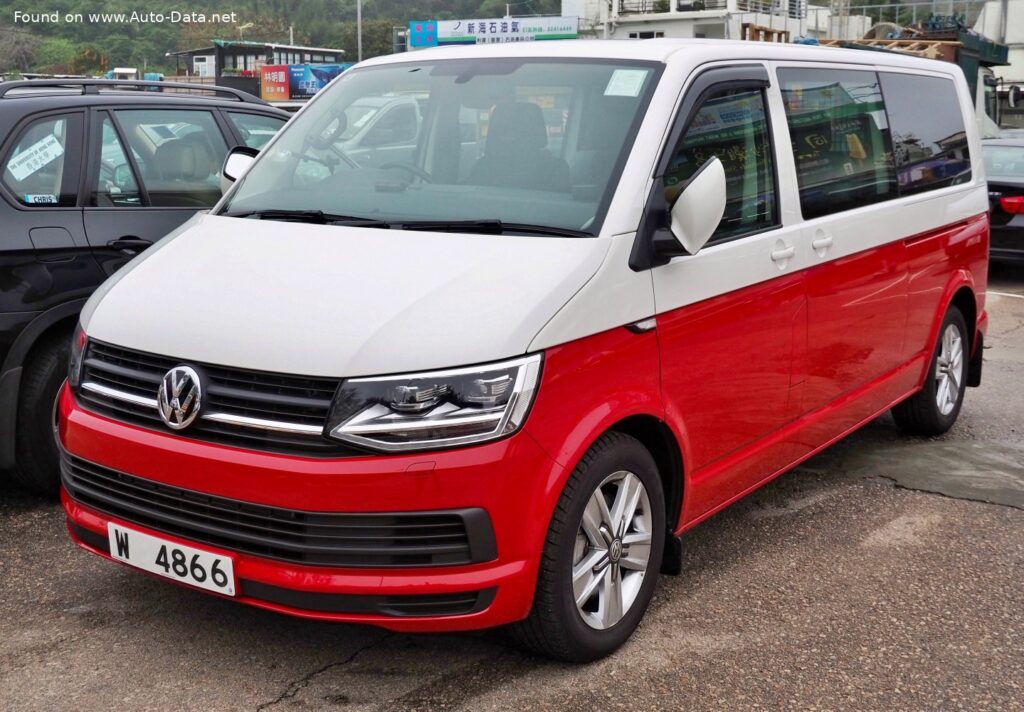
The Volkswagen Transporter (T6) Kombi L2H2 embodies a design philosophy centered on functionality, durability, and a clean, understated aesthetic. As a van body type, its exterior is characterized by its expansive dimensions, specifically a length of 208.82 inches, a width of 74.96 inches (90.43 inches including mirrors), and a significant height of 85.43 inches. The long wheelbase of 133.86 inches contributes to a stable ride and generous interior volume. The “L2H2” designation specifically highlights its extended length and raised roof, providing an impressive maximum trunk (boot) space of 275.45 cubic feet (7800 liters) – a critical factor for commercial users or large families.
The Kombi variant offers exceptional flexibility with its 4-5 doors and seating for 4 to 9 passengers. This modular interior design allows owners to easily reconfigure the space for either maximum passenger capacity, substantial cargo hauling, or a combination of both. The robust construction is evident in its kerb weight range of 3933.05 to 5013.31 lbs., and a maximum permissible weight of 6172.94 to 7054.79 lbs., enabling a substantial maximum payload capacity of 2041.48 to 2239.9 lbs. Furthermore, it boasts impressive towing capabilities, with a permitted trailer load of 4850.17 lbs. (with brakes) and 1653.47 lbs. (without brakes).
Underneath, the T6 Kombi features a sophisticated chassis designed for comfort and stability. It utilizes an independent McPherson strut front suspension with coil springs and an anti-roll bar, paired with an independent coil spring rear suspension featuring wishbones and a transverse stabilizer. This setup ensures a composed ride, even when fully loaded, and predictable handling. Stopping power is provided by ventilated disc brakes on both the front (308×29.5 mm) and rear (294×22 mm) axles, augmented by an Anti-lock Braking System (ABS) for enhanced safety. Steering is managed by a hydraulic rack and pinion system, offering tactile feedback to the driver. The vehicle rides on 205/65 R16 or 215/65 R16 tires fitted to 6.5J x 16 wheel rims, providing a good balance of load capacity and ride comfort.
Practical features include a 18.49 US gallon (70 liter) fuel tank, complemented by a 3.43 US gallon (13 liter) AdBlue tank for its diesel emissions system. A maximum roof load of 220.46 lbs. further expands its utility. The ground clearance of 7.95 inches and decent approach/departure angles (21.2° and 16.2° respectively) contribute to its ability to handle varied terrain, from urban curbs to unpaved work sites.
Technical Specifications
| General Information | |
| Brand | Volkswagen |
| Model | Transporter |
| Generation | Transporter (T6) Kombi |
| Type (Engine) | 2.0 TDI (102 Hp) L2H2 |
| Start of Production | 2015 year |
| End of Production | 2019 year |
| Powertrain Architecture | Internal Combustion engine |
| Body Type | Van |
| Seats | 4-9 |
| Doors | 4-5 |
| Performance Specifications | |
| Fuel Consumption (Urban, NEDC) | 7-9.2 l/100 km (33.6 – 25.6 US mpg) |
| Fuel Consumption (Extra Urban, NEDC) | 5.2-6.7 l/100 km (45.2 – 35.1 US mpg) |
| Fuel Consumption (Combined, NEDC) | 5.9-7.4 l/100 km (39.9 – 31.8 US mpg) |
| CO2 Emissions (NEDC) | 153-192 g/km |
| Fuel Type | Diesel |
| Acceleration 0 – 60 mph | 15.7 sec |
| Acceleration 0 – 100 km/h | 16.5 sec |
| Maximum Speed | 94.45 mph (152 km/h) |
| Emission Standard | Euro 6 |
| Weight-to-Power Ratio | 17.5 kg/Hp (57.2 Hp/tonne) |
| Weight-to-Torque Ratio | 7.1 kg/Nm (140.1 Nm/tonne) |
| Engine Specifications | |
| Power | 102 Hp @ 3000-3750 rpm |
| Power per Liter | 51.8 Hp/l |
| Torque | 184.39 lb.-ft. (250 Nm) @ 1500-2750 rpm |
| Engine Layout | Front, Transverse |
| Engine Model/Code | EA288 / CXGB |
| Engine Displacement | 2.0 Liters (1968 cm³, 120.09 cu. in.) |
| Number of Cylinders | 4 |
| Engine Configuration | Inline |
| Cylinder Bore | 3.19 in. (81 mm) |
| Piston Stroke | 3.76 in. (95.5 mm) |
| Compression Ratio | 15.5:1 |
| Number of Valves per Cylinder | 4 |
| Fuel Injection System | Diesel Commonrail |
| Engine Aspiration | Turbocharger, Intercooler |
| Valvetrain | DOHC |
| Engine Oil Capacity | 7.82 US qt (7.4 l) |
| Engine Systems | Start & Stop System, Particulate filter |
| Space, Volume, and Weights | |
| Kerb Weight | 3933.05 – 5013.31 lbs. (1784-2274 kg) |
| Max. Weight (GVWR) | 6172.94 – 7054.79 lbs. (2800-3200 kg) |
| Max Load | 2041.48 – 2239.9 lbs. (926-1016 kg) |
| Trunk (Boot) Space – Maximum | 275.45 cu. ft. (7800 l) |
| Fuel Tank Capacity | 18.49 US gal (70 l) |
| AdBlue Tank | 3.43 US gal (13 l) |
| Max. Roof Load | 220.46 lbs. (100 kg) |
| Permitted Trailer Load with Brakes (12%) | 4850.17 lbs. (2200 kg) |
| Permitted Trailer Load without Brakes | 1653.47 lbs. (750 kg) |
| Permitted Towbar Download | 220.46 lbs. (100 kg) |
| Dimensions | |
| Length | 208.82 in. (5304 mm) |
| Width | 74.96 in. (1904 mm) |
| Width Including Mirrors | 90.43 in. (2297 mm) |
| Height | 85.43 in. (2170 mm) |
| Wheelbase | 133.86 in. (3400 mm) |
| Front Overhang | 35.75 in. (908 mm) |
| Rear Overhang | 39.09 in. (993 mm) |
| Ride Height (Ground Clearance) | 7.95 in. (202 mm) |
| Minimum Turning Circle (Turning Diameter) | 43.31 ft. (13.2 m) |
| Approach Angle | 21.2° |
| Departure Angle | 16.2° |
| Ramp-over (Brakeover) Angle | 12.2° |
| Drivetrain, Brakes, and Suspension Specifications | |
| Drivetrain Architecture | The Internal combustion engine (ICE) drives the front wheels of the vehicle. |
| Drive Wheel | Front wheel drive |
| Number of Gears and Type of Gearbox | 5 gears, manual transmission |
| Front Suspension | Independent, type McPherson with coil spring and anti-roll bar |
| Rear Suspension | Independent coil spring, Wishbone, Transverse stabilizer |
| Front Brakes | Ventilated discs, 308×29.5 mm |
| Rear Brakes | Ventilated discs, 294×22 mm |
| Assisting Systems | ABS (Anti-lock braking system) |
| Steering Type | Steering rack and pinion |
| Power Steering | Hydraulic Steering |
| Tires Size | 205/65 R16; 215/65 R16 |
| Wheel Rims Size | 6.5J x 16 |
Legacy and Market Influence
The Volkswagen Transporter (T6) Kombi 2.0 TDI (102 Hp) L2H2, like its predecessors, played a pivotal role in the European and international light commercial vehicle (LCV) market during its production run from 2015 to 2019. It stood as a direct descendant of a lineage that began with the iconic T1 “Bus” in the 1950s, a vehicle that transcended mere transportation to become a cultural phenomenon. The T6 generation continued this tradition, adapting to modern demands for efficiency, technology, and versatility while retaining the core values of durability and practicality.
In its primary markets, the Transporter (T6) Kombi was renowned for its robust build quality, comfortable ride for a commercial vehicle, and excellent reliability, which contributed to strong resale values. Its adaptability, particularly in the Kombi configuration, made it a popular choice for a wide array of users, from small businesses needing a flexible cargo and crew carrier to large families requiring ample space for passengers and luggage. The L2H2 variant, with its extended wheelbase and high roof, was particularly favored by tradespeople, delivery services, and even specialized conversion companies for camper vans, due to its cavernous and easily accessible interior.
The T6 Transporter faced stiff competition in Europe from well-established rivals such as the Ford Transit Custom, Mercedes-Benz Vito, Renault Trafic, and Opel/Vauxhall Vivaro. Despite this competitive landscape, the Transporter maintained its position as a segment leader, largely due to its strong brand image, proven engineering, and a comprehensive range of configurations and powertrains. The 2.0 TDI (102 Hp) model, while not the most powerful, was a cornerstone of the lineup, offering an economical and dependable option for fleets and individual owners focused on running costs.
Its absence from the North American market is primarily attributed to several factors, including the “chicken tax” (a tariff on imported light trucks), differing consumer preferences for larger, often gasoline-powered, full-size vans (like the Mercedes-Benz Sprinter, Ford Transit, or Ram ProMaster), and Volkswagen’s strategic decision to focus on passenger cars and SUVs in the U.S. market. However, the Transporter’s legacy is deeply embedded in its ability to serve as a versatile workhorse and a reliable family hauler across continents, continuing to influence the design and functionality of modern vans globally. The T6 generation, with its blend of traditional Volkswagen quality and contemporary efficiency, solidified its place as a significant chapter in the enduring Transporter story.