Vauxhall Insignia I Sports Tourer: A European Mid-Size Contender
The Vauxhall Insignia I Sports Tourer, specifically the 2.0i Turbo ecoTEC (220 Hp) Automatic variant produced between 2008 and 2011, represents a pivotal moment for the British marque Vauxhall and its continental European counterpart, Opel. Launched to replace the long-running Vectra, the Insignia marked a bold new direction in design, technology, and perceived quality for General Motors’ European operations. Positioned in the highly competitive D-segment (mid-size or large family car), the Insignia aimed to elevate the brand’s image with a more sophisticated and dynamic aesthetic, coupled with advanced engineering. The Sports Tourer, Vauxhall’s designation for a station wagon, offered enhanced practicality and cargo capacity without sacrificing the sleek lines of the sedan, making it a popular choice for families and business fleets across the UK and Europe. While not directly sold under the Vauxhall badge in the United States, its platform served as the foundation for the Buick Regal, demonstrating its global engineering significance.
Engine and Performance: The 2.0i Turbo ecoTEC Powertrain
At the heart of this particular Vauxhall Insignia I Sports Tourer lies a robust and efficient 2.0-liter (1998 cm³ or 121.93 cu. in.) inline four-cylinder engine, designated as the A20NHT. This powertrain, part of Vauxhall’s ecoTEC family, was engineered with performance and relative fuel efficiency in mind. Featuring a sophisticated twin-scroll turbocharger and an intercooler, the engine delivers a spirited 220 horsepower at 5300 rpm. More importantly for daily driving, it generates a substantial 258.15 lb.-ft. of torque across a broad and accessible range, from 2000 to 4000 rpm. This wide torque band ensures responsive acceleration and flexible overtaking capability, characteristic of modern turbocharged gasoline engines.
Power is channeled to the front wheels through a smooth-shifting 6-speed automatic transmission, designed to optimize both performance and fuel economy. The combination allows the Insignia Sports Tourer to accelerate from 0 to 60 mph in a respectable 7.2 seconds, with a top speed reaching 144.78 mph. Despite its strong performance, Vauxhall aimed for a balance with efficiency, achieving a combined fuel consumption rating of 24.2 US mpg. Its emission profile, rated at 227 g/km of CO2, met the Euro 5 emissions standard prevalent during its production years, reflecting a commitment to environmental considerations for its time. The engine’s direct injection system and DOHC valvetrain with four valves per cylinder contribute to its precise fuel delivery and efficient combustion, enhancing both power output and fuel economy.
Design and Features of the Vauxhall Insignia I Sports Tourer
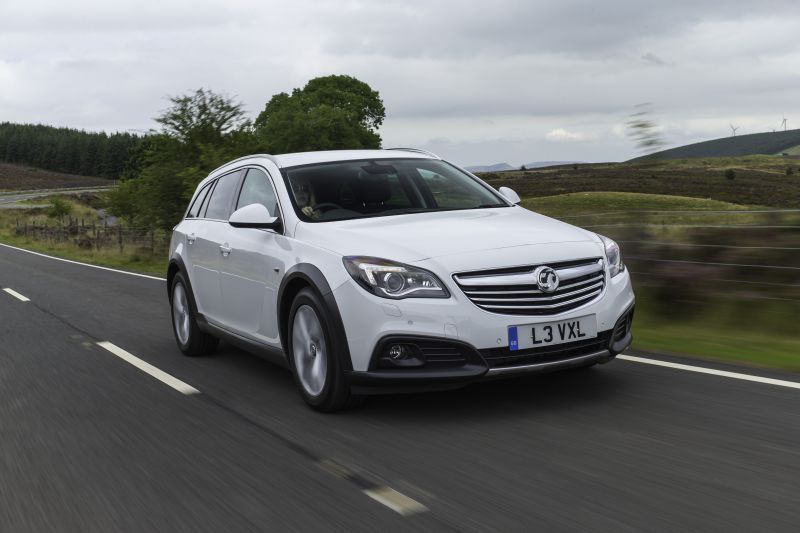
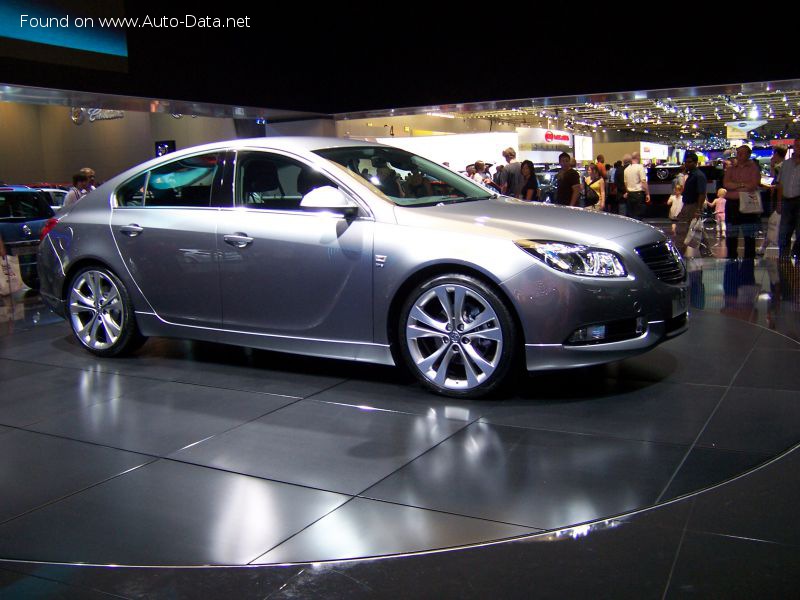
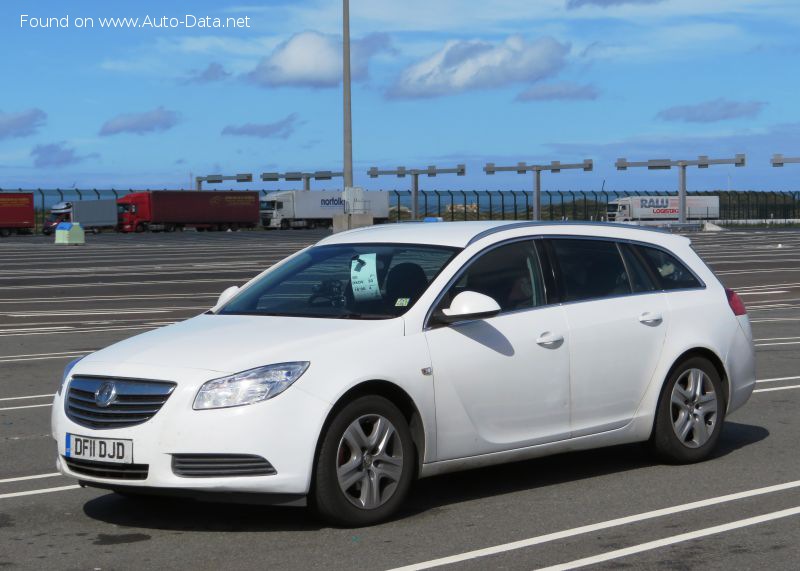
The design of the Vauxhall Insignia I Sports Tourer was a significant departure from its predecessor, embracing a more fluid and athletic styling language. The “Sports Tourer” moniker was well-deserved, as the station wagon variant managed to integrate its extended roofline and generous cargo area seamlessly with the Insignia’s dynamic character. With an overall length of 193.23 inches, a width of 73.07 inches (82.05 inches including mirrors), and a height of 59.84 inches, the Insignia Sports Tourer commanded a strong presence on the road. Its purposeful stance was underpinned by a 107.76-inch wheelbase, contributing to both interior space and ride stability.
Practicality was a cornerstone of the Sports Tourer’s appeal. The vehicle offered a substantial minimum trunk space of 19.07 cubic feet, which could be expanded to an impressive 53.33 cubic feet with the rear seats folded down, making it highly versatile for carrying luggage, sports equipment, or larger cargo. The design also featured a relatively low drag coefficient (Cd) of 0.30, aiding in both fuel efficiency and reduced wind noise at higher speeds.
Underneath, the Insignia I Sports Tourer utilized a well-sorted chassis designed for comfort and confident handling. It featured an independent McPherson strut suspension with coil springs and an anti-roll bar at the front, complemented by an independent multi-link suspension at the rear. This setup provided a balanced ride, absorbing road imperfections while maintaining composure through corners. Braking performance was handled by ventilated discs at the front and solid discs at the rear, augmented by an Anti-lock Braking System (ABS) for enhanced safety and control during emergency stops. The hydraulic power steering offered precise feedback, and the vehicle rode on 215/60 R16 tires mounted on 16-inch wheel rims, providing a good balance of grip and ride comfort.
Technical Specifications: Vauxhall Insignia I Sports Tourer 2.0i Turbo ecoTEC (220 Hp) Automatic
| Category | Specification | Value |
|---|---|---|
| General Information | ||
| Brand | Vauxhall | |
| Model | Insignia | |
| Generation | Insignia I Sports Tourer | |
| Type (Engine) | 2.0i Turbo ecoTEC (220 Hp) Automatic | |
| Start of Production | 2008 year | |
| End of Production | 2011 year | |
| Powertrain Architecture | Internal Combustion engine | |
| Body Type | Station wagon (estate) | |
| Seats | 5 | |
| Doors | 5 | |
| Performance Specs | ||
| Fuel Consumption (Urban) | 14.1 l/100 km (16.7 US mpg) | |
| Fuel Consumption (Extra Urban) | 7.1 l/100 km (33.1 US mpg) | |
| Fuel Consumption (Combined) | 9.7 l/100 km (24.2 US mpg) | |
| CO2 Emissions | 227 g/km | |
| Fuel Type | Petrol (Gasoline) | |
| Acceleration 0 – 60 mph | 7.2 sec | |
| Maximum Speed | 233 km/h (144.78 mph) | |
| Emission Standard | Euro 5 | |
| Weight-to-Power Ratio | 7.5 kg/Hp (132.7 Hp/tonne) | |
| Weight-to-Torque Ratio | 4.7 kg/Nm (211.1 Nm/tonne) | |
| Engine Specs | ||
| Power | 220 Hp @ 5300 rpm | |
| Power per Liter | 110.1 Hp/l | |
| Torque | 350 Nm (258.15 lb.-ft.) @ 2000-4000 rpm | |
| Engine Layout | Front, Transverse | |
| Engine Model/Code | A20NHT | |
| Engine Displacement | 1998 cm³ (2.0 Liters / 121.93 cu. in.) | |
| Number of Cylinders | 4 | |
| Engine Configuration | Inline | |
| Cylinder Bore | 86 mm (3.39 in.) | |
| Piston Stroke | 86 mm (3.39 in.) | |
| Compression Ratio | 9.3:1 | |
| Number of Valves per Cylinder | 4 | |
| Fuel Injection System | Direct injection | |
| Engine Aspiration | Twin-scroll turbo, Intercooler | |
| Valvetrain | DOHC | |
| Engine Oil Capacity | 6 l (6.34 US qt) | |
| Coolant Capacity | 7.3 l (7.71 US qt) | |
| Space, Volume and Weights | ||
| Kerb Weight | 1658 kg (3655.26 lbs.) | |
| Max. Weight | 2305 kg (5081.66 lbs.) | |
| Max Load | 647 kg (1426.39 lbs.) | |
| Trunk (boot) Space – Minimum | 540 l (19.07 cu. ft.) | |
| Trunk (boot) Space – Maximum | 1510 l (53.33 cu. ft.) | |
| Fuel Tank Capacity | 70 l (18.49 US gal) | |
| Permitted Trailer Load with Brakes (12%) | 1700 kg (3747.86 lbs.) | |
| Permitted Trailer Load without Brakes | 750 kg (1653.47 lbs.) | |
| Dimensions | ||
| Length | 4908 mm (193.23 in.) | |
| Width | 1856 mm (73.07 in.) | |
| Width Including Mirrors | 2084 mm (82.05 in.) | |
| Height | 1520 mm (59.84 in.) | |
| Wheelbase | 2737 mm (107.76 in.) | |
| Front Track | 1585 mm (62.4 in.) | |
| Rear (Back) Track | 1585 mm (62.4 in.) | |
| Front Overhang | 1015 mm (39.96 in.) | |
| Rear Overhang | 1156 mm (45.51 in.) | |
| Ride Height (Ground Clearance) | 160 mm (6.3 in.) | |
| Drag Coefficient (Cd) | 0.30 | |
| Minimum Turning Circle (Turning Diameter) | 10.89 m (35.73 ft.) | |
| Drivetrain, Brakes and Suspension Specs | ||
| Drivetrain Architecture | The Internal combustion engine (ICE) drives the front wheels of the vehicle. | |
| Drive Wheel | Front wheel drive | |
| Number of Gears and Type of Gearbox | 6 gears, automatic transmission | |
| Front Suspension | Independent, type McPherson with coil spring and anti-roll bar | |
| Rear Suspension | Independent multi-link suspension | |
| Front Brakes | Ventilated discs | |
| Rear Brakes | Disc | |
| Assisting Systems | ABS (Anti-lock braking system) | |
| Power Steering | Hydraulic Steering | |
| Tires Size | 215/60 R16 | |
| Wheel Rims Size | 16 | |
Legacy and Market Impact of the Vauxhall Insignia I Sports Tourer
The Vauxhall Insignia I Sports Tourer, and the Insignia range as a whole, represented a significant strategic shift for Vauxhall and Opel. It was tasked with replacing the long-standing Vectra, a car that, while competent, had struggled to compete with increasingly premium offerings from rivals. The Insignia, launched in 2008, aimed to address this by offering a more upscale design, improved interior quality, and a more engaging driving experience. Its success was almost immediate, earning the prestigious European Car of the Year award in 2009, a testament to its compelling package.
In its primary markets, particularly the UK and continental Europe, the Insignia I Sports Tourer faced stiff competition from established players like the Ford Mondeo Estate, Volkswagen Passat Variant, Mazda 6 Wagon, and even more premium offerings from BMW and Audi. Despite this, the Insignia carved out a strong niche, particularly among fleet buyers and families who valued its blend of stylish design, spacious interior, comfortable ride, and potent yet relatively efficient powertrains like the 2.0i Turbo ecoTEC. Its generous cargo capacity and strong towing ratings further enhanced its appeal as a versatile workhorse and family hauler.
The Insignia’s impact extended beyond Europe. Its underlying GM Epsilon II platform was a global architecture, forming the basis for several key models, most notably the North American Buick Regal, the second-generation Saab 9-5, and various Chevrolet models. This global commonality underscored GM’s intent to leverage its engineering resources efficiently across different brands and markets. For Vauxhall, the Insignia helped to redefine its brand image, moving it away from a perception of mere utility towards one of sophisticated design and modern technology. It demonstrated that Vauxhall could produce a car that was not only practical but also desirable, contributing to a more positive reputation and setting the stage for future models. The Insignia I Sports Tourer remains a strong example of European automotive engineering that successfully blended practicality, performance, and style for its era.