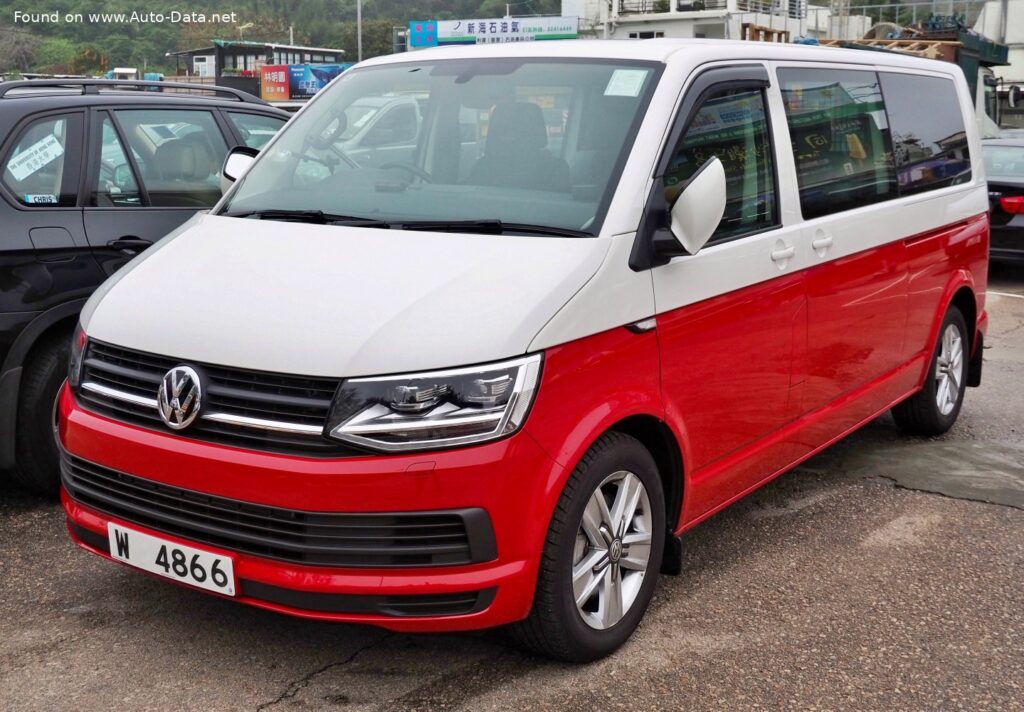
Introduction to the Volkswagen Transporter (T6) Kombi 2.0 TDI (102 Hp) L2H3
The Volkswagen Transporter, a name synonymous with versatility and reliability in the commercial vehicle sector, saw its sixth generation, the T6, introduced in 2015. Among its many configurations, the Volkswagen Transporter (T6) Kombi 2.0 TDI (102 Hp) L2H3 stands out as a particularly practical variant, bridging the gap between a dedicated cargo van and a comfortable passenger shuttle. Produced from 2015 to 2019, this iteration continued the Transporter’s storied legacy, offering a robust platform for businesses and large families across Europe and other international markets where it is a dominant force. While not directly sold in the United States in this modern form, the Transporter series, known historically in North America as the Vanagon or EuroVan, represents Volkswagen’s enduring commitment to functional and efficient people and goods movers.
The “Kombi” designation highlights its dual-purpose nature, allowing for flexible seating arrangements for up to nine occupants or extensive cargo space when seats are removed. The “2.0 TDI (102 Hp)” refers to its efficient 2.0-liter turbocharged diesel engine, delivering 102 horsepower, designed for economy and durability rather than outright speed. The “L2H3” further specifies its dimensions: L2 denotes a long wheelbase, while H3 signifies a high roof, maximizing interior volume for both passengers and freight. This particular configuration makes it an ideal choice for a wide array of applications, from shuttle services and tradesmen needing ample tool storage to families requiring significant space for travel and gear.
The Volkswagen Transporter (T6) Kombi: A European Workhorse
The Volkswagen Transporter series has been a cornerstone of the European automotive landscape since its inception in the 1950s. The T6 generation, including the Volkswagen Transporter (T6) Kombi, built upon this rich heritage by refining its predecessors’ strengths while integrating modern technology and improved efficiency. For European businesses, fleets, and even private users, the Transporter is often the default choice for a medium-duty van, prized for its robust build quality, extensive dealer network, and strong residual values.
Evolution of the T Series
Each generation of the Transporter has introduced advancements, and the T6 was no exception. It offered updated styling, improved interior ergonomics, and a range of new safety and convenience features compared to the outgoing T5. While maintaining its iconic boxy silhouette, the T6 adopted sharper lines and more contemporary lighting, signaling a modern yet familiar presence. The Kombi variant, in particular, has always been central to the Transporter’s appeal, offering a practical blend that few competitors can match with the same level of refinement and perceived quality. Its modular interior design allows owners to easily reconfigure the space, adapting from a full nine-seater passenger vehicle to a spacious cargo carrier in moments, making it incredibly versatile for dynamic operational needs.
Powertrain and Performance of the Volkswagen Transporter (T6) Kombi 2.0 TDI (102 Hp) L2H3
At the heart of the Volkswagen Transporter (T6) Kombi 2.0 TDI (102 Hp) L2H3 lies a highly regarded 2.0-liter TDI (Turbocharged Direct Injection) diesel engine, specifically the EA288 / CXGB model. This inline-four cylinder engine, with its DOHC valvetrain and common rail fuel injection system, is designed for optimal fuel efficiency and strong low-end torque, crucial attributes for a vehicle of its size and intended purpose. With a displacement of 1968 cubic centimeters (approximately 2.0 Liters) and a compression ratio of 15.5:1, the engine is tuned to deliver a balance of power and economy.
The powertrain produces 102 horsepower at a versatile range of 3000-3750 rpm, providing adequate power for urban driving and highway cruising, even when fully loaded. More importantly for a commercial vehicle, it generates a substantial 184.39 lb.-ft. of torque, available from a low 1500 rpm all the way up to 2750 rpm. This broad torque band ensures excellent pulling power, facilitating smooth acceleration from a standstill and confident overtaking maneuvers. Power is delivered to the front wheels via a robust 5-speed manual transmission, a choice that emphasizes driver engagement and cost-effectiveness for fleet operators.
Performance figures reflect its utilitarian focus: the Volkswagen Transporter (T6) Kombi 2.0 TDI (102 Hp) L2H3 accelerates from 0 to 60 mph in a calculated 15.8 seconds, with a maximum speed of 90.1 mph. While these figures may not suggest a sporty drive, they are perfectly adequate for its role as a dependable workhorse. Fuel economy is a strong suit, with combined (NEDC) figures ranging from 31.8 to 39.9 US mpg. Urban consumption is rated between 25.6 and 33.6 US mpg, while extra-urban driving can yield an impressive 35.1 to 45.2 US mpg, making it an economical choice for businesses and long-distance travel. Furthermore, the engine complies with Euro 6 emission standards, featuring a Start & Stop System and a particulate filter to reduce its environmental footprint, generating 153-192 g/km of CO2 emissions.
Design, Ergonomics, and Utility
The design of the Volkswagen Transporter (T6) Kombi 2.0 TDI (102 Hp) L2H3 is dictated by its primary function: maximum utility and interior space. As a van body type, its exterior is characterized by clean lines and a functional aesthetic, prioritizing practicality over flamboyant styling. The L2H3 designation indicates its long wheelbase (133.86 inches) and high roof (97.52 inches), which translates into an enormous interior volume. With a maximum trunk/cargo space of 328.43 cubic feet (9300 Liters), this variant offers exceptional capacity for cargo, equipment, or multiple rows of seating.
Measuring 208.82 inches in length and 74.96 inches in width (90.43 inches including mirrors), the Transporter T6 Kombi L2H3 commands a significant road presence. Despite its size, thoughtful engineering ensures maneuverability, with a minimum turning circle of 43.31 feet. The vehicle can accommodate between 4 and 9 seats, depending on the configuration, accessed through 4 to 5 doors, typically including large sliding side doors for easy passenger and cargo access.
Underneath, the T6 Kombi features an independent McPherson strut front suspension with coil springs and an anti-roll bar, paired with an independent coil spring rear suspension with wishbones and a transverse stabilizer. This setup ensures a comfortable ride and stable handling, even when carrying heavy loads. Braking is handled by ventilated discs both front (308×29.5 mm) and rear (294×22 mm), complemented by an Anti-lock Braking System (ABS) for enhanced safety. The hydraulic rack and pinion steering provides direct feedback and reliable control. With a maximum payload capacity ranging from 2041.48 to 2239.9 lbs. and a permissible trailer load of up to 4850.17 lbs. with brakes, the Transporter T6 Kombi is engineered for demanding tasks. Its 70-liter (18.49 US gallons) fuel tank and 13-liter (3.43 US gallons) AdBlue tank ensure a substantial range between refills, further enhancing its appeal for long-haul operations.
Technical Specifications of the Volkswagen Transporter (T6) Kombi 2.0 TDI (102 Hp) L2H3
| Category | Specification |
|---|---|
| General Information | |
| Brand | Volkswagen |
| Model | Transporter |
| Generation | Transporter (T6) Kombi |
| Type (Engine) | 2.0 TDI (102 Hp) L2H3 |
| Production Start | 2015 |
| Production End | 2019 |
| Powertrain Architecture | Internal Combustion Engine |
| Body Type | Van |
| Seats | 4-9 |
| Doors | 4-5 |
| Engine & Performance | |
| Engine Model/Code | EA288 / CXGB |
| Engine Layout | Front, Transverse |
| Engine Configuration | Inline-4 |
| Engine Displacement | 1968 cm³ (2.0 Liters / 120.09 cu. in.) |
| Power | 102 HP @ 3000-3750 rpm |
| Power per Liter | 51.8 Hp/l |
| Torque | 250 Nm (184.39 lb.-ft.) @ 1500-2750 rpm |
| Cylinder Bore | 81 mm (3.19 in.) |
| Piston Stroke | 95.5 mm (3.76 in.) |
| Compression Ratio | 15.5:1 |
| Valves per Cylinder | 4 |
| Fuel Injection System | Diesel Commonrail |
| Engine Aspiration | Turbocharger, Intercooler |
| Valvetrain | DOHC |
| Fuel Type | Diesel |
| Fuel Economy (Combined) | 31.8 – 39.9 US mpg |
| Fuel Economy (Urban) | 25.6 – 33.6 US mpg |
| Fuel Economy (Extra Urban) | 35.1 – 45.2 US mpg |
| CO2 Emissions (NEDC) | 153-192 g/km |
| Emission Standard | Euro 6 |
| 0-60 mph Acceleration | 15.8 seconds |
| Maximum Speed | 90.1 mph (145 km/h) |
| Weight-to-Power Ratio | 17.5 kg/Hp |
| Weight-to-Torque Ratio | 7.1 kg/Nm |
| Engine Systems | Start & Stop System, Particulate Filter |
| Drivetrain, Brakes & Suspension | |
| Drivetrain Architecture | Front-wheel drive, Internal Combustion Engine |
| Drive Wheel | Front-wheel drive |
| Gearbox Type | 5-speed Manual Transmission |
| Front Suspension | Independent, McPherson with coil spring and anti-roll bar |
| Rear Suspension | Independent coil spring, Wishbone, Transverse stabilizer |
| Front Brakes | Ventilated discs, 308×29.5 mm |
| Rear Brakes | Ventilated discs, 294×22 mm |
| Assisting Systems | ABS (Anti-lock Braking System) |
| Steering Type | Steering rack and pinion |
| Power Steering | Hydraulic Steering |
| Tires Size | 205/65 R16; 215/65 R16 |
| Wheel Rims Size | 6.5J x 16 |
| Dimensions & Capacities | |
| Length | 5304 mm (208.82 in.) |
| Width | 1904 mm (74.96 in.) |
| Width Including Mirrors | 2297 mm (90.43 in.) |
| Height | 2477 mm (97.52 in.) |
| Wheelbase | 3400 mm (133.86 in.) |
| Front Overhang | 908 mm (35.75 in.) |
| Rear Overhang | 993 mm (39.09 in.) |
| Ride Height (Ground Clearance) | 202 mm (7.95 in.) |
| Minimum Turning Circle | 13.2 m (43.31 ft.) |
| Approach Angle | 21.2° |
| Departure Angle | 16.2° |
| Ramp-over (Brakeover) Angle | 12.2° |
| Kerb Weight | 1784-2274 kg (3933.05 – 5013.31 lbs.) |
| Max. Weight | 2800-3200 kg (6172.94 – 7054.79 lbs.) |
| Max. Load | 926-1016 kg (2041.48 – 2239.9 lbs.) |
| Trunk (Boot) Space – Maximum | 9300 l (328.43 cu. ft.) |
| Fuel Tank Capacity | 70 l (18.49 US gal) |
| AdBlue Tank Capacity | 13 l (3.43 US gal) |
| Max. Roof Load | 100 kg (220.46 lbs.) |
| Permitted Trailer Load (with brakes 12%) | 2200 kg (4850.17 lbs.) |
| Permitted Trailer Load (without brakes) | 750 kg (1653.47 lbs.) |
| Permitted Towbar Download | 100 kg (220.46 lbs.) |
| Engine Oil Capacity | 7.4 l (7.82 US qt) |
Legacy and Market Impact
The Volkswagen Transporter series, and specifically the T6 generation including the Volkswagen Transporter (T6) Kombi 2.0 TDI (102 Hp) L2H3, holds a significant and cherished position in the global automotive market, particularly in Europe. Its legacy is built on decades of providing reliable, versatile, and enduring transportation solutions. For many European businesses, from small artisan shops to large logistics companies, the Transporter is an indispensable tool, often serving as the backbone of their operations. Its reputation for durability and low running costs has fostered immense loyalty among its owners.
In its primary markets, the T6 Kombi faced stiff competition from rivals such as the Mercedes-Benz Vito, Ford Transit Custom, Renault Trafic, Opel Vivaro, and Fiat Talento. However, the Transporter consistently maintained a strong market share due to its superior build quality, comfortable driving dynamics for a commercial vehicle, and the prestige associated with the Volkswagen badge. Its robust engineering means that even models from the 2015-2019 production run continue to command strong resale values, a testament to their longevity and desirability.
Beyond its commercial applications, the Kombi variant’s ability to easily transform from a people carrier to a cargo hauler made it incredibly popular