Toyota RAV4 IV (facelift 2015) 2.5 (197 Hp) Hybrid e-CVT: A Comprehensive Review
The Toyota RAV4, a trailblazer in the compact SUV segment, received a significant refresh for its fourth generation in 2015, introducing a highly anticipated hybrid variant to key markets, including the United States. The Toyota RAV4 IV (facelift 2015) 2.5 (197 Hp) Hybrid e-CVT represented a pivotal moment for the model, blending the practicality and versatility of the popular SUV with Toyota’s well-established and highly efficient hybrid powertrain technology. Produced from 2015 to 2018, this particular iteration served as a bridge, offering enhanced fuel economy, reduced emissions, and a refined driving experience, all while maintaining the RAV4’s core appeal as a reliable and capable family vehicle. Positioned within the highly competitive compact crossover segment, the hybrid RAV4 carved out a unique niche, appealing to eco-conscious buyers and those seeking lower running costs without sacrificing cargo capacity or all-weather capability.
Engine and Performance: The Power of Hybrid Synergy
At the heart of the Toyota RAV4 IV (facelift 2015) 2.5 (197 Hp) Hybrid e-CVT lies Toyota’s renowned Full Hybrid Electric Vehicle (FHEV) powertrain architecture. This sophisticated system combines a potent gasoline engine with an electric motor, meticulously managed by an electronic continuously variable transmission (e-CVT). The internal combustion engine (ICE) component is a naturally aspirated 2.5-liter inline-four, specifically the 2AR-FXE model, optimized for efficiency with a high compression ratio of 12.5:1 and DOHC with Dual VVT-i valvetrain. This engine produces a respectable 155 horsepower at 5700 rpm and 154.89 lb.-ft. of torque between 4200 and 4400 rpm, delivering a robust foundation for the hybrid system.
Complementing the gasoline engine is a powerful electric motor, integrated into the transmission, contributing 143 horsepower and a substantial 199.14 lb.-ft. of instant torque. The combined system output for the RAV4 Hybrid is an impressive 197 horsepower, providing a significant boost in performance compared to its non-hybrid counterparts. This synergy allows the RAV4 Hybrid to accelerate from 0 to 60 mph in a brisk 7.9 seconds, making it one of the quicker options in its class. The maximum speed is electronically limited to 111.85 mph, a sensible figure for a family-oriented SUV.
Fuel efficiency is where the hybrid system truly shines. The 2015 RAV4 Hybrid boasts an exceptional combined fuel economy of 47 US mpg (5 liters per 100 km), with urban consumption rated at 46.1 US mpg and extra-urban at 48 US mpg. These figures were class-leading at the time and significantly reduced the environmental footprint, with CO2 emissions of just 117 g/km, meeting stringent Euro 6 W emission standards. The nickel-metal hydride (NiMH) battery, with a gross capacity of 1.6 kWh and operating at 244.8 V, is strategically located under the rear seats, minimizing intrusion into cargo space. While the all-electric range is a modest 0.62 miles, typical of a full hybrid system, it allows for silent, emissions-free driving at low speeds, such as in parking lots or stop-and-go traffic, further enhancing efficiency.
Design and Features: Refinement and Practicality
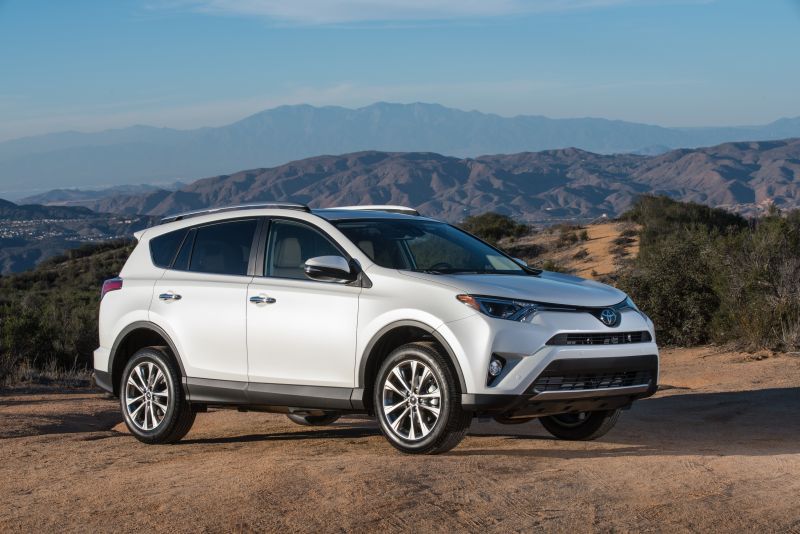
The 2015 facelift brought a series of aesthetic and functional enhancements to the fourth-generation RAV4, giving it a more modern and assertive presence. As a five-door, five-seat SUV, the RAV4 maintained its practical body type, but the refresh introduced a restyled front fascia with a sleeker grille, updated headlights, and a more aggressive bumper design. The rear also saw changes, including new taillights and a revised tailgate, contributing to a more cohesive and contemporary look. The dimensions remained largely consistent, with a length of 181.3 inches, a width of 72.64 inches, and a height of 65.94 inches, riding on a 104.72-inch wheelbase.
Inside, the RAV4 Hybrid offered a spacious and comfortable cabin, designed with practicality in mind. The five-seat configuration provided ample room for passengers, while the cargo area was highly versatile. With the rear seats in place, the trunk offered a generous 17.69 cubic feet of space, expanding to an impressive 57.67 cubic feet with the rear seats folded down. This adaptability made it an ideal choice for families, adventurers, and anyone needing substantial hauling capability. Key features included power steering with an electric assist, ensuring easy maneuverability, and a robust braking system with ventilated discs at the front and disc brakes at the rear, complemented by ABS (Anti-lock Braking System) for enhanced safety.
The vehicle’s architecture, with an independent McPherson front suspension and an independent trapezoidal lever rear suspension, provided a comfortable ride and stable handling. The standard tire size was 225/65 R17 H, mounted on 6.5J 17 or 7J 17 wheel rims, balancing grip and ride comfort. With a ground clearance of 6.97 inches, the RAV4 Hybrid was well-suited for light off-road excursions or navigating challenging urban environments, further enhancing its versatility.
Technical Specifications
| Category | Specification |
|---|---|
| Brand | Toyota |
| Model | RAV4 |
| Generation | RAV4 IV (facelift 2015) |
| Type (Engine) | 2.5 (197 Hp) Hybrid e-CVT |
| Production Years | 2015 – 2018 |
| Powertrain Architecture | FHEV (Full Hybrid Electric Vehicle) |
| Body type | SUV |
| Seats | 5 |
| Doors | 5 |
| Performance Specifications | |
| Fuel consumption (urban) | 5.1 l/100 km (46.1 US mpg) |
| Fuel consumption (extra urban) | 4.9 l/100 km (48 US mpg) |
| Fuel consumption (combined) | 5 l/100 km (47 US mpg) |
| CO2 emissions | 117 g/km |
| Fuel Type | Petrol (Gasoline) |
| Acceleration 0 – 60 mph | 7.9 sec |
| Maximum speed | 180 km/h (111.85 mph) |
| Emission standard | Euro 6 W |
| Weight-to-power ratio | 8.6 kg/Hp (115.9 Hp/tonne) |
| Electric Cars and Hybrids Specifications | |
| Gross battery capacity | 1.6 kWh |
| Battery voltage | 244.8 V |
| Battery technology | Nickel-metal hydride (NiMH) |
| Battery location | Under the rear seats |
| All-electric range | 1 km (0.62 mi) |
| Electric motor 1 power | 143 Hp |
| Electric motor Torque | 270 Nm (199.14 lb.-ft.) |
| Electric motor location | Integrated into the transmission |
| Electric motor type | Synchronous |
| System power | 197 Hp |
| Internal Combustion Engine Specifications | |
| Power | 155 Hp @ 5700 rpm. |
| Power per liter | 62.1 Hp/l |
| Torque | 210 Nm @ 4200-4400 rpm. (154.89 lb.-ft.) |
| Engine layout | Front, Transverse |
| Engine Model/Code | 2AR-FXE |
| Engine displacement | 2494 cm3 (152.19 cu. in.) |
| Number of cylinders | 4 |
| Engine configuration | Inline |
| Compression ratio | 12.5:1 |
| Number of valves per cylinder | 4 |
| Fuel injection system | Multi-port manifold injection |
| Engine aspiration | Naturally aspirated engine |
| Valvetrain | DOHC, Dual VVT-i |
| Engine oil capacity | 4.4 l (4.65 US qt) |
| Coolant | 7.5 l (7.93 US qt) |
| Space, Volume and Weights | |
| Kerb Weight | 1700-1860 kg (3747.86 – 4100.6 lbs.) |
| Max. weight | 2270 kg (5004.49 lbs.) |
| Max load | 410-570 kg (903.9 – 1256.63 lbs.) |
| Trunk (boot) space – minimum | 501 l (17.69 cu. ft.) |
| Trunk (boot) space – maximum | 1633 l (57.67 cu. ft.) |
| Fuel tank capacity | 56 l (14.79 US gal) |
| Max. roof load | 85 kg (187.39 lbs.) |
| Permitted trailer load with brakes (12%) | 1650 kg (3637.63 lbs.) |
| Permitted trailer load without brakes | 750 kg (1653.47 lbs.) |
| Dimensions | |
| Length | 4605 mm (181.3 in.) |
| Width | 1845 mm (72.64 in.) |
| Height | 1675 mm (65.94 in.) |
| Wheelbase | 2660 mm (104.72 in.) |
| Front track | 1560-1570 mm (61.42 – 61.81 in.) |
| Rear (Back) track | 1560-1570 mm (61.42 – 61.81 in.) |
| Ride height (ground clearance) | 177 mm (6.97 in.) |
| Minimum turning circle (turning diameter) | 10.6-11.2 m (34.78 – 36.75 ft.) |
| Approach angle | 19° |
| Departure angle | 22° |
| Drivetrain, Brakes and Suspension Specifications | |
| Drivetrain Architecture | The Internal combustion engine (ICE) and electric motor drive the front wheels of the car with the ability to work in full electric or mixed mode. |
| Drive wheel | Front wheel drive |
| Number of gears and type of gearbox | automatic transmission e-CVT |
| Front suspension | Independent type McPherson |
| Rear suspension | Independent on trapezoidal lever |
| Front brakes | Ventilated discs |
| Rear brakes | Disc |
| Assisting systems | ABS (Anti-lock braking system) |
| Steering type | Steering rack and pinion |
| Power steering | Electric Steering |
| Tires size | 225/65 R17 H |
| Wheel rims size | 6.5J 17; 7J 17 |
Legacy and Market Impact
The introduction of the hybrid powertrain to the RAV4 lineup in 2015 solidified Toyota’s position as a leader in automotive electrification, particularly within the mainstream compact SUV segment. Before this, hybrid SUVs were often larger or more niche, but the RAV4 Hybrid brought this technology to a broader audience, demonstrating that efficiency could be seamlessly integrated into a practical, family-friendly vehicle. This model became a benchmark for fuel economy in its class, challenging competitors to innovate in their own hybrid offerings.
In the highly competitive compact SUV market, the Toyota RAV4 IV (facelift 2015) 2.5 (197 Hp) Hybrid e-CVT faced strong rivals such as the Honda CR-V, Nissan Rogue, Ford Escape, and Mazda CX-5. While many of these competitors offered compelling packages, none could match the RAV4 Hybrid’s blend of power and fuel efficiency at the time. Its strong reputation for reliability, a hallmark of the Toyota brand, further enhanced its appeal and contributed to its robust resale value.
The 2015-2018 RAV4 Hybrid played a crucial role in normalizing hybrid technology, making it a more accessible and desirable option for the average consumer. It proved that hybrid vehicles were not just for early adopters but could deliver tangible benefits in everyday driving, from reduced trips to the gas station to a quieter driving experience. Its success paved the way for subsequent generations of the RAV4 Hybrid, which have continued to build on this foundation, offering even greater efficiency and performance. This generation of the RAV4 Hybrid is remembered as a pivotal model that helped cement the compact hybrid SUV as a mainstream vehicle choice, significantly impacting the automotive landscape and contributing to a greener future.