
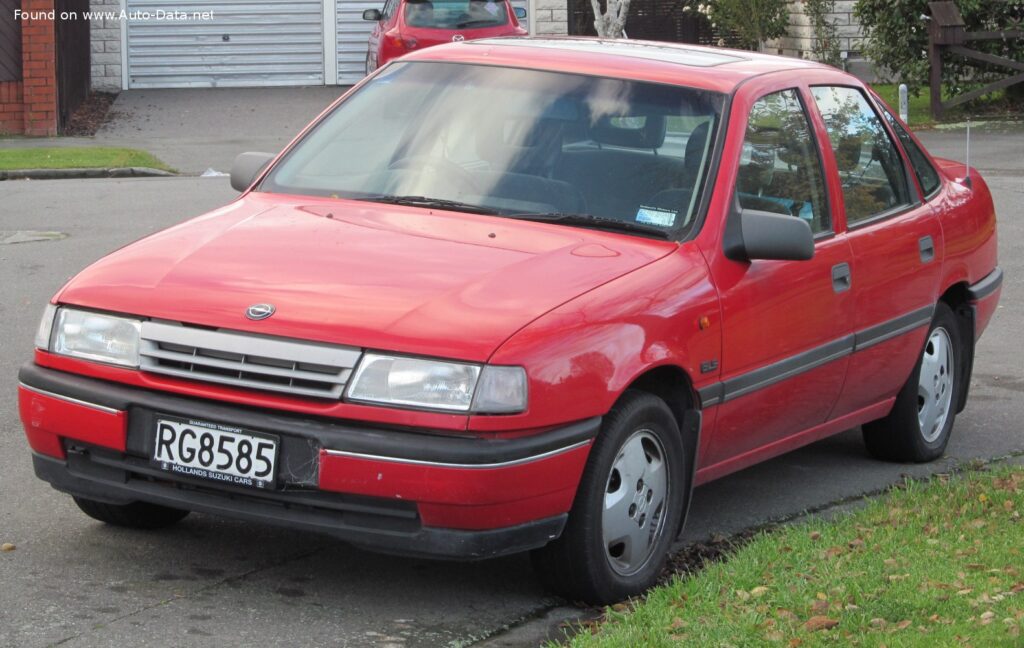
Introduction to the Opel Vectra A 1.8 S (90 Hp) Automatic
The Opel Vectra A 1.8 S (90 Hp) Automatic marked a significant entry into the European mid-size car segment when it debuted in September 1988. As the successor to the long-running Opel Ascona, the Vectra A represented a modern approach to family and business transportation, blending contemporary design, improved aerodynamics, and a strong emphasis on practicality. Primarily designed for the European market, where Opel, a subsidiary of General Motors, held a prominent position, the Vectra A quickly established itself as a formidable competitor.
This particular variant, the 1.8 S (90 Hp) Automatic, was positioned as a sensible choice for consumers seeking a comfortable and relatively effortless driving experience without sacrificing fuel efficiency. Though never officially sold under the Opel badge in the United States, the Vectra A’s engineering and design philosophies mirrored global automotive trends of the late 1980s, emphasizing front-wheel drive layouts, efficient powertrains, and a focus on passenger comfort. Its role in Europe was crucial for Opel, solidifying its presence in a highly competitive segment alongside rivals from Ford, Volkswagen, and other European manufacturers. This first generation of the Opel Vectra, known internally as the Vectra A, was produced until 1995, with the 1.8 S Automatic variant specifically available from September 1988 to July 1989.
Engine and Performance of the Opel Vectra A
Powertrain Overview: The 1.8 S (90 Hp) Automatic
At the heart of the Opel Vectra A 1.8 S (90 Hp) Automatic lies a robust and proven 1.8-liter (1796 cm³ or 109.6 cu. in.) naturally aspirated inline-four engine, designated by the code 18SV. This powerplant, mounted transversely at the front, was a staple of Opel’s lineup during the era, known for its reliability and straightforward operation. Employing an Overhead Camshaft (OHC) valvetrain with two valves per cylinder, and utilizing a carburetor for fuel injection, this engine represented the prevalent technology of its time, prior to the widespread adoption of multi-point fuel injection systems. The compression ratio for this engine was 9.2:1, contributing to its balanced performance and efficiency characteristics.
The engine produced a respectable 90 horsepower at 5400 revolutions per minute (rpm), providing ample power for daily driving and highway cruising. Power per liter stood at 50.1 Hp/l, indicating a solid, if not groundbreaking, specific output for a naturally aspirated engine of its displacement in the late 1980s. Torque output stood at 148 Newton-meters, or approximately 109.
