The Suzuki Liana Wagon I Sport 1.6 i 16V (106 Hp) 4WD: A Practical Global Player
The Suzuki Liana Wagon I Sport 1.6 i 16V (106 Hp) 4WD represents a notable entry in the compact segment from the Japanese automaker Suzuki, produced between 2003 and 2004. Known as the Aerio in North America, the Liana (an acronym for “Life In A New Age”) was designed as a versatile and economical vehicle, aiming to blend the practicality of a station wagon with the driving dynamics of a compact sedan. This specific variant, with its 1.6-liter engine and all-wheel-drive system, was particularly tailored for markets outside the United States, such as Europe and Asia, where compact wagons with enhanced traction held significant appeal. It carved out a niche for itself as a reliable, no-frills family transporter capable of handling diverse road conditions, offering a blend of spaciousness, efficiency, and the added assurance of four-wheel drive.
Powertrain and Performance of the Suzuki Liana Wagon I Sport 1.6 i 16V (106 Hp) 4WD
At the heart of the Suzuki Liana Wagon I Sport 1.6 i 16V (106 Hp) 4WD lies Suzuki’s M16A engine, a naturally aspirated 1.6-liter (1586 cm³) DOHC (Double Overhead Camshaft) 16-valve inline-four gasoline unit. This engine was engineered for a balance of efficiency and usable power, producing 106 horsepower at 5500 rpm and a peak torque of 106.21 lb.-ft. (144 Nm) at 4000 rpm. Its multi-port manifold injection system ensured precise fuel delivery, contributing to its respectable fuel economy for the era.
Power was routed through a 4-speed automatic transmission to an all-wheel-drive (4×4) system, providing enhanced grip and stability, particularly advantageous in adverse weather conditions or on unpaved roads. While not a performance-oriented vehicle, the Liana Wagon I Sport offered a maximum speed of 99.42 mph (160 km/h), making it perfectly adequate for daily commuting and highway cruising. Its weight-to-power ratio stood at 11.6 kg/Hp, or 86.2 Hp per tonne, indicating a modest but capable performance profile.
Fuel efficiency figures for this variant were competitive: an urban consumption of 22.8 US mpg (10.3 liters per 100 km) and an extra-urban consumption of 33.6 US mpg (7.0 liters per 100 km). These figures underscored Suzuki’s commitment to economical operation, a key selling point in its target markets. The 50-liter (13.21 US gallon) fuel tank provided a decent cruising range, reducing the frequency of fuel stops.
Design, Features, and Practicality
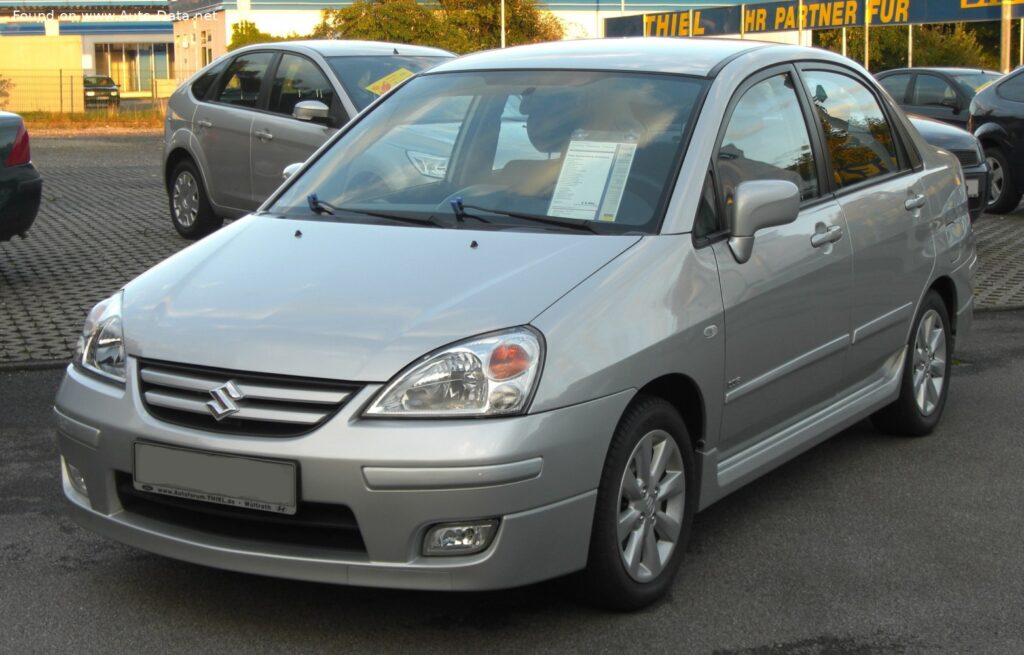
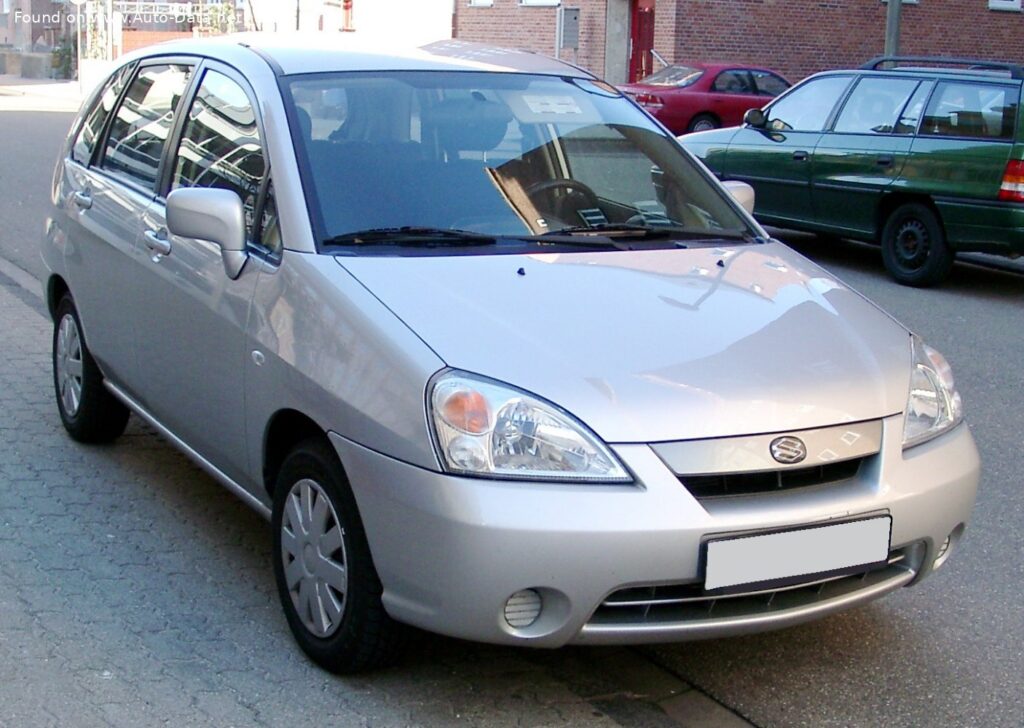
The Suzuki Liana Wagon I adopted a practical and functional station wagon (estate) body type, featuring four doors and seating for five occupants. Its exterior dimensions – 168.5 inches (4280 mm) in length, 67.72 inches (1720 mm) in width, and 61.02 inches (1550 mm) in height – provided a compact footprint while maximizing interior volume. The relatively tall stance, combined with the all-wheel-drive system, gave it a slightly rugged character, hinting at its utility beyond paved roads. A wheelbase of 97.64 inches (2480 mm) contributed to a stable ride and reasonable interior space.
Inside, the Liana Wagon I prioritized utility and straightforward ergonomics. The cabin was designed to be spacious and user-friendly, with controls intuitively placed. One of its strongest attributes was its cargo capacity. With the rear seats in place, it offered 9.85 cubic feet (279 liters) of trunk space. Folding the rear seats significantly expanded this volume to an impressive 40.58 cubic feet (1149 liters), making it highly versatile for carrying luggage, groceries, or larger items.
In terms of chassis and safety, the Liana Wagon I Sport featured a front suspension utilizing wishbones, paired with a rear coil spring setup, providing a comfortable yet stable ride. Braking duties were handled by ventilated discs at the front and drum brakes at the rear, complemented by an Anti-lock Braking System (ABS) for enhanced stopping power and control. The steering system was a hydraulic rack and pinion setup, offering direct feedback to the driver. The vehicle rode on 185/65 R14 tires mounted on 14-inch wheel rims, a common specification for compact vehicles of its era, balancing ride comfort with cost-effectiveness.
Technical Specifications
| Category | Specification | Value |
|---|---|---|
| General Information | ||
| Brand | Suzuki | |
| Model | Liana | |
| Generation | Liana Wagon I | |
| Type (Engine) | Sport 1.6 i 16V (106 Hp) 4WD | |
| Production Start | 2003 year | |
| Production End | 2004 year | |
| Powertrain Architecture | Internal Combustion engine | |
| Body type | Station wagon (estate) | |
| Seats | 5 | |
| Doors | 4 | |
| Performance Specs | ||
| Fuel consumption (economy) – urban | 10.3 l/100 km | 22.8 US mpg |
| Fuel consumption (economy) – extra urban | 7 l/100 km | 33.6 US mpg |
| Fuel Type | Petrol (Gasoline) | |
| Maximum speed | 160 km/h | 99.42 mph |
| Weight-to-power ratio | 11.6 kg/Hp | 86.2 Hp/tonne |
| Weight-to-torque ratio | 8.5 kg/Nm | 117.1 Nm/tonne |
| Engine Specs | ||
| Power | 106 Hp | @ 5500 rpm. |
| Power per liter | 66.8 Hp/l | |
| Torque | 144 Nm | 106.21 lb.-ft. @ 4000 rpm. |
| Engine layout | Front, Transverse | |
| Engine Model/Code | M16A | |
| Engine displacement | 1586 cm3 | 96.78 cu. in. |
| Number of cylinders | 4 | |
| Engine configuration | Inline | |
| Cylinder Bore | 78 mm | 3.07 in. |
| Piston Stroke | 83 mm | 3.27 in. |
| Compression ratio | 9.7:1 | |
| Number of valves per cylinder | 4 | |
| Fuel injection system | Multi-port manifold injection | |
| Engine aspiration | Naturally aspirated engine | |
| Valvetrain | DOHC | |
| Engine oil capacity | 4.1 l | 4.33 US qt |
| Coolant | 6.5 l | 6.87 US qt |
| Space, Volume and Weights | ||
| Kerb Weight | 1230 kg | 2711.69 lbs. |
| Max. weight | 1670 kg | 3681.72 lbs. |
| Max load | 440 kg | 970.03 lbs. |
| Trunk (boot) space – minimum | 279 l | 9.85 cu. ft. |
| Trunk (boot) space – maximum | 1149 l | 40.58 cu. ft. |
| Fuel tank capacity | 50 l | 13.21 US gal |
| Dimensions | ||
| Length | 4280 mm | 168.5 in. |
| Width | 1720 mm | 67.72 in. |
| Height | 1550 mm | 61.02 in. |
| Wheelbase | 2480 mm | 97.64 in. |
| Front track | 1450 mm | 57.09 in. |
| Rear (Back) track | 1450 mm | 57.09 in. |
| Drivetrain, Brakes and Suspension Specs | ||
| Drive wheel | All wheel drive (4×4) | |
| Number of gears and type of gearbox | 4 gears, automatic transmission | |
| Front suspension | Wishbone | |
| Rear suspension | Coil spring | |
| Front brakes | Ventilated discs | |
| Rear brakes | Drum | |
| Assisting systems | ABS (Anti-lock braking system) | |
| Steering type | Steering rack and pinion | |
| Power steering | Hydraulic Steering | |
| Tires size | 185/65 R14 | |
| Wheel rims size | 14 | |
Legacy and Market Impact
The Suzuki Liana, in its various forms, held a unique position in Suzuki’s global lineup. While sold as the Aerio in North America, where it competed in the compact sedan and hatchback segments, the Liana Wagon I Sport 1.6 i 16V (106 Hp) 4WD was particularly significant in European and Asian markets. Here, it offered an attractive alternative to conventional compact sedans and larger, more expensive SUVs. Its all-wheel-drive capability, combined with a practical wagon body, made it a sensible choice for families in regions experiencing varied climates, from snowy winters to unpaved rural roads.
In its primary markets, the Liana Wagon competed against a diverse range of vehicles, including established players like the Toyota Corolla Wagon, Honda Civic Wagon, and various European compact estates from manufacturers such as Opel/Vauxhall, Ford, and Renault. What set the Liana apart was its combination of Suzuki’s reputation for reliability and affordability, coupled with the confidence-inspiring traction of a 4WD system in a compact, fuel-efficient package.
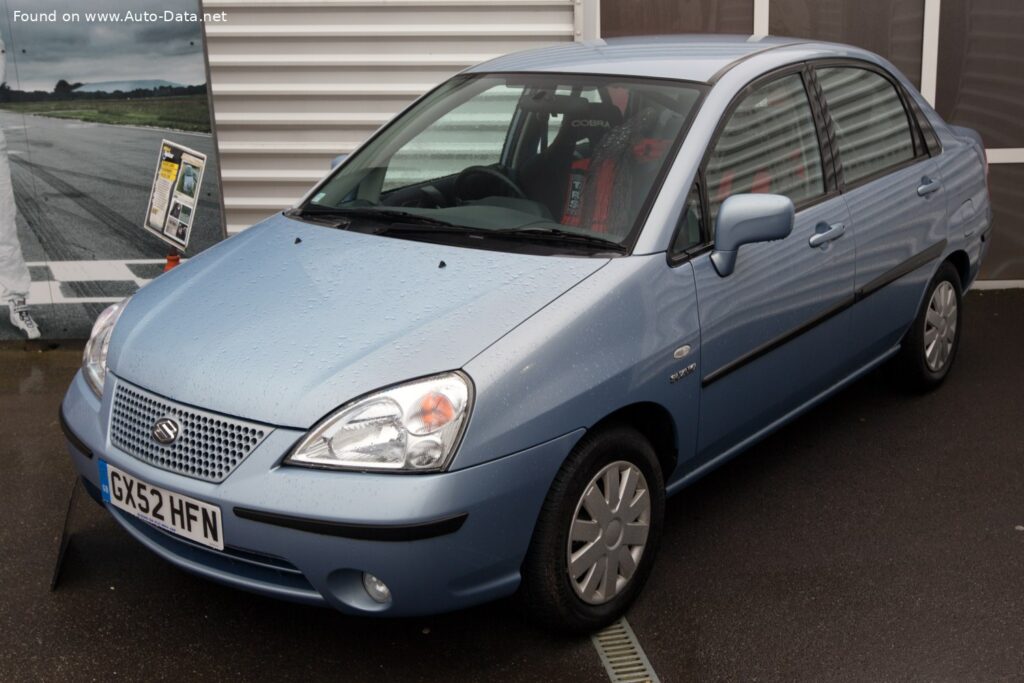
Perhaps one of the most unexpected aspects of the Liana’s legacy, particularly the sedan version, was its role as the “reasonably priced car” on the popular British automotive show “Top Gear” for several seasons. While this exposure provided global recognition, it also inadvertently highlighted the car’s utilitarian rather than exciting character. However, for the typical buyer of the Liana Wagon I Sport 1.6 i 16V (106 Hp) 4WD, excitement was secondary to practicality, economy, and dependable performance.
The Liana’s production run, though relatively short for this specific 4WD wagon variant (2003-2004), contributed to Suzuki’s image as a manufacturer of versatile and robust vehicles. It demonstrated Suzuki’s ability to offer specialized models that catered to specific regional demands, such as the need for all-weather capability in a compact family car. Today, the Liana Wagon remains a testament to Suzuki’s pragmatic approach to automotive design, offering a durable and functional vehicle that served its owners reliably during its operational life. Its impact was less about groundbreaking innovation and more about consistently delivering on its promise of accessible, all-season family transportation.