
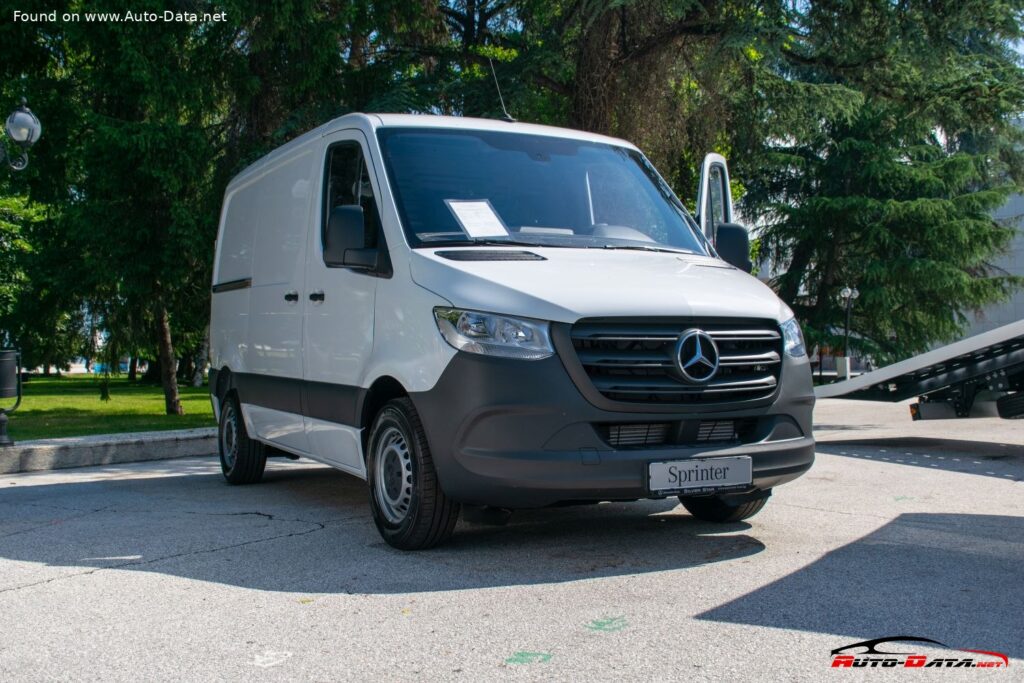
The Mercedes-Benz Sprinter Panel Van Compact (W907/W910): A Global Workhorse
The Mercedes-Benz Sprinter has long stood as a benchmark in the commercial van segment, renowned for its robustness, versatility, and advanced engineering. The specific variant under review, the Mercedes-Benz Sprinter Panel Van Compact (W907/W910) 214 CDI (143 Hp) W910, represents a key offering from the third generation of this iconic light commercial vehicle. Introduced in 2018, this iteration, identified by its W907 (front-wheel drive) and W910 (rear-wheel drive/all-wheel drive) chassis codes, continues the Sprinter’s legacy as a sophisticated and highly adaptable platform for businesses worldwide.
This particular model, the “Compact” panel van, is designed to strike a balance between maneuverability for urban environments and ample cargo capacity, making it a popular choice for delivery services, tradespeople, and various commercial applications across Europe, Asia, and North America. While the Sprinter is a global product, its European roots are evident in its diesel-centric powertrain options and adherence to strict emission standards like Euro VI. Mercedes-Benz has consistently pushed the boundaries of what a commercial van can offer, integrating passenger car levels of technology, safety, and comfort into a utilitarian package, and the W907/W910 generation is no exception.
Engine and Performance: The 214 CDI Powertrain in the Mercedes-Benz Sprinter Panel Van Compact (W907/W910)
At the heart of the Mercedes-Benz Sprinter Panel Van Compact (W907/W910) 214 CDI (143 Hp) W910 lies Mercedes-Benz’s venerable OM 651 engine. This 2.1-liter (2143 cubic centimeters or 130.77 cubic inches) inline-four diesel engine is a testament to efficient and reliable commercial power. Employing a common rail fuel injection system, a turbocharger, and an intercooler, the engine is engineered to deliver a compelling blend of power and fuel efficiency crucial for commercial operations.
The 214 CDI variant produces a respectable 143 horsepower at 3800 revolutions per minute (rpm). More critically for a commercial vehicle, it generates a robust 243.4 lb.-ft. (330 Nm) of torque, available across a broad and usable rev range from 1200 to 2400 rpm. This wide torque band ensures strong pulling power from low speeds, essential for hauling heavy loads and navigating stop-and-go urban traffic without constant gear changes. The engine’s layout is front-mounted and transverse, contributing to the front-wheel-drive architecture of this particular W907/W910 model, which optimizes interior space and reduces curb weight.
Power is channeled through a precise 6-speed manual transmission, offering drivers direct control and contributing to the vehicle’s overall fuel economy. With a weight-to-power ratio of 13.4 kg/Hp (74.5 Hp/tonne) and a weight-to-torque ratio of 5.8 kg/Nm (171.9 Nm/tonne), the Sprinter 214 CDI demonstrates capable performance for its class. The powertrain architecture, driving the front wheels, enhances traction in certain conditions and contributes to a lower loading floor, a practical advantage for cargo vans.
Fuel efficiency figures for this model are impressive for a vehicle of its size and capability. According to NEDC (New European Driving Cycle) standards, the combined fuel consumption ranges from 7.7-7.9 liters per 100 kilometers, translating to approximately 30.5 to 29.8 US miles per gallon. Urban driving yields 25.8 to 25 US mpg, while extra-urban cycles can achieve 33.6 to 32.2 US mpg. These figures, coupled with a 17.17 US gallon (65-liter) fuel tank and a 5.81 US gallon (22-liter) AdBlue tank for emissions reduction, ensure a practical operating range and compliance with Euro VI emission standards, boasting CO2 emissions between 201-208 g/km. A particulate filter is also standard, further underscoring its environmental consideration.
Design and Features
The Mercedes-Benz Sprinter Panel Van Compact (W907/W910) is designed with purpose: to efficiently transport goods. Its body type is a classic panel van, featuring five doors – typically two in the front for cabin access, one or two sliding side doors for cargo access, and a rear door arrangement (often split barn doors) for loading and unloading. This compact variant, with a length of 207.36 inches (5267 mm), a width of 79.53 inches (2020 mm), and a height of 92.76 inches (2356 mm), is optimized for urban maneuverability while still offering substantial cargo volume.
The interior is configured for three occupants, providing a practical and comfortable workspace for the driver and two passengers. Despite its “compact” designation, the Sprinter boasts an impressive maximum trunk (boot) space of 275.45 cubic feet (7800 liters), making it highly capable for a wide range of commercial tasks. The design prioritizes ease of loading and unloading, with a relatively low loading floor and wide door openings.
From a structural standpoint, the Sprinter is built for durability. It features a robust suspension system with a leaf spring setup at the front and a combination of hydraulic elements and leaf springs at the rear, designed to handle heavy loads and provide stable ride characteristics. Braking performance is ensured by disc brakes on both the front and rear axles, complemented by an Anti-lock Braking System (ABS) for enhanced safety and control, particularly under emergency braking or adverse road conditions.
The vehicle rides on 225/65 R16 tires mounted on 6.5J x 16 wheel rims, providing a good balance of load-carrying capacity and ride comfort. With a ground clearance of 5.63 inches (143 mm) and a minimum turning circle of 42.65 feet (13 meters), the Sprinter Compact is surprisingly agile for its size, making it adept at navigating tight city streets and loading docks. The maximum permissible load capacity is 2380.99 lbs. (1080 kg), and it can tow a braked trailer up to 4409.25 lbs. (2000 kg), or an unbraked trailer up to 1653.47 lbs. (750 kg), showcasing its versatility as a workhorse.
Technical Specifications
| Category | Specification | Value |
|---|---|---|
| General Information | Brand | Mercedes-Benz |
| Model | Sprinter | |
| Generation | Sprinter Panel Van Compact (W907/W910) | |
| Type (Engine) | 214 CDI (143 Hp) W910 | |
| Start of Production | 2018 year | |
| Powertrain Architecture | Internal Combustion Engine (ICE) | |
| Body Type | Van | |
| Seats | 3 | |
| Doors | 5 | |
| Performance Specs | Fuel consumption (economy) – urban (NEDC) | 9.1-9.4 l/100 km (25.8 – 25 US mpg) |
| Fuel consumption (economy) – extra urban (NEDC) | 7.0-7.3 l/100 km (33.6 – 32.2 US mpg) | |
| Fuel consumption (economy) – combined (NEDC) | 7.7-7.9 l/100 km (30.5 – 29.8 US mpg) | |
| CO2 emissions (NEDC) | 201-208 g/km | |
| Fuel Type | Diesel | |
| Emission Standard | Euro VI | |
| Weight-to-power ratio | 13.4 kg/Hp (74.5 Hp/tonne) | |
| Weight-to-torque ratio | 5.8 kg/Nm (171.9 Nm/tonne) | |
| Engine Specs | Power | 143 Hp @ 3800 rpm |
| Power per liter | 66.7 Hp/l | |
| Torque | 330 Nm (243.4 lb.-ft.) @ 1200-2400 rpm | |
| Engine Layout | Front, Transverse | |
| Engine Model/Code | OM 651 | |
| Engine Displacement | 2143 cm³ (2.1 Liters / 130.77 cu. in.) | |
| Number of Cylinders | 4 | |
| Engine Configuration | Inline | |
| Number of Valves per Cylinder | 4 | |
| Fuel Injection System | Diesel Commonrail | |
| Engine Aspiration | Turbocharger, Intercooler | |
| Engine Oil Capacity | 11.5 l (12.15 US qt) | |
| Coolant Capacity | 9.5 l (10.04 US qt) | |
| Engine Systems | Particulate Filter | Yes |
| Space, Volume and Weights | Kerb Weight | 1920 kg (4232.88 lbs.) |
| Max. Weight (GVWR) | 3000 kg (6613.87 lbs.) | |
| Max Load | 1080 kg (2380.99 lbs.) | |
| Trunk (boot) space – maximum | 7800 l (275.45 cu. ft.) | |
| Fuel Tank Capacity | 65 l (17.17 US gal) | |
| AdBlue Tank Capacity | 22 l (5.81 US gal) | |
| Max. Roof Load | 300 kg (661.39 lbs.) | |
| Permitted Trailer Load with brakes (12%) | 2000 kg (4409.25 lbs.) | |
| Permitted Trailer Load without brakes | 750 kg (1653.47 lbs.) | |
| Dimensions | Length | 5267 mm (207.36 in.) |
| Width | 2020 mm (79.53 in.) | |
| Width including mirrors | 2345 mm (92.32 in.) | |
| Height | 2356 mm (92.76 in.) | |
| Wheelbase | 3259 mm (128.31 in.) | |
| Front Track | 1759 mm (69.25 in.) | |
| Rear (Back) Track | 1770 mm (69.69 in.) | |
| Front Overhang | 1012 mm (39.84 in.) | |
| Rear Overhang | 996 mm (39.21 in.) | |
| Ride Height (ground clearance) | 143 mm (5.63 in.) | |
| Minimum Turning Circle (turning diameter) | 13 m (42.65 ft.) | |
| Drivetrain, Brakes and Suspension Specs | Drivetrain Architecture | The Internal combustion engine (ICE) drives the front wheels of the vehicle. |
| Drive Wheel | Front-wheel drive | |
| Number of Gears and Type of Gearbox | 6 gears, manual transmission | |
| Front Suspension | Leaf spring | |
| Rear Suspension | Hydraulic elements, Leaf spring | |
| Front Brakes | Disc | |
| Rear Brakes | Disc | |
| Assisting Systems | ABS (Anti-lock braking system) | |
| Tires Size | 225/65 R16 | |
| Wheel Rims Size | 6.5J x 16 |
Legacy and Market Impact
The Mercedes-Benz Sprinter, including the Mercedes-Benz Sprinter Panel Van Compact (W907/W910) 214 CDI (143 Hp) W910, has carved out a formidable reputation as a leader in the light commercial vehicle segment. Its impact on the global market is profound, setting high standards for efficiency, reliability, and driver comfort that many competitors strive to emulate. In its primary markets, particularly Europe, the Sprinter consistently faces strong competition from other major players such as the Ford Transit, Volkswagen Crafter, Fiat Ducato, and Renault Master. However, the Sprinter distinguishes itself with its premium brand appeal, advanced technological features, and a wide array of configurations that cater to virtually any commercial need.
The third-generation W907/W910 Sprinter further cemented this legacy by introducing modern connectivity features, enhanced safety systems, and refined powertrains. The 214 CDI engine, specifically, is a cornerstone of its efficiency proposition, providing ample power for daily tasks while keeping operating costs in check through impressive fuel economy and adherence to stringent emission standards. This blend of performance and economy has made it a favorite among fleet operators and owner-operators alike.
Historically, the Sprinter revolutionized the van market by offering a more car-like driving experience, superior ergonomics, and a greater emphasis on active and passive safety features compared to its contemporaries. This focus on driver well-being and vehicle dynamics helped professional drivers endure long hours with less fatigue, directly impacting productivity and safety. Its robust build quality and extensive dealer network also contribute to its high resale value and long service life, making it a sound investment for businesses.
The “Compact” panel van variant, in particular, addresses the growing demand for commercial vehicles that can navigate congested urban environments with ease. Its optimized dimensions and maneuverability, combined with substantial cargo capacity, make it an ideal choice for last-mile delivery services, urban logistics, and specialized trade applications where larger vans might be unwieldy. The Sprinter’s enduring appeal lies in its ability to adapt and innovate, continuously offering solutions that meet the evolving demands of the global commercial sector, thus maintaining its status as a true industry icon.
