
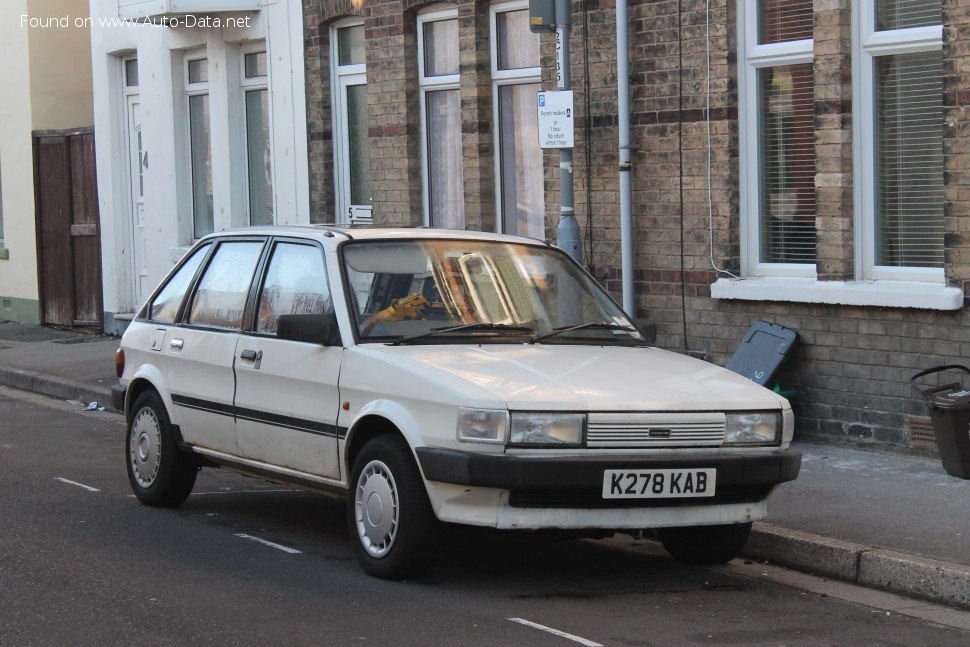
The Rover Maestro 1.3: A British Hatchback’s Journey
The Rover Maestro 1.3 represents a significant, if often debated, chapter in the history of the British automotive industry. Launched in 1983, the Maestro was Austin Rover’s ambitious attempt to modernize its compact family car offering, succeeding the much-maligned Austin Allegro. Positioned squarely in Europe’s highly competitive C-segment, it aimed to rival established contenders like the Ford Escort, Volkswagen Golf, and Vauxhall Astra. While not sold in the United States, the Maestro played a crucial role in the UK and broader European markets as a practical, spacious, and initially well-regarded hatchback designed for the mainstream consumer. Its production spanned an impressive, though often challenging, fourteen years, from 1983 to 1997, undergoing various updates and badge engineering exercises.
Engine and Performance of the Rover Maestro
At the heart of the entry-level Rover Maestro 1.3 was a venerable 1.3-liter (1275 cubic centimeters) inline-four gasoline engine, codenamed 12HE. This powerplant was a direct descendant of the legendary A-Series engine, a design that had powered various British Leyland and Austin models for decades, including the original Mini. In the Maestro application, it was configured with a front, transverse layout, driving the front wheels – a conventional and efficient setup for a compact car of its era.
The engine was naturally aspirated and utilized a carburettor fuel injection system, typical technology for the early 1980s before widespread adoption of electronic fuel injection. It produced a modest but adequate 69 horsepower at 5600 rpm, delivering a power-per-liter figure of 54.1 Hp/l. Torque output stood at 75.23 lb.-ft. at 3500 rpm, providing reasonable low-end grunt for city driving. This powertrain was mated to a four-speed manual transmission, emphasizing economy and simplicity over outright performance.
In terms of performance, the Rover Maestro 1.3 (69 Hp) was designed for practicality rather than speed. It could accelerate from 0 to 60 mph in 11.9 seconds, with a top speed of approximately 95.69 mph. These figures were competitive for an economy-focused variant in its class at the time. Fuel efficiency was a key selling point, with a combined cycle rating of 30.2 US mpg (7.8 l/100 km), making it an economical choice for families and fleet operators in Europe. The engine’s robust, if somewhat dated, design contributed to its longevity, a factor that kept the Maestro on the market for an extended period.
Design and Features
The Rover Maestro adopted a modern, five-door hatchback body style, a practical choice that offered versatility and good cargo capacity. Its design, penned by Ian Beech and Stephen Harper under the direction of Roy Axe, was contemporary for the early 1980s, featuring clean lines and a relatively aerodynamic profile for its time. The focus was on maximizing interior space within a compact footprint.
Measuring 157.48 inches in length, 66.73 inches in width, and 56.3 inches in height, with a wheelbase of 98.82 inches, the Maestro provided seating for five occupants. The interior was praised upon launch for its spaciousness and airy cabin, a significant improvement over its predecessor. Trunk (boot) space was also generous for the class, ranging from 10.59 cubic feet with the rear seats up to a substantial 38.49 cubic feet with them folded down, enhancing its utility as a family vehicle.
Underneath, the Maestro featured an independent suspension system with coil springs at both the front and rear, designed to offer a comfortable ride quality, which was often lauded in contemporary reviews. Braking was handled by disc brakes at the front and drum brakes at the rear, a common setup for economy cars of the era. Later in its production run, and often on higher trim levels, features like ABS (Anti-lock braking system) became available, marking an early step towards modern safety standards in compact cars. Steering was of the rack and pinion type, assisted by a hydraulic power steering system, making it relatively easy to maneuver in urban environments. The car rode on modest 155/80 R13 tires, reflecting its focus on economy and cost-effectiveness.
Technical Specifications
| Category | Specification |
|---|---|
| Brand | Rover |
| Model | Maestro |
| Generation | Maestro |
| Type (Engine) | 1.3 (69 Hp) |
| Start of Production | 1983 year |
| End of Production | 1997 year |
| Powertrain Architecture | Internal Combustion engine, Front-wheel drive |
| Body type | Hatchback |
| Seats | 5 |
| Doors | 5 |
| Performance Specs | |
| Fuel Consumption (Economy) – Urban | 30.2 US mpg (7.8 l/100 km) |
| Fuel Consumption (Economy) – Extra Urban | 42 US mpg (5.6 l/100 km) |
| Fuel Consumption (Economy) – Combined | 30.2 US mpg (7.8 l/100 km) |
| Fuel Type | Petrol (Gasoline) |
| Acceleration 0 – 60 mph | 11.9 sec |
| Maximum Speed | 95.69 mph (154 km/h) |
| Weight-to-power ratio | 13.4 kg/Hp |
| Weight-to-torque ratio | 9.1 kg/Nm |
| Engine Specs | |
| Power | 69 Hp @ 5600 rpm |
| Power per liter | 54.1 Hp/l |
| Torque | 75.23 lb.-ft. (102 Nm) @ 3500 rpm |
| Engine Layout | Front, Transverse |
| Engine Model/Code | 12HE |
| Engine Displacement | 1.3 l (1275 cm3, 77.81 cu. in.) |
| Number of Cylinders | 4 |
| Engine Configuration | Inline |
| Cylinder Bore | 2.78 in. (70.64 mm) |
| Piston Stroke | 3.2 in. (81.28 mm) |
| Compression Ratio | 9.75:1 |
| Number of Valves per Cylinder | 2 |
| Fuel Injection System | Carburettor |
| Engine Aspiration | Naturally aspirated engine |
| Engine Oil Capacity | 2.85 US qt (2.7 l) |
| Coolant Capacity | 7.08 US qt (6.7 l) |
| Space, Volume and Weights | |
| Kerb Weight | 2039.28 lbs. (925 kg) |
| Max. Weight | 3020.33 lbs. (1370 kg) |
| Max Load | 981.06 lbs. (445 kg) |
| Trunk (boot) space – minimum | 10.59 cu. ft. (300 l) |
| Trunk (boot) space – maximum | 38.49 cu. ft. (1090 l) |
| Fuel Tank Capacity | 13.21 US gal (50 l) |
| Dimensions | |
| Length | 157.48 in. (4000 mm) |
| Width | 66.73 in. (1695 mm) |
| Height | 56.3 in. (1430 mm) |
| Wheelbase | 98.82 in. (2510 mm) |
| Front Track | 57.68 in. (1465 mm) |
| Rear (Back) Track | 56.69 in. (1440 mm) |
| Drivetrain, Brakes and Suspension Specs | |
| Drivetrain Architecture | Front-wheel drive |
| Drive Wheel | Front wheel drive |
| Number of Gears and Type of Gearbox | 4 gears, manual transmission |
| Front Suspension | Coil spring |
| Rear Suspension | Coil spring |
| Front Brakes | Disc |
| Rear Brakes | Drum |
| Assisting Systems | ABS (Anti-lock braking system) |
| Steering Type | Steering rack and pinion |
| Power Steering | Hydraulic Steering |
| Tires Size | 155/80 R13 79 T |
Legacy and Market Impact of the Rover Maestro
The Rover Maestro entered the market with high hopes for the struggling Austin Rover Group. It was seen as a crucial model to re-establish the company’s credibility in the volume segment. Initially, it garnered positive reviews for its spacious interior, comfortable ride, and the performance of its more powerful engines. The Rover Maestro 1.3, in particular, was lauded for its fuel economy and low running costs, making it a popular choice for budget-conscious buyers and large fleet operators in the UK and continental Europe.
However, the Maestro’s legacy is complex and often overshadowed by the broader challenges faced by the British automotive industry during the 1980s and 1990s. Despite its initial promise, the car quickly developed a reputation for build quality issues, electrical problems, and rust susceptibility, particularly in its early years. These reliability concerns, coupled with intense competition from increasingly sophisticated and well-built rivals such as the Volkswagen Golf Mk2, Ford Escort Mk3/4, and Vauxhall Astra Mk1/2, hampered its long-term success. Japanese competitors like the Honda Civic also offered superior reliability and refinement, further eroding the Maestro’s market share.
Despite these drawbacks, the Maestro proved to be remarkably resilient. Its long production run until 1997, even after the introduction of its nominal successor, the Rover 200/400 (R8), speaks to its enduring role as a budget option and fleet workhorse. Towards the end of its life, it was primarily sold as a basic, no-frills vehicle, competing on price rather than innovation. The car also saw a brief, unusual second life after mainstream production ended, being assembled in Bulgaria and later China, highlighting its robust, if antiquated, engineering.
Today, the Rover Maestro is remembered as a quintessential 1980s British car, a symbol of a turbulent period for the UK auto industry. While it never achieved the iconic status or sales success of some of its rivals, it provided essential transportation for millions of European families. For automotive enthusiasts and historians, the Maestro is a testament to the engineering capabilities and design aspirations of its time, albeit one that ultimately struggled to overcome the industrial and economic challenges of its era. It remains a classic in its home market, appreciated by a dedicated following for its historical significance and straightforward mechanics.
