
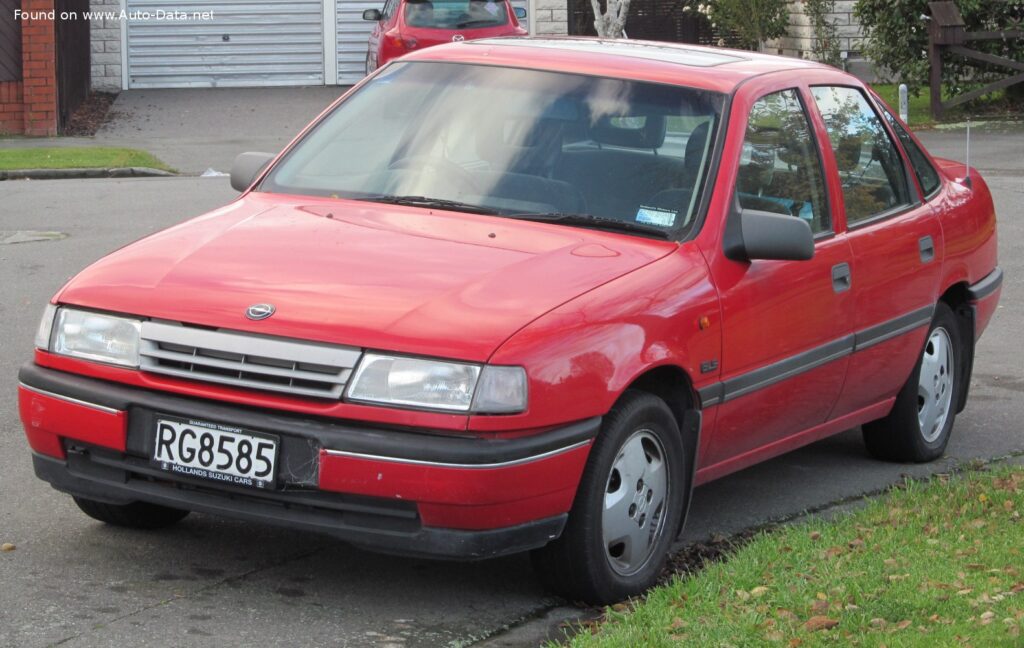
The Opel Vectra A 1.8i CAT (90 Hp): A European Workhorse of the Early 1990s
The Opel Vectra A 1.8i CAT (90 Hp) represents a significant chapter in European automotive history, serving as Opel’s answer to the burgeoning mid-size family car segment in the late 1980s and early 1990s. As the successor to the venerable Opel Ascona, the first-generation Vectra A, introduced in 1988, quickly established itself as a cornerstone of the German automaker’s lineup. While never officially sold in the United States under the Opel badge, the Vectra A was a pervasive sight across Europe, and its influence extended globally through various General Motors (GM) platforms and rebadged variants, such as the Vauxhall Cavalier in the United Kingdom.
This particular variant, the 1.8i CAT (90 Hp) sedan, produced between 1990 and 1992, was a quintessential example of practical, economical, and family-oriented transportation tailored for the European market. It perfectly balanced affordability with modern features for its era, including the crucial addition of a catalytic converter (“CAT”) to meet increasingly stringent emissions standards. The Vectra A’s design, engineering, and market positioning made it a formidable competitor in a highly contested segment, embodying the pragmatic spirit of early 1990s European motoring.
Engine and Performance of the Opel Vectra A 1.8i CAT (90 Hp)
Under the hood, the Opel Vectra A 1.8i CAT (90 Hp) was powered by a robust and reliable 1.8-liter (1796 cm3 or 109.6 cu. in.) inline four-cylinder engine, designated with the code C18NZ. This naturally aspirated powerplant featured an Overhead Camshaft (OHC) valvetrain with two valves per cylinder, a common and proven configuration for efficiency and durability in its time. Fuel delivery was managed by a single-point injection system, a step up from carburetors and a precursor to more advanced multi-point systems, offering improved fuel economy and reduced emissions, especially when combined with the catalytic converter.
The engine produced a respectable 90 horsepower at 5400 rpm and 106.95 lb.-ft. of torque at a relatively low 3000 rpm. This torque characteristic meant the Vectra offered decent pulling power for everyday driving, making it comfortable in urban traffic and capable on highways. Power was sent to the front wheels via a smooth-shifting 5-speed manual transmission, a standard setup for a car in this class and era, prioritizing driver engagement and fuel efficiency.
Performance figures for the 1.8i CAT were adequate for its segment: acceleration from 0 to 60 mph was achieved in a calculated 11.9 seconds, and the top speed reached 113.71 mph (183 km/h). While not a performance car, these numbers underscored its capability as a competent family sedan. Fuel economy was a strong suit, with a combined rating of 33.1 US mpg (7.1 l/100 km), reflecting Opel’s focus on practicality and low running costs. The weight-to-power ratio of 12.3 kg/Hp (81.2 Hp/tonne) further highlighted its balanced approach to performance and efficiency.
Design and Features: Practicality Meets Aerodynamics
The design of the Opel Vectra A, particularly the 4-door sedan variant, was a hallmark of late 1980s and early 1990s automotive aesthetics. Its clean, aerodynamic lines were a significant departure from the more angular designs of the preceding Ascona. With a drag coefficient (Cd) of just 0.29, the Vectra A was remarkably slippery for its time, contributing to its fuel efficiency and reduced wind noise at higher speeds. Its dimensions – 174.49 inches in length, 67.17 inches in width, and 55.12 inches in height, with a 102.36-inch wheelbase – placed it squarely in the mid-size segment, offering ample interior space for five occupants.
Inside, the Vectra A prioritized functionality and comfort. The 5-seat cabin was designed for long-distance comfort, typical of European family cars. The trunk space was particularly generous, ranging from a minimum of 18.72 cu. ft. (530 liters) to a maximum of 29.66 cu. ft. (840 liters) with the rear seats folded, making it highly practical for families and their luggage. The 61-liter (16.11 US gallon) fuel tank provided a substantial cruising range, further cementing its role as a capable tourer.
In terms of chassis and safety, the Vectra A featured a conventional but effective setup. The front suspension utilized wishbones, while the rear employed coil springs, providing a comfortable and predictable ride. Braking duties were handled by ventilated discs at the front and drum brakes at the rear, a common configuration that was enhanced by the availability of an Anti-lock Braking System (ABS) as an assisting system – a notable safety feature for a mainstream family car of its era. Steering was a hydraulic power-assisted rack and pinion system, offering ease of maneuverability. The car rode on 175/70 R14 tires, fitted to 14-inch wheel rims, providing a good balance of grip, comfort, and cost-effectiveness.
Technical Specifications: Opel Vectra A 1.8i CAT (90 Hp)
| Category | Specification |
|---|---|
General Information |
|
| Brand | Opel |
| Model | Vectra |
| Generation | Vectra A |
| Type (Engine) | 1.8i CAT (90 Hp) |
| Start of Production | 1990 year |
| End of Production | 1992 year |
| Powertrain Architecture | Internal Combustion Engine |
| Body Type | Sedan |
| Seats | 5 |
| Doors | 4 |
Performance Specifications |
|
| Fuel Consumption (Urban) | 10.2 l/100 km (23.1 US mpg) |
| Fuel Consumption (Extra Urban) | 5.5 l/100 km (42.8 US mpg) |
| Fuel Consumption (Combined) | 7.1 l/100 km (33.1 US mpg) |
| Fuel Type | Petrol (Gasoline) |
| Acceleration 0-60 mph | 11.9 seconds |
| Maximum Speed | 113.71 mph (183 km/h) |
| Weight-to-Power Ratio | 12.3 kg/Hp (81.2 Hp/tonne) |
| Weight-to-Torque Ratio | 7.6 kg/Nm (130.7 Nm/tonne) |
Engine Specifications |
|
| Power | 90 Hp @ 5400 rpm |
| Power per Liter | 50.1 Hp/l |
| Torque | 145 Nm (106.95 lb.-ft.) @ 3000 rpm |
| Engine Layout | Front, Transverse |
| Engine Model/Code | C18NZ |
| Engine Displacement | 1796 cm3 (1.8 liters / 109.6 cu. in.) |
| Number of Cylinders | 4 |
| Engine Configuration | Inline |
| Cylinder Bore | 84.8 mm (3.34 in.) |
| Piston Stroke | 79.5 mm (3.13 in.) |
| Compression Ratio | 9.2:1 |
| Number of Valves per Cylinder | 2 |
| Fuel Injection System | Single-point injection |
| Engine Aspiration | Naturally aspirated |
| Valvetrain | OHC |
| Engine Oil Capacity | 4 liters (4.23 US qt) |
| Coolant Capacity | 7.2 liters (7.61 US qt) |
Space, Volume, and Weights |
|
| Kerb Weight | 1109 kg (2444.93 lbs.) |
| Max. Weight | 1630 kg (3593.53 lbs.) |
| Max Load | 521 kg (1148.61 lbs.) |
| Trunk (boot) Space – Minimum | 530 liters (18.72 cu. ft.) |
| Trunk (boot) Space – Maximum | 840 liters (29.66 cu. ft.) |
| Fuel Tank Capacity | 61 liters (16.11 US gal) |
Dimensions |
|
| Length | 4432 mm (174.49 in.) |
| Width | 1706 mm (67.17 in.) |
| Height | 1400 mm (55.12 in.) |
| Wheelbase | 2600 mm (102.36 in.) |
| Front Track | 1420 mm (55.91 in.) |
| Rear (Back) Track | 1423 mm (56.02 in.) |
| Drag Coefficient (Cd) | 0.29 |
Drivetrain, Brakes, and Suspension |
|
| Drivetrain Architecture | Front-wheel drive (ICE drives front wheels) |
| Drive Wheel | Front wheel drive |
| Number of Gears and Type of Gearbox | 5 gears, manual transmission |
| Front Suspension | Wishbone |
| Rear Suspension | Coil spring |
| Front Brakes | Ventilated discs |
| Rear Brakes | Drum |
| Assisting Systems | ABS (Anti-lock braking system) |
| Steering Type | Steering rack and pinion |
| Power Steering | Hydraulic Steering |
| Tires Size | 175/70 R14 |
| Wheel Rims Size | 14 inches |
Legacy and Market Impact
The Opel Vectra A, and particularly the 1.8i CAT (90 Hp) variant, left a significant mark on the European automotive landscape. As a direct successor to the highly successful Opel Ascona, the Vectra A had big shoes to fill, and it largely succeeded. Its market impact was substantial, quickly becoming a best-seller in many European countries, including Germany and the United Kingdom (where it was badged as the Vauxhall Cavalier Mk3). The car’s reputation for reliability, spaciousness, and economical operation made it a favorite among families and fleet buyers alike.
In its primary market, the Vectra A competed fiercely with established rivals such as the Ford Sierra (later replaced by the Mondeo), the Volkswagen Passat, the Renault 21, and the Peugeot 405. What set the Vectra A apart was its combination of modern, aerodynamic styling, practical interior packaging, and a range of efficient engines, of which the 1.8i CAT was a popular choice for its balance of power and economy. The inclusion of a catalytic converter, indicated by “CAT” in its name, was also a crucial step in its environmental compliance, reflecting the growing awareness and regulation of vehicle emissions in Europe during the early 1990s. This feature was instrumental in making the car eligible for sale in regions with stricter emissions laws.
The Vectra A’s mechanical impact was also notable. It utilized GM’s new GM2900 platform, which was designed for front-wheel-drive applications and would go on to underpin other significant models, including the Opel Calibra coupe. This platform demonstrated GM Europe’s engineering prowess and commitment to developing modern, adaptable architectures. Although the Vectra A itself was not sold in the US, its underlying platform and design philosophies influenced later GM models globally, showcasing a cross-pollination of engineering expertise within the vast General Motors empire.
Today, the Opel Vectra A 1.8i CAT (90 Hp) is remembered as a sturdy, no-nonsense family car that delivered exactly what its target audience demanded. It represents a period of significant transition in automotive design and technology, bridging the gap between the more utilitarian vehicles of the 1980s and the increasingly sophisticated cars of the mid-1990s. Its enduring presence on European roads for many years after its production ceased is a testament to its robust construction and practical appeal, solidifying its place as a classic European workhorse.
