
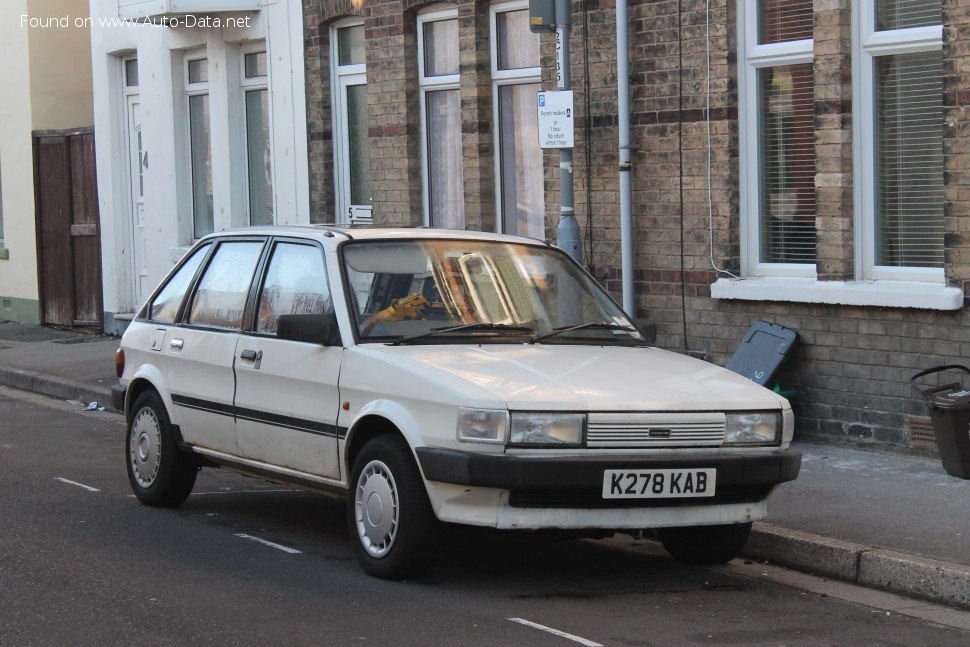
The Rover Maestro 1.6 (86 Hp): A British Family Car Icon
The Rover Maestro 1.6 (86 Hp) represents a significant, albeit often challenging, chapter in British automotive history. Launched in 1983, the Maestro was Austin Rover Group’s crucial entry into the highly competitive European C-segment, designed to replace the aging Austin Allegro and Morris Marina. Positioned as a practical and modern family hatchback, the Maestro aimed to compete directly with established rivals such as the Volkswagen Golf, Ford Escort, and Vauxhall Astra. This particular variant, equipped with the 1.6-liter engine producing 86 horsepower, was a popular choice in its home market, offering a balance of performance and economy for the average family. Its production spanned a remarkable 14 years, from 1983 to 1997, a testament to its initial design principles and the economic pressures faced by its manufacturer, but also highlighting its eventual struggle to keep pace with rapidly evolving automotive technology.
Engineering and Performance of the Rover Maestro
Powertrain and Dynamics
At the heart of the Rover Maestro 1.6 (86 Hp) was a 1,598 cm³ (97.52 cu. in.) inline four-cylinder engine, internally designated as the ‘S-Series’. This unit was a development of the earlier R-series engine, itself derived from the venerable A-Series engine, albeit significantly modernized. The engine featured a front, transverse layout, driving the front wheels, a configuration that had become standard for compact family cars by the early 1980s. With two valves per cylinder and a compression ratio of 9.7:1, the engine relied on a carburettor for fuel delivery, a common technology at the time but one that would soon be superseded by electronic fuel injection. This naturally aspirated engine produced a respectable 86 horsepower at 5600 rpm and 97.36 lb.-ft. of torque at 3500 rpm.
Power was transmitted to the front wheels via a 5-speed manual transmission, offering a balance between acceleration and highway cruising efficiency. The Maestro 1.6 (86 Hp) could accelerate from 0 to 60 mph in a brisk 10 seconds, with a top speed of 103.77 mph. These figures were competitive for its class at launch, providing adequate performance for typical family use and motorway travel.
Fuel Economy and Efficiency
In terms of fuel consumption, the Rover Maestro 1.6 (86 Hp) delivered figures that were considered reasonable for its era. The combined fuel economy was rated at 32.2 US mpg (7.3 l/100 km). In urban driving, it achieved approximately 26.4 US mpg (8.9 l/100 km), while extra-urban (highway) driving saw consumption improve to 44.4 US mpg (5.3 l/100 km). With a 13.21 US gallon (50 l) fuel tank, the Maestro offered a decent cruising range for its market segment. The vehicle’s relatively low curb weight of 2149.51 lbs (975 kg) contributed to its efficiency and nimble handling characteristics.
Design and Features of the Rover Maestro
Body and Interior
The Rover Maestro was designed as a practical 5-door hatchback, a body style that dominated the European compact segment. Its exterior dimensions – 157.48 inches in length, 66.54 inches in width, and 56.3 inches in height – placed it firmly in the compact class, making it maneuverable in city traffic while offering a reasonably spacious interior. The wheelbase measured 98.82 inches, contributing to a stable ride and generous cabin room for up to five occupants.
Inside, the Maestro prioritized practicality and user-friendliness. The design was clean and functional, with a focus on maximizing passenger and cargo space. The trunk offered a minimum capacity of 10.59 cu. ft. (300 l), which could be expanded significantly to 38.49 cu. ft. (1090 l) by folding down the rear seats, providing excellent versatility for a family car. Early models were notable for their optional voice synthesizer and digital dashboard, features that were considered highly advanced and futuristic for a mainstream car in the early 1980s, showcasing Austin Rover’s ambition for the model.
Chassis and Safety
The Maestro featured a conventional but effective chassis setup for its time. It utilized coil springs for both front and rear suspension, providing a comfortable ride quality suitable for varied road conditions. Braking was handled by disc brakes at the front and drum brakes at the rear, a common configuration that offered adequate stopping power. Later in its production run, the Maestro could be equipped with an Anti-lock Braking System (ABS), a significant safety enhancement for a car of its class during the late 1980s and early 1990s. Steering was a rack and pinion system, complemented by hydraulic power steering, making the car easy to maneuver at low speeds and stable at higher velocities. The standard tire size for this variant was 185/55 R15 86 H, providing a good balance of grip and ride comfort.
Technical Specifications: Rover Maestro 1.6 (86 Hp)
| Specification | Value |
|---|---|
| Brand | Rover |
| Model | Maestro |
| Generation | Maestro |
| Type (Engine) | 1.6 (86 Hp) |
| Production Start | 1983 |
| Production End | 1997 |
| Body Type | Hatchback |
| Seats | 5 |
| Doors | 5 |
| Fuel Type | Petrol (Gasoline) |
| Engine Layout | Front, Transverse |
| Engine Model/Code | 16H |
| Engine Displacement | 1598 cm³ (97.52 cu. in.) |
| Number of Cylinders | 4, Inline |
| Valves per Cylinder | 2 |
| Cylinder Bore | 76.2 mm (3 in.) |
| Piston Stroke | 87.6 mm (3.45 in.) |
| Compression Ratio | 9.7:1 |
| Fuel Injection System | Carburettor |
| Engine Aspiration | Naturally Aspirated |
| Power | 86 Hp @ 5600 rpm |
| Power per Liter | 53.8 Hp/l |
| Torque | 132 Nm (97.36 lb.-ft.) @ 3500 rpm |
| Acceleration 0-60 mph | 10 seconds |
| Maximum Speed | 167 km/h (103.77 mph) |
| Fuel Consumption (Urban) | 8.9 l/100 km (26.4 US mpg) |
| Fuel Consumption (Extra Urban) | 5.3 l/100 km (44.4 US mpg) |
| Fuel Consumption (Combined) | 7.3 l/100 km (32.2 US mpg) |
| Fuel Tank Capacity | 50 l (13.21 US gal) |
| Drivetrain Architecture | Front-wheel drive |
| Number of Gears | 5, Manual Transmission |
| Front Suspension | Coil spring |
| Rear Suspension | Coil spring |
| Front Brakes | Disc |
| Rear Brakes | Drum |
| Assisting Systems | ABS (Anti-lock braking system) |
| Steering Type | Rack and Pinion |
| Power Steering | Hydraulic Steering |
| Tires Size | 185/55 R15 86 H |
| Curb Weight | 975 kg (2149.51 lbs) |
| Maximum Weight | 1440 kg (3174.66 lbs) |
| Maximum Load | 465 kg (1025.15 lbs) |
| Trunk Space (Min/Max) | 300 l (10.59 cu. ft.) / 1090 l (38.49 cu. ft.) |
| Length | 4000 mm (157.48 in.) |
| Width | 1690 mm (66.54 in.) |
| Height | 1430 mm (56.3 in.) |
| Wheelbase | 2510 mm (98.82 in.) |
| Front Track | 1465 mm (57.68 in.) |
| Rear Track | 1440 mm (56.69 in.) |
| Weight-to-Power Ratio | 11.3 kg/Hp (88.2 Hp/tonne) |
| Weight-to-Torque Ratio | 7.4 kg/Nm (135.4 Nm/tonne) |
| Engine Oil Capacity | 3.1 l (3.28 US qt) |
| Coolant Capacity | 8.2 l (8.66 US qt) |
Legacy and Market Impact of the Rover Maestro
The Rover Maestro entered the market with high hopes, intended to revitalize Austin Rover and compete fiercely in the critical European C-segment. Its initial reception was generally positive, praised for its spacious interior, comfortable ride, and relatively modern styling compared to its predecessors. The 1.6-liter variant, in particular, offered a good blend of everyday usability and cost-effectiveness, making it a popular choice for families and fleet buyers in the United Kingdom and parts of Europe.
However, the Maestro’s legacy is a mixed one, largely shaped by the tumultuous period of British Leyland/Austin Rover Group’s history. While mechanically sound in many respects, early models suffered from well-documented build quality issues, including problems with trim fitment, electrical glitches, and overall reliability. These issues, combined with aggressive competition from rivals like the Volkswagen Golf Mk2, Ford Escort Mk3/4, and Vauxhall Astra Mk2 (Opel Kadett E), quickly eroded public confidence. These competitors often boasted superior fit and finish, more refined engines (especially with the advent of fuel injection), and more contemporary designs.
Despite these challenges, the Maestro’s long production run, stretching until 1997, highlights its enduring role in the British automotive landscape. It underwent several facelifts and technical updates throughout its life, including the introduction of fuel-injected engines, diesel variants, and sportier MG Maestro models, but it ultimately struggled to keep pace with the rapid technological advancements seen in the automotive industry. Its carbureted 1.6-liter engine, while robust, became increasingly outdated as multi-point fuel injection became the norm across its segment.
The Rover Maestro represents an important transitional vehicle for the British automotive industry. It was one of the last truly mass-produced British family cars before the industry became dominated by foreign ownership and global platforms. It served as a workhorse for many British families and businesses, and despite its flaws, it remains a recognizable part of British motoring heritage. While never sold in the United States, its journey reflects the broader struggles and attempts at modernization within the European automotive sector during the late 20th century. The Maestro’s story is a poignant reminder of the challenges faced by national car manufacturers in an increasingly globalized and competitive market.
