The Renault Espace V 2.0 Blue dCi (200 Hp) EDC 7 Seat: A European Crossover-Minivan Evolution
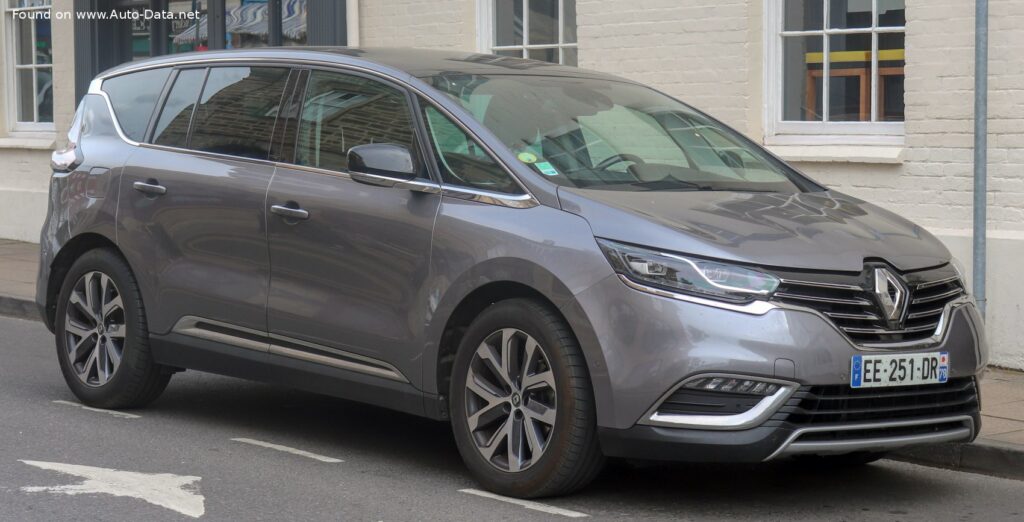
The fifth generation of the Renault Espace, produced from 2018 to 2019, represents a significant evolution for a nameplate synonymous with the European minivan segment. Breaking away from its traditional multi-purpose vehicle (MPV) roots, the Renault Espace V 2.0 Blue dCi (200 Hp) EDC 7 Seat adopted a more crossover-inspired design, blending the practicality of a people carrier with the stylistic cues of an SUV. This strategic shift aimed to appeal to a broader audience in a market increasingly dominated by crossovers, while still offering the spaciousness and versatility expected from an Espace. Primarily targeting families and business users across Europe and select Asian markets, this iteration of the Espace provided a sophisticated, comfortable, and efficient solution for seven passengers, powered by a robust and eco-conscious diesel engine.
While the Renault Espace has been a staple of European roads for decades, it was never officially sold in the United States. Its role in its primary markets, however, was pivotal – pioneering the MPV segment and later adapting to changing consumer preferences by embracing a more dynamic, SUV-like silhouette. This specific variant, featuring the 2.0 Blue dCi engine with 200 horsepower and an EDC automatic transmission, stood out for its blend of performance, fuel economy, and advanced features, positioning it as a premium offering in the competitive European family vehicle segment.
Engine and Performance: Powering the Renault Espace V
Under the hood, the Renault Espace V 2.0 Blue dCi (200 Hp) EDC 7 Seat is equipped with Renault’s M9R engine, a sophisticated 2.0-liter (121.86 cubic inch) inline four-cylinder diesel unit. This powertrain delivers a potent 200 horsepower at 4000 rpm, translating to a robust 100.2 horsepower per liter. More impressively for a family hauler, it generates a substantial 295.02 lb.-ft. of torque at a low 1750 rpm. This ample torque ensures strong acceleration and effortless cruising, even when the vehicle is fully loaded with passengers and cargo.
The engine’s architecture features a front, transverse layout, driving the front wheels. It incorporates a turbocharger and intercooler, enhancing both power output and efficiency. The common rail fuel injection system, combined with a particulate filter, ensures compliance with strict Euro 6d-TEMP emission standards, making it an environmentally responsible choice for its time. The engine oil capacity stands at 8.03 US quarts, indicating a well-engineered system designed for durability.
Mated to this powerful diesel engine is a 6-speed EDC (Efficient Dual Clutch) automatic transmission. This gearbox provides smooth, rapid shifts, contributing to both driving comfort and fuel efficiency. Performance figures for this variant are commendable: the Espace V can accelerate from 0 to 60 mph in a brisk 8.6 seconds, with a top speed reaching 133.59 mph. Despite its size and performance, the vehicle boasts impressive fuel economy, with a combined rating of 44.4 US mpg (5.3 l/100 km). Urban consumption is rated at 37.9 US mpg (6.2 l/100 km), while extra-urban driving yields an excellent 50 US mpg (4.7 l/100 km), highlighting the diesel engine’s inherent efficiency for long-distance travel. CO2 emissions are kept in check at 139 g/km.
Design and Features: A Blend of Practicality and Style
The fifth-generation Renault Espace marked a significant departure from its predecessors in terms of design. While still offering the inherent practicality of a minivan, its styling cues leaned heavily towards the burgeoning crossover segment. With its elevated ride height (6.3 inches ground clearance), muscular wheel arches, and distinctive front fascia, the Espace V presented a more dynamic and less utilitarian aesthetic. This “minivan, crossover” body type, with 5 doors and a 7-seat configuration, offered the best of both worlds for European families.
Measuring 191.22 inches in length, 74.33 inches in width (83.78 inches including mirrors), and 66.02 inches in height, the Espace V is a substantial vehicle, providing ample interior space. The generous 113.54-inch wheelbase is critical for maximizing passenger comfort across all three rows. The interior is designed with versatility in mind; the minimum trunk space of 8.72 cubic feet (247 liters) expands dramatically to a cavernous 71.87 cubic feet (2035 liters) with the rear seats folded, making it highly adaptable for various cargo needs. The maximum load capacity is a robust 1712.99 lbs (777 kg), underscoring its utility.
Standard features for a vehicle of this caliber in the European market would include advanced infotainment systems, premium materials, and a comprehensive suite of safety technologies. While specific interior trim details are not provided in the data, the Espace V was known for its refined cabin, comfortable seating, and innovative storage solutions. Safety is paramount, with standard features like ABS (Anti-lock Braking System) ensuring stable braking performance. The vehicle is equipped with ventilated discs at the front and disc brakes at the rear. Electric power steering and a rack and pinion steering type contribute to a responsive and easy-to-manage driving experience, further aided by a tight minimum turning circle of 36.42 feet. The 235/60 R18 tires on 18-inch wheels provide a good balance of grip, ride comfort, and aesthetic appeal.
Technical Specifications: Renault Espace V 2.0 Blue dCi (200 Hp) EDC 7 Seat
| Category | Specification | US Equivalent |
|---|---|---|
General Information |
||
| Brand | Renault | |
| Model | Espace | |
| Generation | Espace V | |
| Type (Engine) | 2.0 Blue dCi (200 Hp) EDC 7 Seat | |
| Production Start | 2018 year | |
| Production End | 2019 year | |
| Powertrain Architecture | Internal Combustion engine | |
| Body type | Minivan, Crossover | |
| Seats | 7 | |
| Doors | 5 | |
Performance Specifications |
||
| Fuel consumption (urban) | 6.2 l/100 km | 37.9 US mpg |
| Fuel consumption (extra urban) | 4.7 l/100 km | 50 US mpg |
| Fuel consumption (combined) | 5.3 l/100 km | 44.4 US mpg |
| CO2 emissions | 139 g/km | |
| Fuel Type | Diesel | |
| Acceleration 0 – 60 mph | 8.6 sec | |
| Maximum speed | 215 km/h | 133.59 mph |
| Emission standard | Euro 6d – TEMP | |
| Weight-to-power ratio | 8.8 kg/Hp | 19.4 lbs/Hp |
| Weight-to-torque ratio | 4.4 kg/Nm | 9.7 lbs/Nm |
Engine Specifications |
||
| Power | 200 Hp @ 4000 rpm | |
| Power per liter | 100.2 Hp/l | |
| Torque | 400 Nm @ 1750 rpm | 295.02 lb.-ft. @ 1750 rpm |
| Engine layout | Front, Transverse | |
| Engine Model/Code | M9R | |
| Engine displacement | 1997 cm3 | 121.86 cu. in. |
| Number of cylinders | 4 | |
| Engine configuration | Inline | |
| Number of valves per cylinder | 4 | |
| Fuel injection system | Diesel Commonrail | |
| Engine aspiration | Turbocharger, Intercooler | |
| Engine oil capacity | 7.6 l | 8.03 US qt |
| Engine systems | Particulate filter | |
Space, Volume and Weights |
||
| Kerb Weight | 1765 kg | 3891.16 lbs |
| Max. weight | 2542 kg | 5604.15 lbs |
| Max load | 777 kg | 1712.99 lbs |
| Trunk space – minimum | 247 l | 8.72 cu. ft. |
| Trunk space – maximum | 2035 l | 71.87 cu. ft. |
| Fuel tank capacity | 58 l | 15.32 US gal |
| AdBlue tank | 22 l | 5.81 US gal |
| Max. roof load | 80 kg | 176.37 lbs |
| Permitted trailer load with brakes (12%) | 2000 kg | 4409.25 lbs |
| Permitted trailer load without brakes | 750 kg | 1653.47 lbs |
Dimensions |
||
| Length | 4857 mm | 191.22 in. |
| Width | 1888 mm | 74.33 in. |
| Width with mirrors folded | 1914 mm | 75.35 in. |
| Width including mirrors | 2128 mm | 83.78 in. |
| Height | 1677 mm | 66.02 in. |
| Wheelbase | 2884 mm | 113.54 in. |
| Front track | 1630 mm | 64.17 in. |
| Rear (Back) track | 1621 mm | 63.82 in. |
| Front overhang | 1034 mm | 40.71 in. |
| Rear overhang | 939 mm | 36.97 in. |
| Ride height (ground clearance) | 160 mm | 6.3 in. |
| Minimum turning circle | 11.1 m | 36.42 ft. |
Drivetrain, Brakes and Suspension |
||
| Drivetrain Architecture | Internal combustion engine (ICE) drives the front wheels. | |
| Drive wheel | Front wheel drive | |
| Number of gears and type of gearbox | 6 gears, automatic transmission EDC | |
| Front brakes | Ventilated discs | |
| Rear brakes | Disc | |
| Assisting systems | ABS (Anti-lock braking system) | |
| Steering type | Steering rack and pinion | |
| Power steering | Electric Steering | |
| Tires size | 235/60 R18 | |
| Wheel rims size | 18 inches | |
Legacy and Market Impact in Europe
The Renault Espace holds a significant place in European automotive history, often credited with popularizing the minivan (or MPV) segment since its inception in 1984. The Espace V, and particularly the Renault Espace V 2.0 Blue dCi (200 Hp) EDC 7 Seat, represents a bold and necessary adaptation of this iconic nameplate to modern market dynamics. By transforming from a traditional boxy MPV into a sleeker, more stylish crossover-minivan, Renault aimed to capture the attention of buyers who were increasingly gravitating towards SUVs for their perceived style and versatility.
In its primary European market, the Espace V competed against a diverse array of family vehicles. Its rivals included traditional minivans like the Ford Galaxy and Volkswagen Sharan, as well as emerging crossover-MPV hybrids such as the Peugeot 5008 and Citroën C4 Grand Spacetourer. The Espace V carved out its niche by offering a premium feel, sophisticated design, and a strong emphasis on comfort and technology. The 2.0 Blue dCi engine, in particular, was lauded for its powerful yet refined performance and excellent fuel economy, making it an attractive option for long-distance family travel and business use, especially in countries where diesel remains a popular choice.
The Espace V’s reputation was built on its ability to combine practicality with a sense of style and dynamism previously unseen in the Espace line. Its flexible 7-seat interior, coupled with a commanding driving position and a comfortable ride, reinforced its appeal as a versatile family vehicle. The adoption of the EDC automatic transmission further enhanced its sophisticated driving experience, contributing to its premium positioning. While its production run was relatively short for this specific engine variant (2018-2019), it played a crucial role in bridging the gap between Renault’s MPV heritage and its future in the crossover-dominated landscape.
Ultimately, the Renault Espace V, especially this well-specified 2.0 Blue dCi variant, is remembered as a testament to Renault’s ability to innovate and adapt. It successfully reimagined a beloved family car for a new era, offering a compelling blend of design, performance, efficiency, and practicality that resonated with discerning European consumers seeking a sophisticated and capable vehicle for their multi-faceted lifestyles.