Volkswagen Polo III Variant 1.9 TDI (90 Hp): A European Workhorse
The Volkswagen Polo III Variant 1.9 TDI (90 Hp) represents a significant chapter in the history of compact European automobiles, specifically within the highly competitive supermini segment. Launched in 1994, the third generation of the Volkswagen Polo, internally designated as the Typ 6N, saw the introduction of a practical station wagon (estate) body style, known as the “Variant.” This model addressed the growing demand in European markets for a more versatile and family-friendly compact vehicle, offering increased cargo capacity without significantly compromising the Polo’s renowned agility and fuel efficiency. While the Polo itself has been a perennial best-seller across Europe and other global markets, the Variant, particularly with the robust and economical 1.9 TDI engine, carved out its own niche as a highly practical and cost-effective solution for small families and businesses. It was a vehicle designed and marketed primarily for European consumers and was not officially sold in the United States, making its impact largely confined to its primary markets.
The Polo III Variant showcased Volkswagen’s commitment to offering a broad range of body styles and powertrains, catering to diverse customer needs. The 1.9 TDI (90 Hp) variant, produced between 1994 and 2000, stood out due to its pioneering direct-injection turbodiesel technology, which at the time offered a compelling blend of low fuel consumption, strong torque delivery, and surprising performance for its class. This combination made it an ideal choice for long-distance commuting and utility, solidifying its reputation as a dependable and economical choice in a segment often dominated by gasoline engines.
Engine and Performance: The Heart of the Volkswagen Polo III Variant
At the core of the Volkswagen Polo III Variant 1.9 TDI (90 Hp) was Volkswagen’s venerable 1.9-liter Turbodiesel Direct Injection (TDI) engine. This inline four-cylinder powerplant, identified by engine codes AHU and ALE, was a testament to the German automaker’s leadership in diesel engine technology during the 1990s. With a displacement of 1896 cubic centimeters (115.7 cubic inches), it delivered a respectable 90 horsepower at 4000 revolutions per minute. More critically, it produced a substantial 202 Newton-meters (148.99 lb-ft) of torque at a low 1900 rpm. This characteristic torque curve was a hallmark of TDI engines, providing excellent low-end grunt that made the car feel more responsive in everyday driving, especially when carrying loads or navigating city traffic.
The engine featured an overhead camshaft (OHC) valvetrain with two valves per cylinder and utilized a direct injection fuel system, coupled with a turbocharger and intercooler. This forced induction system was crucial for extracting significant power and torque from a relatively small displacement while maintaining impressive fuel efficiency. The high compression ratio of 19.5:1 further optimized the combustion process for diesel fuel. Power was sent to the front wheels via a smooth-shifting 5-speed manual transmission, a common and reliable setup for compact cars of this era.
In terms of performance, the Polo III Variant 1.9 TDI (90 Hp) was no speed demon, but it was certainly capable. It could accelerate from 0 to 60 miles per hour in a calculated 11.4 seconds (0-100 km/h in 12 seconds) and reach a top speed of 109.36 mph (176 km/h). However, its true strength lay in its fuel economy. With an urban fuel consumption rating of 6.5 liters per 100 kilometers (approximately 36.2 US mpg) and an even more impressive extra-urban rating of 4.2 liters per 100 kilometers (approximately 56 US mpg), it was an exceptionally economical vehicle for its time. These figures highlighted the efficiency advantages of diesel engines, making the Polo Variant a popular choice for those prioritizing low running costs and extended range from its 11.89 US gallon fuel tank.
Design and Features: Practicality Meets Compact Dimensions
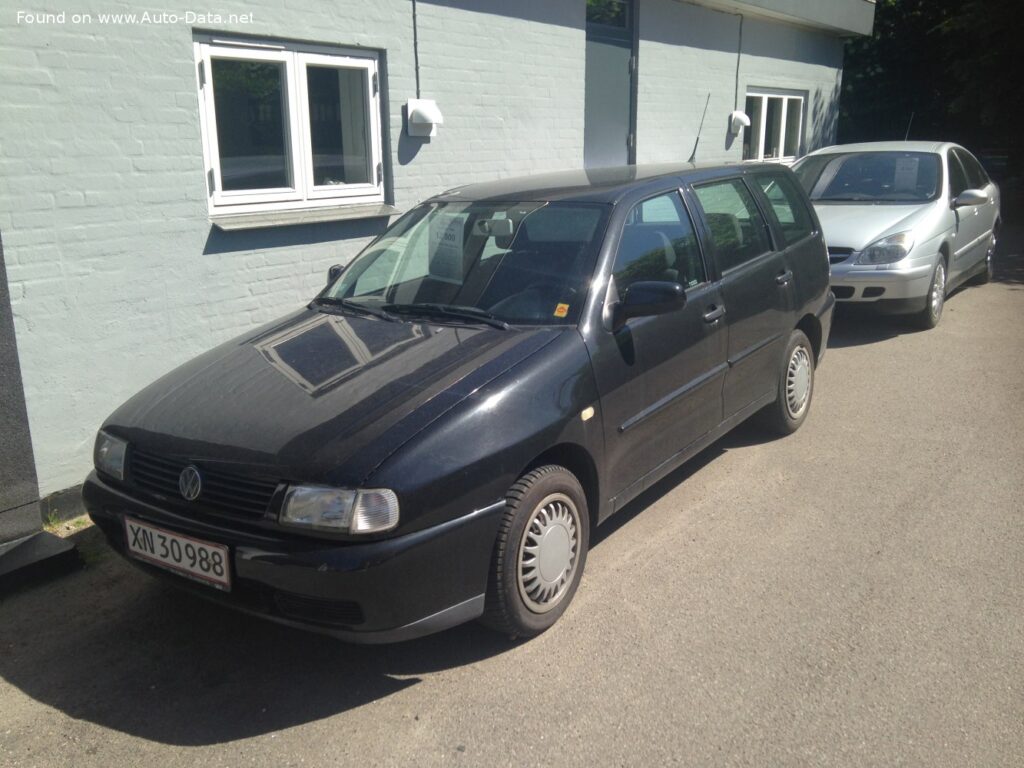
The Volkswagen Polo III Variant adopted a conventional yet functional station wagon design, extending the practicality of the standard Polo hatchback. Its five-door body style provided easy access for passengers and cargo, making it a versatile family vehicle or light commercial transport option. Measuring 162.87 inches in length, 64.57 inches in width, and 56.42 inches in height, the Variant maintained a relatively compact footprint, which was advantageous for navigating congested European city streets and tight parking spaces. The wheelbase of 96.22 inches contributed to a stable ride quality for a car in its class.
Despite its compact exterior dimensions, the Polo III Variant offered a surprisingly spacious interior. With seating for five occupants, it provided adequate room for a small family. The most significant advantage of the Variant body style was its cargo capacity. The trunk (boot) space ranged from a generous 13.77 cubic feet with all seats in place, expanding to an impressive 44.14 cubic feet when the rear seats were folded down. This flexibility allowed it to accommodate anything from weekly groceries to larger luggage or sports equipment, a key selling point for its target audience.
Standard features for the era included a hydraulic power steering system, making maneuvering effortless. For safety, the Polo III Variant 1.9 TDI was equipped with front ventilated disc brakes and rear drum brakes, complemented by an Anti-lock Braking System (ABS), a significant safety enhancement for the 1990s. The suspension setup, featuring coil springs at both the front and rear, aimed to strike a balance between ride comfort and handling stability. The vehicle rode on 185/60 R14 tires mounted on 14-inch wheel rims, a common specification for compact cars of that period. While not opulent, the interior was typically Volkswagen: well-built, ergonomic, and durable, designed to withstand years of daily use.
Technical Specifications
| Category | Specification |
|---|---|
| General Information | |
| Brand | Volkswagen |
| Model | Polo III Variant |
| Type (Engine) | 1.9 TDI (90 Hp) |
| Production Start | 1994 |
| Production End | 2000 |
| Body Type | Station Wagon (Estate) |
| Seats | 5 |
| Doors | 5 |
| Performance Specs | |
| Fuel Consumption (Urban) | 6.5 l/100 km (36.2 US mpg) |
| Fuel Consumption (Extra Urban) | 4.2 l/100 km (56 US mpg) |
| Fuel Type | Diesel |
| Acceleration 0-60 mph | 11.4 sec |
| Acceleration 0-100 km/h | 12 sec |
| Maximum Speed | 176 km/h (109.36 mph) |
| Weight-to-Power Ratio | 13 kg/Hp (76.9 Hp/tonne) |
| Weight-to-Torque Ratio | 5.8 kg/Nm (172.6 Nm/tonne) |
| Engine Specs | |
| Power | 90 Hp @ 4000 rpm |
| Power per Liter | 47.5 Hp/l |
| Torque | 202 Nm (148.99 lb-ft) @ 1900 rpm |
| Engine Layout | Front, Longitudinal |
| Engine Model/Code | AHU, ALE |
| Engine Displacement | 1896 cm3 (1.9 liters / 115.7 cu. in.) |
| Number of Cylinders | 4 |
| Engine Configuration | Inline |
| Cylinder Bore | 79.5 mm (3.13 in.) |
| Piston Stroke | 95.5 mm (3.76 in.) |
| Compression Ratio | 19.5:1 |
| Valves per Cylinder | 2 |
| Fuel Injection System | Direct injection |
| Engine Aspiration | Turbocharger, Intercooler |
| Valvetrain | OHC |
| Engine Oil Capacity | 4.3 l (4.54 US qt) |
| Coolant Capacity | 6 l (6.34 US qt) |
| Space, Volume and Weights | |
| Kerb Weight | 1170 kg (2579.41 lbs) |
| Max. Weight | 1630 kg (3593.53 lbs) |
| Max Load | 460 kg (1014.13 lbs) |
| Trunk Space (Min) | 390 l (13.77 cu. ft.) |
| Trunk Space (Max) | 1250 l (44.14 cu. ft.) |
| Fuel Tank Capacity | 45 l (11.89 US gal) |
| Dimensions | |
| Length | 4137 mm (162.87 in.) |
| Width | 1640 mm (64.57 in.) |
| Height | 1433 mm (56.42 in.) |
| Wheelbase | 2444 mm (96.22 in.) |
| Front Track | 1429 mm (56.26 in.) |
| Rear Track | 1384 mm (54.49 in.) |
| Drivetrain, Brakes and Suspension | |
| Drivetrain Architecture | Front-wheel drive, Internal Combustion Engine |
| Drive Wheel | Front-wheel drive |
| Gearbox | 5 gears, Manual transmission |
| Front Suspension | Coil spring |
| Rear Suspension | Coil spring |
| Front Brakes | Ventilated discs |
| Rear Brakes | Drum |
| Assisting Systems | ABS (Anti-lock braking system) |
| Steering Type | Steering rack and pinion |
| Power Steering | Hydraulic Steering |
| Tires Size | 185/60 R14 |
| Wheel Rims Size | 14 inch |
Legacy and Market Impact
The Volkswagen Polo III Variant 1.9 TDI (90 Hp) left a notable legacy, particularly in the European compact car segment during the late 1990s. Its primary market impact stemmed from its ability to offer the practicality of a small station wagon combined with the exceptional fuel efficiency and robust torque of Volkswagen’s then-pioneering TDI diesel engine technology. In an era when diesel engines were rapidly gaining popularity in Europe due to their lower running costs and improved refinement, the Polo Variant 1.9 TDI stood out as a smart, economical choice.
Competitors in its region included models like the Opel Corsa B Caravan (Vauxhall Corsa Estate in the UK), Ford Escort/Focus Turnier, and potentially even smaller versions of the Skoda Octavia Combi, which, while slightly larger, competed for budget-conscious buyers seeking practicality. The Polo Variant distinguished itself with Volkswagen’s reputation for build quality, a more sophisticated diesel engine than many rivals, and a driving experience that was typically solid and predictable.
Historically, the Polo III Variant, particularly with the 1.9 TDI engine, is significant for several reasons. It demonstrated Volkswagen’s strategy of diversifying its popular supermini platform into more utilitarian forms, appealing to a broader demographic than just urban dwellers. The 1.9 TDI engine itself became legendary for its durability, fuel economy, and strong aftermarket support, contributing to its enduring popularity. Many examples of this engine are still on the road today, a testament to its robust engineering.
While never officially crossing the Atlantic to the American market, the Polo III Variant 1.9 TDI (90 Hp) played a crucial role in shaping European automotive preferences. It solidified the idea that a compact car could also be a genuinely practical family vehicle, offering a compelling alternative to larger, less efficient sedans or hatchbacks. Its blend of modest dimensions, impressive cargo capacity, and groundbreaking diesel efficiency made it a beloved workhorse for countless European families and businesses, securing its place as an important, albeit regionally focused, milestone in Volkswagen’s storied history.