The Toyota RAV4 V 2.0 (149 Hp) AWD CVT: A Deep Dive into Toyota’s Global Compact SUV
The Toyota RAV4, an acronym for “Recreational Activity Vehicle: 4-wheel drive,” pioneered the compact SUV segment when it debuted in 1994. Over successive generations, it has evolved from a niche, car-like SUV to a mainstream global bestseller, consistently ranking among the top-selling vehicles worldwide. The fifth generation, known internally as the XA50 series, launched in 2018, marking a significant departure in design and engineering. This article focuses on a specific variant from this generation, the Toyota RAV4 V 2.0 (149 Hp) AWD CVT, produced between November 2019 and September 2021, and primarily positioned for markets outside of North America, where its smaller displacement engine and Euro 5 emission standard are particularly relevant.
Built on Toyota’s New Global Architecture (TNGA-K) platform, the fifth-generation RAV4 promised enhanced driving dynamics, improved safety, and a more robust, adventurous styling. While the North American market predominantly received a more potent 2.5-liter engine, this 2.0-liter variant catered to regions where fuel efficiency, lower emissions, and sometimes vehicle taxation favor smaller engine displacements. Despite its market-specific powertrain, the Toyota RAV4 V variant retains the core attributes of its generation: a spacious five-seat interior, a versatile all-wheel-drive system, and Toyota’s renowned reputation for reliability.
Engine and Performance of the Toyota RAV4 V
Powering this specific Toyota RAV4 V model is Toyota’s M20A-FKS engine, a naturally aspirated 2.0-liter (1987 cm³ or 121.25 cu. in.) inline four-cylinder unit. This engine is a testament to modern internal combustion engineering, featuring a high compression ratio of 13:1 and a sophisticated DOHC (Dual Overhead Camshaft) valvetrain with 4 valves per cylinder. It employs a dual fuel injection system, combining direct injection for optimal power and efficiency under heavy load with multi-port manifold injection for smoother operation and reduced emissions during lighter loads.
The M20A-FKS engine delivers a respectable 149 horsepower at 6600 rpm, which translates to 75 horsepower per liter of displacement. Torque output peaks at 206 Nm (151.94 lb.-ft.) across a broad range from 4400 to 4900 rpm, ensuring responsive acceleration and ample power for daily driving scenarios. Mated to an automatic Continuously Variable Transmission (CVT), the powertrain is optimized for smooth power delivery and fuel efficiency. The all-wheel-drive (AWD) system provides enhanced traction and stability, making the RAV4 V capable of handling diverse road conditions, from city streets to light off-road trails.
In terms of performance, the Toyota RAV4 V 2.0 (149 Hp) AWD CVT accelerates from 0 to 60 mph in an estimated 10.5 seconds, while its top speed reaches 118.06 mph. These figures position it as a competent, rather than sporty, performer within its segment, prioritizing practicality and economy. Fuel efficiency is a strong suit for this variant, with a combined consumption rating of 6.6 liters per 100 km, which equates to an impressive 35.6 US mpg. Urban driving yields approximately 29.4 US mpg, while highway cruising can achieve up to 40.6 US mpg. With CO2 emissions rated at 151 g/km and compliance with Euro 5 emission standards, this RAV4 variant highlights Toyota’s commitment to environmental responsibility in its global offerings.
Design and Features
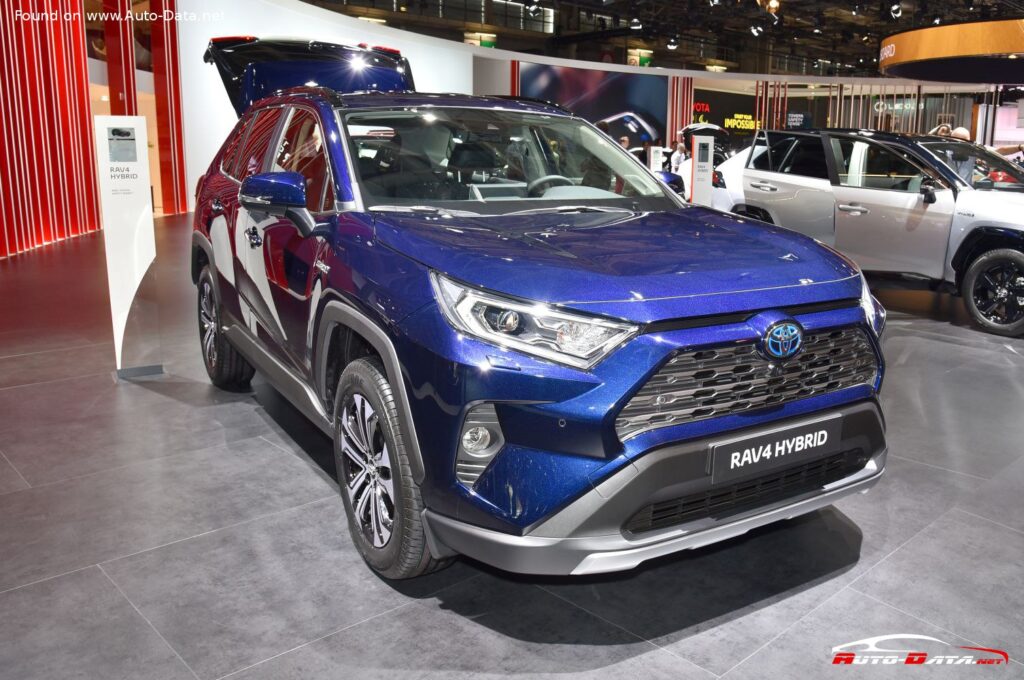
The fifth-generation Toyota RAV4 V sports a significantly more rugged and angular design compared to its predecessors, reflecting a shift towards a more “adventure-ready” aesthetic. Its exterior features sharp lines, pronounced wheel arches, and a bold front grille, giving it a commanding presence. With a length of 181.1 inches, a width of 73.03 inches, and a height of 66.34 inches, it comfortably fits within the compact SUV category, offering a balance of maneuverability and interior space. The 105.91-inch wheelbase contributes to a stable ride and generous cabin room.
Inside, the RAV4 V offers a comfortable and practical environment for five occupants. The cabin is designed with user-friendliness in mind, featuring intuitive controls and quality materials. While specific trim levels and infotainment details are not provided in the technical data, a 2019-2021 model would typically include a modern touchscreen infotainment system, smartphone integration, and a host of convenience features. The rear cargo area is particularly spacious, offering a minimum trunk volume of 580 liters (20.48 cu. ft.), which can be expanded by folding down the rear seats, making it highly versatile for hauling luggage, groceries, or sports equipment.
Safety and driving dynamics are paramount in the Toyota RAV4 V. It comes equipped with an independent McPherson strut front suspension with a coil spring and anti-roll bar, complemented by an independent coil spring rear suspension. This setup ensures a comfortable ride and competent handling. Braking is handled by ventilated discs at the front and solid discs at the rear, supported by an Anti-lock Braking System (ABS) for enhanced stopping power and control. The electric power steering system provides precise and effortless maneuverability, contributing to a refined driving experience. With a ground clearance of 7.68 inches, the RAV4 V is well-suited for navigating varied terrains, from urban obstacles to unpaved roads.
Technical Specifications
| Category | Specification |
|---|---|
General Information |
|
| Brand | Toyota |
| Model | RAV4 |
| Generation | RAV4 V |
| Type (Engine) | 2.0 (149 Hp) AWD CVT |
| Production Start | November, 2019 |
| Production End | September, 2021 |
| Powertrain Architecture | Internal Combustion Engine |
| Body type | SUV |
| Seats | 5 |
| Doors | 5 |
Performance Specs |
|
| Fuel Consumption (Urban) | 29.4 US mpg (8 l/100 km) |
| Fuel Consumption (Extra Urban) | 40.6 US mpg (5.8 l/100 km) |
| Fuel Consumption (Combined) | 35.6 US mpg (6.6 l/100 km) |
| CO2 Emissions | 151 g/km |
| Fuel Type | Petrol (Gasoline) |
| Acceleration 0 – 60 mph | 10.5 sec |
| Maximum Speed | 118.06 mph (190 km/h) |
| Emission Standard | Euro 5 |
| Weight-to-Power Ratio | 11.2 kg/Hp (89 Hp/tonne) |
| Weight-to-Torque Ratio | 8.1 kg/Nm (123 Nm/tonne) |
Engine Specs |
|
| Power | 149 Hp @ 6600 rpm |
| Power per Liter | 75 Hp/l |
| Torque | 151.94 lb.-ft. @ 4400-4900 rpm (206 Nm) |
| Engine Layout | Front, Transverse |
| Engine Model/Code | M20A-FKS |
| Engine Displacement | 2.0 l (1987 cm³ / 121.25 cu. in.) |
| Number of Cylinders | 4 |
| Engine Configuration | Inline |
| Cylinder Bore | 3.17 in (80.5 mm) |
| Piston Stroke | 3.84 in (97.6 mm) |
| Compression Ratio | 13:1 |
| Valves per Cylinder | 4 |
| Fuel Injection System | Direct injection and Multi-port manifold injection |
| Engine Aspiration | Naturally aspirated engine |
| Valvetrain | DOHC |
| Engine Oil Capacity | 4.54 US qt (4.3 l) |
| Coolant Capacity | 7.29 US qt (6.9 l) |
| Engine Systems | Particulate filter |
Space, Volume and Weights |
|
| Kerb Weight | 3692.74 – 3703.77 lbs. (1675-1680 kg) |
| Max. Weight | 4673.8 lbs. (2120 kg) |
| Max Load | 970.03 – 981.06 lbs. (440-445 kg) |
| Trunk (boot) Space – Minimum | 20.48 cu. ft. (580 l) |
| Fuel Tank Capacity | 14.53 US gal (55 l) |
| Permitted Trailer Load with Brakes (12%) | 3306.93 lbs. (1500 kg) |
| Permitted Trailer Load without Brakes | 1653.47 lbs. (750 kg) |
Dimensions |
|
| Length | 181.1 in (4600 mm) |
| Width | 73.03 in (1855 mm) |
| Height | 66.34 in (1685 mm) |
| Wheelbase | 105.91 in (2690 mm) |
| Front Track | 62.99 in (1600 mm) |
| Rear (Back) Track | 64.17 in (1630 mm) |
| Front Overhang | 36.42 in (925 mm) |
| Rear Overhang | 38.78 in (985 mm) |
| Ride Height (Ground Clearance) | 7.68 in (195 mm) |
| Minimum Turning Circle | 36.09 ft (11.0 m) |
Drivetrain, Brakes and Suspension Specs |
|
| Drive Wheel | All-wheel drive (4×4) |
| Number of Gears and Type of Gearbox | Automatic transmission CVT |
| Front Suspension | Independent, type McPherson with coil spring and anti-roll bar |
| Rear Suspension | Independent coil spring |
| Front Brakes | Ventilated discs |
| Rear Brakes | Disc |
| Assisting Systems | ABS (Anti-lock braking system) |
| Steering Type | Steering rack and pinion |
| Power Steering | Electric Steering |
| Tires Size | 225/60 R18 |
Legacy and Market Impact
The Toyota RAV4’s legacy is immense, having virtually invented the compact crossover SUV segment. The fifth-generation Toyota RAV4 V, including this 2.0-liter variant, continued this tradition of innovation and market leadership. While the 2.0-liter (149 Hp) AWD CVT model was not typically offered in the North American market, where larger engines and hybrid powertrains dominate the RAV4 lineup, it played a crucial role in other global markets, particularly in Europe, Asia, and Australia. In these regions, factors like fuel economy, vehicle taxation based on engine displacement, and differing emission regulations made this specific powertrain a compelling choice for consumers.
In its primary markets, the Toyota RAV4 V competed fiercely with rivals such as the Honda CR-V, Mazda CX-5, Nissan Qashqai (Rogue Sport in some markets), Hyundai Tucson, and Kia Sportage. Its strengths lay in Toyota’s established reputation for exceptional reliability, low running costs, and strong resale values. The TNGA-K platform brought significant improvements to driving dynamics, making the RAV4 V more engaging to drive than some of its predecessors, while maintaining its hallmark comfort and practicality.
The availability of an all-wheel-drive system, combined with a respectable ground clearance, cemented its appeal as a versatile family vehicle capable of light off-road excursions or confidently navigating adverse weather conditions. The generous cargo space and comfortable seating further enhanced its utility for families and active lifestyles. The integration of advanced safety features, even in the standard configuration, contributed to its strong safety ratings and overall market appeal.
The production run of this specific 2.0-liter variant, from late 2019 to late 2021, reflects a period of significant transition in the automotive industry, with a growing emphasis on electrification. While this model represents a conventional gasoline offering, it showcases Toyota’s ability to optimize traditional powertrains for efficiency and environmental compliance (Euro 5). Its success in various international markets underscores the global appeal and adaptability of the RAV4 nameplate, solidifying its position as a benchmark in the compact SUV segment worldwide. The Toyota RAV4 V continues to be a crucial model in Toyota’s global portfolio, demonstrating a blend of practicality, efficiency, and robust engineering that resonates with a broad spectrum of consumers.