The Nissan Sylphy (B17): A Global Compact Sedan
The Nissan Sylphy (B17) represents the third generation of Nissan’s compact sedan, a model primarily designed for various international markets, particularly in Asia, the Middle East, and Latin America. Produced from 2012 to 2016, this iteration of the Sylphy built upon its predecessors’ reputation for practicality, comfort, and fuel efficiency. While not offered under the Sylphy nameplate in the United States, where Nissan’s compact sedan segment was typically served by the Sentra, the B17 Sylphy shared platforms and engineering principles with its global counterparts, embodying Nissan’s strategy for a versatile and globally appealing compact vehicle. This particular variant, the 1.8 (131 Hp) CVT, was a popular choice, balancing adequate performance with economical operation.
Positioned as a comfortable and spacious family sedan, the Sylphy (B17) aimed to compete in a highly competitive segment, offering a compelling package for buyers seeking reliability and value. Its design philosophy focused on maximizing interior space and passenger comfort, a critical factor in its target markets. The integration of Nissan’s XTRONIC Continuously Variable Transmission (CVT) further underscored its commitment to smooth driving dynamics and improved fuel economy.
Engine and Performance: The MRA8DE Powertrain
At the heart of the Nissan Sylphy (B17) 1.8 (131 Hp) CVT lies Nissan’s MRA8DE engine, a naturally aspirated inline-four gasoline (petrol) unit. This powerplant, with a displacement of 1798 cubic centimeters (approximately 1.8 liters or 109.72 cubic inches), was engineered for a balance of efficiency and responsive performance suitable for daily driving. It features a modern DOHC (Double Overhead Camshaft) valvetrain with four valves per cylinder, optimizing airflow for better combustion and efficiency. Fuel delivery is handled by a multi-port manifold injection system, a proven technology known for its reliability and precise fuel metering.
The MRA8DE engine generates a respectable 131 horsepower at 6000 revolutions per minute (rpm), delivering a power-per-liter output of 72.9 Hp/l. Torque production stands at 174 Newton-meters (128.34 lb-ft) at a relatively low 3600 rpm. This characteristic torque curve ensures good responsiveness in city driving and ample power for highway cruising, even with a full load of passengers. The engine’s compression ratio is 9.9:1, indicative of its design for regular unleaded gasoline.
Power is transmitted to the front wheels via Nissan’s XTRONIC Continuously Variable Transmission (CVT). This automatic transmission is renowned for its seamless power delivery, eliminating traditional gear shifts for a smoother acceleration experience. The CVT continuously optimizes the engine’s RPM for the most efficient power output, contributing significantly to the vehicle’s overall fuel economy. The drivetrain architecture is front-wheel drive, a common and efficient layout for compact sedans, providing predictable handling and good traction in various conditions. With a curb weight of 2777.82 pounds (1260 kg), the Sylphy 1.8 CVT boasts a weight-to-power ratio of 9.6 kg/Hp (104 Hp/tonne) and a weight-to-torque ratio of 7.2 kg/Nm (138.1 Nm/tonne), highlighting its efficient use of engine output.
Design and Features of the Nissan Sylphy (B17)
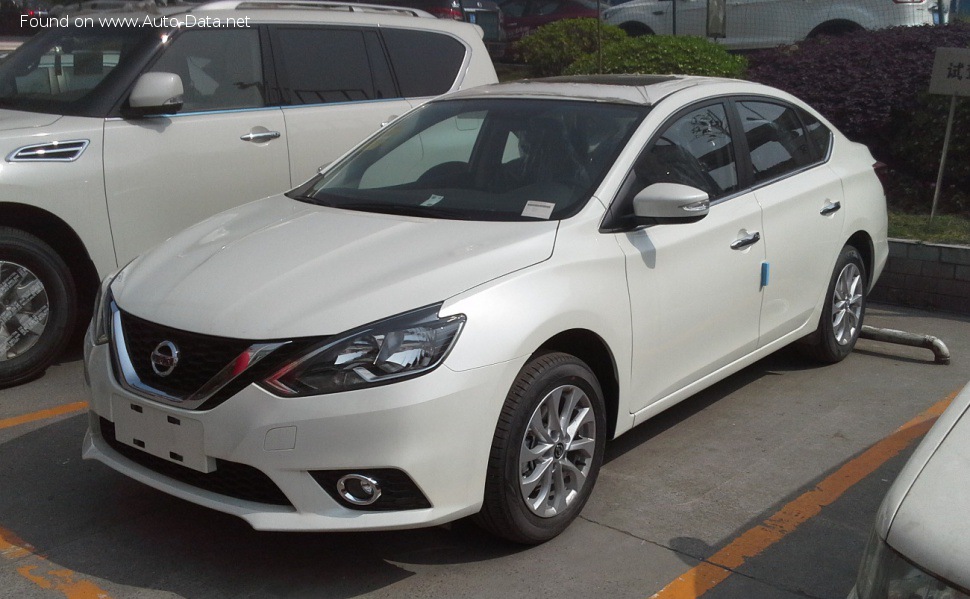
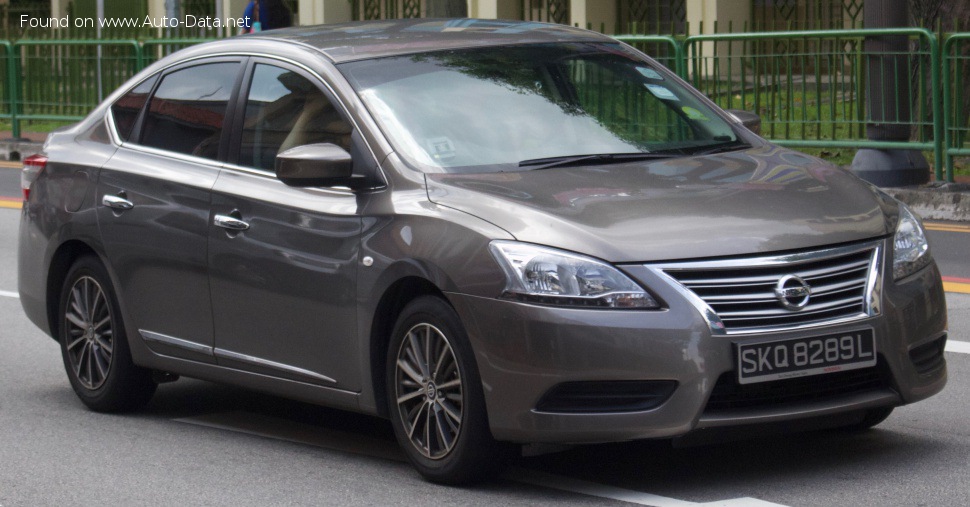
The Nissan Sylphy (B17) adopts a classic four-door, five-seat sedan body type, emphasizing practicality and a mature aesthetic. Its exterior design is characterized by smooth lines and a conservative profile, aiming for broad appeal rather than aggressive styling. The dimensions of the vehicle contribute to its spacious interior: it measures 181.69 inches (4615 mm) in length, 69.29 inches (1760 mm) in width, and 58.86 inches (1495 mm) in height. A generous wheelbase of 106.3 inches (2700 mm) is a key factor in providing ample legroom for both front and rear passengers, enhancing ride comfort for all occupants. The front and rear tracks are identical at 60.63 inches (1540 mm), contributing to stable handling.
Inside, the Sylphy (B17) focuses on ergonomics and passenger comfort. While specific interior features vary by market and trim level, the general design prioritizes ease of use and a pleasant environment. The trunk space is a notable highlight, offering a substantial 18.01 cubic feet (510 liters) of cargo capacity, making it highly practical for family trips or daily errands. The fuel tank capacity is 13.74 US gallons (52 liters), providing a decent range between fill-ups.
In terms of chassis and safety, the Sylphy (B17) features an independent McPherson strut front suspension with coil springs and an anti-roll bar, a setup known for its balance of comfort and handling stability. The rear suspension is a semi-independent design with coil springs, a cost-effective and space-efficient solution for compact sedans. Braking performance is handled by ventilated discs at the front and solid discs at the rear, complemented by an Anti-lock Braking System (ABS) for enhanced safety during emergency braking. The steering system is a rack and pinion type, offering direct and predictable control. The vehicle rides on 17-inch wheel rims, shod with 205/50 R17 tires, providing a good balance of grip and ride comfort.
Technical Specifications: Nissan Sylphy (B17) 1.8 (131 Hp) CVT
| Category | Specification | Value (Metric) | Value (US Customary) |
|---|---|---|---|
| General Information | Brand | Nissan | |
| Model | Sylphy | ||
| Generation | Sylphy (B17) | ||
| Type (Engine) | 1.8 (131 Hp) CVT | ||
| Start of Production | 2012 year | ||
| End of Production | 2016 year | ||
| Powertrain Architecture | Internal Combustion engine | ||
| Body Type | Sedan | ||
| Seats | 5 | ||
| Doors | 4 | ||
| Performance Specs | Fuel Type | Petrol (Gasoline) | |
| Weight-to-Power Ratio | 9.6 kg/Hp | 104 Hp/tonne | |
| Weight-to-Torque Ratio | 7.2 kg/Nm | 138.1 Nm/tonne | |
| Engine Specs | Power | 131 Hp @ 6000 rpm | 131 Hp @ 6000 rpm |
| Power per Liter | 72.9 Hp/l | 72.9 Hp/l | |
| Torque | 174 Nm @ 3600 rpm | 128.34 lb.-ft. @ 3600 rpm | |
| Engine Layout | Front, Transverse | ||
| Engine Model/Code | MRA8DE | ||
| Engine Displacement | 1798 cm3 | 109.72 cu. in. | |
| Number of Cylinders | 4 | ||
| Engine Configuration | Inline | ||
| Cylinder Bore | 79.7 mm | 3.14 in. | |
| Piston Stroke | 90.1 mm | 3.55 in. | |
| Compression Ratio | 9.9:1 | ||
| Number of Valves per Cylinder | 4 | ||
| Fuel Injection System | Multi-port manifold injection | ||
| Engine Aspiration | Naturally aspirated engine | ||
| Valvetrain | DOHC | ||
| Engine Oil Capacity | 3.9 l | 4.12 US qt | |
| Coolant Capacity | 6.6 l | 6.97 US qt | |
| Space, Volume and Weights | Kerb Weight | 1260 kg | 2777.82 lbs. |
| Trunk (boot) Space – minimum | 510 l | 18.01 cu. ft. | |
| Fuel Tank Capacity | 52 l | 13.74 US gal | |
| Dimensions | Length | 4615 mm | 181.69 in. |
| Width | 1760 mm | 69.29 in. | |
| Height | 1495 mm | 58.86 in. | |
| Wheelbase | 2700 mm | 106.3 in. | |
| Front Track | 1540 mm | 60.63 in. | |
| Rear (Back) Track | 1540 mm | 60.63 in. | |
| Drivetrain, Brakes and Suspension Specs | Drivetrain Architecture | The Internal combustion engine (ICE) drives the front wheels of the vehicle. | |
| Drive Wheel | Front wheel drive | ||
| Number of Gears and Type of Gearbox | automatic transmission XTRONIC CVT | ||
| Front Suspension | Independent, type McPherson with coil spring and anti-roll bar | ||
| Rear Suspension | Semi-independent, coil spring | ||
| Front Brakes | Ventilated discs | ||
| Rear Brakes | Disc | ||
| Assisting Systems | ABS (Anti-lock braking system) | ||
| Steering Type | Steering rack and pinion | ||
| Tires Size | 205/50 R17 | ||
| Wheel Rims Size | 17 inches | ||
Legacy and Market Impact of the Nissan Sylphy (B17)
The Nissan Sylphy (B17) carved out a significant niche for itself in the compact sedan market during its production run, particularly in Asian countries like Thailand, China, and Malaysia, as well as parts of the Middle East and Latin America. Its primary competitors varied by region but generally included formidable rivals such as the Toyota Corolla, Honda Civic, Mazda3, and Hyundai Elantra. In this fiercely contested segment, the Sylphy differentiated itself through its emphasis on interior space, ride comfort, and a reputation for solid reliability and low running costs.
Nissan’s strategy with the Sylphy (B17) was to offer a highly practical and unpretentious vehicle that catered to the everyday needs of families and individual commuters. Its conservative styling appealed to a broad demographic looking for a dependable mode of transport without flashy aesthetics. The combination of the efficient 1.8-liter engine and the XTRONIC CVT was a key selling point, providing a smooth and economical driving experience that resonated with cost-conscious buyers in emerging markets. This powertrain choice underscored Nissan’s commitment to fuel efficiency and reduced emissions, a growing concern globally.
The Sylphy (B17) played a crucial role in Nissan’s global sales strategy, serving as a volume seller in markets where compact sedans are highly popular. Its robust build quality and straightforward mechanicals contributed to its appeal as a long-term ownership proposition. The model’s success demonstrated Nissan’s ability to tailor vehicles to specific regional preferences, balancing global platforms with local market demands for space, comfort, and affordability. Although it didn’t bear the Sylphy name in North America, its underlying engineering and design principles were often shared with models like the Sentra, showcasing Nissan’s global development efficiencies. The B17 generation solidified the Sylphy’s standing as a sensible and reliable choice in the global compact sedan landscape, leaving a legacy of practical engineering and widespread market acceptance.