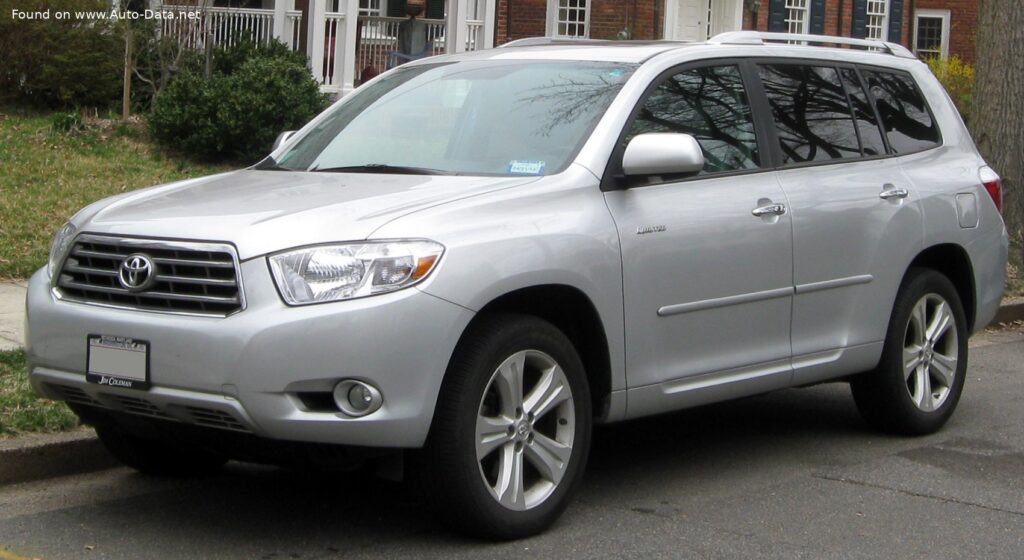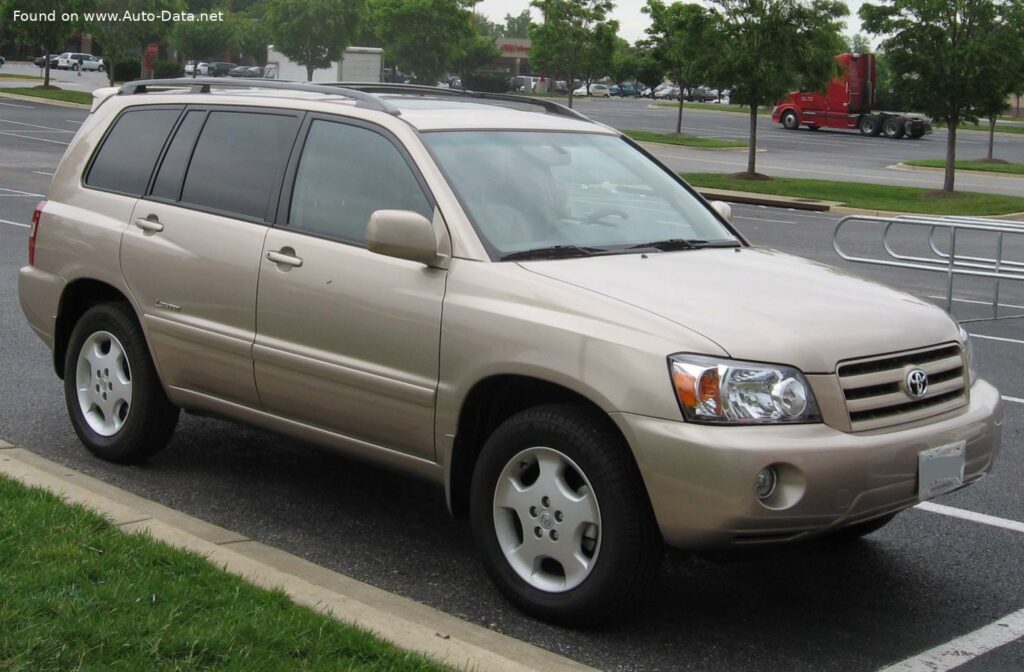
The Toyota Highlander I 3.3 i V6 24V (272 Hp) Hybrid e-CVT: A Pioneer in Sustainable Utility
The Toyota Highlander, first introduced to the North American market in 2001, quickly established itself as a popular choice in the burgeoning mid-size SUV segment. Positioned as a more car-like alternative to traditional, truck-based SUVs, the Highlander offered a comfortable ride, practical interior, and Toyota’s renowned reliability. The first generation, produced from 2001 to 2007, laid the groundwork for its enduring success. However, it was the introduction of the Toyota Highlander I 3.3 i V6 24V (272 Hp) Hybrid e-CVT in 2006 that marked a significant milestone, not just for the Highlander lineage, but for the entire automotive industry. This variant pioneered hybrid technology in the mainstream mid-size SUV category, offering a compelling blend of power, efficiency, and environmental consciousness at a time when such attributes were just beginning to gain widespread traction among consumers.
Produced for a short but impactful run from 2006 to 2007, this specific Highlander represented Toyota’s commitment to expanding its groundbreaking Hybrid Synergy Drive (HSD) technology beyond its initial passenger car applications like the Prius. It demonstrated that a family-friendly SUV could deliver robust performance while significantly improving fuel economy and reducing emissions, setting a new benchmark for the segment.
Powertrain and Performance: The Heart of the Toyota Highlander I 3.3 i V6 24V (272 Hp) Hybrid e-CVT
At the core of the Highlander Hybrid’s appeal was its sophisticated Full Hybrid Electric Vehicle (FHEV) powertrain architecture. This system ingeniously combined a potent gasoline engine with a high-output electric motor, managed by Toyota’s advanced electronic Continuously Variable Transmission (e-CVT). The internal combustion engine (ICE) was a 3.3-liter (3311 cm3 or 202.05 cu. in.) DOHC 24-valve V6, designated as the 3MZ-FE. This naturally aspirated unit produced a respectable 208 horsepower at 5600 rpm and 211.68 lb-ft of torque at 4400 rpm, featuring multi-port manifold injection for efficient fuel delivery.
Complementing the V6 was a powerful synchronous electric motor, integrated into the transmission. This motor delivered an impressive 167 horsepower at 4500 rpm and a substantial 245.61 lb-ft of torque from a standstill (0-1500 rpm). The synergistic combination of these two power sources resulted in a formidable total system output of 272 horsepower. This collective power enabled the Highlander Hybrid to achieve a 0-60 mph acceleration time of a brisk 8.0 seconds, with a top speed electronically limited to 111.85 mph (180 km/h), demonstrating that hybrid technology could deliver performance comparable to or even superior to conventional V6-powered SUVs of its era.
Beyond raw power, the FHEV system’s primary advantage lay in its efficiency. The Highlander Hybrid achieved remarkable fuel economy for a mid-size SUV of its time, rated at 28 US mpg in urban driving, 33.1 US mpg on the highway, and a combined 30.2 US mpg. This was a significant improvement over its conventional gasoline-only counterparts. The system’s ability to operate in full electric mode at low speeds, or combine both power sources seamlessly, contributed to its impressive fuel efficiency. Power was delivered to the front wheels, with the system intelligently managing power flow for optimal performance and economy. Furthermore, the Highlander Hybrid was certified as a Super Ultra-Low Emission Vehicle (SULEV), underscoring its commitment to environmental responsibility.
Design and Features
The first-generation Toyota Highlander Hybrid maintained the familiar and practical styling of its conventional gasoline sibling. As a five-door SUV, it offered a versatile and spacious interior designed to comfortably accommodate five occupants. Its exterior dimensions – a length of 185.59 inches, width of 71.89 inches, and height of 68.7 inches – gave it a substantial road presence without being overly cumbersome, making it suitable for both urban environments and longer journeys. The 106.89-inch wheelbase contributed to a stable ride and generous interior volume.
The design emphasized functionality, with a focus on family-friendly utility. The minimum trunk space of 10.49 cu. ft. (297 liters) was expandable to a cavernous 80.59 cu. ft. (2282 liters) with the rear seats folded, providing ample cargo capacity for groceries, luggage, or sporting equipment. The vehicle’s kerb weight stood at 3935.25 lbs (1785 kg), with a maximum permissible weight of 5361.64 lbs (2432 kg), allowing for a substantial maximum load of 1426.39 lbs (647 kg). It also boasted a permitted trailer load with brakes of 1995.18 lbs (905 kg), adding to its utility.
Underneath, the Highlander Hybrid featured an independent McPherson strut front suspension with coil springs and an anti-roll bar, paired with an independent coil spring rear suspension with a transverse stabilizer. This setup provided a comfortable and composed ride, characteristic of Toyota’s passenger car platforms. Braking was handled by ventilated discs at the front and solid discs at the rear, augmented by an Anti-lock Braking System (ABS) for enhanced safety. The electric power steering system, a rack and pinion type, offered light and precise control. Standard tire size was 225/65 R17 on 6.5J x 17 wheel rims, contributing to both ride comfort and handling stability. The vehicle’s relatively low drag coefficient (Cd) of 0.34 also played a role in its aerodynamic efficiency.
Technical Specifications
| Category | Specification |
|---|---|
| Brand | Toyota |
| Model | Highlander |
| Generation | Highlander I |
| Type (Engine) | 3.3 i V6 24V (272 Hp) Hybrid e-CVT |
| Start of Production | 2006 year |
| End of Production | 2007 year |
| Powertrain Architecture | FHEV (Full Hybrid Electric Vehicle) |
| Body Type | SUV |
| Seats | 5 |
| Doors | 5 |
| Fuel Type | Petrol (Gasoline) |
| Fuel Consumption (Urban) | 28 US mpg (8.4 l/100 km) |
| Fuel Consumption (Extra Urban) | 33.1 US mpg (7.1 l/100 km) |
| Fuel Consumption (Combined) | 30.2 US mpg (7.8 l/100 km) |
| Acceleration 0 – 60 mph | 8.0 sec |
| Maximum Speed | 111.85 mph (180 km/h) |
| Emission Standard | SULEV |
| Weight-to-power ratio | 152.4 Hp/tonne (6.6 kg/Hp) |
| Weight-to-torque ratio | 160.8 Nm/tonne (6.2 kg/Nm) |
| Battery Voltage | 288 V |
| Battery Technology | Nickel-metal hydride (NiMH) |
| Electric Motor Power | 167 Hp @ 4500 rpm |
| Electric Motor Torque | 245.61 lb.-ft. @ 0–1500 rpm (333 Nm) |
| Electric Motor Location | Integrated into the transmission |
| Electric Motor Type | Synchronous |
| System Power | 272 Hp |
| Internal Combustion Engine Power | 208 Hp @ 5600 rpm |
| Power per Liter | 62.8 Hp/l |
| Internal Combustion Engine Torque | 211.68 lb.-ft. @ 4400 rpm (287 Nm) |
| Engine Layout | Front, Transverse |
| Engine Model/Code | 3MZ-FE |
| Engine Displacement | 3.3 l (3311 cm3 / 202.05 cu. in.) |
| Number of Cylinders | 6 |
| Engine Configuration | V-engine |
| Cylinder Bore | 3.62 in. (92 mm) |
| Piston Stroke | 3.27 in. (83 mm) |
| Number of Valves per Cylinder | 4 |
| Fuel Injection System | Multi-port manifold injection |
| Engine Aspiration | Naturally aspirated engine |
| Valvetrain | DOHC |
| Engine Oil Capacity | 4.97 US qt (4.7 l) |
| Coolant Capacity | 10.88 US qt (10.3 l) |
| Kerb Weight | 3935.25 lbs (1785 kg) |
| Max. Weight | 5361.64 lbs (2432 kg) |
| Max Load | 1426.39 lbs (647 kg) |
| Trunk (boot) space – minimum | 10.49 cu. ft. (297 l) |
| Trunk (boot) space – maximum | 80.59 cu. ft. (2282 l) |
| Fuel Tank Capacity | 17.17 US gal (65 l) |
| Permitted Trailer Load with Brakes (12%) | 1995.18 lbs (905 kg) |
| Length | 185.59 in. (4714 mm) |
| Width | 71.89 in. (1826 mm) |
| Height | 68.7 in. (1745 mm) |
| Wheelbase | 106.89 in. (2715 mm) |
| Front Track | 62.01 in. (1575 mm) |
| Rear (Back) Track | 61.18 in. (1554 mm) |
| Ride Height (Ground Clearance) | 6.89 in. (175 mm) |
| Drag Coefficient (Cd) | 0.34 |
| Minimum Turning Circle (Turning Diameter) | 37.4 ft (11.4 m) |
| Drivetrain Architecture | ICE and electric motor drive the front wheels, full electric or mixed mode capability |
| Drive Wheel | Front wheel drive |
| Number of Gears and Type of Gearbox | Automatic transmission e-CVT |
| Front Suspension | Independent, McPherson with coil spring and anti-roll bar |
| Rear Suspension | Independent coil spring, Transverse stabilizer |
| Front Brakes | Ventilated discs |
| Rear Brakes | Disc |
| Assisting Systems | ABS (Anti-lock braking system) |
| Steering Type | Steering rack and pinion |
| Power Steering | Electric Steering |
| Tires Size | 225/65 R17 |
| Wheel Rims Size | 6.5J x 17 |
Legacy and Market Impact
The Toyota Highlander I 3.3 i V6 24V (272 Hp) Hybrid e-CVT holds a significant place in automotive history as one of the very first hybrid mid-size SUVs available in the North American market. Its introduction in 2006 marked a pivotal moment, signaling that hybrid technology was ready for broader applications beyond compact sedans and could effectively power larger, more utilitarian vehicles without compromising on performance or practicality. Toyota, having already established itself as a leader in hybrid technology with the Prius, leveraged its expertise to offer a compelling option for families seeking a more environmentally friendly and fuel-efficient SUV.
At the time, the Highlander Hybrid faced competition from traditional gasoline-powered mid-size SUVs such as the Honda Pilot, Ford Explorer, Nissan Murano, and Chevrolet Trailblazer. While these rivals offered similar space and utility, none could match the Highlander Hybrid’s impressive fuel economy figures. Its combined 30.2 US mpg was a game-changer, appealing to consumers increasingly conscious of rising gasoline prices and environmental impact. This efficiency, combined with the Highlander’s reputation for reliability and comfort, made it a unique proposition in the market.
The Highlander Hybrid’s early success helped to legitimize the concept of hybrid SUVs, paving the way for a multitude of hybrid and plug-in hybrid SUV models from various manufacturers in subsequent years. It demonstrated that consumers were willing to pay a premium for advanced technology that delivered tangible benefits in terms of running costs and reduced emissions. Its SULEV rating further bolstered Toyota’s image as an innovator in clean vehicle technology.
In terms of historical significance, the first-generation Highlander Hybrid played a crucial role in mainstreaming hybrid powertrains. It proved that hybrid technology was not just for niche eco-cars but could be seamlessly integrated into popular family vehicles, offering a practical and powerful solution. Its robust Nickel-metal hydride (NiMH) battery technology, while now superseded by more advanced lithium-ion systems, proved reliable and durable for its era. The Highlander Hybrid’s legacy is evident in the widespread adoption of hybrid and electrified SUVs today, confirming Toyota’s foresight in bringing this technology to the utility vehicle segment. It remains a testament to early 21st-century automotive innovation, combining V6 power with hybrid efficiency in a family-friendly package.