
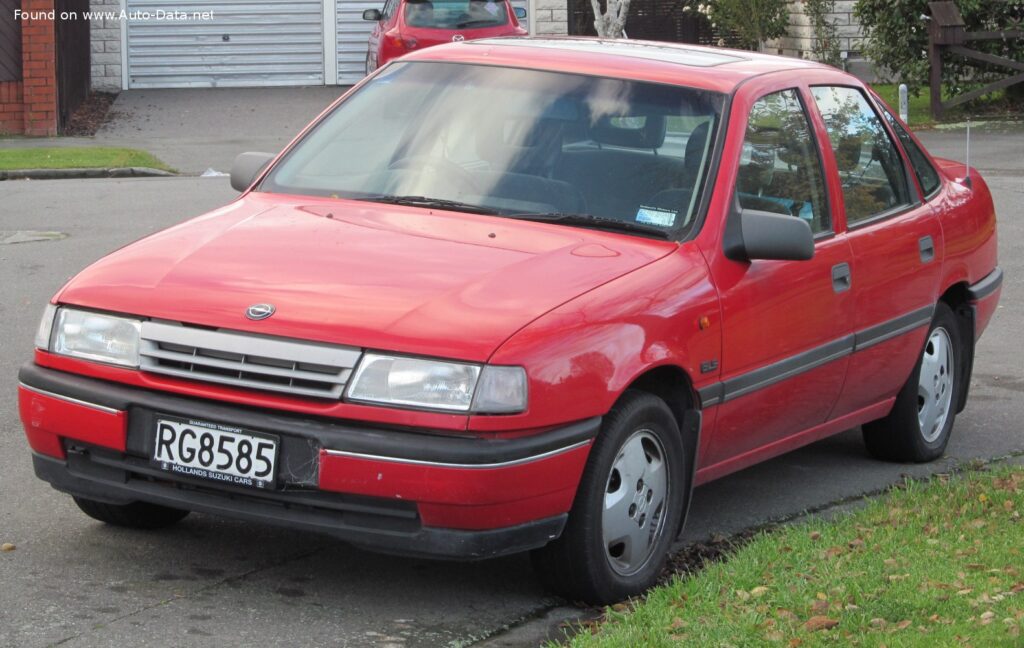
Opel Vectra A 2.0 (101 Hp) Automatic: A European Mid-Size Standard Bearer
The Opel Vectra A 2.0 (101 Hp) Automatic represents a pivotal model in the history of General Motors’ European subsidiary, Opel. Launched in 1988 as the successor to the long-running Ascona, the first-generation Vectra A marked a significant modernization for the brand in the highly competitive European mid-size family car segment. Positioned as a practical, reliable, and aerodynamically efficient sedan, the Vectra A quickly established itself as a staple on European roads. This particular variant, produced between 1988 and 1989, featured a robust 2.0-liter engine paired with a four-speed automatic transmission, catering to drivers seeking comfort and ease of use in their daily commute. While never officially sold in the United States under the Opel badge, its underlying engineering and market role are comparable to contemporary American mid-size sedans of the era, emphasizing practicality and value.
Engine and Performance of the Opel Vectra A
Powertrain Philosophy: Reliability Over Raw Power
The heart of the 1988-1989 Opel Vectra A 2.0 (101 Hp) Automatic was its 2.0-liter (1998 cm3 or 121.93 cu. in.) C20NEF inline-four engine. This naturally aspirated gasoline unit was engineered for durability and smooth operation, rather than outright performance. Utilizing a single overhead camshaft (OHC) valvetrain with two valves per cylinder, the engine delivered a respectable 101 horsepower at 5200 revolutions per minute. This power output, combined with a specific power rating of 50.6 horsepower per liter, placed it squarely in the mainstream for family sedans of its time.
A key characteristic of this powertrain was its torque delivery. The engine produced a solid 158 Newton-meters (116.53 lb.-ft.) of torque at a relatively low 2600 rpm. This low-end torque was crucial for everyday drivability, ensuring responsive acceleration from a standstill and ample pulling power for highway cruising, especially when paired with an automatic transmission. The multi-port manifold injection system ensured efficient fuel delivery, contributing to the engine’s reputation for reliability and reasonable fuel economy for its era.
Power was sent to the front wheels via a four-speed automatic transmission. While modern automatics boast more gears and greater sophistication, the four-speed unit in the Vectra A was a common and well-proven setup in the late 1980s. It provided a comfortable and effortless driving experience, particularly in urban environments, making the car an attractive option for families and commuters who prioritized convenience over ultimate driving engagement. The front-wheel-drive architecture was also a standard for the segment, offering predictable handling and efficient packaging.
Design and Features of the Opel Vectra A
Aerodynamic Efficiency Meets Practical Sedan Design
The design of the first-generation Opel Vectra A represented a clear departure from its more angular predecessor, the Ascona. Opel embraced the emerging trend of aerodynamic styling, resulting in a sleek and modern appearance that was highly competitive in the late 1980s. The 4-door sedan body type was the cornerstone of its appeal, offering a practical and spacious interior for five occupants.
One of the most notable achievements of the Vectra A’s design was its remarkably low drag coefficient (Cd) of 0.29. This figure was exceptionally good for a mass-market sedan of its time, rivaling even some sports cars. The low Cd not only contributed to a modern aesthetic but also played a significant role in improving fuel efficiency and reducing wind noise at higher speeds, enhancing the overall comfort for occupants.
In terms of dimensions, the Vectra A was a substantial vehicle for its class, measuring 174.49 inches in length, 67.17 inches in width, and 55.12 inches in height. A wheelbase of 102.36 inches provided a stable ride and contributed to a generous interior space. The focus on practicality was evident in its cargo capacity, with a minimum trunk space of 18.72 cubic feet, which could expand to a maximum of 29.66 cubic feet with the rear seats folded (where applicable, though specific folding capability is not detailed for this variant, the range suggests flexibility). This made the Vectra A a highly versatile vehicle, capable of accommodating family luggage or larger items with ease.
Interior features for this era were functional and user-friendly. While not laden with the advanced technology seen in modern cars, the Vectra A offered a comfortable cabin with durable materials. Standard amenities would have included power steering, a capable heating and ventilation system, and perhaps options like power windows or a sunroof, depending on the trim level. Safety, by late 1980s standards, focused on a rigid passenger cell and basic occupant restraints, with the aerodynamic design also contributing to a quieter and more stable driving experience.
Technical Specifications
| Feature | Value |
|---|---|
| General Information | |
| Brand | Opel |
| Model | Vectra |
| Generation | Vectra A |
| Type (Engine) | 2.0 (101 Hp) Automatic |
| Start of Production | 1988 year |
| End of Production | 1989 year |
| Powertrain Architecture | Internal Combustion Engine |
| Body type | Sedan |
| Seats | 5 |
| Doors | 4 |
| Performance Specs | |
| Fuel Type | Petrol (Gasoline) |
| Power | 101 Hp @ 5200 rpm |
| Power per liter | 50.6 Hp/l |
| Torque | 158 Nm @ 2600 rpm (116.53 lb.-ft. @ 2600 rpm) |
| Engine Specs | |
| Engine Model/Code | C20NEF |
| Engine Displacement | 1998 cm3 (121.93 cu. in.) |
| Number of Cylinders | 4 |
| Engine Configuration | Inline |
| Cylinder Bore | 86 mm (3.39 in.) |
| Piston Stroke | 86 mm (3.39 in.) |
| Compression Ratio | 9.2:1 |
| Number of Valves per Cylinder | 2 |
| Fuel Injection System | Multi-port manifold injection |
| Engine Aspiration | Naturally aspirated engine |
| Valvetrain | OHC |
| Engine Oil Capacity | 4 l (4.23 US qt) |
| Coolant Capacity | 7 l (7.4 US qt) |
| Space, Volume and Weights | |
| Trunk (boot) space – minimum | 530 l (18.72 cu. ft.) |
| Trunk (boot) space – maximum | 840 l (29.66 cu. ft.) |
| Fuel Tank Capacity | 61 l (16.11 US gal) |
| Dimensions | |
| Length | 4432 mm (174.49 in.) |
| Width | 1706 mm (67.17 in.) |
| Height | 1400 mm (55.12 in.) |
| Wheelbase | 2600 mm (102.36 in.) |
| Front Track | 1420 mm (55.91 in.) |
| Rear (Back) Track | 1423 mm (56.02 in.) |
| Drag Coefficient (Cd) | 0.29 |
| Drivetrain, Brakes and Suspension Specs | |
| Drivetrain Architecture | Internal combustion engine (ICE) drives the front wheels |
| Drive Wheel | Front wheel drive |
| Number of Gears and Type of Gearbox | 4 gears, automatic transmission |
Legacy and Market Impact
A Cornerstone of European Motoring
The Opel Vectra A, and particularly variants like the 2.0 (101 Hp) Automatic, left a substantial mark on the European automotive landscape. As the successor to the Ascona, it had big shoes to fill, and it did so by successfully modernizing Opel’s offering in the fiercely competitive D-segment. Its reputation was built on a foundation of reliability, practicality, and solid engineering, characteristics that resonated strongly with European buyers looking for a dependable family car.
In its primary markets, the Vectra A faced stiff competition from formidable rivals such as the Ford Sierra, which also emphasized aerodynamic design, the Volkswagen Passat, known for its build quality, and French contenders like the Renault 21 and Peugeot 405, which offered distinctive styling and comfortable rides. Despite this crowded field, the Vectra A carved out a significant market share, becoming one of Europe’s best-selling mid-size cars during its production run. Its success was a testament to Opel’s understanding of the European consumer’s desire for a car that was both functional and aesthetically pleasing.
The 2.0-liter engine, in particular, was a popular choice, striking a good balance between performance and economy for the average driver. The availability of an automatic transmission further broadened its appeal, catering to a growing segment of buyers who preferred the convenience of clutch-less driving, especially in increasingly congested urban areas. The Vectra A’s low drag coefficient was not just a technical detail but a marketing highlight, showcasing Opel’s commitment to modern engineering and efficiency.
The Opel Vectra A’s legacy extends beyond its sales figures. It set the stage for subsequent generations of the Vectra, which continued to be a core model for Opel/Vauxhall (in the UK) for many years. It helped solidify Opel’s image as a manufacturer of robust, family-friendly vehicles that offered good value for money. While it may not be a collector’s item in the same vein as some high-performance classics, the Opel Vectra A 2.0 (101 Hp) Automatic remains an important historical artifact, embodying the practical and technological advancements in European mainstream motoring at the close of the 1980s. Its impact on the daily lives of countless European families underscores its significance in automotive history.
