The Nissan Sylphy (B17, Facelift 2016): A Global Compact Sedan
The Nissan Sylphy, specifically the B17 generation with its 2016 facelift, represents a crucial offering in the global compact sedan segment for the Japanese automaker. While not directly sold under the Sylphy nameplate in the United States, where it is more commonly known as the Sentra, this particular iteration plays a significant role in various Asian markets, including China, Southeast Asia, and parts of the Middle East. Positioned as a practical, comfortable, and fuel-efficient family car, the Nissan Sylphy (B17, facelift 2016) embodies Nissan’s strategy of delivering reliable transportation with a focus on passenger comfort and ease of use. The facelift introduced subtle but impactful design updates and refinements to keep the model competitive in its highly contested class from 2016 until its eventual replacement in 2019. This article delves into the technical aspects, design philosophy, and market impact of the 1.8-liter variant paired with a Continuously Variable Transmission (CVT).
Engine and Performance
Under the hood, the Nissan Sylphy (B17, facelift 2016) 1.8 (139 Hp) CVT is powered by Nissan’s MRA8DE engine, a naturally aspirated 1.8-liter (1798 cm3 or 109.72 cu. in.) inline four-cylinder gasoline unit. This engine is engineered for efficiency and smooth power delivery, producing 139 horsepower at 6000 rpm and a peak torque of 128.34 lb.-ft. (174 Nm) at 3600 rpm. With a compression ratio of 9.9:1 and a DOHC valvetrain, the engine utilizes multi-port manifold injection to optimize fuel delivery and combustion.
Power is transmitted to the front wheels via Nissan’s XTRONIC Continuously Variable Transmission (CVT). This automatic transmission is renowned for its seamless shifts and ability to keep the engine in its most efficient operating range, contributing significantly to the vehicle’s commendable fuel economy. The Sylphy 1.8 CVT achieves an extra-urban fuel consumption rating of approximately 41.3 US mpg (5.7 l/100 km), making it an economical choice for daily commuting and longer journeys.
In terms of acceleration, the Sylphy 1.8 CVT reaches 60 mph from a standstill in an estimated 10.8 seconds (0-100 km/h in 11.4 seconds), with a top speed of 115.58 mph (186 km/h). While these figures don’t place it in the realm of performance sedans, they are entirely adequate for the urban and highway driving conditions it typically encounters in its target markets. The powertrain architecture, with its front, transverse engine layout and front-wheel-drive system, is a proven setup for compact sedans, balancing packaging efficiency with predictable handling characteristics.
Design and Features of the Nissan Sylphy (B17, Facelift 2016)
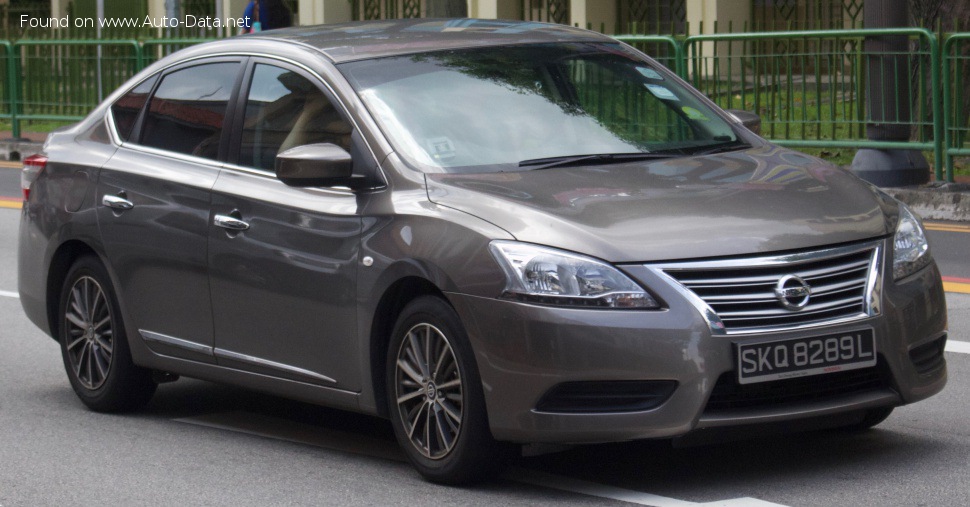
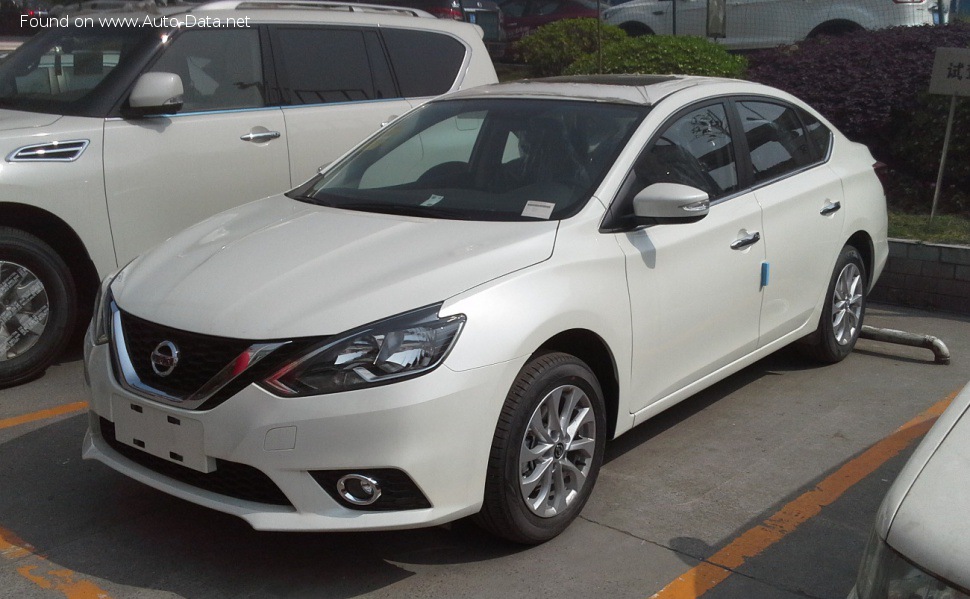
The Nissan Sylphy (B17, facelift 2016) maintains a classic four-door, five-seat sedan body style, prioritizing interior space and comfort. The B17 generation, launched in 2012, received a significant visual refresh in 2016, bringing it in line with Nissan’s contemporary “V-motion” design language. This included a more assertive front fascia with a prominent chrome grille, redesigned headlights, and updated bumper styling, giving the car a more sophisticated and modern appearance.
Measuring 182.32 inches (4631 mm) in length, 69.29 inches (1760 mm) in width, and 59.17 inches (1503 mm) in height, the Sylphy offers generous exterior dimensions for its class. A wheelbase of 106.3 inches (2700 mm) is particularly noteworthy, contributing to a spacious cabin and ample rear legroom, a key selling point in markets where rear passenger comfort is highly valued. The trunk space is also impressive, offering 18.01 cu. ft. (510 liters) of cargo volume, making it suitable for family use or business travel.
The chassis features an independent MacPherson strut front suspension with coil springs and an anti-roll bar, providing a balance of comfort and stability. The rear utilizes a semi-independent suspension with coil springs, a common and cost-effective setup for compact vehicles that still offers a compliant ride. Braking is handled by ventilated discs at the front and solid discs at the rear, supported by an Anti-lock Braking System (ABS) for enhanced safety. The electric power steering system, coupled with a rack and pinion setup, ensures light and responsive steering, particularly beneficial in congested city environments. The vehicle comes equipped with 205/50 R17 tires on 17-inch wheel rims, providing a good compromise between ride comfort and handling.
Technical Specifications
| Category | Specification | Value (US/Metric) |
|---|---|---|
| General Information | Brand | Nissan |
| Model | Sylphy (B17, facelift 2016) 1.8 (139 Hp) CVT | |
| Production Start | 2016 | |
| Production End | 2019 | |
| Body Type | Sedan | |
| Seats / Doors | 5 / 4 | |
| Performance Specs | Fuel Consumption (Extra Urban) | 41.3 US mpg (5.7 l/100 km) |
| Fuel Type | Gasoline (Petrol) | |
| Acceleration 0-60 mph | 10.8 sec | |
| Acceleration 0-100 km/h | 11.4 sec | |
| Maximum Speed | 115.58 mph (186 km/h) | |
| Weight-to-power ratio | 9.1 kg/Hp, 109.4 Hp/tonne | |
| Weight-to-torque ratio | 7.3 kg/Nm, 137 Nm/tonne | |
| Engine Specs | Power | 139 Hp @ 6000 rpm |
| Torque | 128.34 lb.-ft. (174 Nm) @ 3600 rpm | |
| Engine Layout | Front, Transverse | |
| Engine Model/Code | MRA8DE | |
| Engine Displacement | 109.72 cu. in. (1798 cm3, 1.8 L) | |
| Number of Cylinders | 4, Inline | |
| Cylinder Bore | 3.14 in. (79.7 mm) | |
| Piston Stroke | 3.55 in. (90.1 mm) | |
| Compression Ratio | 9.9:1 | |
| Valves per Cylinder | 4 | |
| Fuel Injection System | Multi-port manifold injection | |
| Engine Aspiration | Naturally aspirated | |
| Valvetrain | DOHC | |
| Engine Oil Capacity | 4.12 US qt (3.9 l) | |
| Coolant Capacity | 6.97 US qt (6.6 l) | |
| Dimensions & Weights | Kerb (Curb) Weight | 2799.87 lbs. (1270 kg) |
| Trunk (Boot) Space – minimum | 18.01 cu. ft. (510 l) | |
| Fuel Tank Capacity | 13.74 US gal (52 l) | |
| Length | 182.32 in. (4631 mm) | |
| Width | 69.29 in. (1760 mm) | |
| Height | 59.17 in. (1503 mm) | |
| Wheelbase | 106.3 in. (2700 mm) | |
| Front Track | 60.24 in. (1530 mm) | |
| Rear Track | 60.24 in. (1530 mm) | |
| Ride Height (Ground Clearance) | 6.54 in. (166 mm) | |
| Minimum Turning Circle | 34.12 ft. (10.4 m) | |
| Drivetrain, Brakes & Suspension | Drivetrain Architecture | Front-wheel drive, Internal Combustion Engine |
| Drive Wheel | Front-wheel drive | |
| Gearbox Type | Automatic transmission CVT XTRONIC | |
| Front Suspension | Independent, MacPherson with coil spring and anti-roll bar | |
| Rear Suspension | Semi-independent, coil spring | |
| Front Brakes | Ventilated discs | |
| Rear Brakes | Disc | |
| Assisting Systems | ABS (Anti-lock braking system) | |
| Steering Type | Steering rack and pinion | |
| Power Steering | Electric Steering | |
| Tires Size | 205/50 R17 | |
| Wheel Rims Size | 17 inches |
Legacy and Market Impact
The Nissan Sylphy (B17, facelift 2016) continued the model’s legacy as a strong contender in the compact sedan segment across numerous international markets. In regions like Southeast Asia (e.g., Thailand, Malaysia, the Philippines) and China, the Sylphy faced stiff competition from segment leaders such as the Toyota Corolla Altis, Honda Civic, and Mazda3. Despite this intense rivalry, the Sylphy carved out its niche by emphasizing attributes like spaciousness, fuel efficiency, and a comfortable ride quality, often appealing to families and those seeking a reliable and low-maintenance daily driver.
Its strong reputation for durability and affordability, coupled with Nissan’s extensive service network in these regions, contributed to its consistent sales performance. The B17 generation, particularly after the 2016 facelift, was praised for its improved exterior styling, which gave it a more premium feel compared to its pre-facelift iteration. The XTRONIC CVT, while sometimes criticized by enthusiasts for a lack of engagement, was widely appreciated by the target demographic for its smooth operation and contribution to fuel economy, aligning perfectly with the car’s practical positioning.
The Sylphy’s historical significance lies in its role as a global compact sedan that adapted its identity to various markets. While known as Sentra in the Americas, Pulsar in Australia, and Sylphy in Asia, the underlying B17 platform shared many commonalities, showcasing Nissan’s global engineering capabilities. The 2016 facelift ensured that the Sylphy remained a fresh and competitive option until its replacement by the fourth-generation model (C13, based on the global Sentra/Pulsar) and later the C14 generation (current Sentra/Sylphy), solidifying its place as a cornerstone of Nissan’s international product portfolio. Its enduring appeal in its primary markets underscores its success as a well-rounded and dependable compact family sedan.