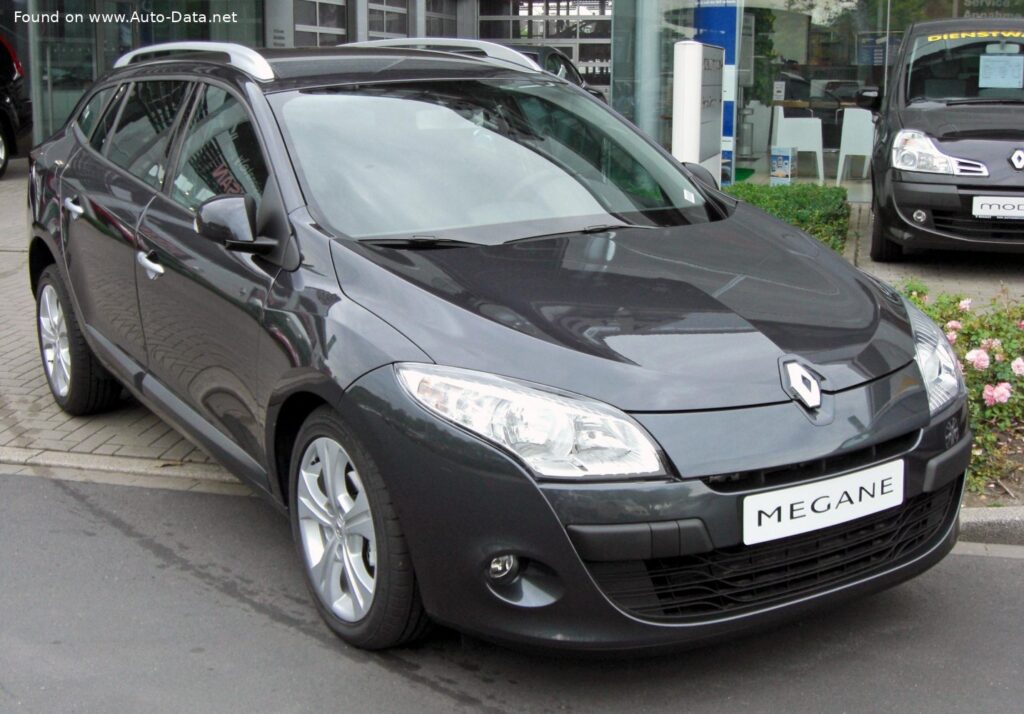
Introduction to the Renault Megane III Grandtour GT 2.0 TCe (180 Hp)
The Renault Megane III Grandtour GT 2.0 TCe (180 Hp) represents a compelling blend of practicality and spirited performance within the highly competitive European C-segment. Launched in 2010 as part of the third generation Megane lineup, the Grandtour (known as an estate or station wagon in other markets) specifically catered to families and individuals demanding versatile cargo capacity without sacrificing driving dynamics. This particular GT variant, produced until 2012, was positioned as a sportier, more engaging option, offering a potent turbocharged gasoline engine and a refined chassis setup.
While the Renault Megane series has historically been a cornerstone of the French automaker’s presence across Europe, Asia, and other global markets, it was never officially sold in the United States. Consequently, its role in its primary European market was significant, competing directly with established rivals from Volkswagen, Ford, Opel, and Peugeot. The Megane III Grandtour, with its five doors and seating for five, provided a practical solution for daily commuting, family trips, and hauling duties, all wrapped in a distinctive design language that characterized Renault’s styling at the turn of the decade. The GT 2.0 TCe (180 Hp) specifically aimed to inject an element of driving enthusiasm into the capable Grandtour package, appealing to those who desired more than just utilitarian transport.
Engine and Performance: The Heart of the Renault Megane III Grandtour GT 2.0 TCe (180 Hp)
At the core of the Renault Megane III Grandtour GT 2.0 TCe (180 Hp) lies a robust 2.0-liter (1998 cm3 or 121.93 cu. in.) turbocharged, intercooled inline-four engine, designated as the F4R 870. This powertrain architecture, featuring a front, transverse engine layout, was meticulously engineered to deliver a balance of power and efficiency. With a compression ratio of 9.3:1 and a multi-port manifold injection system, the engine produced a healthy 180 horsepower at 5500 rpm. This translated to an impressive power per liter figure of 90.1 horsepower per liter, showcasing modern engine design principles for its time.
Torque delivery was equally impressive, peaking at 300 Nm (221.27 lb.-ft.) at a relatively low 2250 rpm. Such a broad and accessible torque curve ensured strong pulling power across the rev range, making the Grandtour GT feel responsive in various driving conditions, from urban commuting to highway cruising. This ample torque, combined with the 180 horsepower, propelled the vehicle from 0 to 60 mph in a swift 7.6 seconds, with a maximum speed reaching 139.81 mph (225 km/h). These figures underscored the GT’s sporting credentials within the station wagon segment.
Power was sent to the front wheels via a precise 6-speed manual transmission, offering drivers an engaging and direct connection to the powertrain. This setup contributed to the car’s dynamic character, allowing for optimal gear selection to maximize either performance or fuel economy. Speaking of economy, the GT 2.0 TCe achieved a combined fuel consumption of 7.7 liters per 100 km, which translates to approximately 30.5 US mpg. Urban consumption stood at 10.9 l/100 km (21.6 US mpg), while extra-urban driving yielded 5.9 l/100 km (39.9 US mpg). These figures, alongside CO2 emissions of 178 g/km, met the Euro 5 emission standard, reflecting a conscientious approach to environmental impact for its production era.
Design and Features: Practicality Meets Sportiness
The Renault Megane III Grandtour adopted a sleek and dynamic design, moving away from some of the more controversial styling elements of its predecessor. As a station wagon, its primary design goal was to maximize utility, which it achieved with a generous length of 179.49 inches (4559 mm) and a substantial wheelbase of 106.42 inches (2703 mm). The five-door body type offered excellent access to both front and rear seating, accommodating five occupants comfortably.
The GT trim level further enhanced the Grandtour’s aesthetic appeal and functionality. It typically featured sportier bumpers, unique alloy wheels – 18-inch rims with 225/40 R18 tires in this specification – and subtle badging to differentiate it from standard Megane models. Inside, the GT likely offered sport seats, unique trim accents, and perhaps a leather-wrapped steering wheel, all designed to create a more engaging driver environment.
Practicality was a key strength of the Grandtour. It boasted a minimum trunk (boot) space of 18.5 cu. ft. (524 liters), which could expand to an impressive 56.33 cu. ft. (1595 liters) with the rear seats folded down. This made it highly capable for carrying luggage, sports equipment, or larger items. Additional utility features included a maximum roof load capacity of 176.37 lbs. (80 kg) and significant towing capabilities, with a permitted trailer load of 2866.01 lbs. (1300 kg) with brakes.
In terms of ride and handling, the Megane III Grandtour GT featured an independent McPherson type front suspension and a torsion beam rear suspension, a common and effective setup for compact vehicles, tuned for a sportier feel in the GT variant. Braking performance was handled by ventilated discs at the front and solid discs at the rear, supported by an Anti-lock Braking System (ABS) for enhanced safety. The electric power steering system provided precise control and ease of maneuverability, contributing to a minimum turning circle of 36.25 feet (11.05 meters). With a kerb weight of 3066.63 lbs. (1391 kg) and a drag coefficient of 0.32, the vehicle offered a stable and aerodynamically efficient profile.
Technical Specifications
| Category | Specification | US Equivalent / Notes |
|---|---|---|
| General Information | ||
| Brand | Renault | |
| Model | Megane | |
| Generation | Megane III Grandtour | |
| Type (Engine) | GT 2.0 TCe (180 Hp) | |
| Production Start | 2010 | |
| Production End | 2012 | |
| Powertrain Architecture | Internal Combustion engine | |
| Body type | Station wagon (estate) | 5 Doors, 5 Seats |
| Performance Specs | ||
| Fuel consumption (urban) | 10.9 l/100 km | 21.6 US mpg |
| Fuel consumption (extra urban) | 5.9 l/100 km | 39.9 US mpg |
| Fuel consumption (combined) | 7.7 l/100 km | 30.5 US mpg |
| CO2 emissions | 178 g/km | |
| Fuel Type | Petrol (Gasoline) | |
| Acceleration 0-62 mph (0-100 km/h) | 8 sec | |
| Acceleration 0-60 mph (calculated) | 7.6 sec | |
| Maximum speed | 225 km/h | 139.81 mph |
| Emission standard | Euro 5 | |
| Weight-to-power ratio | 7.7 kg/Hp | 129.4 Hp/tonne |
| Weight-to-torque ratio | 4.6 kg/Nm | 215.7 Nm/tonne |
| Engine Specs | ||
| Power | 180 Hp @ 5500 rpm | |
| Power per liter | 90.1 Hp/l | |
| Torque | 300 Nm @ 2250 rpm | 221.27 lb.-ft. @ 2250 rpm |
| Engine layout | Front, Transverse | |
| Engine Model/Code | F4R 870 | |
| Engine displacement | 1998 cm3 | 2.0 Liters / 121.93 cu. in. |
| Number of cylinders | 4 | Inline configuration |
| Cylinder Bore | 82.7 mm | 3.26 in. |
| Piston Stroke | 93 mm | 3.66 in. |
| Compression ratio | 9.3:1 | |
| Number of valves per cylinder | 4 | |
| Fuel injection system | Multi-port manifold injection | |
| Engine aspiration | Turbocharger, Intercooler | |
| Engine oil capacity | 5.4 l | 5.71 US qt |
| Coolant capacity | 6.5 l | 6.87 US qt |
| Space, Volume and Weights | ||
| Kerb Weight | 1391 kg | 3066.63 lbs. |
| Max. weight | 1884 kg | 4153.51 lbs. |
| Max load | 493 kg | 1086.88 lbs. |
| Trunk (boot) space – minimum | 524 l | 18.5 cu. ft. |
| Trunk (boot) space – maximum | 1595 l | 56.33 cu. ft. |
| Fuel tank capacity | 60 l | 15.85 US gal |
| Max. roof load | 80 kg | 176.37 lbs. |
| Permitted trailer load with brakes (12%) | 1300 kg | 2866.01 lbs. |
| Permitted trailer load without brakes | 730 kg | 1609.37 lbs. |
| Permitted towbar download | 75 kg | 165.35 lbs. |
| Dimensions | ||
| Length | 4559 mm | 179.49 in. |
| Width | 1766 mm | 69.53 in. |
| Height | 1461 mm | 57.52 in. |
| Wheelbase | 2703 mm | 106.42 in. |
| Front track | 1546 mm | 60.87 in. |
| Rear (Back) track | 1547 mm | 60.91 in. |
| Front overhang | 862 mm | 33.94 in. |
| Rear overhang | 994 mm | 39.13 in. |
| Ride height (ground clearance) | 120 mm | 4.72 in. |
| Drag coefficient (Cd) | 0.32 | |
| Minimum turning circle | 11.05 m | 36.25 ft. |
| Drivetrain, Brakes and Suspension | ||
| Drivetrain Architecture | Front-wheel drive, Internal Combustion Engine | |
| Drive wheel | Front wheel drive | |
| Number of gears and type of gearbox | 6 gears, manual transmission | |
| Front suspension | Independent type McPherson | |
| Rear suspension | Torsion | |
| Front brakes | Ventilated discs | |
| Rear brakes | Disc | |
| Assisting systems | ABS (Anti-lock braking system) | |
| Steering type | Steering rack and pinion | |
| Power steering | Electric Steering | |
| Tires size | 225/40 R18 | |
| Wheel rims size | 18 inches |
Legacy and Market Impact in Europe
The Renault Megane III Grandtour GT 2.0 TCe (180 Hp) carved out a distinct niche in the highly competitive European compact segment during its production run from 2010 to 2012. While not a high-volume seller compared to the mainstream Megane models, the GT variant appealed to a specific demographic that valued a blend of everyday practicality, French design flair, and a genuinely engaging driving experience. In a market where station wagons are a staple, the Grandtour offered a compelling alternative to hatchbacks, particularly for young families or individuals with active lifestyles requiring more cargo space.
Its primary competitors included other C-segment station wagons with sporty pretensions, such as the Volkswagen Golf Variant GT, Ford Focus Estate (especially in its Titanium or Sport trims), Opel Astra Sports Tourer, and the Peugeot 308 SW. The Megane GT differentiated itself with its distinctive styling, a strong and responsive turbocharged engine, and a chassis tuned for a balance of comfort and dynamic handling. Renault’s reputation for innovation in design and safety also contributed to its appeal.
The 2.0 TCe engine, with its 180 horsepower and robust torque, provided performance that often surprised competitors, especially given the Grandtour’s family-oriented body style. It offered a level of acceleration and top speed that was more akin to dedicated hot hatches of the era, yet packaged within the versatile form factor of a wagon. The manual transmission was a key factor in its appeal to enthusiasts, offering direct control and a more involving drive compared to many automatic-equipped rivals.
Overall, the Renault Megane III Grandtour GT 2.0 TCe (180 Hp) contributed to the Megane’s legacy as a versatile and well-rounded compact car. It demonstrated Renault’s ability to infuse performance and character into a practical body style, reinforcing the brand’s image for offering vehicles that were both sensible and enjoyable to drive. While it never reached American shores, its impact in Europe was significant, showcasing a successful marriage of utility, style, and performance that resonated with a discerning segment of the market. Its blend of features, performance, and practicality ensures its place as a noteworthy model in Renault’s recent history.