The Volkswagen Polo IV (9N) 1.4 16V (75 Hp): A European Subcompact Icon
The Volkswagen Polo IV (9N) 1.4 16V (75 Hp) represents a significant chapter in the long and successful history of Volkswagen’s subcompact (or supermini) segment contender. Launched in 2001, the fourth generation Polo, internally designated as the 9N, marked a notable evolution for the model line, bringing increased sophistication, improved space, and a more mature design language to the highly competitive European B-segment. This specific variant, powered by a 1.4-liter 16-valve engine producing 75 horsepower, stood as a popular choice for its blend of economy, practicality, and Volkswagen’s renowned build quality. While never officially sold in the United States, the Polo IV (9N) was a ubiquitous sight across Europe and other international markets, serving as a gateway into the Volkswagen brand for countless drivers seeking a compact, reliable, and efficient daily driver.
The 9N generation was a complete redesign from its predecessor, the Polo 6N/6N2, and was built on the Volkswagen Group’s PQ24 platform, shared with other successful models like the Skoda Fabia and SEAT Ibiza. This platform allowed for greater interior volume, enhanced safety features, and improved driving dynamics, positioning the Polo as a premium offering within its class. The 1.4 16V (75 Hp) model was particularly valued for its balanced performance and fuel efficiency, making it an ideal vehicle for urban commuting and longer journeys alike.
Engine and Performance of the Volkswagen Polo IV (9N)
At the heart of the Volkswagen Polo IV (9N) 1.4 16V (75 Hp) lay a 1.4-liter (1390 cm³ or 84.82 cu. in.) naturally aspirated inline-four gasoline engine. This powerplant, identified by engine codes such as AUA, BBY, and BKY, featured a multi-port manifold injection system and a 16-valve cylinder head, allowing for efficient breathing and a respectable power output for its displacement. The engine was configured in a front, transverse layout, driving the front wheels, a standard setup for compact cars of this era, optimizing interior space and manufacturing efficiency.
The engine produced 75 horsepower (HP) at 5000 revolutions per minute (rpm), providing adequate motivation for the Polo’s relatively light curb weight of 2116.44 pounds. Torque peaked at 92.93 lb.-ft. at 3800 rpm, delivering a responsive feel in city driving and sufficient power for highway cruising. Mated to a standard 5-speed manual transmission, the powertrain offered a direct and engaging driving experience.
In terms of performance, the Polo 1.4 16V (75 Hp) was capable of accelerating from 0 to 60 mph in a calculated 12.3 seconds, with a top speed of 106.88 mph (172 km/h). While not a performance-oriented variant, these figures were competitive for its segment and purpose. Fuel economy was a strong suit, with an estimated urban consumption of 26.7 US mpg and an impressive extra-urban figure of 45.2 US mpg, making it an economical choice for drivers concerned with running costs. Its 10:1 compression ratio and overhead camshaft (OHC) valvetrain were indicative of modern engine design for the early 2000s, balancing power and efficiency.
Design and Features
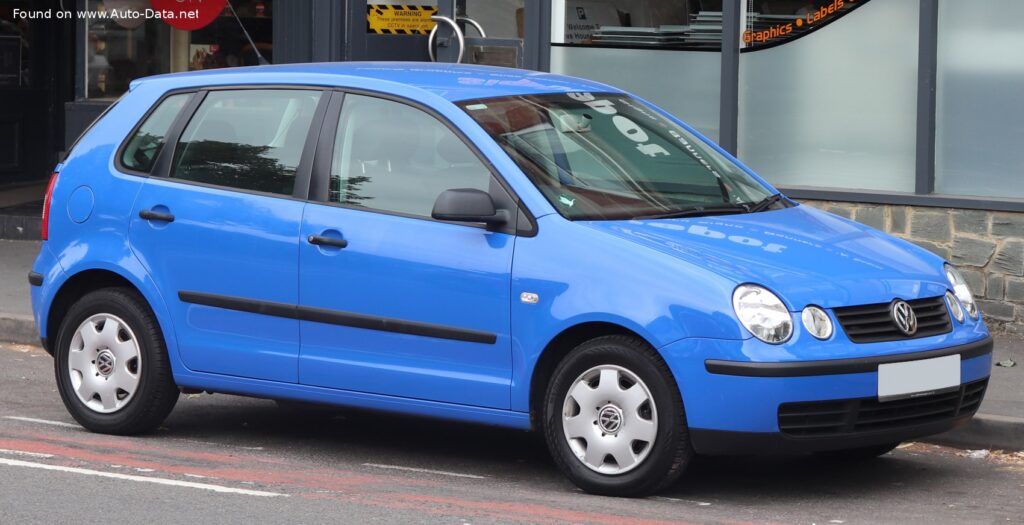
The design of the Volkswagen Polo IV (9N) represented a significant departure from its predecessor, adopting a more grown-up and rounded aesthetic that mirrored the larger Golf IV. Its clean lines, distinctive headlamps, and quality fit-and-finish gave it a premium feel that was uncommon in the subcompact segment at the time. The Polo 9N was available as a versatile hatchback, offered in both 3-door and 5-door configurations, providing options for varied customer needs. With seating for five occupants, it offered a practical interior layout for its compact footprint.
Dimensions for the 9N were 147.36 inches in length, 64.25 inches in width, and 55.83 inches in height, with a wheelbase of 94.76 inches. These dimensions contributed to a surprisingly spacious cabin for a vehicle of its class, particularly for front occupants. The trunk (boot) space was also commendable, offering a minimum of 8.65 cubic feet (245 liters) with the rear seats up, expandable to a generous 34.43 cubic feet (975 liters) when the rear seats were folded down, enhancing its utility for carrying cargo.
Underneath, the Polo 9N utilized a robust suspension setup, featuring coil springs at the front and a trailing arm design at the rear, providing a comfortable ride and stable handling characteristics. Braking was handled by disc brakes at the front and drum brakes at the rear, augmented by an Anti-lock Braking System (ABS) as a crucial safety feature for the era. The hydraulic rack and pinion steering provided direct feedback and ease of maneuverability, particularly appreciated in urban environments. Standard tires were 175/65 R13, mounted on 5.5J x 13-inch wheel rims, contributing to both ride comfort and efficiency.
Technical Specifications
| Category | Specification |
|---|---|
| General Information | |
| Brand | Volkswagen |
| Model | Polo |
| Generation | Polo IV (9N) |
| Type (Engine) | 1.4 16V (75 Hp) |
| Start of Production | 2001 |
| End of Production | 2005 |
| Powertrain Architecture | Internal Combustion Engine |
| Body Type | Hatchback |
| Seats | 5 |
| Doors | 3-5 |
| Performance Specs | |
| Fuel Consumption (Urban) | 26.7 US mpg (8.8 l/100 km) |
| Fuel Consumption (Extra Urban) | 45.2 US mpg (5.2 l/100 km) |
| Fuel Type | Petrol (Gasoline) |
| Acceleration 0 – 60 mph | 12.3 sec |
| Maximum Speed | 106.88 mph (172 km/h) |
| Weight-to-Power Ratio | 12.8 kg/Hp, 78.1 Hp/tonne |
| Weight-to-Torque Ratio | 7.6 kg/Nm, 131.3 Nm/tonne |
| Engine Specs | |
| Power | 75 HP @ 5000 rpm |
| Power per Liter | 54 Hp/l |
| Torque | 92.93 lb.-ft. @ 3800 rpm (126 Nm) |
| Engine Layout | Front, Transverse |
| Engine Model/Code | AUA, BBY, BKY |
| Engine Displacement | 1.4 Liters (1390 cm³, 84.82 cu. in.) |
| Number of Cylinders | 4 |
| Engine Configuration | Inline |
| Cylinder Bore | 3.01 in. (76.5 mm) |
| Piston Stroke | 2.98 in. (75.6 mm) |
| Compression Ratio | 10:1 |
| Number of Valves per Cylinder | 4 |
| Fuel Injection System | Multi-port manifold injection |
| Engine Aspiration | Naturally aspirated engine |
| Valvetrain | OHC |
| Engine Oil Capacity | 3.38 US qt (3.2 l) |
| Coolant Capacity | 4.44 US qt (4.2 l) |
| Space, Volume and Weights | |
| Kerb Weight | 2116.44 lbs (960 kg) |
| Max. Weight | 3284.89 lbs (1490 kg) |
| Max Load | 1168.45 lbs (530 kg) |
| Trunk (boot) Space – Minimum | 8.65 cu. ft. (245 l) |
| Trunk (boot) Space – Maximum | 34.43 cu. ft. (975 l) |
| Fuel Tank Capacity | 11.89 US gal (45 l) |
| Dimensions | |
| Length | 147.36 in. (3743 mm) |
| Width | 64.25 in. (1632 mm) |
| Height | 55.83 in. (1418 mm) |
| Wheelbase | 94.76 in. (2407 mm) |
| Front Track | 54.8 in. (1392 mm) |
| Rear (Back) Track | 55.12 in. (1400 mm) |
| Drivetrain, Brakes and Suspension Specs | |
| Drivetrain Architecture | Front-wheel drive, Internal Combustion Engine |
| Drive Wheel | Front wheel drive |
| Number of Gears and Type of Gearbox | 5 gears, manual transmission |
| Front Suspension | Coil spring |
| Rear Suspension | Trailing arm |
| Front Brakes | Disc |
| Rear Brakes | Drum |
| Assisting Systems | ABS (Anti-lock braking system) |
| Steering Type | Steering rack and pinion |
| Power Steering | Hydraulic Steering |
| Tires Size | 175/65 R13 |
| Wheel Rims Size | 5.5J x 13 |
Legacy and Market Impact
The Volkswagen Polo IV (9N), particularly in its 1.4 16V (75 Hp) guise, carved out a formidable legacy in the European subcompact segment. It was widely regarded as a benchmark for quality and refinement, often dubbed the “baby Golf” due to its similar styling cues and a driving experience that felt more substantial than its size suggested. Its strong build quality, durable powertrains, and sensible engineering contributed to a reputation for reliability and low running costs, which were critical factors for European buyers.
In a segment crowded with strong competitors, the Polo 9N stood out. Its primary rivals included the Ford Fiesta, Opel Corsa (Vauxhall Corsa in the UK), Renault Clio, and Peugeot 206. While some competitors offered more flamboyant styling or sportier handling, the Polo consistently appealed to buyers looking for a more understated, mature, and practical package. Its platform-sharing strategy with the Skoda Fabia and SEAT Ibiza also allowed Volkswagen to leverage economies of scale, offering advanced engineering at a competitive price point, further solidifying its market position.
The Volkswagen Polo IV (9N)‘s impact was profound in its primary markets. It continued the Polo’s tradition of being a top-seller, consistently appearing in the top ranks of European sales charts. It was a popular choice for first-time car buyers, small families, and urban dwellers who appreciated its compact dimensions combined with surprising interior space and Volkswagen’s perceived upscale brand image. The 1.4 16V (75 Hp) model, in particular, embodied the ideal balance for many of these consumers, offering sufficient power for daily tasks without sacrificing fuel economy.
Ultimately, the fourth-generation Polo cemented its place as a cornerstone of Volkswagen’s global product strategy. It demonstrated Volkswagen’s ability to infuse premium qualities into a smaller, more affordable package, influencing subsequent generations of the Polo and other subcompacts. Its enduring presence on European roads years after its production ceased is a testament to its robust design, practical appeal, and lasting significance in the automotive landscape.