Peugeot 307 Station Wagon (facelift 2005): A Practical European Family Hauler
The Peugeot 307 Station Wagon (facelift 2005) 2.0 (140 Hp) represents a significant offering from the French automaker in the highly competitive European C-segment. Launched as part of the 307’s mid-cycle refresh in 2005, this particular variant combined a robust 2.0-liter gasoline engine with the practicality of a station wagon body style, a configuration immensely popular with families and businesses across the continent. While never officially sold in the United States, the 307 played a crucial role in Peugeot’s global strategy, embodying the brand’s commitment to comfort, efficiency, and utilitarian design. This facelifted model, produced from 2005 to 2008, aimed to enhance the original 307’s appeal with updated styling cues, refined interiors, and technological improvements, solidifying its position as a versatile and economical choice in its primary markets.
Engine and Performance
Under the hood, the Peugeot 307 Station Wagon (facelift 2005) 2.0 (140 Hp) featured a naturally aspirated 2.0-liter (1997 cm³) inline-four gasoline engine, designated by Peugeot as the RFJ EW10A or RFN EW10J4. This powerplant was engineered to deliver a balance of usable power and reasonable fuel efficiency for its class and era. It produced a respectable 140 horsepower at 6000 rpm, providing ample thrust for both city driving and highway cruising. Torque output stood at 147.51 lb.-ft. (200 Nm) at 4000 rpm, ensuring decent low-end responsiveness for a vehicle of its size and weight.
The engine’s architecture included a 4-valve per cylinder design, contributing to better breathing and efficiency, paired with a multi-port manifold injection system for precise fuel delivery. Power was channeled to the front wheels via a 5-speed manual transmission, a common and reliable setup for European compacts, offering drivers direct control and engagement.
Fuel economy figures were competitive for the time, with a combined rating of 29.8 US mpg (7.9 l/100 km). Urban driving yielded approximately 21.4 US mpg (11 l/100 km), while extra-urban (highway) consumption improved significantly to 38.6 US mpg (6.1 l/100 km). These figures, combined with a 15.85 US gallon (60-liter) fuel tank, provided a practical cruising range for long European journeys. Emissions were rated at 188 g/km of CO2, meeting the Euro 4 emission standard, which was a key environmental benchmark for vehicles sold in Europe during this period. The car’s weight-to-power ratio stood at 10.5 kg/Hp (95.5 Hp/tonne), indicating a solid performance capability for a family station wagon.
Design and Features of the Peugeot 307 Station Wagon (facelift 2005)
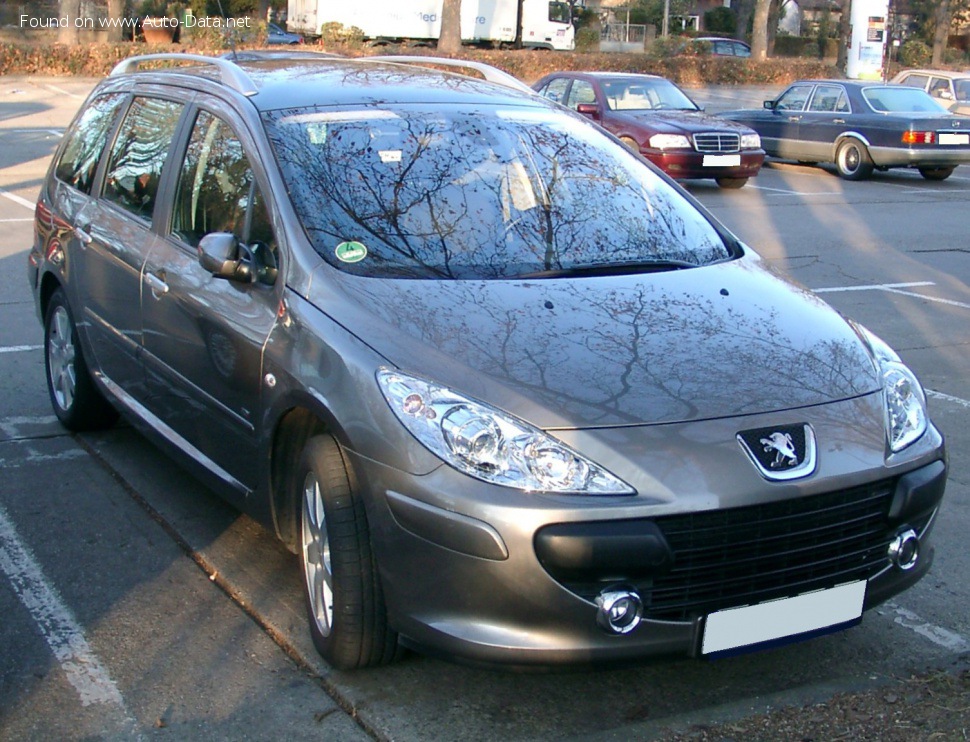
The 307 Station Wagon’s design ethos centered around maximizing interior space and versatility within a compact footprint. The facelift introduced subtle yet effective changes to the exterior, primarily focusing on a more aggressive and modern front fascia. This included revised headlights, a larger, more prominent grille featuring Peugeot’s updated lion badge, and restyled bumpers. These updates brought the 307 in line with Peugeot’s contemporary design language, giving it a fresher and more sophisticated appearance.
Measuring 174.33 inches (4428 mm) in length, 69.37 inches (1762 mm) in width, and between 61.42 to 62.2 inches (1560-1580 mm) in height, the 307 Station Wagon boasted a relatively tall and wide stance for its class, contributing to its impressive interior volume. The generous 106.61-inch (2708 mm) wheelbase was a key factor in providing excellent passenger room for five occupants and a remarkably spacious cargo area.
The true strength of the station wagon variant lay in its cargo capacity. With all five seats in place, the trunk offered a substantial 18.36 cubic feet (520 liters) of space. When the rear seats were folded down, this expanded dramatically to an cavernous 78.08 cubic feet (2211 liters), making the 307 Station Wagon an incredibly practical vehicle for transporting luggage, sports equipment, or even small furniture. This flexibility was a major draw for European consumers who valued utility without sacrificing maneuverability in urban environments.
In terms of features, the 307 Station Wagon was equipped with front ventilated disc brakes and rear disc brakes, complemented by an Anti-lock Braking System (ABS) for enhanced stopping power and control. The steering utilized a rack and pinion system, offering predictable and comfortable handling. While specific interior amenities varied by trim level, typical features for a 2005 European family car would include air conditioning, power windows, a decent audio system, and various storage compartments, all designed to enhance passenger comfort and convenience during long trips.
Technical Specifications
| Category | Specification | Value |
|---|---|---|
| General Information | ||
| Brand | Peugeot | |
| Model | 307 | |
| Generation | 307 Station Wagon (facelift 2005) | |
| Type (Engine) | 2.0 (140 Hp) | |
| Start of Production | 2005 year | |
| End of Production | 2008 year | |
| Powertrain Architecture | Internal Combustion engine | |
| Body Type | Station wagon (estate) | |
| Seats | 5 | |
| Doors | 5 | |
| Performance Specifications | ||
| Fuel Consumption (Economy) – Urban | 21.4 US mpg (11 l/100 km) | |
| Fuel Consumption (Economy) – Extra Urban | 38.6 US mpg (6.1 l/100 km) | |
| Fuel Consumption (Economy) – Combined | 29.8 US mpg (7.9 l/100 km) | |
| CO2 Emissions | 188 g/km | |
| Fuel Type | Petrol (Gasoline) | |
| Emission Standard | Euro 4 | |
| Weight-to-Power Ratio | 10.5 kg/Hp, 95.5 Hp/tonne | |
| Weight-to-Torque Ratio | 7.3 kg/Nm, 136.4 Nm/tonne | |
| Engine Specifications | ||
| Power | 140 Hp @ 6000 rpm | |
| Power per Liter | 70.1 Hp/l | |
| Torque | 147.51 lb.-ft. (200 Nm) @ 4000 rpm | |
| Engine Layout | Front, Transverse | |
| Engine Model/Code | RFJ EW10A, RFN EW10J4 | |
| Engine Displacement | 121.86 cu. in. (1997 cm³) | |
| Number of Cylinders | 4 | |
| Engine Configuration | Inline | |
| Cylinder Bore | 3.35 in. (85 mm) | |
| Piston Stroke | 3.46 in. (88 mm) | |
| Number of Valves per Cylinder | 4 | |
| Fuel Injection System | Multi-port manifold injection | |
| Engine Aspiration | Naturally aspirated engine | |
| Engine Oil Capacity | 4.54 US qt (4.3 l) | |
| Coolant Capacity | 6.55 US qt (6.2 l) | |
| Space, Volume and Weights | ||
| Kerb Weight | 3231.98 lbs. (1466 kg) | |
| Max. Weight (Gross Vehicle Weight) | 4343.11 lbs. (1970 kg) | |
| Max Load | 1111.13 lbs. (504 kg) | |
| Trunk (Boot) Space – Minimum | 18.36 cu. ft. (520 l) | |
| Trunk (Boot) Space – Maximum | 78.08 cu. ft. (2211 l) | |
| Fuel Tank Capacity | 15.85 US gal (60 l) | |
| Permitted Trailer Load with Brakes (12%) | 3306.93 lbs. (1500 kg) | |
| Permitted Trailer Load without Brakes | 1609.37 lbs. (730 kg) | |
| Dimensions | ||
| Length | 174.33 in. (4428 mm) | |
| Width | 69.37 in. (1762 mm) | |
| Height | 61.42 – 62.2 in. (1560 – 1580 mm) | |
| Wheelbase | 106.61 in. (2708 mm) | |
| Front Track | 59.25 in. (1505 mm) | |
| Rear (Back) Track | 59.45 in. (1510 mm) | |
| Front Overhang | 34.96 in. (888 mm) | |
| Rear Overhang | 32.76 in. (832 mm) | |
| Drivetrain, Brakes and Suspension Specifications | ||
| Drivetrain Architecture | The Internal combustion engine (ICE) drives the front wheels of the vehicle. | |
| Drive Wheel | Front wheel drive | |
| Number of Gears and Type of Gearbox | 5 gears, manual transmission | |
| Front Brakes | Ventilated discs | |
| Rear Brakes | Disc | |
| Assisting Systems | ABS (Anti-lock braking system) | |
| Steering Type | Steering rack and pinion | |
Legacy and Market Impact
The Peugeot 307, and particularly its station wagon variant, held a significant position in the European automotive landscape during its production run. It succeeded the hugely popular Peugeot 306 and faced stiff competition from rivals such as the Ford Focus Wagon, Opel Astra Caravan (known as the Saturn Astra in limited US markets), Renault Mégane Estate, and the Volkswagen Golf Variant. Despite the intense competition, the 307 Station Wagon carved out a reputation for its distinctive styling, comfortable ride quality, and exceptional practicality.
Its “tall car” design philosophy, which prioritized vertical space, contributed to an airy cabin feel and easy ingress/egress, features highly valued by families. The 2005 facelift helped maintain its relevance against newer models by refreshing its aesthetics and incorporating minor ergonomic and technical improvements. For European buyers, the 307 Station Wagon offered a compelling blend of French flair, family-friendly utility, and economical operation, particularly with the robust 2.0-liter gasoline engine providing a good balance of performance and fuel efficiency.
While its presence was largely confined to Europe and other international markets, the 307 Station Wagon exemplifies a segment of vehicle design that prioritized function and space over pure performance or luxury. Its legacy lies in its contribution to Peugeot’s continued success in the compact family car segment, proving that practical, well-designed station wagons remained a vital part of the automotive market, especially in regions where SUVs had not yet achieved their current dominance. The 307’s overall impact was one of solid, dependable transportation for the masses, offering a versatile and comfortable solution for everyday life.