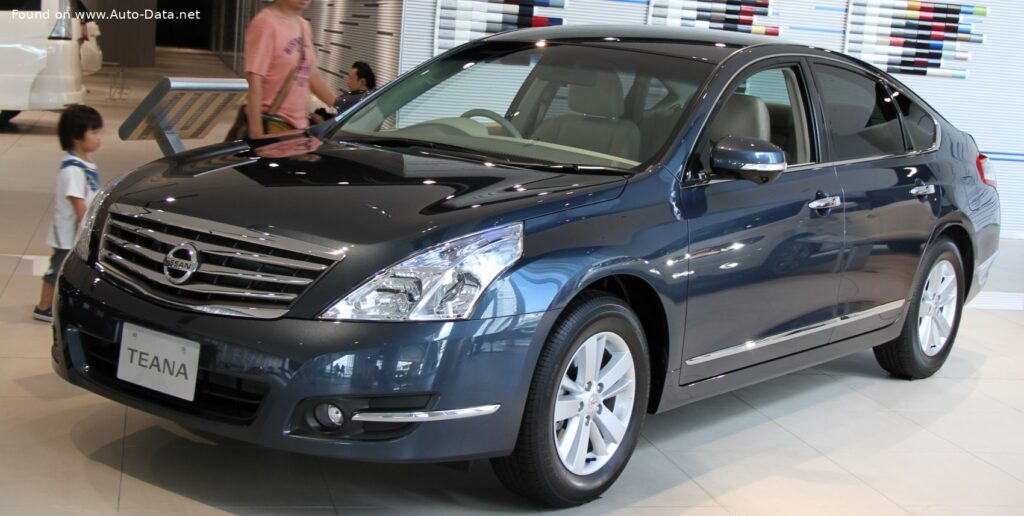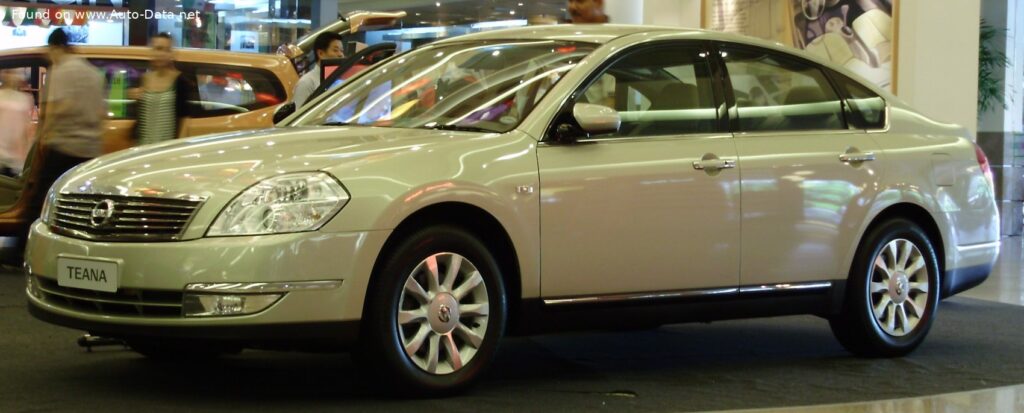
Nissan Teana 2.0 i 16V (136 Hp) (2003-2008)
The first-generation Nissan Teana, produced from 2003 to 2008, represented Nissan’s ambitious foray into the executive mid-size sedan segment, primarily targeting markets outside of North America. The specific variant, the Nissan Teana 2.0 i 16V (136 Hp), was a key offering, providing a balance of refined performance, spacious comfort, and modern styling for its era. While the Teana nameplate might be unfamiliar to American consumers, it played a significant role in Nissan’s global strategy, particularly across Asia, Russia, and select European and Middle Eastern countries, where it competed directly with established players like the Toyota Camry and Honda Accord. This generation of the Teana, internally designated J31, was built on Nissan’s FF-L platform, shared with other global models such as the North American Maxima and Murano, emphasizing its commitment to a comfortable and composed driving experience.
Positioned as a sophisticated and comfortable family or executive sedan, the Teana aimed to offer a more luxurious and spacious alternative to traditional mid-size offerings in its target markets. Its design language was characterized by clean lines and an elegant stance, appealing to a demographic that valued understated luxury and reliability. The 2.0 i 16V variant, with its 136 horsepower engine, served as an accessible entry point into the Teana lineup, promising efficient yet adequate performance for daily commuting and longer journeys alike.
Engine and Performance of the Nissan Teana 2.0 i 16V (136 Hp)
Powering the Nissan Teana 2.0 i 16V (136 Hp) was Nissan’s QR20DE engine, a robust and well-regarded 2.0-liter (121.93 cu. in.) inline-four gasoline unit. This naturally aspirated, multi-port manifold injected engine featured a Double Overhead Camshaft (DOHC) valvetrain with 16 valves (four per cylinder), a configuration known for its efficiency and smooth power delivery. It generated a respectable 136 horsepower at 6000 rpm, providing sufficient motivation for the sedan’s size and weight. Torque output stood at 137.92 lb.-ft. at 4000 rpm, contributing to a responsive feel during typical driving conditions.
The QR20DE engine was transversely mounted at the front, driving the front wheels through a conventional 4-speed automatic transmission. While a 4-speed automatic might seem modest by today’s standards, it was a common and reliable choice for this segment during the early 2000s, prioritizing smooth shifts and durability over outright performance. The powertrain architecture was designed for comfort and ease of driving, reflecting the Teana’s target audience.
In terms of performance, the Teana 2.0 i 16V was capable of accelerating from 0 to 60 mph in a calculated 11.9 seconds, with a top speed of 111.85 mph (180 km/h). These figures placed it competitively within its class, emphasizing its role as a comfortable cruiser rather than a performance-oriented machine. Fuel economy was rated at a combined 23.5 US mpg (10 l/100 km), which was considered reasonable for a mid-size sedan of its weight (3207.73 lbs. curb weight) and engine displacement at the time. The 18.49 US gallon fuel tank capacity provided a good cruising range, enhancing its appeal for long-distance travel.
Design and Features of the Nissan Teana
The first-generation Nissan Teana adopted a design philosophy that emphasized elegance, spaciousness, and understated luxury. Its sedan body style, featuring four doors and seating for five occupants, was characterized by smooth, flowing lines and a confident stance. Measuring 190.75 inches in length, 69.49 inches in width, and 58.07 inches in height, with a substantial 109.25-inch wheelbase, the Teana offered ample interior room, particularly for rear-seat passengers—a crucial selling point in many of its target markets. The generous dimensions also contributed to a comfortable ride quality, absorbing road imperfections with ease.
Inside, the Teana’s cabin was designed with comfort and convenience in mind. While specific trim levels varied by market, the general layout prioritized ergonomics and a refined ambiance. Features commonly found in this variant included power windows, air conditioning, and a multi-speaker audio system. Higher trim levels often offered amenities such as automatic climate control, leather upholstery, and wood grain accents, further elevating its executive appeal. The trunk space was a commendable 16.81 cu. ft. (476 liters), providing ample capacity for luggage or groceries, reinforcing its practicality as a family or executive vehicle.
For safety, the Teana 2.0 i 16V was equipped with an Anti-lock Braking System (ABS), a vital active safety feature for the period, ensuring stable braking performance under various conditions. The braking system comprised ventilated discs at the front and solid discs at the rear, providing confident stopping power. The suspension setup featured coil springs at the front and spring struts at the rear, a conventional arrangement that delivered a balance of ride comfort and handling stability. Steering was managed by a rack and pinion system, offering predictable and easy maneuverability. The vehicle rode on 205/65 R16 tires, a common size that contributed to both ride comfort and grip.
Technical Specifications: Nissan Teana 2.0 i 16V (136 Hp)
| Category | Specification |
|---|---|
| General Information | |
| Brand | Nissan |
| Model | Teana |
| Generation | Teana (J31) |
| Type (Engine) | 2.0 i 16V (136 Hp) |
| Start of Production | 2003 year |
| End of Production | 2008 year |
| Powertrain Architecture | Internal Combustion engine |
| Body type | Sedan |
| Seats | 5 |
| Doors | 4 |
| Performance Specs | |
| Fuel consumption (economy) – urban | 13.2 l/100 km (17.8 US mpg) |
| Fuel consumption (economy) – extra urban | 8.1 l/100 km (29 US mpg) |
| Fuel consumption (economy) – combined | 10 l/100 km (23.5 US mpg) |
| Fuel Type | Petrol (Gasoline) |
| Acceleration 0 – 60 mph | 11.9 sec |
| Acceleration 0 – 100 km/h | 12.5 sec |
| Maximum speed | 180 km/h (111.85 mph) |
| Weight-to-power ratio | 10.7 kg/Hp (93.5 Hp/tonne) |
| Weight-to-torque ratio | 7.8 kg/Nm (128.5 Nm/tonne) |
| Engine Specs | |
| Power | 136 Hp @ 6000 rpm |
| Power per liter | 68.1 Hp/l |
| Torque | 187 Nm @ 4000 rpm (137.92 lb.-ft. @ 4000 rpm) |
| Engine layout | Front, Transverse |
| Engine Model/Code | QR20DE |
| Engine displacement | 1998 cm3 (121.93 cu. in.) |
| Number of cylinders | 4 |
| Engine configuration | Inline |
| Cylinder Bore | 89 mm (3.5 in.) |
| Piston Stroke | 80.3 mm (3.16 in.) |
| Number of valves per cylinder | 4 |
| Fuel injection system | Multi-port manifold injection |
| Engine aspiration | Naturally aspirated engine |
| Valvetrain | DOHC |
| Engine oil capacity | 3.9 l (4.12 US qt) |
| Engine oil specification | Not specified |
| Coolant | 7.4 l (7.82 US qt) |
| Space, Volume and Weights | |
| Kerb Weight | 1455 kg (3207.73 lbs.) |
| Max. weight | 1900 kg (4188.78 lbs.) |
| Max load | 445 kg (981.06 lbs.) |
| Trunk (boot) space – minimum | 476 l (16.81 cu. ft.) |
| Fuel tank capacity | 70 l (18.49 US gal) |
| Dimensions | |
| Length | 4845 mm (190.75 in.) |
| Width | 1765 mm (69.49 in.) |
| Height | 1475 mm (58.07 in.) |
| Wheelbase | 2775 mm (109.25 in.) |
| Front track | 1530 mm (60.24 in.) |
| Rear (Back) track | 1535 mm (60.43 in.) |
| Drivetrain, Brakes and Suspension Specs | |
| Drivetrain Architecture | The Internal combustion engine (ICE) drives the front wheels of the vehicle. |
| Drive wheel | Front wheel drive |
| Number of gears and type of gearbox | 4 gears, automatic transmission |
| Front suspension | Coil spring |
| Rear suspension | Spring Strut |
| Front brakes | Ventilated discs |
| Rear brakes | Disc |
| Assisting systems | ABS (Anti-lock braking system) |
| Steering type | Steering rack and pinion |
| Tires size | 205/65 R16 |
Legacy and Market Impact of the Nissan Teana
The first-generation Nissan Teana, including the Nissan Teana 2.0 i 16V (136 Hp) variant, carved out a significant niche in its intended markets, particularly in Japan, China, Russia, and various Southeast Asian nations. It was not sold in the United States or Canada, where Nissan offered the more performance-oriented Maxima and the more mainstream Altima as its primary mid-size and full-size sedan options. However, in its primary markets, the Teana quickly established a reputation for its compelling blend of comfort, reliability, and spacious interior, making it a popular choice for both private buyers seeking a refined family car and corporate fleets requiring dependable executive transport.
In these regions, the Teana competed fiercely with established rivals such as the Toyota Camry, Honda Accord, Mazda 6, and Hyundai Sonata. What set the Teana apart was often its emphasis on a more luxurious and serene cabin environment, coupled with a smooth, comfortable ride that was highly valued by consumers. Its elegant styling, while perhaps conservative to some, resonated well with buyers who appreciated a sophisticated and understated aesthetic. The 2.0-liter engine, while not the most powerful in the lineup (which also included V6 options), offered a cost-effective solution with adequate performance and reasonable fuel economy, making it a popular choice for daily use in regions where fuel prices or vehicle taxation favored smaller displacement engines.
The Teana was instrumental in reinforcing Nissan’s brand image as a producer of quality, comfortable, and reliable vehicles in these international markets. It demonstrated Nissan’s capability to design and engineer a vehicle that met the specific demands and preferences of diverse global consumer bases, distinguishing itself from its more utilitarian or sport-oriented siblings. Its success laid the groundwork for subsequent generations of the Teana, which continued to evolve and maintain its strong presence in these key markets. The first-generation Teana remains a testament to Nissan’s strategic global product planning during a period of significant corporate revitalization. Its legacy is one of a comfortable, dependable, and elegantly styled sedan that successfully met the needs of a broad international audience.