
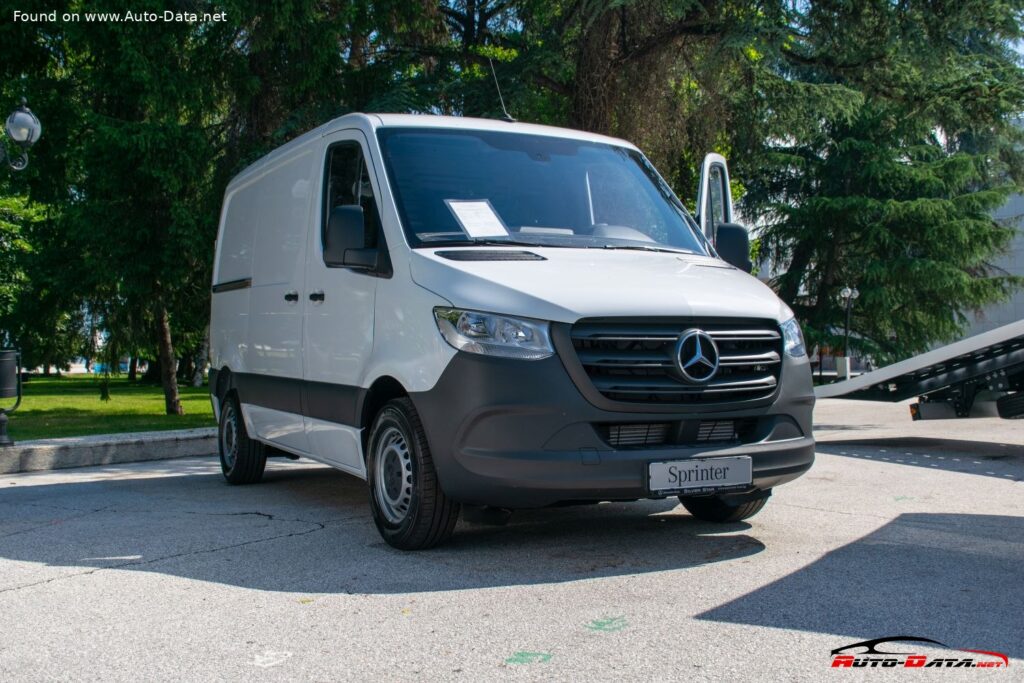
The Mercedes-Benz Sprinter Panel Van Compact (W907/W910) 311 CDI (114 Hp) W910 9G-TRONIC: A Global Workhorse
The Mercedes-Benz Sprinter has long established itself as a benchmark in the commercial van segment, renowned for its versatility, reliability, and advanced engineering. The W907/W910 generation, launched in 2018, continued this legacy, introducing significant technological advancements and improved efficiency. This particular iteration, the Mercedes-Benz Sprinter Panel Van Compact (W907/W910) 311 CDI (114 Hp) W910 9G-TRONIC, represents a core offering within the Sprinter lineup, tailored for urban deliveries, small businesses, and a myriad of commercial applications requiring a balance of maneuverability and cargo capacity. While the Sprinter enjoys a strong presence in the United States, this specific 311 CDI variant, with its 114 horsepower diesel engine, is primarily aimed at European and other international markets where such power outputs are common for efficiency and emissions regulations. Nevertheless, its underlying platform, design philosophy, and advanced transmission system are consistent with the global Sprinter model, demonstrating Mercedes-Benz’s commitment to innovation across its commercial vehicle offerings.
Engine & Performance: The Efficient Heart of the Mercedes-Benz Sprinter Panel Van Compact (W907/W910)
At the core of the Mercedes-Benz Sprinter Panel Van Compact (W907/W910) 311 CDI (114 Hp) W910 9G-TRONIC lies the robust OM 651 diesel engine, a 2.1-liter (2143 cm3 or 130.77 cubic inches) inline four-cylinder unit. This powerplant is designed for durability and efficiency, crucial attributes for any commercial vehicle. Equipped with a turbocharger and intercooler, it delivers 114 horsepower at 3800 rpm, a figure optimized for sustained operation and fuel economy rather than outright speed. More importantly for a utility vehicle, the engine generates a substantial 300 Nm (221.27 lb.-ft.) of torque across a broad and usable range, specifically from 1200 to 2200 rpm. This low-end torque is critical for effortless acceleration, especially when the van is fully loaded or navigating challenging urban environments.
The OM 651 engine utilizes a common rail diesel fuel injection system, ensuring precise fuel delivery for optimal combustion and reduced emissions. This is further complemented by a particulate filter, allowing the vehicle to meet stringent Euro VI emission standards. Power is delivered to the front wheels, a configuration that offers advantages in terms of cargo floor height and interior space utilization compared to traditional rear-wheel-drive vans.
A standout feature of this particular Sprinter variant is its advanced 9G-TRONIC automatic transmission. With nine forward gears, this gearbox is meticulously engineered to provide exceptionally smooth shifts, optimize fuel consumption, and keep the engine operating within its most efficient rev range. The greater number of gears allows for closer ratios, reducing engine strain and enhancing both driving comfort and overall efficiency, whether cruising on the highway or maneuvering in stop-and-go city traffic.
Fuel economy figures for the 311 CDI are impressive for a vehicle of its size and capability. In the NEDC combined cycle, it achieves between 8.0-8.2 l/100 km, translating to approximately 29.4 – 28.7 US mpg. Urban consumption ranges from 8.5-8.6 l/100 km (27.7 – 27.4 US mpg), while extra-urban driving sees figures between 7.8-8.1 l/100 km (30.2 – 29 US mpg). These numbers underscore the engine and transmission’s synergy in delivering cost-effective operation, a key consideration for fleet owners and businesses.
Design & Features: Functional Aesthetics and Practicality
The Mercedes-Benz Sprinter Panel Van Compact (W907/W910) embodies a design philosophy that prioritizes functionality and practicality without sacrificing the distinctive Mercedes-Benz aesthetic. As a panel van, its primary purpose is cargo transport, and the compact designation refers to its shorter length within the Sprinter family, making it more agile in congested urban areas. With a length of 207.36 inches (5267 mm), a width of 79.53 inches (2020 mm), and a height of 92.76 inches (2356 mm), this Sprinter offers a substantial 275.45 cubic feet (7800 liters) of maximum cargo space. This generous volume, combined with a maximum payload capacity of 2380.99 lbs (1080 kg), makes it highly capable for a wide range of commercial tasks, from parcel delivery to equipment transport.
The vehicle features five doors, typically including two front doors, a sliding side door for easy access to the cargo area, and rear swing-out doors. The cabin accommodates three occupants, providing a comfortable and ergonomic workspace for the driver and crew. The design emphasizes ease of loading and unloading, with a relatively low load floor and wide door openings.
From a structural and safety perspective, the Sprinter is built on a robust chassis. The suspension system comprises leaf springs at the front and a combination of hydraulic elements and leaf springs at the rear, designed to handle heavy loads while maintaining stability and ride comfort. Braking is handled by disc brakes on both the front and rear axles, augmented by an Anti-lock Braking System (ABS) for enhanced control during emergency stops. The standard tire size is 225/65 R16 on 6.5J x 16 wheel rims, providing a good balance of load-carrying capacity and road grip.
Additional practical features include a 17.17 US gallon (65-liter) fuel tank and a 5.81 US gallon (22-liter) AdBlue tank for the diesel exhaust fluid, ensuring decent range between refills. The maximum roof load capacity of 661.39 lbs (300 kg) and impressive towing capabilities (4409.25 lbs with brakes, 1653.47 lbs without brakes) further extend the van’s utility, allowing businesses to transport larger items or pull trailers when needed. The compact turning circle of 42.65 ft (13 meters) is particularly beneficial for urban maneuverability, allowing the driver to navigate tight streets and loading docks with greater ease.
Technical Specifications
| Category | Specification | US/Imperial Equivalent |
|---|---|---|
| Brand | Mercedes-Benz | |
| Model | Sprinter | |
| Generation | Sprinter Panel Van Compact (W907/W910) | |
| Type (Engine) | 311 CDI (114 Hp) W910 9G-TRONIC | |
| Start of Production | 2018 year | |
| Powertrain Architecture | Internal Combustion engine | |
| Body Type | Van | |
| Seats | 3 | |
| Doors | 5 | |
| Performance Specs | ||
| Fuel Consumption (Urban, NEDC) | 8.5-8.6 l/100 km | 27.7 – 27.4 US mpg |
| Fuel Consumption (Extra Urban, NEDC) | 7.8-8.1 l/100 km | 30.2 – 29 US mpg |
| Fuel Consumption (Combined, NEDC) | 8-8.2 l/100 km | 29.4 – 28.7 US mpg |
| CO2 Emissions (NEDC) | 210-216 g/km | |
| Fuel Type | Diesel | |
| Emission Standard | Euro VI | |
| Weight-to-Power Ratio | 16.8 kg/Hp | 59.4 Hp/tonne |
| Weight-to-Torque Ratio | 6.4 kg/Nm | 156.3 Nm/tonne |
| Engine Specs | ||
| Power | 114 Hp @ 3800 rpm | |
| Power per Liter | 53.2 Hp/l | |
| Torque | 300 Nm @ 1200-2200 rpm | 221.27 lb.-ft. @ 1200-2200 rpm |
| Engine Layout | Front, Transverse | |
| Engine Model/Code | OM 651 | |
| Engine Displacement | 2143 cm3 | 2.1 Liters / 130.77 cu. in. |
| Number of Cylinders | 4 | |
| Engine Configuration | Inline | |
| Number of Valves per Cylinder | 4 | |
| Fuel Injection System | Diesel Commonrail | |
| Engine Aspiration | Turbocharger, Intercooler | |
| Engine Oil Capacity | 11.5 l | 12.15 US qt |
| Coolant Capacity | 9.5 l | 10.04 US qt |
| Engine Systems | Particulate filter | |
| Space, Volume and Weights | ||
| Kerb Weight | 1920 kg | 4232.88 lbs. |
| Max. Weight (GVWR) | 3000 kg | 6613.87 lbs. |
| Max Load (Payload) | 1080 kg | 2380.99 lbs. |
| Trunk (Boot) Space – Maximum | 7800 l | 275.45 cu. ft. |
| Fuel Tank Capacity | 65 l | 17.17 US gal |
| AdBlue Tank Capacity | 22 l | 5.81 US gal |
| Max. Roof Load | 300 kg | 661.39 lbs. |
| Permitted Trailer Load with Brakes (12%) | 2000 kg | 4409.25 lbs. |
| Permitted Trailer Load without Brakes | 750 kg | 1653.47 lbs. |
| Dimensions | ||
| Length | 5267 mm | 207.36 in. |
| Width | 2020 mm | 79.53 in. |
| Width Including Mirrors | 2345 mm | 92.32 in. |
| Height | 2356 mm | 92.76 in. |
| Wheelbase | 3259 mm | 128.31 in. |
| Front Track | 1759 mm | 69.25 in. |
| Rear (Back) Track | 1770 mm | 69.69 in. |
| Front Overhang | 1012 mm | 39.84 in. |
| Rear Overhang | 996 mm | 39.21 in. |
| Ride Height (Ground Clearance) | 143 mm | 5.63 in. |
| Minimum Turning Circle (Diameter) | 13 m | 42.65 ft. |
| Drivetrain, Brakes and Suspension Specs | ||
| Drivetrain Architecture | The Internal combustion engine (ICE) drives the front wheels of the vehicle. | |
| Drive Wheel | Front wheel drive | |
| Number of Gears and Type of Gearbox | 9 gears, automatic transmission G-TRONIC | |
| Front Suspension | Leaf spring | |
| Rear Suspension | Hydraulic elements, Leaf spring | |
| Front Brakes | Disc | |
| Rear Brakes | Disc | |
| Assisting Systems | ABS (Anti-lock braking system) | |
| Tires Size | 225/65 R16 | |
| Wheel Rims Size | 6.5J x 16 | |
Legacy & Market Impact
The Mercedes-Benz Sprinter, including the W907/W910 generation and its compact panel van variants like the 311 CDI, holds an undeniable position as a global leader in the commercial van segment. Its reputation for durability, advanced technology, and operational efficiency has made it a preferred choice for businesses across various industries, from logistics and construction to passenger transport and emergency services. The introduction of the W907/W910 series in 2018 marked a significant evolution, bringing enhanced connectivity features, improved safety systems, and a more refined driving experience to the segment.
While this specific 311 CDI (114 Hp) variant is more common in markets prioritizing lower power outputs for fuel efficiency and specific vehicle class regulations, it nonetheless contributes to the Sprinter’s overall legacy. It showcases Mercedes-Benz’s ability to tailor its core platform to diverse global needs, offering a spectrum of engine options to suit different operating environments and customer demands. In Europe, where this variant is particularly prevalent, it competes fiercely with rivals such as the Ford Transit, Volkswagen Crafter, Renault Master, and Fiat Ducato. Its robust build quality, comprehensive service network, and strong resale value often give it an edge in a competitive market.
In the North American market, the Sprinter primarily features more powerful diesel and gasoline engine options to meet different market preferences and regulations. However, the foundational engineering, the advanced 9G-TRONIC transmission, and the innovative chassis design found in the 311 CDI are shared across the global Sprinter lineup, highlighting Mercedes-Benz’s unified approach to commercial vehicle excellence. The front-wheel-drive architecture, as seen in this compact panel van, represents a strategic move to maximize cargo space and improve traction in certain conditions, further broadening the Sprinter’s appeal.
The Sprinter’s historical significance lies in its pioneering role in defining the modern large commercial van. Since its inception, it has continually pushed boundaries in terms of safety, technology, and driver comfort, setting standards that competitors strive to match. The W907/W910 generation continues this tradition, integrating features like advanced driver-assistance systems (though not explicitly detailed for this base variant, they are available on the platform) and improved ergonomics, transforming the commercial van from a utilitarian workhorse into a sophisticated mobile office. The Mercedes-Benz Sprinter Panel Van Compact (W907/W910) 311 CDI (114 Hp) W910 9G-TRONIC, therefore, is not merely a vehicle; it is a vital component of countless businesses worldwide, embodying efficiency, reliability, and the enduring quality associated with the Mercedes-Benz brand.
