The Rover Mini MK I 1.3 i (63 Hp): A Late-Generation Icon
The Rover Mini MK I 1.3 i (63 Hp) represents a significant chapter in the storied history of one of the automotive world’s most recognizable and beloved vehicles. Produced between 1991 and 1996, this particular iteration falls within the later stages of the classic Mini’s production run under the Rover Group, before its eventual reinterpretation by BMW. While the “MK I” designation might seem to suggest an early model, in the context of Rover’s naming conventions for its Mini range, it often referred to a specific series or trim level rather than the very first generation of the original Mini. This variant, specifically, integrated modern (for its time) fuel injection technology into the venerable A-series engine, ensuring the Mini could meet evolving emissions standards while retaining its characteristic charm and driving dynamics. Positioned as a compact hatchback, the Rover Mini MK I 1.3 i (63 Hp) continued to serve as an accessible and iconic city car, particularly dominant in the European and Japanese markets where its diminutive size and agile handling made it perfectly suited for congested urban environments.
Despite its production era, which placed it alongside more technologically advanced and larger competitors, the Rover Mini MK I 1.3 i (63 Hp) remained true to the original design principles laid down by Sir Alec Issigonis in 1959. It maintained the transverse-mounted engine, front-wheel-drive layout, and remarkably efficient use of interior space. Its enduring appeal was a testament to its timeless design and the unique driving experience it offered. For many, this late-model classic Mini was the perfect blend of traditional Mini character with a touch of modern reliability and drivability, making it a highly sought-after vehicle for enthusiasts and collectors worldwide, even if it was never officially sold in the United States.
Engine and Performance of the Rover Mini MK I 1.3 i (63 Hp)
At the heart of the Rover Mini MK I 1.3 i (63 Hp) was the final evolution of the legendary A-series engine, a 1.3-liter (1273 cm3 or 77.68 cu. in.) naturally aspirated inline-four gasoline unit. This particular variant benefited from a single-point fuel injection system, a crucial upgrade from earlier carbureted versions. This transition to fuel injection was primarily driven by the need to comply with stricter emissions regulations emerging in the early 1990s, particularly in Europe. The single-point injection, while simpler than a multi-point system, offered improved fuel economy, smoother idle, and more consistent performance compared to its predecessors.
The engine produced a respectable 63 horsepower at 5700 rpm and 70.07 lb.-ft. of torque at 3900 rpm. While these figures may seem modest by contemporary standards, they were more than adequate for a vehicle weighing a mere 1543.24 pounds (700 kg). The Mini’s exceptional power-to-weight ratio (approximately 90 HP per tonne or 11.1 kg/Hp) meant that it felt surprisingly peppy and agile. Paired with a four-speed manual transmission, the Mini could accelerate from 0 to 60 mph in a brisk 11.9 seconds, with a top speed of 91.96 mph (148 km/h). These performance metrics underscored its capability as an urban commuter and a spirited backroad companion.
Fuel efficiency was also a strong suit for the Mini, even with its older engine architecture. The combined fuel consumption was rated at an impressive 32.2 US mpg (7.3 l/100 km), making it an economical choice for daily driving. The engine’s layout, front and transverse, driving the front wheels, was a groundbreaking design in its time and contributed significantly to the Mini’s renowned packaging efficiency and handling characteristics. Its compression ratio of 10.1:1 and two valves per cylinder were standard for the era, providing a robust and reliable powertrain that, despite its age, continued to deliver the distinctive Mini driving experience.
Design and Features
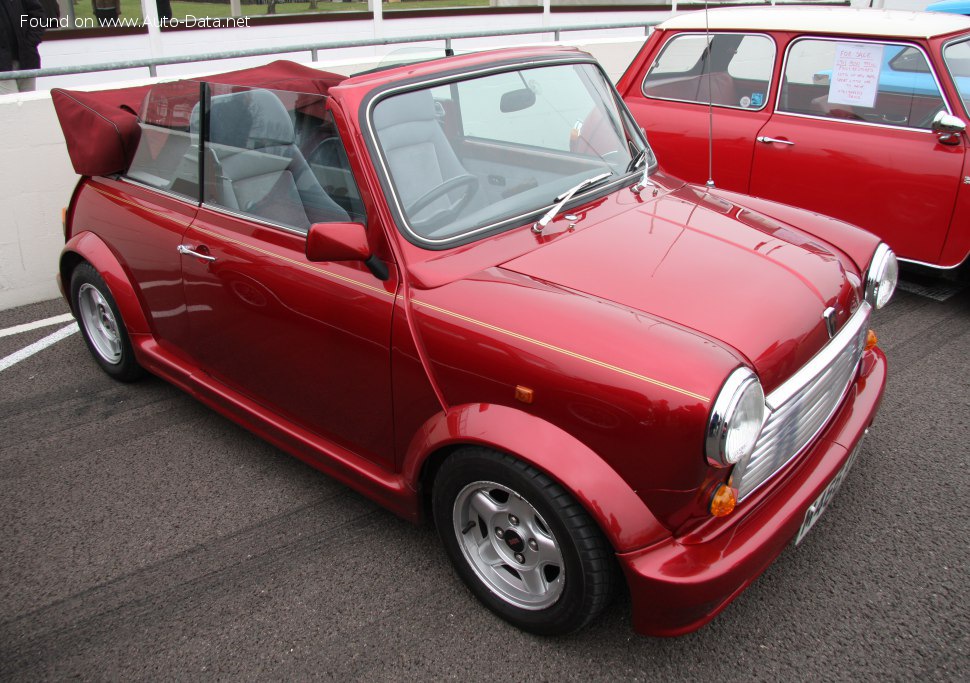
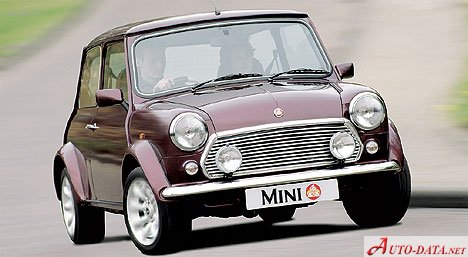
The design of the Rover Mini MK I 1.3 i (63 Hp) was, unmistakably, a Mini. It adhered rigidly to the iconic two-box, three-door hatchback body style that had charmed the world for decades. Its diminutive dimensions – 122.05 inches in length, 56.69 inches in width, and 53.19 inches in height – were central to its appeal, allowing for exceptional maneuverability and ease of parking in tight city spaces. The wheelbase of 80.12 inches further contributed to its famously nimble “go-kart” handling, a trait that drivers universally lauded.
Despite its compact exterior, the Mini was remarkably space-efficient. Officially, it was designed to accommodate five occupants, though realistically, the rear bench was more suited for two adults or children. The minimalist interior, often featuring a central speedometer (though some later models moved it to a more conventional position in front of the driver), toggle switches, and exposed seams, spoke to its utilitarian origins but also contributed to its unique charm. The trunk space was a modest 4.24 cubic feet (120 liters), sufficient for daily errands but highlighting its primary role as a city car rather than a long-distance tourer.
In terms of features, the 1990s Mini, including this 1.3 i variant, started to incorporate more modern amenities and safety considerations. A notable inclusion for this model was the Anti-lock Braking System (ABS), a significant safety enhancement for a car of its size and vintage. The braking system comprised discs at the front and drums at the rear, a common setup for light vehicles. The suspension system, featuring wishbones at the front and trailing arms at the rear, was fundamental to the Mini’s legendary handling, offering a firm yet communicative ride. The steering utilized a rack and pinion system, providing direct feedback to the driver. The small 145/70 R12 Q tires were perfectly matched to the car’s lightweight and agile nature, ensuring responsive turn-in and grip for its intended purpose.
Technical Specifications
| Category | Specification |
|---|---|
| General Information | |
| Brand | Rover |
| Model | Mini MK |
| Generation | Mini MK I |
| Type (Engine) | 1.3 i (63 Hp) |
| Start of Production | 1991 year |
| End of Production | 1996 year |
| Powertrain Architecture | Internal Combustion engine |
| Body Type | Hatchback |
| Seats | 5 |
| Doors | 3 |
| Performance Specs | |
| Fuel Consumption (combined) | 7.3 l/100 km (32.2 US mpg) |
| Fuel Type | Petrol (Gasoline) |
| Acceleration 0 – 60 mph | 11.9 sec |
| Acceleration 0 – 62 mph (0 – 100 km/h) | 12.5 sec |
| Maximum Speed | 91.96 mph (148 km/h) |
| Weight-to-Power Ratio | 11.1 kg/Hp (90 Hp/tonne) |
| Weight-to-Torque Ratio | 7.4 kg/Nm (135.7 Nm/tonne) |
| Engine Specs | |
| Power | 63 Hp @ 5700 rpm |
| Power per liter | 49.5 Hp/l |
| Torque | 95 Nm (70.07 lb.-ft.) @ 3900 rpm |
| Engine Layout | Front, Transverse |
| Engine Displacement | 1273 cm3 (1.3 liters, 77.68 cu. in.) |
| Number of Cylinders | 4 |
| Engine Configuration | Inline |
| Cylinder Bore | 70.6 mm (2.78 in.) |
| Piston Stroke | 81.3 mm (3.2 in.) |
| Compression Ratio | 10.1:1 |
| Number of Valves per Cylinder | 2 |
| Fuel Injection System | Single-point injection |
| Engine Aspiration | Naturally aspirated engine |
| Engine Oil Capacity | 4.8 l (5.07 US qt) |
| Coolant Capacity | 4 l (4.23 US qt) |
| Space, Volume and Weights | |
| Kerb Weight | 700 kg (1543.24 lbs) |
| Max. Weight | 1050 kg (2314.85 lbs) |
| Max Load | 350 kg (771.62 lbs) |
| Trunk (Boot) Space – Minimum | 120 l (4.24 cu. ft.) |
| Fuel Tank Capacity | 34 l (8.98 US gal) |
| Dimensions | |
| Length | 3100 mm (122.05 in.) |
| Width | 1440 mm (56.69 in.) |
| Height | 1351 mm (53.19 in.) |
| Wheelbase | 2035 mm (80.12 in.) |
| Front Track | 1250 mm (49.21 in.) |
| Rear (Back) Track | 1208 mm (47.56 in.) |
| Minimum Turning Circle | 8.6 m (28.22 ft.) |
| Drivetrain, Brakes and Suspension Specs | |
| Drivetrain Architecture | The Internal combustion engine (ICE) drives the front wheels of the vehicle. |
| Drive Wheel | Front-wheel drive |
| Number of Gears and Type of Gearbox | 4 gears, manual transmission |
| Front Suspension | Wishbone |
| Rear Suspension | Trailing arm |
| Front Brakes | Disc |
| Rear Brakes | Drum |
| Assisting Systems | ABS (Anti-lock braking system) |
| Steering Type | Steering rack and pinion |
| Tires Size | 145/70 R12 Q |
Legacy and Market Impact
The Rover Mini MK I 1.3 i (63 Hp) holds a unique place in automotive history, not just as another variant of the Mini, but as a crucial bridge between the original, carbureted classics and the modern interpretation. Its production from 1991 to 1996 meant it was one of the last iterations of the true Issigonis design before BMW’s acquisition of Rover and the subsequent launch of the “New MINI” in 2001. This period saw the Mini evolving to meet contemporary demands without sacrificing its core identity.
In its primary markets, particularly Europe and Japan, the Mini remained a strong seller throughout the 1990s. Its compact size was invaluable in densely populated cities, and its reputation for agile handling and a fun-to-drive character ensured its continued popularity. While it competed with a new generation of small hatchbacks like the Ford Fiesta, Peugeot 205, and Renault Clio, the Mini largely occupied its own niche. These competitors might have offered more modern interiors, better crash safety, or more powerful engines, but none could match the Mini’s unparalleled heritage, iconic status, or its distinct “go-kart” driving feel. The Mini’s influence stretched beyond mere sales figures; it was a cultural icon, appearing in countless films, TV shows, and advertisements, cementing its place in popular consciousness.
The introduction of single-point fuel injection and, notably, ABS, allowed the Mini to stay relevant and meet tightening regulations, proving that the nearly 40-year-old design could still adapt. These features made the later classic Minis more practical and safer for everyday use, enhancing their appeal to a broader audience who might have otherwise been deterred by the perceived antiquated nature of earlier models. The 1.3 i engine, with its balance of power and efficiency, was well-suited to the Mini’s lightweight chassis, contributing to its enduring reputation for lively performance.
Today, the Rover Mini MK I 1.3 i (63 Hp) is highly regarded by enthusiasts. It represents the culmination of the classic Mini’s development, offering a blend of traditional charm with modern reliability features. These late-model Minis are often sought after for their drivability, their relative ease of maintenance compared to older carbureted versions, and their inherent collectibility. They serve as a vibrant testament to a design that defied convention and proved that sometimes, the best way forward is to refine and cherish a timeless classic rather than completely reinvent it. The legacy of the Mini, and this specific variant, continues to resonate, reminding us of a time when small cars delivered big personalities and driving enjoyment.