
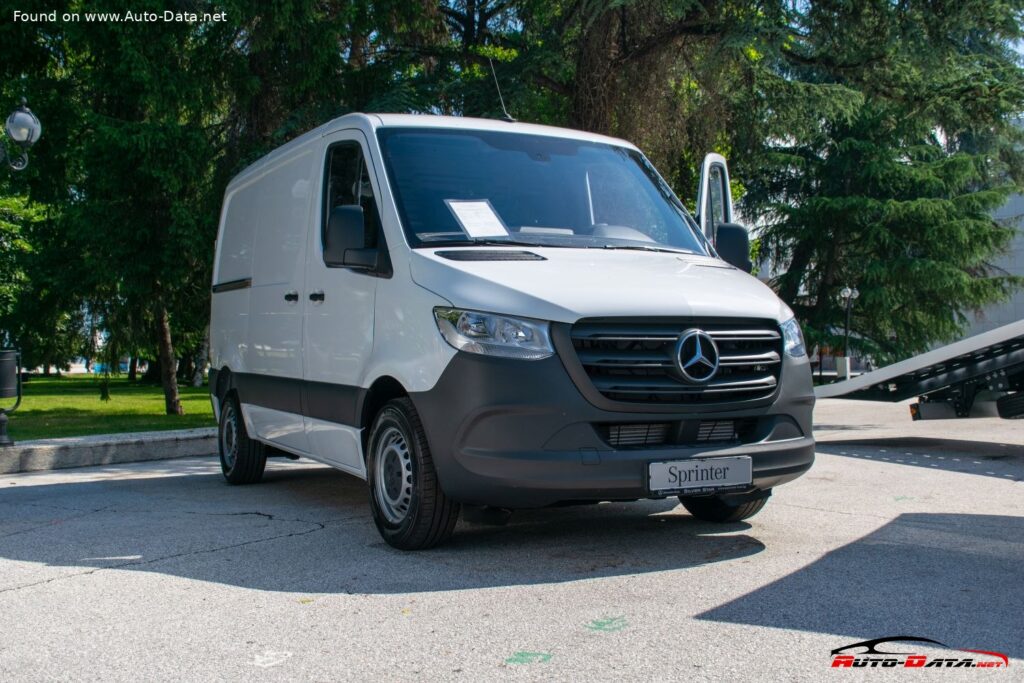
The Mercedes-Benz Sprinter Panel Van Compact (W907/W910) 314 CDI (143 Hp) W907 G-TRONIC: A Pillar of Commercial Efficiency
The Mercedes-Benz Sprinter has long been a benchmark in the light commercial vehicle (LCV) segment, renowned for its robustness, versatility, and advanced engineering. The specific model, the Mercedes-Benz Sprinter Panel Van Compact (W907/W910) 314 CDI (143 Hp) W907 G-TRONIC, represents the third generation of this iconic van, introduced in 2018. This iteration, designated W907 for rear-wheel drive and W910 for all-wheel drive variants, brought significant advancements in technology, comfort, and efficiency, solidifying its position as a premium choice for businesses requiring dependable transportation solutions. The “Compact” designation refers to one of the multiple length configurations available, offering a balance between cargo capacity and maneuverability, particularly suited for urban delivery routes and trades where space is at a premium.
As a global product, the Sprinter plays a critical role across continents, including a substantial presence in the North American market where it competes fiercely with other full-size vans. While the “314 CDI” nomenclature is specific to European markets, indicating a 3.5-ton gross vehicle weight rating and a 143 horsepower diesel engine, the underlying engineering principles and many features are shared with its American counterparts. This particular variant, equipped with the G-TRONIC automatic transmission, emphasizes ease of driving and optimized fuel consumption, making it an attractive proposition for fleet operators and independent contractors alike.
Engine and Performance: Powering the Mercedes-Benz Sprinter Panel Van Compact (W907/W910)
At the heart of the Mercedes-Benz Sprinter Panel Van Compact (W907/W910) 314 CDI lies the venerable OM 651 engine, a 2.1-liter (2143 cm³) inline-four diesel powerplant. This engine is a testament to Mercedes-Benz’s commitment to efficient and powerful commercial vehicle propulsion. Utilizing a common rail fuel injection system, coupled with a turbocharger and intercooler, the OM 651 delivers a respectable 143 horsepower at 3800 rpm. More critically for a commercial vehicle, it produces a robust 243.4 lb.-ft. (330 Nm) of torque, available across a broad and usable range from 1200 to 2400 rpm. This low-end torque is crucial for effortless acceleration, hauling heavy loads, and maintaining speed on inclines, which are daily demands for a panel van.
Power is efficiently transferred to the rear wheels via a sophisticated 7-speed G-TRONIC automatic transmission. This advanced gearbox is designed to optimize gear selection for both performance and fuel economy, providing smooth shifts that reduce driver fatigue during long working hours. The rear-wheel-drive architecture is a classic choice for vans, offering superior traction under heavy loads and better weight distribution for towing. With fuel consumption figures ranging from 29.4 to 32.2 US mpg combined (NEDC), this Sprinter variant demonstrates impressive efficiency for its class, helping businesses manage operational costs. Adherence to the Euro 6 emission standard, complemented by a particulate filter, underscores Mercedes-Benz’s dedication to environmental responsibility and compliance with stringent regulations.
Design and Features: Form Meets Function in the Mercedes-Benz Sprinter
The Mercedes-Benz Sprinter Panel Van Compact (W907/W910) is a masterclass in functional design. As a panel van, its primary purpose is utility, and every aspect of its design serves this goal. The compact length of 207.36 inches (5267 mm) and a width of 79.53 inches (2020 mm) without mirrors (92.32 inches or 2345 mm with mirrors) strike an excellent balance. This size allows for agile navigation through congested urban environments and tight loading docks, while still offering a substantial cargo volume of 264.86 cubic feet (7500 liters). The five-door configuration, typically comprising two front doors, a sliding side door, and rear barn doors, ensures flexible access to the cargo area for various loading and unloading scenarios.
Inside, the driver-centric cabin is designed for comfort and practicality. With seating for three, the Sprinter prioritizes ergonomics, offering a commanding driving position and intuitive controls. While not explicitly detailed in the provided data, modern Sprinters of this generation are known for advanced infotainment systems, connectivity options, and a suite of driver-assistance technologies that enhance safety and reduce driver strain. Key safety features include an Anti-lock Braking System (ABS), standard on all Sprinters, providing crucial control during emergency braking maneuvers.
The robust suspension system, featuring leaf springs at the front and a combination of hydraulic elements and leaf springs at the rear, is engineered to handle substantial payloads. With a maximum load capacity of 3328.98 lbs. (1510 kg) and a maximum gross vehicle weight of 7716.18 lbs. (3500 kg), the Sprinter 314 CDI is well-equipped for demanding commercial tasks. The vehicle’s durable construction extends to its 225/65 R16 tires mounted on 6.5J x 16 wheel rims, providing excellent grip and load-bearing capability. Furthermore, the impressive 4409.25 lbs. (2000 kg) permitted trailer load with brakes enhances its utility for businesses requiring towing capabilities.
Technical Specifications
| Category | Specification | Value (US/Metric) |
|---|---|---|
| General Information | ||
| Brand | Mercedes-Benz | |
| Model | Sprinter | |
| Generation | Sprinter Panel Van Compact (W907/W910) | |
| Type (Engine) | 314 CDI (143 Hp) W907 G-TRONIC | |
| Start of Production | 2018 year | |
| Powertrain Architecture | Internal Combustion Engine (ICE) | |
| Body Type | Van | |
| Seats | 3 | |
| Doors | 5 | |
| Performance Specifications | ||
| Fuel consumption (economy) – urban (NEDC) | 25.3 – 32.7 US mpg (7.2-9.3 l/100 km) | |
| Fuel consumption (economy) – extra urban (NEDC) | 30.2 – 33.6 US mpg (7-7.8 l/100 km) | |
| Fuel consumption (economy) – combined (NEDC) | 29.4 – 32.2 US mpg (7.3-8 l/100 km) | |
| CO2 emissions (NEDC) | 192-210 g/km | |
| Fuel Type | Diesel | |
| Emission Standard | Euro 6 | |
| Weight-to-power ratio | 13.9 kg/Hp, 71.9 Hp/tonne | |
| Weight-to-torque ratio | 6 kg/Nm, 165.8 Nm/tonne | |
| Engine Specifications | ||
| Power | 143 Hp @ 3800 rpm | |
| Power per liter | 66.7 Hp/l | |
| Torque | 243.4 lb.-ft. (330 Nm) @ 1200-2400 rpm | |
| Engine Layout | Front, Transverse | |
| Engine Model/Code | OM 651 | |
| Engine Displacement | 2.1 Liters (2143 cm³, 130.77 cu. in.) | |
| Number of Cylinders | 4 | |
| Engine Configuration | Inline | |
| Number of Valves per Cylinder | 4 | |
| Fuel Injection System | Diesel Commonrail | |
| Engine Aspiration | Turbocharger, Intercooler | |
| Engine Oil Capacity | 12.15 US qt (11.5 l) | |
| Engine Oil Specification | Not specified | |
| Coolant Capacity | 10.04 US qt (9.5 l) | |
| Engine Systems | Particulate filter | |
| Space, Volume, and Weights | ||
| Kerb Weight | 4387.2 lbs. (1990 kg) | |
| Max. Weight (GVWR) | 7716.18 lbs. (3500 kg) | |
| Max Load | 3328.98 lbs. (1510 kg) | |
| Trunk (boot) space – maximum | 264.86 cu. ft. (7500 l) | |
| Fuel Tank Capacity | 18.76 US gal (71 l) | |
| AdBlue Tank Capacity | 5.81 US gal (22 l) | |
| Max. Roof Load | 661.39 lbs. (300 kg) | |
| Permitted Trailer Load with Brakes (12%) | 4409.25 lbs. (2000 kg) | |
| Permitted Trailer Load without Brakes | 1653.47 lbs. (750 kg) | |
| Dimensions | ||
| Length | 207.36 in. (5267 mm) | |
| Width | 79.53 in. (2020 mm) | |
| Width including mirrors | 92.32 in. (2345 mm) | |
| Height | 92.76 in. (2356 mm) | |
| Wheelbase | 127.95 in. (3250 mm) | |
| Front Track | 69.25 in. (1759 mm) | |
| Rear (Back) Track | 69.69 in. (1770 mm) | |
| Front Overhang | 40.2 in. (1021 mm) | |
| Rear Overhang | 39.21 in. (996 mm) | |
| Ride Height (Ground Clearance) | 5.63 in. (143 mm) | |
| Minimum Turning Circle (Turning Diameter) | 39.7 ft. (12.1 m) | |
| Drivetrain, Brakes, and Suspension Specifications | ||
| Drivetrain Architecture | The Internal Combustion Engine (ICE) drives the rear wheels of the vehicle. | |
| Drive Wheel | Rear wheel drive | |
| Number of Gears and Type of Gearbox | 7 gears, automatic transmission G-TRONIC | |
| Front Suspension | Leaf spring | |
| Rear Suspension | Hydraulic elements, Leaf spring | |
| Front Brakes | Disc | |
| Rear Brakes | Disc | |
| Assisting Systems | ABS (Anti-lock braking system) | |
| Tires Size | 225/65 R16 | |
| Wheel Rims Size | 6.5J x 16 | |
Legacy and Market Impact
The Mercedes-Benz Sprinter, including the Mercedes-Benz Sprinter Panel Van Compact (W907/W910) variant, has carved out an indelible legacy in the global commercial vehicle market. Since its inception, the Sprinter has consistently set standards for comfort, safety, and operational efficiency in the van segment. Its reputation for durability and reliability makes it a preferred choice for businesses where vehicle downtime directly impacts profitability. The W907/W910 generation, in particular, further cemented this standing by integrating more advanced safety features, enhanced connectivity, and improved ergonomics, catering to the evolving demands of modern logistics and service industries.
In the highly competitive light commercial vehicle sector, the Sprinter faces strong rivals such as the Ford Transit, Ram ProMaster (based on the Fiat Ducato), and in international markets, the Volkswagen Crafter. However, the Sprinter often distinguishes itself through its premium build quality, sophisticated powertrain options, and the prestige associated with the Mercedes-Benz brand. Its versatile platform allows for extensive customization and upfitting, ranging from basic cargo transport to specialized applications like refrigerated delivery, mobile workshops, or passenger shuttles, making it an incredibly adaptable tool for a diverse array of businesses.
The economic impact of the Sprinter is significant. It empowers countless small and large businesses by providing a reliable and efficient means of transport for goods and services. Its continuous evolution, focusing on driver comfort, fuel economy, and advanced safety systems, reflects a deep understanding of the challenges faced by commercial operators. The Mercedes-Benz Sprinter Panel Van Compact (W907/W910) 314 CDI (143 Hp) W907 G-TRONIC, with its balanced performance, compact dimensions, and robust cargo capabilities, remains a vital component in the intricate web of global commerce, symbolizing efficiency and reliability in the professional transportation landscape.
