The Renault Megane III Grandtour (Phase II, 2012): A Practical European Workhorse
The Renault Megane III Grandtour (Phase II, 2012) represents a significant iteration of Renault’s popular compact family car, specifically tailored for the European market. Introduced in 2012 as part of the Megane’s third generation, and an update within that generation (Phase II), this particular model, equipped with the 1.5 dCi (110 Hp) FAP engine, embodies the pragmatic approach to motoring prevalent across the continent. As a station wagon (known as an estate in Europe), it prioritizes versatility, fuel efficiency, and everyday usability for families and individuals requiring ample cargo space without the larger footprint of an SUV. While never officially sold in the United States, the Megane series has been a cornerstone of Renault’s global lineup, competing fiercely in the C-segment against established rivals with its blend of French design, comfort, and economical powertrains.
Engine and Performance of the Renault Megane III Grandtour (Phase II, 2012)
At the heart of this particular Renault Megane III Grandtour (Phase II, 2012) variant is the venerable K9K 656 1.5-liter (89.16 cu. in.) dCi (common rail direct injection) diesel engine. This four-cylinder inline powerplant, transversely mounted in the front, was engineered for impressive fuel economy and robust torque delivery, characteristics highly valued in its primary markets. Generating 110 horsepower at 4000 rpm, the engine delivers a respectable 75.3 Hp per liter, a testament to its efficient design. More notably, it produces 240 Nm (177.01 lb.-ft.) of torque at a low 1750 rpm, providing strong pulling power for daily driving and highway cruising, even when fully loaded or towing.
The engine’s performance figures reflect its focus on economy rather than outright speed. The Renault Megane III Grandtour (Phase II, 2012) accelerates from 0 to 60 mph in a calculated 12 seconds, reaching a maximum speed of 118.06 mph. Power is transmitted to the front wheels via a smooth-shifting 6-speed manual transmission, offering drivers precise control and further aiding fuel efficiency. A key feature of this powertrain is the inclusion of a turbocharger and intercooler, which optimize air intake for improved combustion and power output. Furthermore, the engine incorporates a Diesel Particulate Filter (FAP), ensuring compliance with Euro 5 emission standards and contributing to a relatively low CO2 output of 106 g/km, making it an environmentally conscious choice for its era.
Fuel economy is a standout attribute of this model. The combined cycle consumption is an impressive 4.1 liters per 100 kilometers, translating to approximately 57.4 US mpg. Urban driving yields around 48 US mpg, while extra-urban (highway) figures soar to an outstanding 67.2 US mpg, showcasing the efficiency benefits of a modern diesel engine paired with a manual transmission. This exceptional fuel economy made the Megane Grandtour a highly cost-effective vehicle to operate, particularly in regions with higher fuel prices.
Design and Features
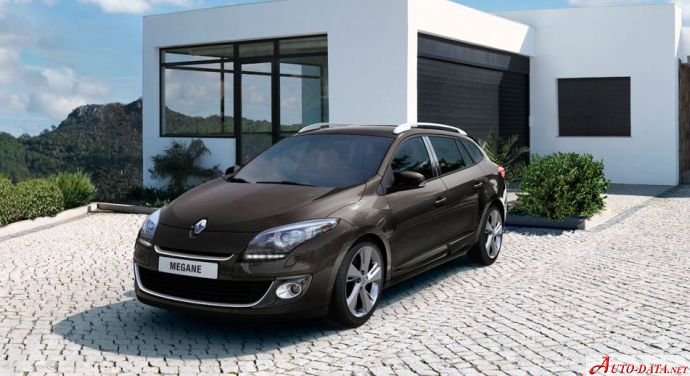
The Renault Megane III Grandtour (Phase II, 2012) boasts a practical and aesthetically pleasing station wagon body style, designed with functionality and family needs in mind. Measuring 179.49 inches in length, 69.53 inches in width, and 57.52 inches in height, it strikes a balance between maneuverability in urban environments and generous interior space. The 106.42-inch wheelbase contributes to a stable ride and ample legroom for its five occupants.
Inside, the Megane Grandtour offers comfortable seating for five adults across two rows. The true highlight, however, is its cargo versatility. With the rear seats in place, the trunk provides a substantial 18.5 cubic feet of storage. Folding down the rear seats expands this capacity significantly to a cavernous 56.33 cubic feet, making it capable of handling large loads, from luggage for family vacations to bulky items for home projects. The maximum payload capacity stands at 1223.57 lbs, further enhancing its utility.
From a chassis and safety perspective, the Megane III Grandtour features a robust setup. The front suspension employs an independent McPherson strut system, providing a comfortable and predictable ride, while the rear utilizes an elastic beam, a common and cost-effective solution for compact front-wheel-drive vehicles that balances ride comfort and cargo capacity. Braking is handled by ventilated discs at the front and solid discs at the rear, complemented by an Anti-lock Braking System (ABS) for enhanced stopping power and stability. The vehicle also benefits from an electric power steering system, offering light and precise control, particularly at lower speeds, which aids maneuverability in tight spaces with a minimum turning circle of 36.25 feet. The car rides on 195/65 R15 tires mounted on 6.5J x 15-inch wheel rims.
Technical Specifications
| Category | Specification |
|---|---|
| General Information | |
| Brand | Renault |
| Model | Megane |
| Generation | Megane III Grandtour (Phase II, 2012) |
| Type (Engine) | 1.5 dCi (110 Hp) FAP |
| Start of Production | 2012 |
| End of Production | 2013 |
| Powertrain Architecture | Internal Combustion Engine |
| Body type | Station wagon (estate) |
| Seats | 5 |
| Doors | 5 |
| Performance Specs | |
| Fuel Consumption (Urban) | 4.9 l/100 km (48 US mpg) |
| Fuel Consumption (Extra Urban) | 3.5 l/100 km (67.2 US mpg) |
| Fuel Consumption (Combined) | 4.1 l/100 km (57.4 US mpg) |
| CO2 Emissions | 106 g/km |
| Fuel Type | Diesel |
| Acceleration 0 – 60 mph | 12 seconds |
| Acceleration 0 – 62 mph | 12.6 seconds |
| Maximum Speed | 190 km/h (118.06 mph) |
| Emission Standard | Euro 5 |
| Weight-to-Power Ratio | 11.8 kg/Hp (84.5 Hp/tonne) |
| Weight-to-Torque Ratio | 5.4 kg/Nm (184.3 Nm/tonne) |
| Engine Specs | |
| Power | 110 Hp @ 4000 rpm |
| Power per liter | 75.3 Hp/l |
| Torque | 240 Nm (177.01 lb.-ft.) @ 1750 rpm |
| Engine Layout | Front, Transverse |
| Engine Model/Code | K9K 656 |
| Engine Displacement | 1461 cm3 (89.16 cu. in.) |
| Number of Cylinders | 4 |
| Engine Configuration | Inline |
| Cylinder Bore | 76 mm (2.99 in.) |
| Piston Stroke | 80.5 mm (3.17 in.) |
| Compression Ratio | 15.2:1 |
| Valves per Cylinder | 2 |
| Fuel Injection System | Diesel Commonrail |
| Engine Aspiration | Turbocharger, Intercooler |
| Engine Oil Capacity | 4.5 l (4.76 US qt) |
| Coolant Capacity | 6.5 l (6.87 US qt) |
| Engine Systems | Particulate filter |
| Space, Volume and Weights | |
| Kerb Weight | 1302 kg (2870.42 lbs) |
| Max. Weight | 1857 kg (4093.98 lbs) |
| Max Load | 555 kg (1223.57 lbs) |
| Trunk (boot) Space – Minimum | 524 l (18.5 cu. ft.) |
| Trunk (boot) Space – Maximum | 1595 l (56.33 cu. ft.) |
| Fuel Tank Capacity | 60 l (15.85 US gal) |
| Max. Roof Load | 80 kg (176.37 lbs) |
| Permitted Trailer Load with Brakes (12%) | 1500 kg (3306.93 lbs) |
| Permitted Trailer Load without Brakes | 685 kg (1510.17 lbs) |
| Permitted Towbar Download | 75 kg (165.35 lbs) |
| Dimensions | |
| Length | 4559 mm (179.49 in.) |
| Width | 1766 mm (69.53 in.) |
| Height | 1461 mm (57.52 in.) |
| Wheelbase | 2703 mm (106.42 in.) |
| Front Track | 1546 mm (60.87 in.) |
| Rear Track | 1547 mm (60.91 in.) |
| Front Overhang | 862 mm (33.94 in.) |
| Rear Overhang | 994 mm (39.13 in.) |
| Minimum Turning Circle | 11.05 m (36.25 ft.) |
| Drivetrain, Brakes and Suspension Specs | |
| Drivetrain Architecture | Front-wheel drive with Internal Combustion Engine |
| Drive Wheel | Front-wheel drive |
| Number of Gears and Type of Gearbox | 6 gears, manual transmission |
| Front Suspension | Independent type McPherson |
| Rear Suspension | Elastic beam |
| Front Brakes | Ventilated discs |
| Rear Brakes | Disc |
| Assisting Systems | ABS (Anti-lock braking system) |
| Steering Type | Steering rack and pinion |
| Power Steering | Electric Steering |
| Tires Size | 195/65 R15 91H |
| Wheel Rims Size | 6.5J x 15 |
Legacy and Market Impact
The Renault Megane III Grandtour (Phase II, 2012) played a crucial role in Renault’s strategy for the competitive European C-segment. While compact hatchbacks typically dominate this category, the Grandtour variant offered a compelling alternative for families seeking enhanced practicality without sacrificing the nimble driving dynamics of a smaller car. Its segment was characterized by strong contenders such as the Volkswagen Golf Variant, Ford Focus Estate, Opel Astra Sports Tourer, and Peugeot 308 SW, all vying for market share with similar propositions of space, efficiency, and comfort.
The Megane III Grandtour, particularly with the 1.5 dCi engine, carved out a reputation for being an incredibly economical and reliable vehicle. Its diesel powertrain offered a significant advantage in terms of running costs, a primary concern for many European consumers facing high fuel prices and stringent emissions regulations. The “Phase II” update brought subtle but effective refinements, keeping the model fresh and competitive against its rivals, which were also undergoing continuous evolution.
Renault’s design philosophy for the Megane III emphasized a blend of modern aesthetics with functional sensibility. The Grandtour’s clean lines and well-proportioned silhouette gave it a timeless appeal, contributing to its enduring presence on European roads. Its robust build quality and practical features ensured its popularity among a wide demographic, from young families to active retirees. The ample towing capacity further broadened its appeal, allowing owners to easily transport trailers, caravans, or boats for leisure activities.
For the North American market, the Megane III Grandtour, like many other European compacts, remained an exotic curiosity. Renault had largely exited the U.S. passenger car market decades prior, and the demand for compact diesel station wagons was virtually non-existent at the time, dominated instead by larger SUVs and sedans. However, its success in Europe underscores a different automotive culture, one that values efficiency, utility, and compact dimensions for navigating narrower roads and higher population densities. The Renault Megane III Grandtour (Phase II, 2012) stands as a prime example of a well-engineered, highly practical, and economically savvy vehicle that perfectly met the needs of its intended audience, securing its place as a respected player in the European automotive landscape.