
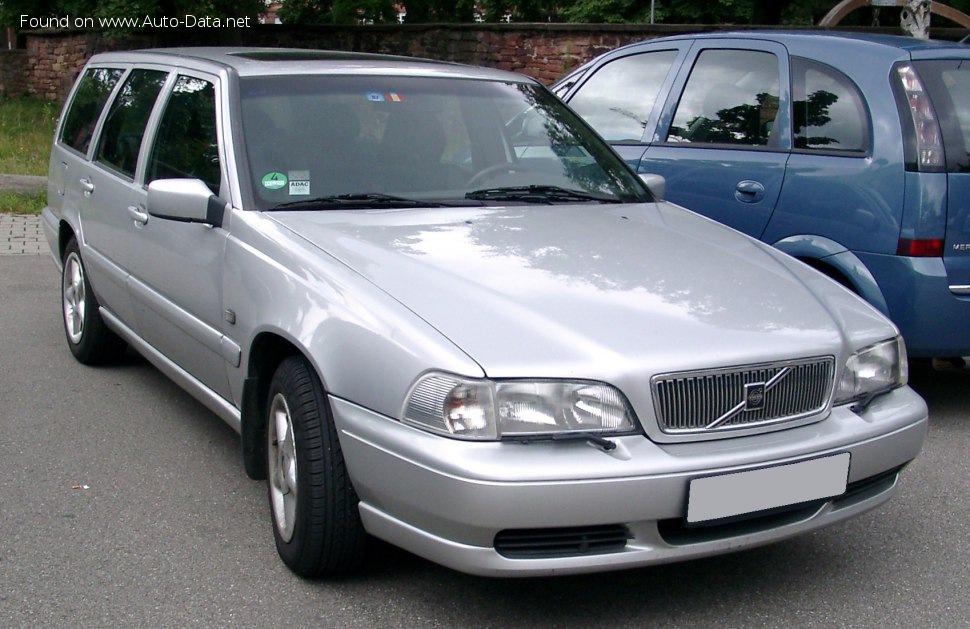
The Volvo V70 I 2.0 (126 Hp): A Quintessential European Family Wagon
The Volvo V70 I, launched in 1996, represented a significant evolution for the Swedish automaker, succeeding the highly successful Volvo 850 series. Positioned as a mid-size luxury station wagon, the V70 I built upon its predecessor’s robust foundation, refining its design and enhancing its interior comfort while maintaining Volvo’s unwavering commitment to safety. The specific variant, the Volvo V70 I 2.0 (126 Hp), was a particularly relevant offering in European markets, where engine displacement and fuel efficiency often dictated consumer choice and tax implications. Produced between 1996 and 2000, this first-generation V70 quickly established itself as a practical, reliable, and family-friendly vehicle, blending Scandinavian design with functional engineering.
Engine & Performance: The Heart of the Volvo V70 I 2.0 (126 Hp)
At the core of this particular V70 I variant was Volvo’s distinctive B5202FS engine, a naturally aspirated 2.0-liter (1984 cm³ or 121.07 cu. in.) inline-five cylinder gasoline unit. This engine configuration was a hallmark of Volvo during this era, renowned for its smooth operation, unique auditory signature, and inherent balance. While many markets, particularly the United States, received more potent 2.3-liter and 2.4-liter turbocharged or naturally aspirated five-cylinder engines, the 2.0-liter version was strategically important for regions with taxation systems that penalized larger displacements.
The B5202FS engine delivered 126 horsepower (Hp) at a spirited 6250 revolutions per minute (rpm), providing adequate power for daily driving and highway cruising. Torque output stood at 170 Newton-meters (Nm), or 125.39 pound-feet (lb.-ft.), peaking at 4800 rpm. This power was managed through a precise 5-speed manual transmission, sending drive to the front wheels (Front Wheel Drive). The engine’s specification included a DOHC (Dual Overhead Camshaft) valvetrain with two valves per cylinder, a compression ratio of 10:1, and a multi-port manifold injection system, ensuring efficient fuel delivery and combustion.
In terms of performance, the Volvo V70 I 2.0 (126 Hp) was no drag racer, but it offered respectable acceleration for a family wagon of its size and era. It could accelerate from 0 to 60 mph in a calculated 11.3 seconds, reaching a maximum speed of 121.17 mph (195 km/h). Fuel economy figures, crucial for its target market, were competitive: a combined cycle of 23.5 US mpg (10 l/100 km), with urban consumption at 17.6 US mpg (13.4 l/100 km) and extra-urban at 29 US mpg (8.1 l/100 km). These figures underscored its role as an economical yet capable family transporter.
Design & Features: Practicality Meets Scandinavian Style
The V70 I retained the fundamental architecture of the 850 but introduced a more rounded and contemporary aesthetic. Its station wagon (estate) body type was central to its appeal, offering exceptional versatility and cargo capacity. Measuring 186.22 inches (4730 mm) in length, 69.29 inches (1760 mm) in width, and 56.3 inches (1430 mm) in height, with a wheelbase of 104.72 inches (2660 mm), the V70 I presented a substantial, yet not unwieldy, presence on the road. The vehicle’s drag coefficient (Cd) of 0.32 was quite good for its segment and era, contributing to its highway efficiency and reduced wind noise.
Inside, the V70 I was a testament to Volvo’s reputation for ergonomic design and passenger comfort. It comfortably accommodated five occupants across its two rows of seating. The cabin prioritized functionality, with intuitive controls and high-quality materials designed for durability. Cargo space was a significant selling point, offering a minimum of 14.83 cubic feet (420 liters) with all seats in place, expanding to a cavernous 55.8 cubic feet (1580 liters) when the rear seats were folded down. This made it ideal for families, outdoor enthusiasts, and anyone requiring substantial hauling capability.
Safety, as expected from Volvo, was paramount. The V70 I came equipped with standard features like ABS (Anti-lock Braking System), a significant advancement for its time, enhancing braking control in emergency situations. The robust body structure, inherited from the 850, was engineered to provide excellent crash protection. Suspension duties were handled by a wishbone setup at the front and coil springs at the rear, delivering a comfortable and composed ride. Braking performance was assured by 280 mm ventilated discs at the front and 295 mm solid discs at the rear. Steering was a hydraulic rack and pinion system, offering a direct and communicative feel, while the standard 185/65 R15 tires on 15-inch wheel rims provided a good balance of comfort and grip.
Technical Specifications
| Category | Specification |
|---|---|
| Brand | Volvo |
| Model | V70 |
| Generation | V70 I |
| Engine Type | 2.0 (126 Hp) |
| Production Start | 1996 |
| Production End | 2000 |
| Powertrain Architecture | Internal Combustion Engine |
| Body Type | Station wagon (estate) |
| Seats | 5 |
| Doors | 5 |
| Performance | |
| Fuel Consumption (Urban) | 13.4 l/100 km (17.6 US mpg) |
| Fuel Consumption (Extra Urban) | 8.1 l/100 km (29 US mpg) |
| Fuel Consumption (Combined) | 10 l/100 km (23.5 US mpg) |
| Fuel Type | Petrol (Gasoline) |
| Acceleration 0-60 mph | 11.3 sec |
| Maximum Speed | 121.17 mph (195 km/h) |
| Weight-to-Power Ratio | 11.7 kg/Hp (85.7 Hp/tonne) |
| Weight-to-Torque Ratio | 8.6 kg/Nm (115.6 Nm/tonne) |
| Engine Specifications | |
| Power | 126 Hp @ 6250 rpm |
| Power per liter | 63.5 Hp/l |
| Torque | 170 Nm @ 4800 rpm (125.39 lb.-ft. @ 4800 rpm) |
| Engine Layout | Front, Transverse |
| Engine Model/Code | B5202FS |
| Engine Displacement | 1984 cm³ (2.0 liters / 121.07 cu. in.) |
| Number of Cylinders | 5 |
| Engine Configuration | Inline |
| Cylinder Bore | 3.19 in. (81 mm) |
| Piston Stroke | 3.03 in. (77 mm) |
| Compression Ratio | 10:1 |
| Valves per Cylinder | 2 |
| Fuel Injection System | Multi-port manifold injection |
| Engine Aspiration | Naturally aspirated |
| Valvetrain | DOHC |
| Engine Oil Capacity | 6.13 US qt (5.8 l) |
| Coolant Capacity | 7.61 US qt (7.2 l) |
| Dimensions & Weights | |
| Kerb Weight | 3240.8 lbs. (1470 kg) |
| Max. Weight | 4343.11 lbs. (1970 kg) |
| Max Load | 1102.31 lbs. (500 kg) |
| Trunk Space (Minimum) | 14.83 cu. ft. (420 l) |
| Trunk Space (Maximum) | 55.8 cu. ft. (1580 l) |
| Fuel Tank Capacity | 18.49 US gal (70 l) |
| Max. Roof Load | 220.46 lbs. (100 kg) |
| Length | 186.22 in. (4730 mm) |
| Width | 69.29 in. (1760 mm) |
| Height | 56.3 in. (1430 mm) |
| Wheelbase | 104.72 in. (2660 mm) |
| Front Track | 59.84 in. (1520 mm) |
| Rear Track | 57.87 in. (1470 mm) |
| Drag Coefficient (Cd) | 0.32 |
| Drivetrain, Brakes & Suspension | |
| Drivetrain Architecture | Front-wheel drive with Internal Combustion Engine |
| Drive Wheel | Front Wheel Drive |
| Gearbox Type | 5 gears, manual transmission |
| Front Suspension | Wishbone |
| Rear Suspension | Coil spring |
| Front Brakes | Ventilated discs, 280 mm |
| Rear Brakes | Disc, 295 mm |
| Assisting Systems | ABS (Anti-lock braking system) |
| Steering Type | Steering rack and pinion |
| Power Steering | Hydraulic Steering |
| Tire Size | 185/65 R15 |
| Wheel Rims Size | 15 inches |
Legacy & Market Impact of the Volvo V70 I
The Volvo V70 I, including its 2.0-liter variant, carved out a significant legacy as a benchmark for safety, practicality, and durability in the mid-size premium wagon segment. In its primary European markets, the Volvo V70 I 2.0 (126 Hp) was a highly competitive offering. It faced off against formidable rivals such as the Mercedes-Benz E-Class Wagon, BMW 5 Series Touring, Audi A6 Avant, and the domestic Saab 9-5 Wagon. While some competitors offered more outright luxury or sportiness, the V70 distinguished itself with its unpretentious, functional design, class-leading safety features for its time, and unmatched cargo versatility.
The decision to offer a 2.0-liter engine, which was largely absent from the North American market V70 lineup, was a direct response to the unique market dynamics in Europe. Countries like Italy, Portugal, and Greece, for instance, imposed higher taxes on vehicles with engine displacements exceeding 2.0 liters. This made the 126 Hp 2.0-liter V70 an economically sensible choice for families and businesses in these regions, allowing them to access Volvo’s premium attributes without incurring prohibitive tax penalties. This strategic engine offering cemented the V70’s position as a versatile and accessible premium wagon across diverse European economies.
Beyond its market positioning, the V70 I reinforced Volvo’s brand identity. It was a car that resonated with consumers who valued substance over flash, and who prioritized the safety and comfort of their families. Its robust build quality and reputation for longevity meant that many V70 Is continued to serve their owners faithfully for hundreds of thousands of miles, contributing to its strong resale value and cult following. The V70 I also played a crucial role in bridging the gap between the angular, boxy Volvos of old and the more curvaceous designs that would define the brand in the 21st century. It demonstrated that Volvo could evolve its styling while staying true to its core values of safety, quality, and practicality.
Today, the Volvo V70 I is regarded as a modern classic, appreciated by enthusiasts for its comfortable ride, spacious interior, distinctive inline-five engine note, and inherent reliability. It represents a golden era for Volvo wagons, a period when the brand solidified its reputation as the definitive choice for discerning buyers seeking a safe, capable, and enduring family vehicle.
