Ford Shelby II Cabrio (facelift 2010) GT 500 5.4 V8: An American Icon Reborn
The Ford Shelby II Cabrio (facelift 2010) GT 500 5.4 V8 (548 Hp) represents a significant chapter in the storied history of American muscle cars, blending raw power with the exhilaration of open-top motoring. As a high-performance variant of the fifth-generation Ford Mustang (S197 chassis), this particular model received a substantial refresh for the 2010 model year, enhancing both its aesthetics and mechanical prowess. Positioned at the apex of the Mustang lineup, the GT500 convertible was not merely a performance car; it was a statement, a direct descendant of the legendary Carroll Shelby’s vision for a track-ready, street-legal beast. Produced from 2010 to 2014, this generation of the Shelby GT500 continued to solidify Ford’s commitment to delivering unparalleled performance in a package that was distinctly American, offering a compelling blend of heritage, brute force, and modern technology for its time.
The 2010 facelift brought a host of improvements over its predecessors. While the core philosophy remained intact—a supercharged V8 engine driving the rear wheels—the refinements made the vehicle more capable, more refined, and visually more aggressive. The convertible body style, or “Cabrio” as it’s often referred to in international markets, offered enthusiasts the unique opportunity to experience the thunderous roar of its supercharged engine and feel the wind in their hair, a quintessential American driving experience. This article delves into the technical specifications, design philosophies, and market impact of this iconic vehicle, emphasizing its role as a modern classic in the performance car segment.
Engine and Performance of the Ford Shelby II Cabrio (facelift 2010) GT 500 5.4 V8
At the heart of the Ford Shelby II Cabrio (facelift 2010) GT 500 5.4 V8 lies a formidable 5.4-liter (330.02 cubic inches) V8 engine, a powerplant engineered for serious performance. This all-aluminum, DOHC (Dual Overhead Camshaft) engine features four valves per cylinder, ensuring efficient airflow and combustion. However, the true secret to its immense power output is the Eaton supercharger, coupled with an intercooler, which forces air into the engine, significantly boosting horsepower and torque. This setup allows the engine to churn out a staggering 548 horsepower at 6200 rpm and an equally impressive 510.39 lb.-ft. of torque at 4500 rpm. With a compression ratio of 8.4:1, the engine is optimized for the forced induction system, delivering immediate and relentless power across the rev range.
Power is transmitted to the rear wheels via a robust 6-speed manual transmission, offering direct driver engagement and control—a hallmark of true performance vehicles. This drivetrain architecture, combined with the engine’s longitudinal front placement, contributes to a balanced weight distribution and predictable handling characteristics, despite the car’s considerable power. The weight-to-power ratio stands at an impressive 3.3 kg/Hp (approximately 7.28 lbs/Hp), translating to explosive acceleration and exhilarating straight-line performance. While specific acceleration figures are not provided, it’s widely known that vehicles of this caliber could achieve 0-60 mph times in the low 4-second range, making them competitive with many European sports cars of the era.
Fuel efficiency, while not the primary concern for buyers of such a vehicle, is nonetheless part of its technical profile. The official figures indicate a combined fuel consumption of 17 US mpg (13.8 l/100 km), with urban driving yielding around 14 US mpg (16.8 l/100 km) and extra-urban driving reaching 22 US mpg (10.7 l/100 km). These figures, while modest by modern economy car standards, are respectable for a supercharged V8 performance convertible of its size and power, underscoring the advancements in engine management systems even in high-output applications.
Design and Features
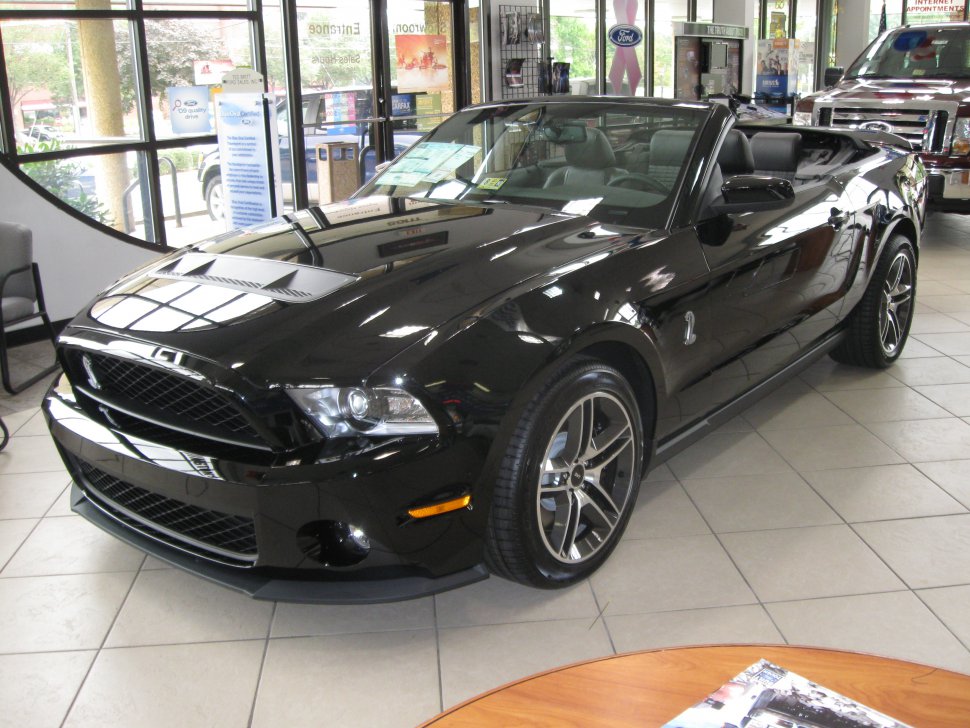
The exterior design of the 2010 Ford Shelby GT500 Convertible received a significant facelift, giving it a more aggressive and contemporary appearance while retaining its classic muscle car proportions. Measuring 188.19 inches in length, 73.9 inches in width, and 55.91 inches in height, the car maintained a commanding road presence. The revised front fascia featured a larger grille opening for improved cooling, a prominent splitter, and distinct fog lamp designs. The iconic Shelby cobra badge adorned the grille and rear, signifying its elite status. Functional hood vents and heat extractors further emphasized its performance pedigree, aiding in engine cooling.
As a convertible, the GT500 offered the versatility of open-air driving, with a power-operated soft top that could be stowed away, transforming the car’s character. The interior provided seating for four, though the rear seats were more suited for occasional use or additional storage. Inside, the cabin featured sport seats designed for support during spirited driving, unique Shelby badging, and an updated instrument cluster. While specific infotainment features are not detailed in the provided data, models of this era typically included a premium sound system, climate control, and connectivity options relevant to the period.
Underneath its muscular skin, the GT500 was equipped with a robust chassis and advanced braking system to match its power. It featured large ventilated disc brakes on both the front and rear axles, complemented by an Anti-lock Braking System (ABS) for enhanced stopping power and control. The steering system utilized a rack and pinion setup, delivering precise feedback to the driver. The car rode on performance tires, with a staggered setup: 255/45 ZR18 in the front and wider 285/40 ZR18 in the rear, mounted on 18-inch alloy wheel rims. This tire configuration was crucial for putting the immense power to the pavement effectively and maintaining grip during dynamic driving. The overall design was a harmonious blend of classic muscle car aesthetics and modern performance cues, making the 2010 Shelby GT500 Convertible instantly recognizable and highly desirable.
Technical Specifications: Ford Shelby II Cabrio (facelift 2010) GT 500 5.4 V8
| Category | Specification | Value |
|---|---|---|
General Information |
||
| Brand | Ford | |
| Model | Shelby | |
| Generation | Shelby II Cabrio (facelift 2010) | |
| Type (Engine) | GT 500 5.4 V8 (548 Hp) | |
| Start of production | 2010 year | |
| End of production | 2014 year | |
| Powertrain Architecture | Internal Combustion engine | |
| Body type | Cabriolet | |
| Seats | 4 | |
| Doors | 2 | |
Performance Specifications |
||
| Fuel consumption (urban) | 16.8 l/100 km | 14 US mpg |
| Fuel consumption (extra urban) | 10.7 l/100 km | 22 US mpg |
| Fuel consumption (combined) | 13.8 l/100 km | 17 US mpg |
| Fuel Type | Petrol (Gasoline) | |
| Weight-to-power ratio | 3.3 kg/Hp | 300.9 Hp/tonne |
| Weight-to-torque ratio | 2.6 kg/Nm | 380 Nm/tonne |
Engine Specifications |
||
| Power | 548 Hp | @ 6200 rpm |
| Power per liter | 101.3 Hp/l | |
| Torque | 692 Nm | 510.39 lb.-ft. @ 4500 rpm |
| Engine layout | Front, Longitudinal | |
| Engine displacement | 5408 cm3 | 5.4 liters (330.02 cu. in.) |
| Number of cylinders | 8 | |
| Engine configuration | V-engine | |
| Cylinder Bore | 90.2 mm | 3.55 in. |
| Piston Stroke | 105.8 mm | 4.17 in. |
| Compression ratio | 8.4:1 | |
| Number of valves per cylinder | 4 | |
| Fuel injection system | Multi-port manifold injection | |
| Engine aspiration | Supercharger, Intercooler | |
| Valvetrain | DOHC | |
| Engine oil capacity | 6.1 l | 6.45 US qt |
| Engine oil specification | Not specified | |
| Coolant | 20 l | 21.13 US qt |
Space, Volume and Weights |
||
| Kerb Weight | 1821 kg | 4014.62 lbs. |
| Fuel tank capacity | 60 l | 15.85 US gal |
Dimensions |
||
| Length | 4780 mm | 188.19 in. |
| Width | 1877 mm | 73.9 in. |
| Height | 1420 mm | 55.91 in. |
| Wheelbase | 2720 mm | 107.09 in. |
| Front track | 1572 mm | 61.89 in. |
| Rear (Back) track | 1587 mm | 62.48 in. |
| Drag coefficient (Cd) | 0.38 | |
| Minimum turning circle | 11.27 m | 36.98 ft. |
Drivetrain, Brakes and Suspension |
||
| Drivetrain Architecture | The Internal combustion engine (ICE) drives the rear wheels of the vehicle. | |
| Drive wheel | Rear wheel drive | |
| Number of gears and type of gearbox | 6 gears, manual transmission | |
| Front brakes | Ventilated discs | |
| Rear brakes | Ventilated discs | |
| Assisting systems | ABS (Anti-lock braking system) | |
| Steering type | Steering rack and pinion | |
| Tires size | 255/45 ZR18 (Front); 285/40 ZR18 (Rear) | |
| Wheel rims size | 18 inches | |
Legacy and Market Impact
The Ford Shelby II Cabrio (facelift 2010) GT 500 5.4 V8 holds a significant place in the modern muscle car pantheon. It arrived at a time when the “pony car wars” were heating up, competing fiercely with rivals like the Chevrolet Camaro SS and the Dodge Challenger SRT8, both of which also offered powerful V8 engines and retro-inspired styling. However, the GT500, with its direct lineage to Carroll Shelby and its supercharged powertrain, often stood a step above in terms of outright power and performance, cementing its reputation as the ultimate factory-built Mustang.
Its market impact was profound, appealing to a demographic that valued heritage, raw power, and an unmistakable American identity. The convertible variant, in particular, offered a unique proposition, combining the visceral thrills of a high-performance GT500 with the sensory experience of open-air driving. It wasn’t just a car for drag strips; it was a vehicle designed to be enjoyed on winding roads and open highways, with the soundtrack of its supercharged V8 filling the air.
The 2010-2014 GT500 models are often seen as a bridge between the more analog muscle cars of the past and the increasingly technologically advanced performance vehicles of today. While it featured modern amenities and safety systems like ABS, its core driving experience remained raw and engaging, relying heavily on the driver’s skill and connection to the machine. This characteristic has contributed to its enduring appeal among enthusiasts and collectors, who appreciate its blend of classic muscle car ethos and contemporary engineering.
Today, these GT500 convertibles are regarded as highly desirable modern classics. They represent a peak in the S197 Mustang’s evolution and a testament to Ford’s ability to innovate within the performance segment while honoring a legendary nameplate. Its legacy is one of uncompromising power, iconic styling, and a driving experience that remains thrilling and distinctively American, ensuring its place in automotive history as a true performance icon.