
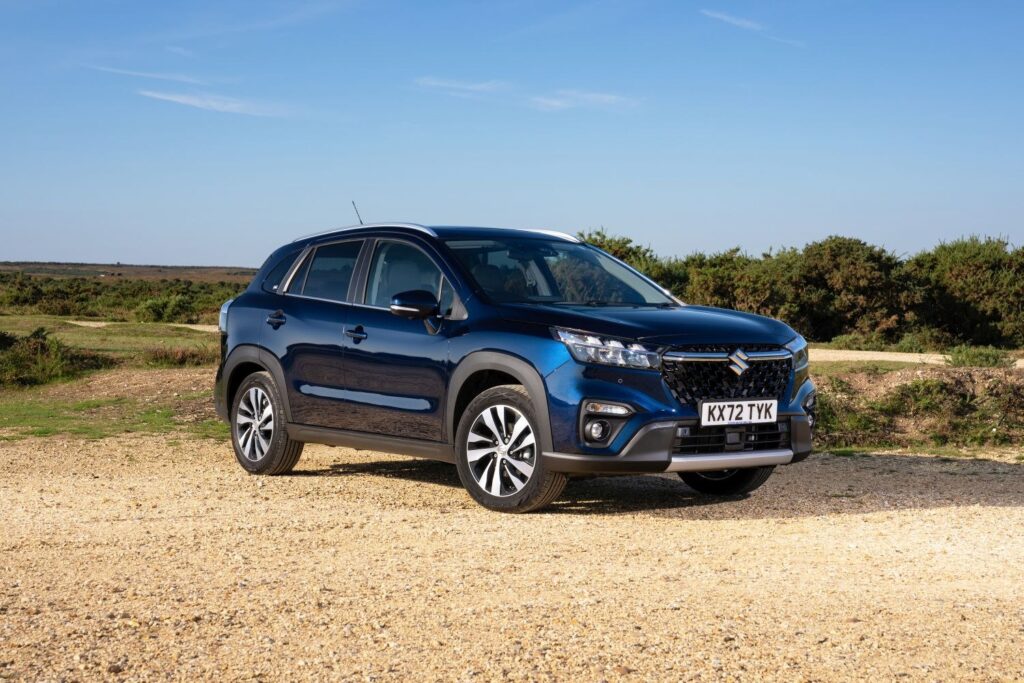
The Suzuki S-Cross III: A Modern Crossover for Global Markets
The Suzuki S-Cross III 1.4 Boosterjet (129 Hp) Mild Hybrid AllGrip represents the third generation of Suzuki’s compact crossover, a vehicle primarily designed for and sold in European and Asian markets. Launched in November 2021, this iteration of the S-Cross — known as the SX4 S-Cross in some regions — continues Suzuki’s tradition of producing practical, efficient, and capable vehicles. While not available in the United States, where Suzuki’s automotive division withdrew in 2012, the S-Cross III is a significant player in its segment abroad, offering a compelling blend of mild-hybrid technology, all-wheel drive capability, and a versatile body style that appeals to a broad range of consumers seeking a reliable daily driver with an adventurous spirit.
Positioned in the highly competitive C-segment SUV market, the S-Cross III builds upon its predecessors’ foundation of robust engineering and value. This particular variant, featuring the 1.4-liter Boosterjet engine paired with a mild-hybrid system and Suzuki’s proprietary AllGrip all-wheel-drive, highlights the brand’s commitment to efficiency and dynamic performance. The vehicle’s architecture, an MHEV (Mild Hybrid Electric Vehicle), signifies a step towards electrification, providing power-assist capabilities and improved fuel economy without the complexity or cost of a full hybrid system.
Engineering and Performance: The Heart of the Suzuki S-Cross III
At the core of the Suzuki S-Cross III‘s appeal is its sophisticated powertrain, a harmonious integration of a turbocharged gasoline engine and a mild-hybrid electric system. The internal combustion engine is Suzuki’s proven K14D 1.4-liter (1373 cm3 or 83.79 cu. in.) inline-four Boosterjet unit, featuring direct injection and an intercooler-equipped turbocharger. This engine alone generates a robust 129 horsepower at 5500 rpm and a substantial 173.33 lb.-ft. of torque, available across a broad rev range from 2000 to 3000 rpm. Its power-per-liter ratio stands at an impressive 94 Hp/l, showcasing its efficiency and advanced design.
Complementing this potent gasoline engine is an electric motor, model WA06B, which contributes an additional 14 horsepower at 3000 rpm and a significant 39.09 lb.-ft. of torque at a low 500 rpm. This mild-hybrid system, powered by a Lithium-ion battery, functions as a power-assist hybrid, boosting acceleration and improving fuel efficiency by allowing the engine to shut off during coasting or when stationary, thanks to its Start & Stop system. The combined system power for the S-Cross III stands at 129 horsepower, working in tandem with a precise 6-speed manual transmission.
Performance figures for the S-Cross III are respectable for its class. The vehicle can accelerate from 0 to 60 mph in an estimated 9.7 seconds, with a 0-100 km/h sprint taking 10.2 seconds. Its maximum speed reaches 121.17 mph (195 km/h). Fuel economy is a strong suit, with a combined WLTP rating of 39.9 US mpg (5.9 l/100 km), and CO2 emissions of 133 g/km, adhering to the Euro 6d emission standard. This efficiency is crucial in markets where environmental regulations and fuel costs are significant considerations for consumers.
The S-Cross III’s drivetrain architecture is particularly noteworthy. Suzuki’s AllGrip system ensures that the internal combustion engine and the electric motor permanently drive the front wheels. When conditions demand it, such as in slippery terrain or for enhanced traction, the electrically or mechanically controlled clutch engages the rear wheels, providing true all-wheel-drive (4×4) capability. This setup offers both the fuel efficiency of front-wheel drive and the added confidence of all-wheel drive when needed.
Design and Features: A Practical and Stylish Crossover
The Suzuki S-Cross III adopts a contemporary SUV/Crossover body type, offering a blend of rugged aesthetics and urban practicality. With five doors and seating for five occupants, it is designed to be a versatile family vehicle or a capable companion for active lifestyles. Its exterior dimensions are optimized for maneuverability in city environments while providing ample interior space: a length of 169.29 inches (4300 mm), a width of 70.28 inches (1785 mm), and a height of 62.4 inches (1585 mm). A wheelbase of 102.36 inches (2600 mm) contributes to a stable ride and generous cabin room, while a ground clearance of 6.89 inches (175 mm) hints at its ability to tackle light off-road conditions.
Inside, the S-Cross III prioritizes functionality and comfort. While specific interior features vary by trim level, typical modern amenities would include an infotainment system with smartphone integration, climate control, and a suite of driver-assistance technologies. Given its modern production date, safety features like ABS (Anti-lock braking system) are standard, along with multiple airbags and electronic stability control systems, though specific advanced driver-assistance systems (ADAS) are not detailed in the provided data. The steering system utilizes electric power steering with a rack and pinion setup, ensuring light and responsive handling, with a minimum turning circle of 35.43 feet (10.8 m).
Practicality extends to its cargo capacity. The trunk offers a minimum of 15.19 cu. ft. (430 liters) of space, which can be expanded significantly to 23.48 cu. ft. (665 liters) by folding down the rear seats. This flexibility makes the S-Cross III suitable for carrying luggage, groceries, or sports equipment. The vehicle rides on 17-inch wheel rims fitted with 215/55 R17 tires, providing a good balance between comfort and grip. Braking is handled by ventilated discs at the front and solid discs at the rear, ensuring confident stopping power.
Technical Specifications
The following table details the comprehensive technical specifications for the Suzuki S-Cross III 1.4 Boosterjet (129 Hp) Mild Hybrid AllGrip:
| Category | Specification |
|---|---|
| Brand | Suzuki |
| Model | SX4 S-Cross |
| Generation | S-Cross III |
| Engine Type | 1.4 Boosterjet (129 Hp) Mild Hybrid AllGrip |
| Start of Production | November, 2021 |
| Powertrain Architecture | MHEV (Mild Hybrid Electric Vehicle) |
| Body Type | SUV, Crossover |
| Seats | 5 |
| Doors | 5 |
| Performance Specifications | |
| Fuel Consumption (WLTP, Combined) | 5.9 l/100 km (39.9 US mpg) |
| CO2 Emissions (WLTP) | 133 g/km |
| Fuel Type | Petrol (Gasoline) |
| Acceleration 0-60 mph | 9.7 sec |
| Maximum Speed | 195 km/h (121.17 mph) |
| Emission Standard | Euro 6d |
| Weight-to-power ratio | 9.5 kg/Hp (104.9 Hp/tonne) |
| Weight-to-torque ratio | 5.2 kg/Nm (191.1 Nm/tonne) |
| Electric Cars and Hybrids Specs | |
| Battery Technology | Lithium-ion (Li-Ion) |
| Electric Motor Power | 14 Hp @ 3000 rpm |
| Electric Motor Torque | 53 Nm (39.09 lb.-ft.) @ 500 rpm |
| Electric Motor Model/Code | WA06B |
| System Power | 129 Hp @ 5500 rpm |
| Internal Combustion Engine Specs | |
| Power | 129 Hp @ 5500 rpm |
| Power per liter | 94 Hp/l |
| Torque | 235 Nm (173.33 lb.-ft.) @ 2000-3000 rpm |
| Engine Layout | Front, Transverse |
| Engine Model/Code | K14D |
| Engine Displacement | 1373 cm3 (83.79 cu. in.) |
| Number of Cylinders | 4 |
| Engine Configuration | Inline |
| Number of Valves per Cylinder | 4 |
| Fuel Injection System | Direct injection |
| Engine Aspiration | Turbocharger, Intercooler |
| Engine Oil Capacity | 3.6 l (3.8 US qt) |
| Coolant Capacity | 6.7 l (7.08 US qt) |
| Engine Systems | Start & Stop System, Particulate filter |
| Space, Volume and Weights | |
| Kerb Weight | 1230 kg (2711.69 lbs.) |
| Max. Weight (GVWR) | 1755 kg (3869.11 lbs.) |
| Max Load | 525 kg (1157.43 lbs.) |
| Trunk (boot) Space – Minimum | 430 l (15.19 cu. ft.) |
| Trunk (boot) Space – Maximum | 665 l (23.48 cu. ft.) |
| Fuel Tank Capacity | 47 l (12.42 US gal) |
| Permitted Trailer Load with Brakes (12%) | 1500 kg (3306.93 lbs.) |
| Permitted Trailer Load without Brakes | 600 kg (1322.77 lbs.) |
| Dimensions | |
| Length | 4300 mm (169.29 in.) |
| Width | 1785 mm (70.28 in.) |
| Height | 1585 mm (62.4 in.) |
| Wheelbase | 2600 mm (102.36 in.) |
| Ride Height (Ground Clearance) | 175 mm (6.89 in.) |
| Minimum Turning Circle (Turning Diameter) | 10.8 m (35.43 ft.) |
| Drivetrain, Brakes and Suspension Specs | |
| Drivetrain Architecture | ICE and electric motor permanently drive front wheels; rear wheels driven via clutch when necessary. |
| Drive Wheel | All-wheel drive (4×4) |
| Number of Gears and Gearbox Type | 6 gears, manual transmission |
| Front Brakes | Ventilated discs |
| Rear Brakes | Disc |
| Assisting Systems | ABS (Anti-lock braking system) |
| Steering Type | Steering rack and pinion |
| Power Steering | Electric Steering |
| Tires Size | 215/55 R17 |
| Wheel Rims Size | 17 inches |
Legacy and Market Impact
The Suzuki S-Cross III, particularly the 1.4 Boosterjet Mild Hybrid AllGrip variant, continues Suzuki’s legacy as a manufacturer of compact, efficient, and surprisingly capable vehicles for markets outside North America. In regions like Europe, Australia, and parts of Asia, Suzuki maintains a strong presence, often celebrated for its expertise in small cars and SUVs, especially those with all-wheel-drive capabilities. The S-Cross III fits perfectly into this niche, offering a compelling alternative to competitors.
Its market impact is significant in its primary regions. The S-Cross competes in the fiercely contested compact SUV segment against established rivals such as the Nissan Qashqai (known as Rogue Sport in the US), Skoda Karoq, Hyundai Kona, Kia Seltos, and its domestic rival, the Toyota C-HR. The S-Cross III distinguishes itself with its standard mild-hybrid powertrain, offering a tangible advantage in fuel economy and lower emissions compared to many non-hybrid competitors. Furthermore, the availability of Suzuki’s AllGrip all-wheel-drive system, which is a hallmark of the brand’s SUV offerings, provides an edge for consumers in areas with challenging weather conditions or those who frequently venture onto unpaved roads.
Historically, the S-Cross (and its SX4 S-Cross predecessor) has been instrumental in Suzuki’s global strategy, serving as a pillar of its SUV lineup alongside the Vitara and the iconic Jimny. The third generation’s move towards electrification with the mild-hybrid system demonstrates Suzuki’s adaptability to evolving market demands and increasingly stringent environmental regulations. Its reputation is built on reliability, affordability, and a practical, no-nonsense approach to motoring. While it may not command the same brand recognition as some European or Japanese giants, the S-Cross III reinforces Suzuki’s position as a smart choice for buyers prioritizing efficiency, compact dimensions, and genuine all-wheel-drive capability in a modern crossover package.
The S-Cross III’s continued success in its target markets underscores Suzuki’s expertise in designing and engineering vehicles that are well-suited to specific regional needs, even if its presence is not felt in every global automotive landscape.
