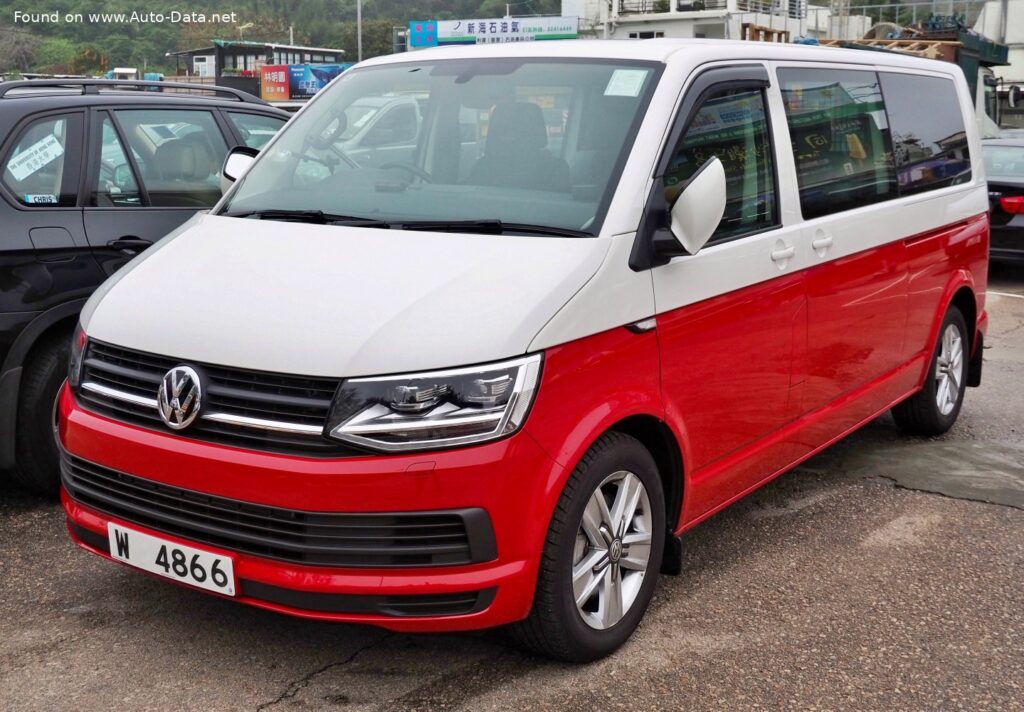
Introduction to the Volkswagen Transporter (T6) Kombi 2.0 TDI (150 Hp) 4MOTION L1H1
The Volkswagen Transporter, a name synonymous with versatility and robust utility across the globe, entered its sixth generation with the introduction of the T6 in 2015. Among its diverse lineup, the Volkswagen Transporter (T6) Kombi 2.0 TDI (150 Hp) 4MOTION L1H1 stands out as a particularly capable and popular variant, especially within European and international markets where it serves as a cornerstone for businesses, large families, and adventurous individuals alike. Produced from 2015 to 2019, this specific model combined the practicality of a commercial van with the comfort and passenger-carrying capabilities of an MPV, bridging the gap between a pure work vehicle and a multi-purpose family transporter. Its designation, “Kombi,” highlights this dual-purpose nature, offering flexible seating for anywhere from four to nine occupants while still providing substantial cargo space. The “L1H1” signifies its standard wheelbase and standard roof height, making it a highly maneuverable option in urban environments, while the “4MOTION” all-wheel-drive system dramatically enhances its traction and capability in challenging conditions. Powered by an efficient 2.0-liter TDI diesel engine producing 150 horsepower, this Transporter T6 variant embodies Volkswagen’s commitment to delivering reliable, economical, and adaptable vehicles in the light commercial and passenger van segment.
The Volkswagen Transporter (T6) Kombi: A European Workhorse and People Mover
The Volkswagen Transporter series boasts a rich heritage dating back to the iconic Type 2, affectionately known as the “Bus” or “Microbus,” which first captivated the world in the 1950s. Each subsequent generation, from the T1 to the T5, built upon this legacy, evolving the vehicle’s design, technology, and capabilities to meet the ever-changing demands of a global market. The T6 generation, launched in 2015, represented a significant refinement rather than a radical redesign of its predecessor, the T5. It maintained the familiar, functional silhouette while introducing updated engines, enhanced connectivity, and more sophisticated safety features.
In its primary markets, particularly across Europe and parts of Asia and Australia, the Transporter (T6) occupies a crucial segment of the automotive landscape. It’s not typically sold in the United States in this specific configuration, where Volkswagen offered larger, more specialized vans like the Routan (a rebadged Chrysler minivan) or the full-size Crafter. However, its reputation for durability and versatility has made it a benchmark in its class globally. The “Kombi” variant, in particular, is engineered for maximum flexibility. It can be configured with multiple rows of seating, making it an ideal shuttle vehicle, a family hauler for those requiring significant space, or a crew van for businesses transporting both personnel and equipment. When the seats are removed or folded, the Kombi transforms into a spacious cargo carrier, showcasing its true multi-purpose design.
The “L1H1” designation of this specific model refers to its dimensions: L1 indicates the standard wheelbase, and H1 denotes the standard roof height. This configuration strikes an excellent balance between interior volume and exterior maneuverability, making it suitable for a wide range of applications from city deliveries to long-distance travel. The inclusion of the “4MOTION” all-wheel-drive system further elevates the Volkswagen Transporter (T6) Kombi 2.0 TDI (150 Hp) 4MOTION L1H1‘s appeal. This advanced drivetrain provides superior traction in adverse weather conditions, on unpaved roads, or during light off-road excursions, making it a favored choice for tradespeople working in diverse terrains, outdoor enthusiasts, or anyone needing enhanced grip and stability beyond what a standard front-wheel-drive van can offer.
Engine and Performance
At the heart of this particular Transporter T6 Kombi lies a robust and efficient 2.0-liter TDI (Turbocharged Direct Injection) diesel engine, a powerplant renowned for its excellent balance of power, torque, and fuel economy. Designated with engine codes like EA288, CXFA, or CXHA, this inline four-cylinder unit features a DOHC (Dual Overhead Camshaft) valvetrain with four valves per cylinder, a common-rail fuel injection system, and is boosted by a turbocharger and intercooler. With an engine displacement of 1968 cubic centimeters (approximately 120.09 cubic inches), it delivers a healthy 150 horsepower at an engine speed range of 3250-3750 revolutions per minute (rpm). More impressively for a vehicle of its size and purpose, it generates a substantial 250.77 lb.-ft. of torque, available broadly across the rev range from 1500 to 3000 rpm. This ample low-end torque is crucial for effortless acceleration, strong pulling power, and managing heavy loads, making it highly effective for both commercial and passenger applications.
Performance figures for the Volkswagen Transporter (T6) Kombi 2.0 TDI (150 Hp) 4MOTION L1H1 are respectable for a van. It can accelerate from 0 to 60 mph in approximately 11.6 seconds, with a top speed of 111.23 mph. These figures underscore its capability to keep pace with highway traffic and provide confident overtaking performance. Fuel efficiency, a primary concern for both commercial operators and private owners, is a strong suit for this diesel variant. Under the NEDC (New European Driving Cycle) combined cycle, it achieves between 29 and 36.2 US mpg, a commendable figure for an all-wheel-drive van of its size. The engine also meets the stringent Euro 6 emission standard, thanks in part to its particulate filter and standard Start & Stop System, which contributes to lower CO2 emissions (169-212 g/km) and reduced fuel consumption in urban driving conditions. The 4MOTION all-wheel-drive system, which primarily drives the front wheels but engages the rear wheels via an electrically or mechanically operated clutch when slippage is detected, ensures optimal traction and stability without significantly compromising efficiency. Power is transmitted to the wheels via a precise and durable 6-speed manual transmission, offering direct control and engagement for the driver.
Design and Features
The design of the Volkswagen Transporter (T6) Kombi is a testament to functional elegance, maintaining the iconic, boxy silhouette that has defined the series for decades while incorporating modern styling cues. Its exterior is characterized by clean lines, a prominent Volkswagen grille, and contemporary lighting elements that give it a refined yet robust appearance. The L1H1 configuration, with a length of 193.07 inches and a width of 74.96 inches (90.43 inches including mirrors), ensures a commanding road presence without being overly cumbersome for urban environments or parking. Its height of 78.35 inches allows for ample interior headroom while remaining compatible with most standard parking structures.
Inside, the Kombi truly shines with its exceptional versatility. Designed to accommodate anywhere from 4 to 9 seats, its interior can be reconfigured to suit various needs, from a full passenger carrier to a part-passenger, part-cargo solution, or even a pure cargo van with a cavernous 204.83 cubic feet of maximum trunk space. This adaptability makes it an invaluable asset for businesses needing to transport both crew and equipment, or for families requiring substantial space for luggage, sports gear, or recreational equipment. The cabin itself is ergonomically designed, with durable materials chosen to withstand the rigors of daily use. While specific luxury features might vary by trim, the T6 Kombi typically offers a comfortable and practical environment for both driver and passengers.
Underpinning the Volkswagen Transporter (T6) Kombi 2.0 TDI (150 Hp) 4MOTION L1H1 is a sophisticated chassis designed for car-like handling and ride comfort. It features an independent McPherson strut front suspension with coil springs and an anti-roll bar, paired with an independent coil spring rear suspension with wishbones and a transverse stabilizer. This setup ensures stable handling, reduced body roll, and a comfortable ride even when fully loaded. The hydraulic rack and pinion steering provides precise control, while ventilated disc brakes (308×29.5 mm front, 294×22 mm rear) deliver strong and consistent stopping power, complemented by an Anti-lock Braking System (ABS). With a ground clearance of 7.91 inches and impressive approach, departure, and ramp-over angles, coupled with a wading depth of 11.81 inches, the 4MOTION variant is remarkably capable of tackling challenging terrain, making it suitable for construction sites, rural roads, or off-grid adventures. Standard tire sizes typically range from 205/65 R16 to 215/65 R16, mounted on 6.5J x 16-inch wheel rims, providing a good balance of durability and ride comfort.
Technical Specifications
| Category | Specification |
|---|---|
| Brand | Volkswagen |
| Model | Transporter (T6) Kombi 2.0 TDI (150 Hp) 4MOTION L1H1 |
| Generation | Transporter (T6) Kombi |
| Type (Engine) | 2.0 TDI (150 Hp) 4MOTION L1H1 |
| Production Years | 2015 – 2019 |
| Powertrain Architecture | Internal Combustion Engine |
| Body Type | Van |
| Seats | 4-9 |
| Doors | 4-5 |
| Performance Specs | |
| Fuel Consumption (Urban, NEDC) | 30.2 – 24 US mpg |
| Fuel Consumption (Extra Urban, NEDC) | 40.6 – 32.7 US mpg |
| Fuel Consumption (Combined, NEDC) | 36.2 – 29 US mpg |
| CO2 Emissions (NEDC) | 169-212 g/km |
| Fuel Type | Diesel |
| Acceleration 0 – 60 mph | 11.6 sec |
| Maximum Speed | 111.23 mph |
| Emission Standard | Euro 6 |
| Weight-to-Power Ratio | 12.8 kg/Hp (28.22 lbs/Hp) |
| Weight-to-Torque Ratio | 5.6 kg/Nm (12.35 lbs/Nm) |
| Engine Specs | |
| Power | 150 Hp @ 3250-3750 rpm |
| Power per liter | 76.2 Hp/l |
| Torque | 250.77 lb.-ft. @ 1500-3000 rpm |
| Engine Layout | Front, Transverse |
| Engine Model/Code | EA288 / CXFA, CXHA |
| Engine Displacement | 120.09 cu. in. (1968 cm3) |
| Number of Cylinders | 4 |
| Engine Configuration | Inline |
| Cylinder Bore | 3.19 in. (81 mm) |
| Piston Stroke | 3.76 in. (95.5 mm) |
| Compression Ratio | 15.5:1 |
| Valves per Cylinder | 4 |
| Fuel Injection System | Diesel Commonrail |
| Engine Aspiration | Turbocharger, Intercooler |
| Valvetrain | DOHC |
| Engine Oil Capacity | 7.82 US qt (7.4 l) |
| Engine Systems | Start & Stop System, Particulate filter |
| Dimensions, Volume & Weights | |
| Kerb Weight | 4221.85 – 5013.31 lbs (1915-2274 kg) |
| Max. Weight | 6172.94 – 7054.79 lbs (2800-3200 kg) |
| Max Load | 1951.09 – 2041.48 lbs (885-926 kg) |
| Trunk (Boot) Space – Max | 204.83 cu. ft. (5800 l) |
| Fuel Tank Capacity | 18.49 US gal (70 l) |
| AdBlue Tank | 3.43 US gal (13 l) |
| Max. Roof Load | 220.46 lbs (100 kg) |
| Permitted Trailer Load with Brakes (12%) | 5511.56 lbs (2500 kg) |
| Permitted Trailer Load without Brakes | 1653.47 lbs (750 kg) |
| Permitted Towbar Download | 220.46 lbs (100 kg) |
| Length | 193.07 in. (4904 mm) |
| Width | 74.96 in. (1904 mm) |
| Width including Mirrors | 90.43 in. (2297 mm) |
| Height | 78.35 in. (1990 mm) |
| Wheelbase | 118.11 in. (3000 mm) |
| Front Overhang | 35.75 in. (908 mm) |
| Rear Overhang | 39.09 in. (993 mm) |
| Ride Height (Ground Clearance) | 7.91 in. (201 mm) |
| Minimum Turning Circle | 39.04 ft. (11.9 m) |
| Approach Angle | 21.2° |
| Departure Angle | 16.2° |
| Ramp-over (Brakeover) Angle | 13.7° |
| Climb Angle | 37° |
| Wading Depth | 11.81 in. (300 mm) |
| Drivetrain, Brakes & Suspension | |
| Drivetrain Architecture | ICE drives front wheels permanently, rear wheels driven via clutch if necessary. |
| Drive Wheel | All-Wheel Drive (4×4) |
| Number of Gears & Gearbox Type | 6 gears, Manual Transmission |
| Front Suspension | Independent, McPherson with coil spring and anti-roll bar |
| Rear Suspension | Independent coil spring, Wishbone, Transverse stabilizer |
| Front Brakes | Ventilated discs, 12.13 x 1.16 in. (308×29.5 mm) |
| Rear Brakes | Ventilated discs, 11.57 x 0.87 in. (294×22 mm) |
| Assisting Systems | ABS (Anti-lock Braking System) |
| Steering Type | Steering rack and pinion |
| Power Steering | Hydraulic Steering |
| Tires Size | 205/65 R16; 215/65 R16 |
| Wheel Rims Size | 6.5J x 16 |
Legacy and Market Impact
The Volkswagen Transporter (T6) Kombi 2.0 TDI (150 Hp) 4MOTION L1H1 continued the enduring legacy of the Transporter series, solidifying its reputation as a highly dependable, versatile, and efficient light commercial vehicle and people mover. Its market impact, particularly in Europe, was substantial, maintaining Volkswagen’s dominant position in the segment. The T6 built upon the strengths of its predecessors, offering improved refinement, enhanced technology, and more economical powertrains, which resonated strongly with both commercial fleet operators and private customers seeking a multi-functional vehicle.
The Transporter’s reputation for rugged reliability and low running costs made it a favorite among tradespeople, delivery services, and public transport operators. Its modular interior, especially in the Kombi configuration, allowed for unparalleled flexibility, seamlessly transitioning from a cargo hauler to a comfortable passenger shuttle. The availability of the 4MOTION all-wheel-drive system further broadened its appeal, attracting customers in regions with challenging climates or those who required enhanced traction for work or leisure activities, such as towing boats or navigating unpaved campsites.
In the competitive European van market, the Volkswagen Transporter (T6) Kombi 2.0 TDI (150 Hp) 4MOTION L1H1 faced strong rivals, including the Ford Transit Custom, Mercedes-Benz Vito, Renault Trafic, and Peugeot Expert/Citroën Jumpy. However, the Transporter consistently held its own, often being perceived as a more premium offering with superior build quality and a stronger residual value. Its robust engineering, coupled with the efficiency of the TDI engine and the capability of the 4MOTION system, ensured its continued success.
Historically, the Transporter series holds a unique place in automotive culture, evolving from the counter-culture icon of the T1 and T2 to the sophisticated, modern workhorse and family vehicle of the T6. This particular T6 Kombi variant, while not as overtly charismatic as its early ancestors, represented a crucial step in modernizing the line, blending practicality with contemporary automotive standards of safety, efficiency, and comfort. It served as a bridge, carrying forward the spirit of utility and adaptability that has defined the Transporter for over seven decades, while meeting the demands of the 21st-century automotive landscape. Its presence on European roads, from bustling city centers to remote rural routes, is a testament to its enduring design, engineering excellence, and profound market significance.