
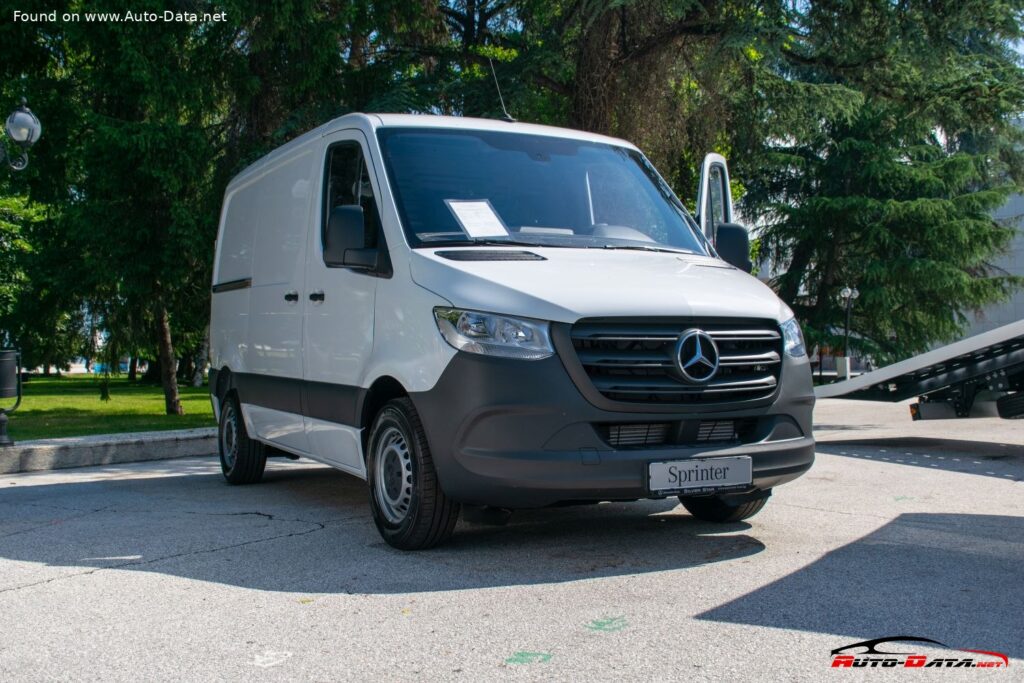
Introduction to the Mercedes-Benz Sprinter Panel Van Compact (W907/W910)
The Mercedes-Benz Sprinter has long been a benchmark in the light commercial vehicle segment, renowned for its versatility, durability, and advanced engineering. Introduced in 2018, the W907/W910 generation marked a significant evolution for the venerated van, building upon its robust heritage while integrating cutting-edge technology and enhanced efficiency. This particular variant, the Mercedes-Benz Sprinter Panel Van Compact (W907/W910) 314 CDI (143 Hp) W910 9G-TRONIC, represents a highly capable and efficient offering within the Sprinter lineup, specifically tailored for urban logistics and businesses requiring a compact yet capacious cargo solution.
As a compact panel van, this Sprinter variant is designed to navigate congested city streets with greater agility while still offering substantial cargo capacity. The “W910” designation highlights its front-wheel-drive architecture, a notable departure from the traditional rear-wheel-drive Sprinters (W907). This FWD configuration allows for a lower load floor, optimizing cargo volume and ease of loading, making it an attractive option for a wide array of commercial applications across Europe and other global markets where it competes fiercely in the bustling van segment.
Engine and Performance of the Mercedes-Benz Sprinter Panel Van Compact (W907/W910)
At the heart of this Mercedes-Benz Sprinter Panel Van Compact (W907/W910) is a sophisticated 2.1-liter (2143 cm3) inline-four diesel engine, designated OM 651. This powerplant is a testament to Mercedes-Benz’s commitment to efficiency and performance in its commercial vehicles. Equipped with a turbocharger and intercooler, the engine delivers a respectable 143 horsepower at 3800 rpm. More critically for a commercial vehicle, it produces a robust 330 Nm (243.4 lb.-ft.) of torque, available across a broad and usable range from 1200 to 2400 rpm. This ample low-end torque is crucial for effortless acceleration, hauling heavy loads, and maintaining momentum, especially in stop-and-go urban environments.
Fuel is delivered via a Diesel Commonrail injection system, ensuring precise fuel metering and optimal combustion, which contributes to both power delivery and fuel economy. The engine adheres to the stringent Euro 6 emission standard, incorporating a particulate filter to reduce harmful emissions, underscoring its environmental responsibility. Power is transmitted to the front wheels via an advanced 9G-TRONIC automatic transmission, featuring nine forward gears. This gearbox is engineered for smooth shifts, enhanced fuel efficiency, and reduced driver fatigue, particularly over long hauls or in heavy traffic. The combination of the efficient diesel engine and the multi-ratio automatic transmission results in competitive fuel consumption figures, with a combined NEDC rating of 7.9-8.4 liters per 100 km, translating to approximately 29.8 to 28 US mpg, depending on driving conditions.
With a kerb weight of 4243.9 lbs. (1925 kg) and a power-to-weight ratio of 74.3 Hp per tonne, the Sprinter 314 CDI offers a balanced blend of performance and economy for its class. Its robust powertrain architecture and front-wheel-drive layout provide a nimble driving experience while maintaining the cargo-carrying capabilities expected of a Mercedes-Benz commercial vehicle.
Design and Features
The design of the Mercedes-Benz Sprinter Panel Van Compact (W907/W910) is purpose-built, prioritizing functionality, durability, and driver comfort. As a panel van, it features a utilitarian yet aesthetically pleasing exterior, with five doors providing excellent access to both the cabin and the cargo area. The compact variant measures 207.36 inches (5267 mm) in length, 79.53 inches (2020 mm) in width (92.32 inches or 2345 mm including mirrors), and 92.76 inches (2356 mm) in height. Its wheelbase extends to 128.31 inches (3259 mm), contributing to its stable ride and respectable maneuverability, with a minimum turning circle of 42.65 feet (13 meters) making it surprisingly agile for its size.
Inside, the cabin is configured for three occupants, offering a comfortable and ergonomic workspace for the driver and passengers. While specific interior features are not detailed, Mercedes-Benz commercial vehicles of this era typically include modern infotainment options, advanced driver-assistance systems, and high-quality materials designed to withstand the rigors of daily commercial use. Safety is paramount, with standard features like ABS (Anti-lock Braking System) ensuring confident stopping power.
The true strength of the panel van lies in its cargo capacity. The compact Sprinter boasts a substantial maximum trunk space of 275.45 cubic feet (7800 liters). This generous volume, coupled with a maximum payload capacity of 3472.28 lbs. (1575 kg), makes it an ideal choice for delivery services, tradespeople, and various other businesses requiring significant hauling capability. The front suspension employs leaf springs, while the rear features a combination of hydraulic elements and leaf springs, a robust setup engineered to handle heavy loads consistently and provide a stable ride even when fully laden. The vehicle rides on 225/65 R16 tires mounted on 6.5J x 16 wheel rims, providing a good balance of load-bearing capacity and ride comfort. Furthermore, the Sprinter is capable of towing up to 4409.25 lbs. (2000 kg) with brakes, adding to its utility.
Technical Specifications
| General Information | |
| Brand | Mercedes-Benz |
| Model | Sprinter |
| Generation | Sprinter Panel Van Compact (W907/W910) |
| Type (Engine) | 314 CDI (143 Hp) W910 9G-TRONIC |
| Start of Production | 2018 year |
| Powertrain Architecture | Internal Combustion engine |
| Body Type | Van |
| Seats | 3 |
| Doors | 5 |
| Performance Specifications | |
| Fuel Consumption (Urban, NEDC) | 9.7 l/100 km (24.2 US mpg) |
| Fuel Consumption (Extra-Urban, NEDC) | 7.4-8 l/100 km (31.8 – 29.4 US mpg) |
| Fuel Consumption (Combined, NEDC) | 7.9-8.4 l/100 km (29.8 – 28 US mpg) |
| CO2 Emissions (NEDC) | 209-221 g/km |
| Fuel Type | Diesel |
| Emission Standard | Euro 6 |
| Weight-to-Power Ratio | 13.5 kg/Hp (74.3 Hp/tonne) |
| Weight-to-Torque Ratio | 5.8 kg/Nm (171.4 Nm/tonne) |
| Engine Specifications | |
| Power | 143 Hp @ 3800 rpm |
| Power per liter | 66.7 Hp/l |
| Torque | 330 Nm (243.4 lb.-ft.) @ 1200-2400 rpm |
| Engine Layout | Front, Transverse |
| Engine Model/Code | OM 651 |
| Engine Displacement | 2143 cm3 (130.77 cu. in.) |
| Number of Cylinders | 4 |
| Engine Configuration | Inline |
| Number of Valves per Cylinder | 4 |
| Fuel Injection System | Diesel Commonrail |
| Engine Aspiration | Turbocharger, Intercooler |
| Engine Oil Capacity | 11.5 l (12.15 US qt) |
| Engine Oil Specification | Not provided |
| Coolant Capacity | 9.5 l (10.04 US qt) |
| Engine Systems | Particulate filter |
| Space, Volume and Weights | |
| Kerb Weight | 1925 kg (4243.9 lbs.) |
| Max. Weight | 3500 kg (7716.18 lbs.) |
| Max Load | 1575 kg (3472.28 lbs.) |
| Trunk (Boot) Space – Maximum | 7800 l (275.45 cu. ft.) |
| Fuel Tank Capacity | 65 l (17.17 US gal) |
| AdBlue Tank | 22 l (5.81 US gal) |
| Max. Roof Load | 300 kg (661.39 lbs.) |
| Permitted Trailer Load with Brakes (12%) | 2000 kg (4409.25 lbs.) |
| Permitted Trailer Load without Brakes | 750 kg (1653.47 lbs.) |
| Dimensions | |
| Length | 5267 mm (207.36 in.) |
| Width | 2020 mm (79.53 in.) |
| Width Including Mirrors | 2345 mm (92.32 in.) |
| Height | 2356 mm (92.76 in.) |
| Wheelbase | 3259 mm (128.31 in.) |
| Front Track | 1759 mm (69.25 in.) |
| Rear (Back) Track | 1770 mm (69.69 in.) |
| Front Overhang | 1012 mm (39.84 in.) |
| Rear Overhang | 996 mm (39.21 in.) |
| Ride Height (Ground Clearance) | 143 mm (5.63 in.) |
| Minimum Turning Circle (Turning Diameter) | 13 m (42.65 ft.) |
| Drivetrain, Brakes and Suspension Specifications | |
| Drivetrain Architecture | The Internal combustion engine (ICE) drives the front wheels of the vehicle. |
| Drive Wheel | Front wheel drive |
| Number of Gears and Type of Gearbox | 9 gears, automatic transmission G-TRONIC |
| Front Suspension | Leaf spring |
| Rear Suspension | Hydraulic elements, Leaf spring |
| Front Brakes | Disc |
| Rear Brakes | Disc |
| Assisting Systems | ABS (Anti-lock braking system) |
| Tires Size | 225/65 R16 |
| Wheel Rims Size | 6.5J x 16 |
Legacy and Market Impact
The Mercedes-Benz Sprinter, across all its generations, has cultivated an enviable reputation for reliability, longevity, and versatility, making it a cornerstone of commercial fleets worldwide. The W907/W910 generation, particularly the front-wheel-drive W910 variants like the 314 CDI, further solidified this legacy by introducing modern advancements that cater to evolving business needs. The adoption of front-wheel drive was a strategic move, allowing for a lower load floor and thus greater cargo volume and easier loading/unloading, which is a significant advantage in urban delivery and logistics.
In the highly competitive light commercial vehicle market, the Sprinter Panel Van Compact (W907/W910) faces strong rivals such as the Ford Transit, Ram ProMaster (derived from the Fiat Ducato), Volkswagen Crafter, and Renault Master. However, the Sprinter consistently stands out due to its premium brand image, perceived higher quality, and comprehensive suite of technological features. Its advanced OM 651 diesel engine, paired with the sophisticated 9G-TRONIC automatic transmission, offers a compelling balance of fuel efficiency, robust performance, and reduced emissions, meeting the demands of businesses focused on operational costs and environmental compliance.
The Sprinter’s impact extends beyond mere transportation; it serves as a mobile office, a workshop, and a reliable partner for countless enterprises. Its inherent adaptability allows for a vast array of conversions, from specialized service vehicles to recreational RVs, although this specific model is optimized as a panel van. The commitment to safety, driver comfort, and advanced telematics (not detailed in the provided data but typical for the generation) further enhances its appeal. By offering a compact yet highly capable variant like the 314 CDI, Mercedes-Benz ensured that the Sprinter remained a top contender for businesses seeking an efficient, durable, and technologically advanced solution for their diverse commercial needs in the modern era.
