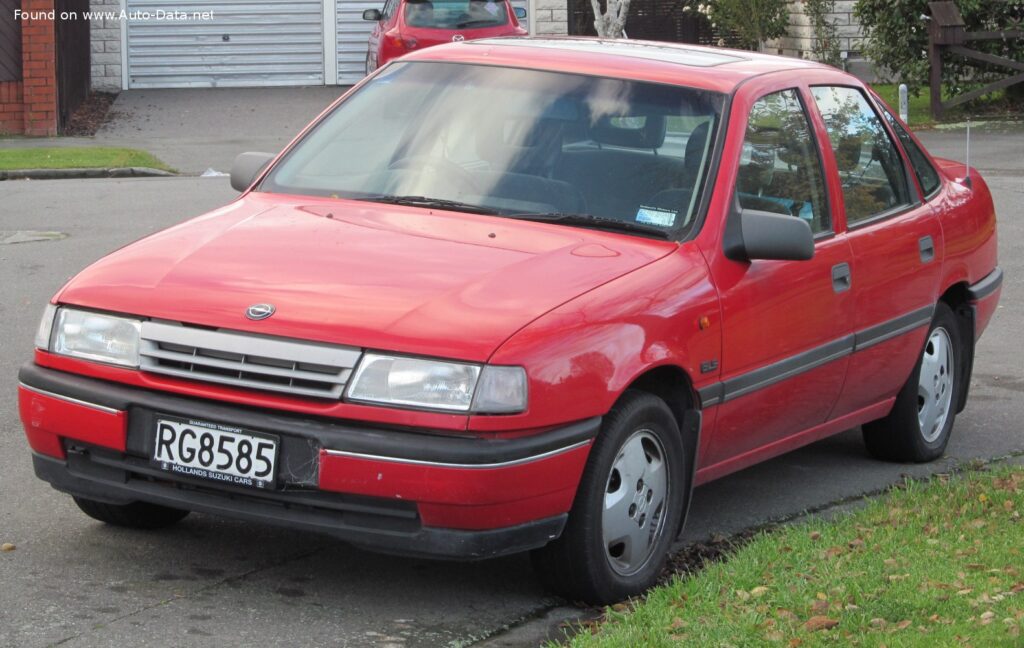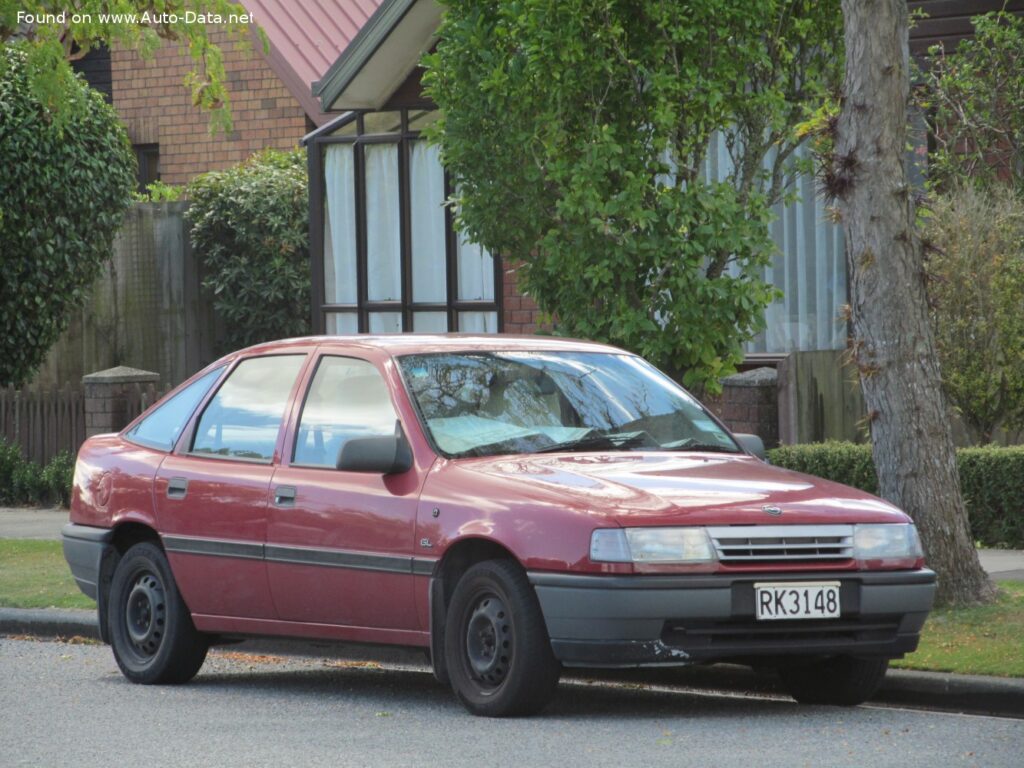
The Opel Vectra A CC 1.8 S (88 Hp) represents a pivotal moment for the European automotive manufacturer Opel, a brand long associated with General Motors. Launched in October 1988, the Vectra A generation was introduced as a successor to the venerable Opel Ascona, marking a significant step forward in design, aerodynamics, and engineering for the mid-size family car segment. The “CC” designation, standing for “Combi Coupé” in Opel’s nomenclature, denoted the five-door hatchback body style, a highly popular and practical choice in European markets. This particular variant, the 1.8 S, was positioned as a sensible and economical option within the Vectra lineup, offering a balance of performance and fuel efficiency suitable for daily commuting and family use across the continent. While never officially sold in the United States, the Opel Vectra A CC 1.8 S (88 Hp) played a crucial role in shaping the European automotive landscape of the late 1980s and early 1990s, defining a segment characterized by practicality, comfort, and affordability.
Engineering and Performance of the Opel Vectra A CC 1.8 S (88 Hp)
At the heart of the Opel Vectra A CC 1.8 S (88 Hp) was its E18NVR engine, a naturally aspirated, inline four-cylinder powerplant with an overhead camshaft (OHC) valvetrain. This 1.8-liter (1796 cm3 or 109.6 cu. in.) engine was a workhorse for Opel during this era, known for its reliability and straightforward design. Producing 88 horsepower at 5400 revolutions per minute (rpm), it delivered adequate power for its segment, emphasizing smooth operation rather than outright speed. Torque output stood at 143 Newton-meters (105.47 lb.-ft.) available at a relatively low 3200 rpm, contributing to a tractable driving experience in urban environments and on highways. The engine’s layout was front, transverse, a common and efficient configuration for front-wheel-drive vehicles, optimizing cabin space and weight distribution.
A notable characteristic of this particular variant was its fuel injection system: a carburetor. While electronic fuel injection was becoming more prevalent in higher-end models and newer designs by the late 1980s, carburetion remained a cost-effective and proven technology for many mainstream vehicles like the Vectra 1.8 S. With a compression ratio of 9.2:1 and two valves per cylinder, the engine was designed for durability and ease of maintenance, running on readily available petrol (gasoline). Power was transmitted to the front wheels via a five-speed manual transmission, offering drivers direct control and contributing to the car’s respectable combined fuel consumption figures of 7.1 liters per 100 kilometers (33.1 US mpg or 39.8 UK mpg). In terms of straight-line performance, the Opel Vectra A CC 1.8 S (88 Hp) could achieve a maximum speed of 182 km/h (113.09 mph), a perfectly respectable figure for a family car of its time and class.
Design and Features of the Opel Vectra A CC
The Opel Vectra A CC, or Combi Coupé, distinguished itself with its five-door hatchback body style, a testament to Opel’s understanding of European consumer preferences for practicality and versatility. The design of the Vectra A generation was a significant departure from its predecessor, the Ascona, featuring smoother, more aerodynamic lines that were fashionable in the late 1980s. With a length of 4352 mm (171.34 in.), a width of 1706 mm (67.17 in.), and a height of 1400 mm (55.12 in.), the Vectra A CC offered a substantial footprint for a mid-size car, translating into a comfortable and spacious interior for five occupants. The 2600 mm (102.36 in.) wheelbase further contributed to ride comfort and stability.
The hatchback configuration was a key selling point, offering exceptional cargo flexibility. The trunk (boot) space ranged from a generous 460 liters (16.24 cu. ft.) with all seats in place, expanding to a cavernous 1290 liters (45.56 cu. ft.) when the rear seats were folded down. This adaptability made the Vectra A CC an ideal choice for families, small businesses, and anyone needing to transport bulky items, a feature that continues to make hatchbacks popular in Europe. While specific comfort and convenience features varied by trim level, the 1.8 S model would have offered a functional and ergonomic cabin, typical of Opel’s focus on user-friendliness. Safety features for this era were basic compared to modern standards, primarily focusing on passive safety through structural integrity, seatbelts, and potentially rudimentary crumple zones.
Technical Specifications
| Category | Specification | Value |
|---|---|---|
| Brand | Opel | |
| Model | Vectra | |
| Generation | Vectra A CC | |
| Type (Engine) | 1.8 S (88 Hp) | |
| Start of production | October, 1988 year | |
| End of production | June, 1989 year | |
| Powertrain Architecture | Internal Combustion engine | |
| Body type | Hatchback | |
| Seats | 5 | |
| Doors | 5 | |
| Performance Specs | ||
| Fuel consumption (combined) | Metric | 7.1 l/100 km |
| Fuel consumption (combined) | US | 33.1 US mpg |
| Fuel consumption (combined) | UK | 39.8 UK mpg |
| Fuel consumption (combined) | Km/l | 14.1 km/l |
| Fuel Type | Petrol (Gasoline) | |
| Maximum speed | Metric | 182 km/h |
| Maximum speed | Imperial | 113.09 mph |
| Engine Specs | ||
| Power | Horsepower | 88 Hp @ 5400 rpm. |
| Power per liter | 49 Hp/l | |
| Torque | Metric | 143 Nm @ 3200 rpm. |
| Torque | Imperial | 105.47 lb.-ft. @ 3200 rpm. |
| Engine layout | Front, Transverse | |
| Engine Model/Code | E18NVR | |
| Engine displacement | Metric | 1796 cm3 |
| Engine displacement | Imperial | 109.6 cu. in. |
| Number of cylinders | 4 | |
| Engine configuration | Inline | |
| Cylinder Bore | Metric | 84.8 mm |
| Cylinder Bore | Imperial | 3.34 in. |
| Piston Stroke | Metric | 79.5 mm |
| Piston Stroke | Imperial | 3.13 in. |
| Compression ratio | 9.2:1 | |
| Number of valves per cylinder | 2 | |
| Fuel injection system | Carburettor | |
| Engine aspiration | Naturally aspirated engine | |
| Valvetrain | OHC | |
| Engine oil capacity | Metric | 4 l |
| Engine oil capacity | US | 4.23 US qt |
| Engine oil capacity | UK | 3.52 UK qt |
| Coolant | Metric | 6.5 l |
| Coolant | US | 6.87 US qt |
| Coolant | UK | 5.72 UK qt |
| Space, Volume and Weights | ||
| Trunk (boot) space – minimum | Metric | 460 l |
| Trunk (boot) space – minimum | Imperial | 16.24 cu. ft. |
| Trunk (boot) space – maximum | Metric | 1290 l |
| Trunk (boot) space – maximum | Imperial | 45.56 cu. ft. |
| Fuel tank capacity | Metric | 61 l |
| Fuel tank capacity | US | 16.11 US gal |
| Fuel tank capacity | UK | 13.42 UK gal |
| Dimensions | ||
| Length | Metric | 4352 mm |
| Length | Imperial | 171.34 in. |
| Width | Metric | 1706 mm |
| Width | Imperial | 67.17 in. |
| Height | Metric | 1400 mm |
| Height | Imperial | 55.12 in. |
| Wheelbase | Metric | 2600 mm |
| Wheelbase | Imperial | 102.36 in. |
| Front track | Metric | 1420 mm |
| Front track | Imperial | 55.91 in. |
| Rear (Back) track | Metric | 1423 mm |
| Rear (Back) track | Imperial | 56.02 in. |
| Ride height (ground clearance) | Metric | 140 mm |
| Ride height (ground clearance) | Imperial | 5.51 in. |
| Drivetrain, Brakes and Suspension Specs | ||
| Drivetrain Architecture | The Internal combustion engine (ICE) drives the front wheels of the vehicle. | |
| Drive wheel | Front wheel drive | |
| Number of gears and type of gearbox | 5 gears, manual transmission | |
Legacy and Market Impact of the Opel Vectra A CC 1.8 S (88 Hp)
The Opel Vectra A, including the versatile CC hatchback, enjoyed considerable success in its primary European market. It was a direct competitor to other prominent mid-size family cars of the era, such as the Ford Sierra, Volkswagen Passat, and Renault 21. Opel’s strategy with the Vectra was to offer a modern, reliable, and practical vehicle that appealed to a broad demographic, from private families to fleet operators. The 1.8 S (88 Hp) variant, with its economical carbureted engine and manual transmission, perfectly embodied this philosophy, providing a low-cost entry point into the Vectra range without sacrificing essential functionality.
The Vectra A generation was significant for Opel as it helped solidify the brand’s reputation for producing well-engineered, mass-market vehicles. Its aerodynamic design was a talking point, contributing to better fuel efficiency and reduced wind noise compared to many contemporaries. While its performance figures were modest by today’s standards, they were entirely appropriate for the vehicle’s intended purpose and the driving conditions of the late 1980s. The car’s robust mechanicals, coupled with Opel’s extensive dealer network, meant that maintenance was generally straightforward and parts were readily available, contributing to its popularity and longevity on European roads.
Although the Opel Vectra A CC 1.8 S (88 Hp) never officially made its way to the United States under the Opel badge, its underlying platform and engineering principles were sometimes shared with other GM products sold globally. In Europe, it was a ubiquitous sight, becoming a symbol of accessible, dependable family transport. Its legacy is one of practicality, solid engineering for its time, and a significant contribution to the evolution of the European mid-size segment. The Vectra A paved the way for subsequent generations, progressively incorporating more advanced technology and refinement, but the original CC hatchback remains a classic example of a successful European family car from a bygone era.