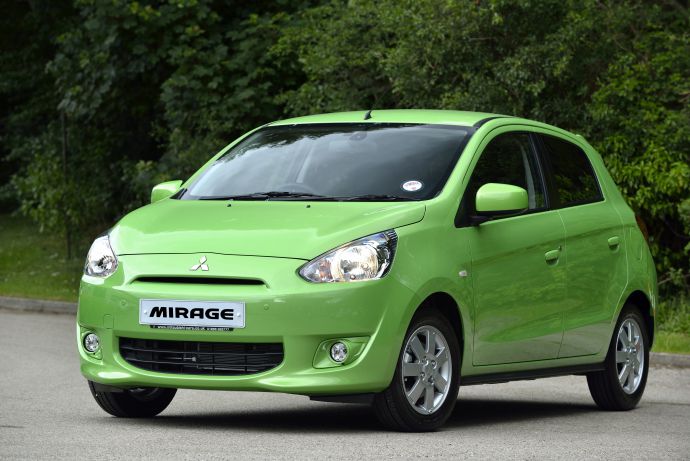
The Mitsubishi Mirage VI Hatchback 1.2 MIVEC (74 Hp) represents a pivotal offering in the global subcompact segment, designed with a primary focus on affordability, fuel efficiency, and urban maneuverability. Launched in 2014 as part of the sixth generation of the Mirage nameplate, this particular variant, produced until 2016, aimed to provide a no-frills, reliable transportation solution for economy-conscious buyers worldwide. While not always a high-volume seller in every market, its role as a practical and economical choice has been consistent, particularly in regions where low running costs and a compact footprint are paramount.
Mitsubishi Mirage VI Hatchback 1.2 MIVEC (74 Hp) Overview
Market Positioning and Generation
The Mitsubishi Mirage VI Hatchback, specifically the 1.2 MIVEC (74 Hp) model, was strategically positioned as an entry-level compact car. Its production span from 2014 to 2016 highlights its place within the broader sixth generation of the Mirage, a nameplate that has historically served as Mitsubishi’s global small car. In markets like the United States, the Mirage is recognized as one of the most affordable new cars available, appealing to buyers seeking minimal acquisition and ownership costs. Globally, it competes in a fiercely contested segment, often alongside rivals such as the Nissan Versa, Chevrolet Spark, Kia Rio, and Toyota Yaris. Its compact dimensions and efficient powertrain were tailored for urban environments, where ease of parking and agility through congested streets are highly valued. This generation of the Mirage continued Mitsubishi’s philosophy of offering practical, unpretentious vehicles designed for everyday utility.
Engine and Performance of the Mitsubishi Mirage VI Hatchback
Powertrain Details
At the heart of the Mitsubishi Mirage VI Hatchback 1.2 MIVEC (74 Hp) lies a 1.2-liter, naturally aspirated inline three-cylinder engine, designated as the 3A92. This engine, featuring a Double Overhead Camshaft (DOHC) valvetrain and multi-port manifold injection, was engineered for maximum efficiency rather than outright power. It produces a modest 74 horsepower at 6000 rpm and 73.76 lb.-ft. of torque at 4000 rpm. While these figures might seem conservative by modern standards, they are entirely adequate for the vehicle’s intended purpose as an urban commuter. The engine’s compact and lightweight design contributes significantly to the car’s overall efficiency and low curb weight. Power is delivered to the front wheels via a standard 5-speed manual transmission, a choice that further underscores its economy-oriented design by offering direct control and often slightly better fuel economy compared to automatic options of the era. The front, transverse engine layout is typical for front-wheel-drive subcompacts, optimizing interior space and packaging efficiency.
Fuel Efficiency
One of the most compelling attributes of the Mitsubishi Mirage VI Hatchback 1.2 MIVEC (74 Hp) is its exceptional fuel economy. With a combined fuel consumption rating of 36.8 US mpg (6.4 l/100 km), it stood out as a leader in its class. In urban driving, it achieved an estimated 34.1 US mpg (6.9 l/100 km), while extra-urban driving saw figures as high as 42 US mpg (5.6 l/100 km). These impressive numbers are a direct result of several engineering choices: the small displacement three-cylinder engine, its naturally aspirated design, the vehicle’s remarkably low curb weight (ranging from 1973.14 to 1995.18 lbs.), and a highly aerodynamic body with a drag coefficient (Cd) of just 0.28. This focus on efficiency made the Mirage an attractive option for drivers looking to minimize their gasoline expenses, particularly in markets with high fuel prices. The 9.25 US gallon fuel tank, while small, still provided a decent range given the car’s frugal consumption.
Design and Features of the Mitsubishi Mirage VI Hatchback
Exterior and Interior Design
The Mitsubishi Mirage VI Hatchback adopted a functional and straightforward design ethos. Its body type is a 5-door hatchback, offering practical access to both the passenger cabin and the cargo area. With seating for five, it maximized interior utility within its compact footprint. The exterior dimensions—148.82 inches in length, 65.59 inches in width, and 59.09 inches in height—make it remarkably agile and easy to park in congested city environments. The relatively long wheelbase of 96.46 inches for its overall length contributes to a stable ride quality, while the minimal front and rear overhangs enhance maneuverability. The clean lines and smooth surfaces were not merely aesthetic choices; they were instrumental in achieving the low drag coefficient of 0.28, which directly contributed to its impressive fuel economy. Inside, the focus was on practicality and durability, with a simple, user-friendly layout designed to withstand the rigors of daily use. While not luxurious, the interior offered essential amenities and a surprising amount of passenger space for a vehicle of its class.
Practicality and Safety
Practicality was a cornerstone of the Mirage VI Hatchback’s design. The 5-door configuration provided easy access to the rear seats, which could comfortably accommodate adults for short to medium journeys. Cargo versatility was a key strength, with a minimum trunk space of 17.2 cubic feet (487 liters), expanding significantly to an impressive 47 cubic feet (1331 liters) with the rear seats folded down. This made the Mirage surprisingly capable of hauling groceries, luggage, or even larger items, adding to its appeal as a versatile urban companion. The vehicle’s compact size and a minimum turning circle of 30.18 feet (9.2 meters) made it exceptionally nimble, allowing for easy navigation through tight city streets and parking lots. In terms of safety, the Mirage VI Hatchback included essential features for its time and segment, such as an Anti-lock Braking System (ABS) and ventilated disc brakes at the front paired with drum brakes at the rear, providing adequate stopping power. The electric power steering system offered light and responsive steering, further enhancing its ease of use in urban settings. The robust chassis, combined with McPherson struts at the front and a torsion beam at the rear, provided a comfortable ride while maintaining predictable handling characteristics.
Technical Specifications
| Category | Specification | Metric Units | US/Imperial Units |
|---|---|---|---|
| General Information | |||
| Brand | Mitsubishi | ||
| Model | Mirage | ||
| Generation | Mirage VI Hatchback | ||
| Type (Engine) | 1.2 MIVEC (74 Hp) | ||
| Start of production | 2014 year | ||
| End of production | 2016 year | ||
| Powertrain Architecture | Internal Combustion engine | ||
| Body type | Hatchback | ||
| Seats | 5 | ||
| Doors | 5 | ||
| Performance Specs | |||
| Fuel consumption (economy) – urban | 6.9 l/100 km | 34.1 US mpg, 40.9 UK mpg | |
| Fuel consumption (economy) – extra urban | 5.6 l/100 km | 42 US mpg, 50.4 UK mpg | |
| Fuel consumption (economy) – combined | 6.4 l/100 km | 36.8 US mpg, 44.1 UK mpg | |
| Fuel Type | Petrol (Gasoline) | ||
| Weight-to-power ratio | 12.1 kg/Hp | 82.7 Hp/tonne | |
| Weight-to-torque ratio | 9 kg/Nm | 111.7 Nm/tonne | |
| Engine Specs | |||
| Power | 74 Hp @ 6000 rpm | ||
| Power per liter | 62 Hp/l | ||
| Torque | 100 Nm @ 4000 rpm | 73.76 lb.-ft. @ 4000 rpm | |
| Engine layout | Front, Transverse | ||
| Engine Model/Code | 3A92 | ||
| Engine displacement | 1193 cm3 | 72.8 cu. in. | |
| Number of cylinders | 3 | ||
| Engine configuration | Inline | ||
| Cylinder Bore | 75 mm | 2.95 in. | |
| Piston Stroke | 90 mm | 3.54 in. | |
| Compression ratio | 10.5:1 | ||
| Number of valves per cylinder | 4 | ||
| Fuel injection system | Multi-port manifold injection | ||
| Engine aspiration | Naturally aspirated engine | ||
| Valvetrain | DOHC | ||
| Engine oil capacity | 3 l | 3.17 US qt | 2.64 UK qt | |
| Engine oil specification | Not specified | ||
| Coolant | 4 l | 4.23 US qt | 3.52 UK qt | |
| Space, Volume and Weights | |||
| Kerb Weight | 895-905 kg | 1973.14 – 1995.18 lbs. | |
| Max. weight | 1320 kg | 2910.1 lbs. | |
| Max load | 415-425 kg | 914.92 – 936.96 lbs. | |
| Trunk (boot) space – minimum | 487 l | 17.2 cu. ft. | |
| Trunk (boot) space – maximum | 1331 l | 47 cu. ft. | |
| Fuel tank capacity | 35 l | 9.25 US gal | 7.7 UK gal | |
| Dimensions | |||
| Length | 3780 mm | 148.82 in. | |
| Width | 1666 mm | 65.59 in. | |
| Height | 1501 mm | 59.09 in. | |
| Wheelbase | 2450 mm | 96.46 in. | |
| Front track | 1430 mm | 56.3 in. | |
| Rear (Back) track | 1415 mm | 55.71 in. | |
| Ride height (ground clearance) | 160 mm | 6.3 in. | |
| Drag coefficient (Cd) | 0.28 | ||
| Minimum turning circle (turning diameter) | 9.2 m | 30.18 ft. | |
| Drivetrain, Brakes and Suspension Specs | |||
| Drivetrain Architecture | The Internal combustion engine (ICE) drives the front wheels of the vehicle. | ||
| Drive wheel | Front wheel drive | ||
| Number of gears and type of gearbox | 5 gears, manual transmission | ||
| Front suspension | Independent, type McPherson with coil spring and anti-roll bar | ||
| Rear suspension | Torsion | ||
| Front brakes | Ventilated discs | ||
| Rear brakes | Drum | ||
| Assisting systems | ABS (Anti-lock braking system) | ||
| Steering type | Steering rack and pinion | ||
| Power steering | Electric Steering | ||
| Tires size | 165/65 R14 | ||
| Wheel rims size | 14 | ||
Legacy and Market Impact of the Mitsubishi Mirage VI Hatchback
Reputation and Competitors
The Mitsubishi Mirage VI Hatchback 1.2 MIVEC (74 Hp) cemented its reputation as a highly economical and dependable vehicle, albeit one that prioritized utility over performance or luxurious appointments. Its primary appeal lay in its low purchase price, excellent fuel efficiency, and low maintenance costs, making it a strong contender for budget-conscious consumers, first-time car buyers, and those needing a reliable urban commuter. In its segment, it faced stiff competition from other global subcompacts and economy cars such as the Nissan Versa Note, Chevrolet Spark, Kia Rio, and the Toyota Yaris Hatchback. While some rivals might have offered slightly more power, refined interiors, or advanced features, the Mirage consistently held its ground as one of the most cost-effective options. Its robust construction and straightforward mechanicals contributed to a reputation for durability, particularly in markets where harsh road conditions or limited access to complex repairs are common. The Mirage’s position was less about winning accolades for driving dynamics and more about delivering practical, no-nonsense transportation.
Historical Significance
The Mirage nameplate itself boasts a long and varied history, dating back to the late 1970s. The sixth generation, including the 2014-2016 1.2 MIVEC Hatchback, continued this legacy by adapting to modern demands for efficiency and compact utility. It represented Mitsubishi’s commitment to the small car segment during a period when many manufacturers were shifting focus towards larger SUVs and crossovers. This generation of the Mirage played a crucial role in Mitsubishi’s global strategy, serving as an accessible entry point to the brand, particularly in emerging markets across Asia and Latin America, as well as being a value proposition in more mature markets like North America and Europe. Its unpretentious design and engineering reflected a clear understanding of its target audience’s needs: reliable, affordable, and efficient personal mobility. While it may not be remembered as a performance icon, the Mitsubishi Mirage VI Hatchback 1.2 MIVEC (74 Hp) holds significance as a persistent symbol of accessible and economical transportation, continuing to offer a practical solution for millions of drivers worldwide.