
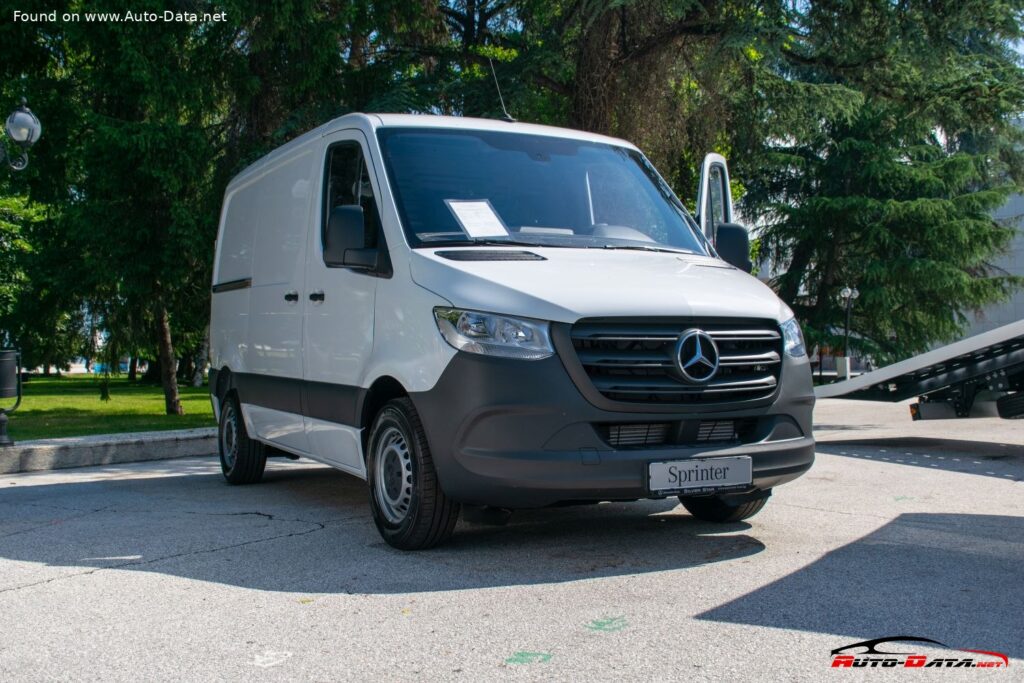
The Mercedes-Benz Sprinter Panel Van Compact (W907/W910) 414 CDI (143 Hp) W907 G-TRONIC represents a pivotal offering in the global light commercial vehicle market, embodying Mercedes-Benz’s commitment to utility, efficiency, and robust performance. Introduced in 2018, this generation of the Sprinter, known internally as the W907/W910, built upon its predecessors’ legacy as a versatile workhorse, designed to meet the demanding needs of businesses worldwide. While designated “Compact,” this term is relative within the Sprinter lineup, still offering substantial cargo capacity and presence on the road. This particular variant, the 414 CDI with 143 horsepower and the G-TRONIC automatic transmission, strikes an excellent balance between power, fuel economy, and ease of operation, making it a popular choice for urban delivery, logistics, and various trades that require a reliable and efficient transport solution.
The Mercedes-Benz Sprinter Panel Van Compact (W907/W910): A Global Workhorse
The Mercedes-Benz Sprinter has long been a benchmark in the commercial van segment, and the W907/W910 generation, launched in 2018, continued to solidify this reputation. The Sprinter Panel Van Compact (W907/W910) 414 CDI (143 Hp) W907 G-TRONIC is engineered to serve a diverse range of commercial applications, from parcel delivery and construction support to mobile workshops and passenger transport conversions. Its robust construction and thoughtful design cater to the rigorous demands of daily commercial use, providing businesses with a dependable platform for their operations. The Sprinter’s global presence means it’s a familiar sight on roads from North America to Europe and beyond, adapted to various market needs while maintaining its core identity of reliability and capability. This particular ‘Compact’ designation refers to its shorter wheelbase and overall length compared to other Sprinter variants, positioning it as an agile option for navigating congested urban environments while still offering significant cargo volume.
Powertrain and Performance
At the heart of the Mercedes-Benz Sprinter Panel Van Compact (W907/W910) 414 CDI (143 Hp) W907 G-TRONIC lies a highly efficient and proven powertrain. This model is equipped with Mercedes-Benz’s OM 651 engine, a 2.1-liter (specifically, 2143 cm³ or 130.77 cu. in.) inline-four diesel unit. This engine is renowned for its durability and strong low-end torque, essential for a commercial vehicle that often operates under heavy loads. It produces a healthy 143 horsepower at 3800 rpm, which, combined with 243.4 lb.-ft. (330 Nm) of torque available across a broad range from 1200 to 2400 rpm, ensures responsive acceleration and ample pulling power. The engine’s configuration includes a turbocharger and intercooler, enhancing its efficiency and power delivery, while a common rail direct injection system optimizes fuel combustion.
Power is managed by Mercedes-Benz’s sophisticated 7-speed G-TRONIC automatic transmission. This gearbox is critical for a commercial vehicle, offering smooth and precise shifts that reduce driver fatigue during long working hours and contribute to overall fuel efficiency. The rear-wheel-drive architecture is a fundamental aspect of the Sprinter’s design, providing superior traction and stability, especially when carrying heavy loads. This configuration allows for a higher maximum payload and better weight distribution compared to front-wheel-drive alternatives, a crucial factor for a van with a substantial maximum load capacity of 1855 kg (4089.57 lbs.).
From an environmental and economic perspective, the 414 CDI variant demonstrates impressive efficiency for its class. Its fuel consumption figures, measured under the NEDC cycle, indicate a combined economy of 7.6-8.1 liters per 100 km, which translates to an estimated 30.9 – 29 US mpg. Urban driving yields 7.8-8.3 l/100 km (30.2 – 28.3 US mpg), while extra-urban conditions see 7.5-8 l/100 km (31.4 – 29.4 US mpg). These figures highlight Mercedes-Benz’s focus on operational cost-effectiveness. Furthermore, the vehicle complies with the stringent Euro VI emission standard, with CO2 emissions ranging from 200-213 g/km, reflecting its advanced particulate filter system and commitment to reducing environmental impact.
Design, Utility, and Features
The Mercedes-Benz Sprinter Panel Van Compact (W907/W910) 414 CDI (143 Hp) W907 G-TRONIC is purpose-built for utility. Its panel van body type, characterized by its enclosed cargo area, offers maximum security and weather protection for goods. With 5 doors, including generous rear and side access, loading and unloading are made efficient. The standard configuration provides seating for three occupants in the front cabin, making it suitable for a driver and a work crew. The overall dimensions of the “Compact” model are substantial, with a length of 5267 mm (207.36 in.), a width of 2020 mm (79.53 in.) (2345 mm or 92.32 in. including mirrors), and a height of 2356 mm (92.76 in.). These dimensions, combined with a wheelbase of 3250 mm (127.95 in.) and a minimum turning circle of 12.1 meters (39.7 ft), offer a balance of cargo capacity and maneuverability, essential for urban environments.
The cargo area is the Sprinter’s crowning glory, boasting a maximum trunk (boot) space of 7500 liters (264.86 cu. ft.). This cavernous volume, coupled with a maximum payload of 1855 kg (4089.57 lbs.) and a robust kerb weight of 2245 kg (4949.38 lbs.), underscores its capability as a serious commercial hauler. The vehicle’s suspension system is designed for durability and load-bearing, featuring leaf springs at the front and a combination of hydraulic elements and leaf springs at the rear. This setup ensures stable handling even when fully laden. Braking is handled by disc brakes on both the front and rear axles, complemented by an Anti-lock Braking System (ABS) for enhanced safety and control under diverse driving conditions. The Sprinter also offers significant towing capabilities, with a permitted trailer load of 2000 kg (4409.25 lbs.) with brakes and 750 kg (1653.47 lbs.) without brakes, further expanding its versatility for businesses.
Technical Specifications
| Category | Specification | US Equivalent |
|---|---|---|
| General Information | ||
| Brand | Mercedes-Benz | |
| Model | Sprinter | |
| Generation | Sprinter Panel Van Compact (W907/W910) | |
| Type (Engine) | 414 CDI (143 Hp) W907 G-TRONIC | |
| Start of production | 2018 year | |
| Powertrain Architecture | Internal Combustion engine | |
| Body type | Van | |
| Seats | 3 | |
| Doors | 5 | |
| Performance Specs | ||
| Fuel consumption (urban NEDC) | 7.8-8.3 l/100 km | 30.2 – 28.3 US mpg |
| Fuel consumption (extra urban NEDC) | 7.5-8 l/100 km | 31.4 – 29.4 US mpg |
| Fuel consumption (combined NEDC) | 7.6-8.1 l/100 km | 30.9 – 29 US mpg |
| CO2 emissions (NEDC) | 200-213 g/km | |
| Fuel Type | Diesel | |
| Emission standard | Euro VI | |
| Weight-to-power ratio | 15.7 kg/Hp, 63.7 Hp/tonne | |
| Weight-to-torque ratio | 6.8 kg/Nm, 147 Nm/tonne | |
| Engine Specs | ||
| Power | 143 Hp @ 3800 rpm | |
| Power per liter | 66.7 Hp/l | |
| Torque | 330 Nm @ 1200-2400 rpm | 243.4 lb.-ft. @ 1200-2400 rpm |
| Engine layout | Front, Transverse | |
| Engine Model/Code | OM 651 | |
| Engine displacement | 2143 cm3 | 130.77 cu. in. |
| Number of cylinders | 4 | |
| Engine configuration | Inline | |
| Number of valves per cylinder | 4 | |
| Fuel injection system | Diesel Commonrail | |
| Engine aspiration | Turbocharger, Intercooler | |
| Engine oil capacity | 11.5 l | 12.15 US qt |
| Coolant | 9.5 l | 10.04 US qt |
| Engine systems | Particulate filter | |
| Space, Volume and Weights | ||
| Kerb Weight | 2245 kg | 4949.38 lbs. |
| Max. weight | 4100 kg | 9038.95 lbs. |
| Max load | 1855 kg | 4089.57 lbs. |
| Trunk (boot) space – maximum | 7500 l | 264.86 cu. ft. |
| Fuel tank capacity | 71 l | 18.76 US gal |
| AdBlue tank | 22 l | 5.81 US gal |
| Max. roof load | 300 kg | 661.39 lbs. |
| Permitted trailer load with brakes (12%) | 2000 kg | 4409.25 lbs. |
| Permitted trailer load without brakes | 750 kg | 1653.47 lbs. |
| Dimensions | ||
| Length | 5267 mm | 207.36 in. |
| Width | 2020 mm | 79.53 in. |
| Width including mirrors | 2345 mm | 92.32 in. |
| Height | 2356 mm | 92.76 in. |
| Wheelbase | 3250 mm | 127.95 in. |
| Front track | 1759 mm | 69.25 in. |
| Rear (Back) track | 1770 mm | 69.69 in. |
| Front overhang | 1021 mm | 40.2 in. |
| Rear overhang | 996 mm | 39.21 in. |
| Ride height (ground clearance) | 143 mm | 5.63 in. |
| Minimum turning circle (turning diameter) | 12.1 m | 39.7 ft. |
| Drivetrain, Brakes and Suspension Specs | ||
| Drivetrain Architecture | The Internal combustion engine (ICE) drives the rear wheels of the vehicle. | |
| Drive wheel | Rear wheel drive | |
| Number of gears and type of gearbox | 7 gears, automatic transmission G-TRONIC | |
| Front suspension | Leaf spring | |
| Rear suspension | Hydraulic elements, Leaf spring | |
| Front brakes | Disc | |
| Rear brakes | Disc | |
| Assisting systems | ABS (Anti-lock braking system) | |
| Tires size | 225/65 R16 | |
| Wheel rims size | 6.5J x 16 | |
Legacy and Market Impact
The Mercedes-Benz Sprinter has carved out an indelible legacy in the commercial vehicle sector, consistently setting high standards for reliability, versatility, and technological innovation. The Sprinter Panel Van Compact (W907/W910) 414 CDI (143 Hp) W907 G-TRONIC, as part of this highly successful lineage, continues to exert a significant market impact. Its primary competitors include formidable rivals such as the Ford Transit, Ram ProMaster (Fiat Ducato), and Volkswagen Crafter in various global markets. However, the Sprinter distinguishes itself with its premium brand appeal, advanced safety features (many of which are optional or standard on higher trims), and a reputation for superior build quality and longevity.
The W907/W910 generation further enhanced the Sprinter’s appeal with improved connectivity options, driver-assistance systems, and refined interior ergonomics, making it not just a tool for work but also a comfortable and safe mobile office. Its adaptability is a key factor in its widespread adoption; the robust chassis and available configurations allow for easy customization, from specialized delivery vehicles to camper vans and ambulances. This flexibility has made it a favorite among upfitters and businesses that require bespoke solutions. The enduring demand for the Sprinter reflects its critical role in supporting global logistics and trade, demonstrating that a well-engineered commercial vehicle can be a cornerstone of economic activity. Mercedes-Benz’s continuous investment in the Sprinter platform ensures its continued relevance and leadership in a highly competitive segment, solidifying its historical significance as an industry benchmark for efficiency and utility.
