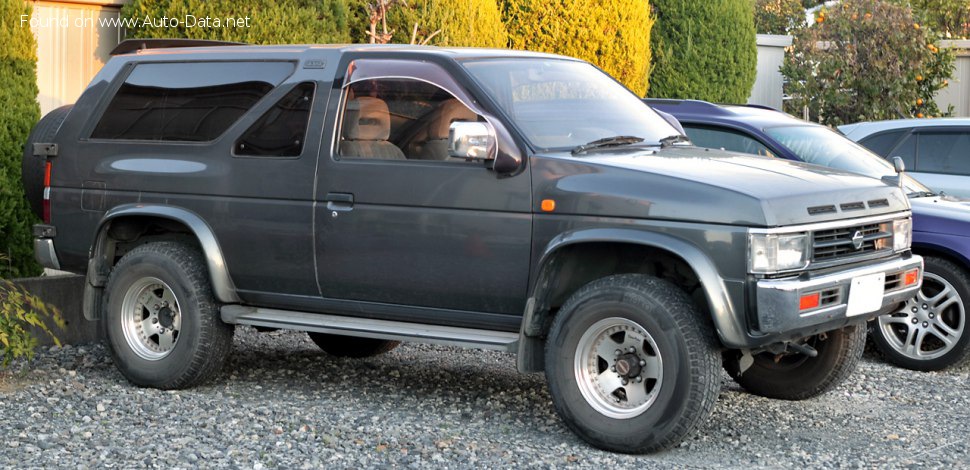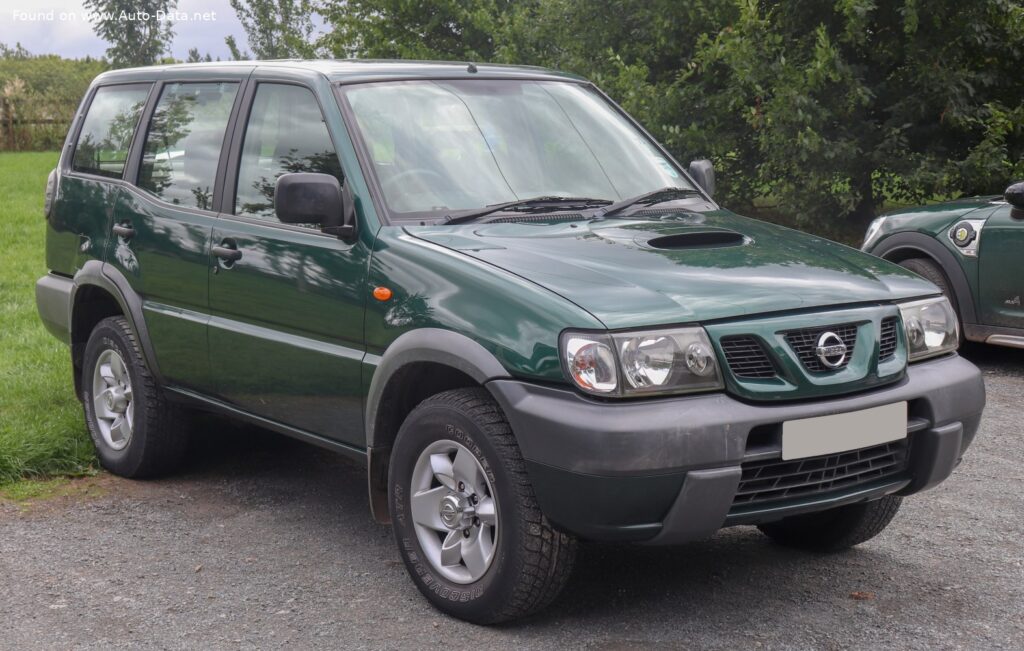
The Nissan Terrano II (R20), specifically the 2.4 i 12V 4WD (3 dr) (124 Hp) variant produced between 1993 and 1996, represents a significant chapter in the evolution of compact and mid-size SUVs. While not officially sold in the United States under the Terrano nameplate, this robust sport utility vehicle carved out a strong niche in European, Asian, and Australian markets. It was developed as a joint venture with Ford of Europe, where it was also rebadged and sold as the Ford Maverick. The Terrano II (R20) was designed to bridge the gap between more rugged, utilitarian off-roaders and the emerging segment of more comfortable, on-road-friendly SUVs. Its three-door configuration, combined with a capable four-wheel-drive system, aimed to appeal to consumers seeking both adventurous capability and practical daily usability. This generation marked a pivotal moment for Nissan, as it adapted its successful SUV formula to a broader international audience, emphasizing reliability and a blend of performance for diverse driving conditions.
The Nissan Terrano II (R20): Engineering for Global Markets
The Nissan Terrano II (R20) emerged during a period of rapid expansion in the global SUV market, where consumer demand shifted towards vehicles offering a more car-like driving experience alongside traditional off-road prowess. Launched in 1993, the R20 generation was an evolution from the more utilitarian Terrano I (known as the Pathfinder in North America), adopting a more rounded, contemporary aesthetic and improved on-road dynamics. Its primary market was outside of North America, where it competed effectively against other growing compact and mid-size SUV offerings. The specific 2.4 i 12V 4WD (3 dr) (124 Hp) model, produced until 1996, was a cornerstone of the Terrano II lineup, offering a balance of performance and efficiency suitable for a wide range of buyers, from families to outdoor enthusiasts. Its design and engineering reflected a global approach, aiming to meet diverse regulatory and consumer preferences across continents.
Engine and Performance
At the heart of the Nissan Terrano II (R20) 2.4 i 12V 4WD (3 dr) (124 Hp) lay the venerable KA24 inline four-cylinder engine. This naturally aspirated 2.4-liter (2389 cm³ or 145.79 cu. in.) powerplant was a well-regarded unit known for its durability and relatively smooth power delivery. Featuring a multi-port manifold injection system and an OHC (Overhead Camshaft) valvetrain with three valves per cylinder, it produced a respectable 124 horsepower at 5200 rpm. Torque output was equally robust for its class, peaking at 145.3 lb.-ft. at 4000 rpm. This engine was longitudinally mounted in the front, contributing to a balanced weight distribution and aiding in its four-wheel-drive system’s efficiency.
Power was delivered to all four wheels via a standard 5-speed manual transmission, a setup favored by many for its direct engagement and control, particularly in off-road scenarios. The Terrano II’s performance figures, while not groundbreaking by modern standards, were competitive for a 1990s SUV. It could accelerate from 0 to 60 mph in a calculated 12.5 seconds, reaching a maximum speed of 99.42 mph. Fuel economy was rated at a combined 21.2 US mpg (11.1 l/100 km), which was a reasonable figure for an all-wheel-drive SUV of its size and era. The vehicle’s weight-to-power ratio stood at 13.1 kg/Hp (76.5 Hp/tonne), indicating a solid, if not spirited, performance characteristic tailored more for reliability and capability than outright speed. The engine’s compression ratio of 8.6:1 further underscored its design for robust, consistent operation across various fuel qualities available globally.
Design and Features
The Nissan Terrano II (R20) 2.4 i 12V 4WD (3 dr) (124 Hp) distinguished itself with a design that blended rugged utility with a touch of contemporary styling for the mid-1990s. Its three-door SUV body type, while offering a sportier appearance, also provided a compact footprint ideal for urban maneuvering and tight off-road trails. Measuring 161.61 inches in length, 68.31 inches in width, and 71.06 inches in height, the Terrano II struck a balance between a compact and mid-size vehicle. The 96.46-inch wheelbase contributed to its stable ride and respectable off-road articulation.
Inside, the Terrano II offered seating for five occupants, making it a versatile choice for families or small groups. Despite its relatively compact exterior, the vehicle provided practical cargo space, with a minimum trunk capacity of 11.83 cu. ft. (335 liters) that could expand significantly to 58.27 cu. ft. (1650 liters) with the rear seats folded, catering to various hauling needs. The suspension system was designed for both comfort and capability, featuring a double wishbone setup at the front and a coil spring arrangement at the rear. This combination provided a compliant ride on paved roads while offering the necessary articulation and robustness for off-road excursions. Braking was handled by ventilated discs at the front for effective stopping power and drum brakes at the rear, a common configuration for SUVs of this period. Safety and convenience features included ABS (Anti-lock Braking System) and hydraulic power steering, which made the vehicle easier to maneuver both on and off the pavement. The standard tire size of 215/75 R15 T provided a good balance of grip and ride comfort for its intended use.
Technical Specifications: Nissan Terrano II (R20) 2.4 i 12V 4WD (3 dr) (124 Hp)
| General Information | |
| Brand | Nissan |
| Model | Terrano |
| Generation | Terrano II (R20) |
| Type (Engine) | 2.4 i 12V 4WD (3 dr) (124 Hp) |
| Start of Production | 1993 year |
| End of Production | 1996 year |
| Powertrain Architecture | Internal Combustion engine |
| Body type | SUV |
| Seats | 5 |
| Doors | 3 |
| Performance Specs | |
| Fuel consumption (combined) | 21.2 US mpg (11.1 l/100 km) |
| Fuel Type | Petrol (Gasoline) |
| Acceleration 0 – 60 mph | 12.5 sec |
| Maximum speed | 99.42 mph (160 km/h) |
| Weight-to-power ratio | 13.1 kg/Hp (76.5 Hp/tonne) |
| Weight-to-torque ratio | 8.2 kg/Nm (121.6 Nm/tonne) |
| Engine Specs | |
| Power | 124 Hp @ 5200 rpm |
| Power per liter | 51.9 Hp/l |
| Torque | 145.3 lb.-ft. @ 4000 rpm (197 Nm @ 4000 rpm) |
| Engine layout | Front, Longitudinal |
| Engine Model/Code | KA24 |
| Engine displacement | 2389 cm³ (145.79 cu. in.) |
| Number of cylinders | 4 |
| Engine configuration | Inline |
| Cylinder Bore | 3.5 in. (89 mm) |
| Piston Stroke | 3.78 in. (96 mm) |
| Compression ratio | 8.6:1 |
| Number of valves per cylinder | 3 |
| Fuel injection system | Multi-port manifold injection |
| Engine aspiration | Naturally aspirated engine |
| Valvetrain | OHC |
| Engine oil capacity | 4.54 US qt (4.3 l) |
| Coolant capacity | 7.29 US qt (6.9 l) |
| Space, Volume and Weights | |
| Kerb Weight | 3571.49 lbs. (1620 kg) |
| Max. weight | 5070.63 lbs. (2300 kg) |
| Max load | 1499.14 lbs. (680 kg) |
| Trunk (boot) space – minimum | 11.83 cu. ft. (335 l) |
| Trunk (boot) space – maximum | 58.27 cu. ft. (1650 l) |
| Fuel tank capacity | 19.02 US gal (72 l) |
| Dimensions | |
| Length | 161.61 in. (4105 mm) |
| Width | 68.31 in. (1735 mm) |
| Height | 71.06 in. (1805 mm) |
| Wheelbase | 96.46 in. (2450 mm) |
| Front track | 57.28 in. (1455 mm) |
| Rear (Back) track | 56.3 in. (1430 mm) |
| Drivetrain, Brakes and Suspension Specs | |
| Drive wheel | All wheel drive (4×4) |
| Number of gears and type of gearbox | 5 gears, manual transmission |
| Front suspension | Double wishbone |
| Rear suspension | Coil spring |
| Front brakes | Ventilated discs |
| Rear brakes | Drum |
| Assisting systems | ABS (Anti-lock braking system) |
| Power steering | Hydraulic Steering |
| Tires size | 215/75 R15 T |
Legacy and Market Impact of the Nissan Terrano II (R20)
The Nissan Terrano II (R20) holds a significant place in the history of SUVs, particularly in markets outside of North America. Its primary impact was felt across Europe, Asia, and Australia, where it was celebrated for its robust construction, reliable powertrain, and genuine off-road capabilities, combined with a level of on-road comfort that was becoming increasingly important to consumers. The joint venture with Ford, resulting in the Ford Maverick, further cemented its presence and appeal in these regions, showcasing a successful collaboration between two major automotive players.
In its target markets, the Terrano II competed with a growing array of compact and mid-size SUVs. Key rivals included the first-generation Toyota RAV4, which emphasized a more car-like driving experience, and the Suzuki Vitara/Grand Vitara, known for its smaller footprint and agility. Later in its production, it also faced competition from models like the Honda CR-V and the Land Rover Freelander, all vying for a share of the burgeoning SUV segment. However, the Terrano II distinguished itself with a reputation for being a true workhorse. Its traditional ladder-frame chassis, combined with a capable 4×4 system and solid axles in some configurations (though the 2.4L model specified here uses a coil-sprung rear), gave it an edge in terms of durability and off-road ruggedness compared to some of its more car-based competitors.
The 2.4 i 12V 4WD (3 dr) (124 Hp) variant, with its KA24 engine, was particularly noted for its longevity and ease of maintenance, contributing to its enduring appeal among owners who valued practicality and reliability over cutting-edge technology. While it may not have boasted the luxurious interiors or advanced features of some later SUVs, its straightforward design and mechanical integrity made it a popular choice for both daily driving and more adventurous pursuits. The Terrano II’s legacy is one of a dependable, capable, and versatile SUV that successfully navigated the transitional period of the 1990s, helping to define what a modern SUV could be for a global audience, even without a direct presence in the competitive North American market under its original name.