
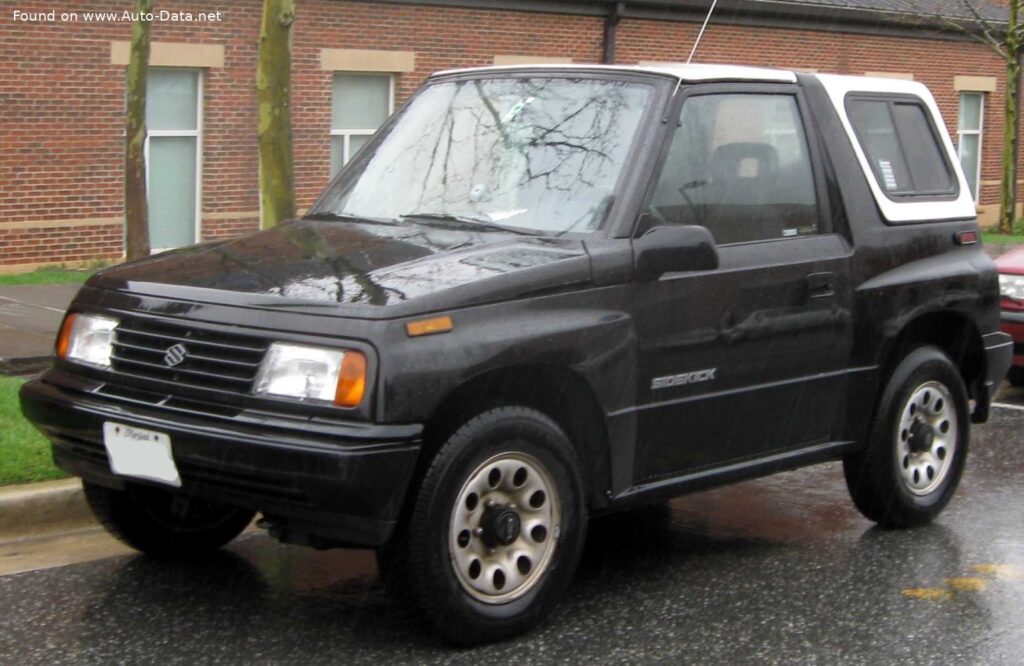
The Suzuki Sidekick 1.6 (80 Hp), produced from 1988 to 1998, represents a pivotal model in the evolution of the compact sport utility vehicle (SUV) segment. Launched at a time when the automotive market was beginning to embrace smaller, more versatile vehicles, the Sidekick carved out a significant niche for itself. Known for its robust, body-on-frame construction, capable four-wheel-drive system, and accessible price point, it quickly became a popular choice for consumers seeking an adventurous yet practical daily driver. In the North American market, it was also famously rebadged and sold as the Geo Tracker, a collaboration between General Motors and Suzuki, further cementing its presence and appeal across a broader audience. This generation of the Suzuki Sidekick, particularly with its 1.6-liter engine, became synonymous with reliability, affordability, and a surprisingly nimble off-road prowess, setting a benchmark for future compact SUVs.
The Suzuki Sidekick 1.6 (80 Hp): A Pioneer in Compact SUVs
The Suzuki Sidekick’s introduction in 1988 marked a significant moment for the automotive industry, particularly in the burgeoning compact SUV category. While larger, more traditional SUVs had long been a staple, the Sidekick offered a fresh perspective: a smaller, more fuel-efficient, and more maneuverable alternative that didn’t compromise on the fundamental utility and off-road capability expected of an SUV. Its compact footprint made it equally adept at navigating urban environments and tackling challenging trails, a versatility that resonated deeply with buyers. The vehicle’s straightforward design and mechanical simplicity contributed to its reputation for durability and ease of maintenance, qualities that ensured its longevity and continued popularity throughout its production run and beyond. The Sidekick’s success played a crucial role in legitimizing the concept of the “mini-SUV” and paved the way for a wave of subsequent competitors in the segment.
Engine and Powertrain Dynamics
At the heart of the Suzuki Sidekick 1.6 (80 Hp) was a reliable and efficient G16 series internal combustion engine. This 1.6-liter, naturally aspirated gasoline engine produced a modest but entirely adequate 80 horsepower. While 80 Hp might seem low by modern standards, it was perfectly suited to the Sidekick’s lightweight construction and intended purpose. The engine was praised for its simplicity, which translated into excellent reliability and straightforward serviceability, making it a favorite among owners who valued dependability over raw power.
The powertrain architecture of the Sidekick was designed for ruggedness and versatility. The engine utilized a pump-nozzle (unit injector) fuel injection system, a robust choice for ensuring consistent fuel delivery and efficiency. Being naturally aspirated, the engine delivered power smoothly and predictably across its RPM range, an important characteristic for off-road driving where precise throttle control is paramount. Mated to a durable transmission (typically a five-speed manual or a four-speed automatic, though specific transmission details are not provided in the core data, these were common for the model), the G16 engine provided ample torque for climbing hills, pulling light loads, and navigating uneven terrain. The vehicle’s design prioritized a balance of on-road civility and off-road capability, with the engine playing a key role in achieving this equilibrium. Its relatively small displacement also contributed to better fuel economy compared to larger SUVs of the era, making it a more economical choice for daily commuting.
Design Philosophy and Practical Features
The Suzuki Sidekick 1.6 (80 Hp) was offered primarily as a 3-door SUV, a body style that emphasized its compact, adventurous character. This configuration, often available as a soft-top convertible or with a removable hardtop, further enhanced its appeal as a fun, recreational vehicle. The design was unmistakably utilitarian, with clean lines, prominent wheel arches, and a relatively high ground clearance that visually communicated its off-road aspirations. Functionality dictated much of its aesthetic, from the robust bumpers to the practical interior layout.
Inside, the Sidekick’s cabin was designed for durability and ease of use rather than luxury. Materials were hard-wearing, capable of withstanding the rigors of outdoor adventures. While modern comforts like advanced infotainment systems or sophisticated driver-assistance features were non-existent in this era, the Sidekick provided essential amenities. Its compact dimensions made it easy to maneuver in tight spaces, while the relatively short wheelbase contributed to its impressive breakover angle for off-road obstacles. The 3-door configuration, while limiting rear passenger access somewhat, allowed for a more rigid body structure and often a lighter overall weight, beneficial for both performance and fuel efficiency. For its time, the Sidekick offered a compelling package for those who sought a genuine SUV experience in a more manageable and affordable format.
Legacy and Market Impact
The Suzuki Sidekick 1.6 (80 Hp) left an indelible mark on the automotive landscape, particularly in North America and other global markets where it was sold under various names, including the Geo Tracker. Its primary legacy lies in its role as a pioneer and popularizer of the compact SUV segment. Before the Sidekick, smaller SUVs were often niche products; the Sidekick, along with its sibling the Suzuki Samurai, demonstrated that there was a substantial demand for vehicles that combined the ruggedness of a traditional SUV with the practicality and efficiency of a smaller car.
Competitors in its segment were somewhat limited at its initial launch, but as the segment grew, it faced rivals like the Daihatsu Rocky/Feroza. Later, as the market evolved, it indirectly influenced the development of more car-like compact SUVs such as the Toyota RAV4 and Honda CR-V, though these models often adopted a unibody construction rather than the Sidekick’s more traditional body-on-frame approach. The Sidekick’s reputation for exceptional reliability and low running costs contributed significantly to its enduring popularity. It became a favorite among first-time SUV buyers, outdoor enthusiasts, and those looking for an economical second vehicle.
Even years after its production ceased in 1998, the Sidekick and Tracker maintain a strong following in the used car market. Their simple mechanicals make them relatively easy and inexpensive to maintain, and their robust construction means many examples are still on the road today, often modified for more serious off-roading. The Sidekick’s impact extended beyond sales figures; it helped shape consumer perception of what an SUV could be, proving that capability didn’t necessarily require a large, imposing, or fuel-thirsty vehicle. It solidified Suzuki’s reputation as a master of small, capable 4x4s, a legacy that continues to influence the brand’s offerings today.
Technical Specifications of the Suzuki Sidekick 1.6 (80 Hp)
| Category | Specification |
|---|---|
| Brand | Suzuki |
| Model | Sidekick |
| Generation | Sidekick |
| Type (Engine) | 1.6 (80 Hp) |
| Start of production | 1988 year |
| End of production | 1998 year |
| Powertrain Architecture | Internal Combustion engine |
| Body type | SUV |
| Doors | 3 |
| Fuel Type | Petrol (Gasoline) |
| Power | 80 Hp |
| Engine Model/Code | G16 |
| Fuel injection system | Pump-nozzle (Unit Injector) |
| Engine aspiration | Naturally aspirated engine |
| Engine oil capacity | 4.44 US qt |
| Coolant capacity | 5.6 US qt |
| Fuel tank capacity | 11.1 US gal |
| Drivetrain | Internal Combustion engine (Note: This refers to the engine type as the primary power source, as specified in the raw data.) |
