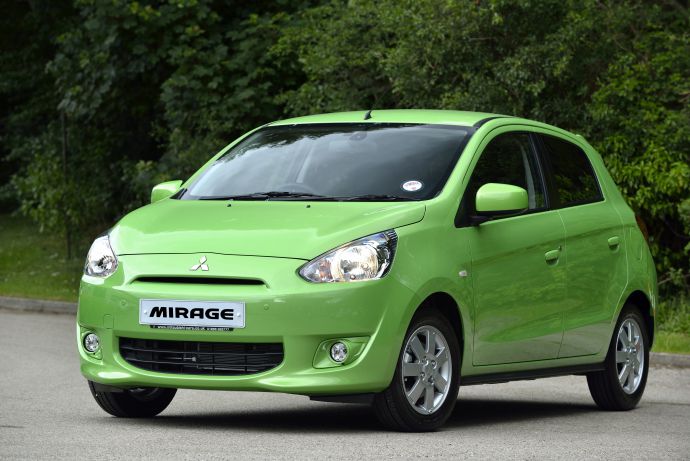
The Mitsubishi Mirage VI Hatchback, specifically the 1.2 MIVEC (80 Hp) variant, represents a pivotal offering in the global subcompact segment from the Japanese automaker. Launched in 2012 and produced until 2016, this generation of the Mirage was engineered with a primary focus on fuel efficiency, affordability, and compact maneuverability, targeting urban drivers and budget-conscious consumers across various international markets, particularly in Asia and Europe. Known for its pragmatic design and economical operation, the Mitsubishi Mirage VI Hatchback aimed to provide reliable transportation with minimal environmental impact, embodying Mitsubishi’s commitment to accessible and efficient mobility.
The Mitsubishi Mirage VI Hatchback: A Global Contender
Positioned as a global car, the Mitsubishi Mirage VI Hatchback, also known as the Mitsubishi Space Star in some European markets, was designed from the ground up to be a lightweight and aerodynamically optimized vehicle. Its compact dimensions made it an ideal choice for navigating congested city streets and tight parking spaces, a common requirement in its target markets. Unlike its North American counterpart, which typically featured a slightly different powertrain lineup, this 1.2 MIVEC (80 Hp) version was a staple in regions where fuel economy and lower emissions were paramount, often driven by tax incentives and consumer preferences for smaller, more efficient engines. The car’s development prioritized reducing overall weight and drag, leading to a drag coefficient of just 0.28, an impressive figure for its class, directly contributing to its remarkable fuel efficiency.
The Mirage VI Hatchback’s market segment is characterized by fierce competition, with rivals such as the Toyota Yaris, Honda Fit (Jazz), Nissan Micra, and Suzuki Swift vying for consumer attention. Mitsubishi differentiated the Mirage by emphasizing its straightforward engineering, proven reliability, and low running costs. Its simple, yet functional, interior design and robust mechanicals appealed to buyers looking for a no-frills vehicle that could withstand the rigors of daily commuting without demanding excessive maintenance. This generation marked a return to the Mirage nameplate in many markets after a hiatus, signaling Mitsubishi’s renewed focus on the compact car segment as a cornerstone of its global strategy.
Engine & Performance: The Mitsubishi Mirage VI Hatchback Powertrain
At the heart of the Mitsubishi Mirage VI Hatchback 1.2 MIVEC (80 Hp) lies a compact and efficient 1.2-liter (1193 cm³) inline three-cylinder engine, designated with the model code 3A92. This naturally aspirated gasoline engine incorporates Mitsubishi’s MIVEC (Mitsubishi Innovative Valve timing Electronic Control) technology, which optimizes valve timing for improved fuel efficiency and power delivery across the rev range. With a power output of 80 horsepower at 6000 rpm and a peak torque of 78.18 lb.-ft. (106 Nm) at 5000 rpm, the engine is tuned for urban driving, offering adequate pep for city maneuvers while excelling in fuel economy.
The engine’s configuration features a DOHC (Double Overhead Camshaft) valvetrain with four valves per cylinder, contributing to its efficiency and smooth operation. Fuel delivery is handled by a multi-port manifold injection system, a reliable and cost-effective solution for this segment. With a compression ratio of 11:1, the engine is designed to extract maximum energy from each drop of gasoline. Power is sent to the front wheels via a standard 5-speed manual transmission, a choice that further enhances driver engagement and allows for precise control over the engine’s output, contributing to its strong fuel economy figures.
Performance figures for the 1.2 MIVEC (80 Hp) Mirage reflect its economical nature rather than outright speed. It accelerates from 0 to 60 mph in 11.1 seconds, with a 0-100 km/h sprint taking 11.7 seconds. The top speed is rated at 111.85 mph (180 km/h). These numbers are competitive within its class, providing sufficient performance for daily commuting and occasional highway travel. Crucially, the car achieves impressive combined fuel economy of 57.4 US mpg (4.1 l/100 km), with urban economy at 49 US mpg (4.8 l/100 km) and extra-urban at 63.6 US mpg (3.7 l/100 km). This exceptional efficiency, coupled with its Euro 5 emission standard compliance, made it an attractive option in markets with strict environmental regulations and high fuel prices.
Design & Features: Practicality in a Compact Package
The Mitsubishi Mirage VI Hatchback adopts a conventional 5-door hatchback body type, offering practical access to both the passenger cabin and the cargo area. Designed to accommodate five occupants, the interior prioritizes functionality and space utilization. Despite its compact exterior dimensions—measuring 146.06 inches (3710 mm) in length, 65.55 inches (1665 mm) in width, and 58.66 inches (1490 mm) in height—the Mirage offers a surprisingly airy cabin, thanks to a relatively long wheelbase of 96.46 inches (2450 mm). This design philosophy maximizes interior volume and ensures reasonable legroom for rear passengers, a key selling point for a car of its size.
The exterior design is characterized by smooth, aerodynamic lines, contributing to its low drag coefficient of 0.28. While not overtly sporty, the design is clean and contemporary, reflecting its practical purpose. The body is lightweight, with a curb weight of just 1862.91 lbs (845 kg), which significantly aids in both performance and fuel efficiency. The suspension system features an independent McPherson strut setup with coil springs and an anti-roll bar at the front, providing a comfortable ride and stable handling, while the rear utilizes a torsion beam setup, a common and space-efficient solution for subcompacts.
In terms of features, the Mirage VI Hatchback 1.2 MIVEC (80 Hp) is equipped with essential modern conveniences and safety systems. Steering is managed by a responsive steering rack and pinion system, assisted by electric power steering, which makes maneuvering at low speeds effortless, particularly in urban environments. Braking is handled by ventilated discs at the front and traditional drum brakes at the rear, complemented by an Anti-lock Braking System (ABS) for enhanced safety during emergency stops. The car rides on 165/65 R14 tires fitted to 14-inch wheel rims, a sensible choice balancing ride comfort, grip, and cost-effectiveness. The vehicle also boasts a generous trunk capacity, ranging from 17.2 cu. ft. (487 liters) with the rear seats up, expandable to an impressive 47 cu. ft. (1331 liters) with the rear seats folded down, making it highly versatile for cargo needs.
Technical Specifications for the Mitsubishi Mirage VI Hatchback 1.2 MIVEC (80 Hp)
| Category | Specification |
|---|---|
| General Information | |
| Brand | Mitsubishi |
| Model | Mirage |
| Generation | Mirage VI Hatchback |
| Type (Engine) | 1.2 MIVEC (80 Hp) |
| Start of Production | 2012 year |
| End of Production | 2016 year |
| Powertrain Architecture | Internal Combustion engine |
| Body Type | Hatchback |
| Seats | 5 |
| Doors | 5 |
| Performance Specs | |
| Fuel Consumption (Economy) – Urban | 4.8 l/100 km (49 US mpg) |
| Fuel Consumption (Economy) – Extra Urban | 3.7 l/100 km (63.6 US mpg) |
| Fuel Consumption (Economy) – Combined | 4.1 l/100 km (57.4 US mpg) |
| Fuel Type | Petrol (Gasoline) |
| Acceleration 0 – 60 mph | 11.1 sec |
| Acceleration 0 – 100 km/h | 11.7 sec |
| Maximum Speed | 180 km/h (111.85 mph) |
| Emission Standard | Euro 5 |
| Weight-to-Power Ratio | 10.6 kg/Hp, 94.7 Hp/tonne |
| Weight-to-Torque Ratio | 8 kg/Nm, 125.4 Nm/tonne |
| Engine Specs | |
| Power | 80 Hp @ 6000 rpm |
| Power per Liter | 67.1 Hp/l |
| Torque | 106 Nm @ 5000 rpm (78.18 lb.-ft. @ 5000 rpm) |
| Engine Layout | Front, Transverse |
| Engine Model/Code | 3A92 |
| Engine Displacement | 1193 cm³ (1.2 liters, 72.8 cu. in.) |
| Number of Cylinders | 3 |
| Engine Configuration | Inline |
| Cylinder Bore | 75 mm (2.95 in.) |
| Piston Stroke | 90 mm (3.54 in.) |
| Compression Ratio | 11:1 |
| Number of Valves per Cylinder | 4 |
| Fuel Injection System | Multi-port manifold injection |
| Engine Aspiration | Naturally aspirated engine |
| Valvetrain | DOHC |
| Engine Oil Capacity | 3 liters (3.17 US qt) |
| Coolant Capacity | 4 liters (4.23 US qt) |
| Space, Volume and Weights | |
| Kerb Weight | 845 kg (1862.91 lbs) |
| Max. Weight | 1340 kg (2954.19 lbs) |
| Max Load | 495 kg (1091.29 lbs) |
| Trunk (Boot) Space – Minimum | 487 liters (17.2 cu. ft.) |
| Trunk (Boot) Space – Maximum | 1331 liters (47 cu. ft.) |
| Fuel Tank Capacity | 35 liters (9.25 US gal) |
| Dimensions | |
| Length | 3710 mm (146.06 in.) |
| Width | 1665 mm (65.55 in.) |
| Height | 1490 mm (58.66 in.) |
| Wheelbase | 2450 mm (96.46 in.) |
| Front Track | 1430 mm (56.3 in.) |
| Rear (Back) Track | 1415 mm (55.71 in.) |
| Ride Height (Ground Clearance) | 140 mm (5.51 in.) |
| Drag Coefficient (Cd) | 0.28 |
| Minimum Turning Circle (Turning Diameter) | 9.2 m (30.18 ft.) |
| Drivetrain, Brakes and Suspension Specs | |
| Drivetrain Architecture | The Internal combustion engine (ICE) drives the front wheels of the vehicle. |
| Drive Wheel | Front wheel drive |
| Number of Gears and Type of Gearbox | 5 gears, manual transmission |
| Front Suspension | Independent, type McPherson with coil spring and anti-roll bar |
| Rear Suspension | Torsion |
| Front Brakes | Ventilated discs |
| Rear Brakes | Drum |
| Assisting Systems | ABS (Anti-lock braking system) |
| Steering Type | Steering rack and pinion |
| Power Steering | Electric Steering |
| Tires Size | 165/65 R14 |
| Wheel Rims Size | 14 inches |
Legacy & Market Impact of the Mitsubishi Mirage VI Hatchback
The Mitsubishi Mirage VI Hatchback 1.2 MIVEC (80 Hp) cemented its legacy as a highly practical and economical vehicle in its primary markets. It was often lauded for its robust build quality, low running costs, and exceptional fuel efficiency, making it a favorite among commuters, first-time car buyers, and fleet operators. While it didn’t boast class-leading luxury or performance, its strength lay in its reliability and affordability, offering a compelling value proposition in a segment where every dollar (or euro/yen) counts.
In Europe and Asia, where this specific variant was prevalent, the Mirage VI competed against a host of well-established subcompacts. Its key rivals included models like the Volkswagen Polo, Ford Fiesta, Renault Clio, and Hyundai i20, all of which offered varying degrees of sophistication and driving dynamics. The Mirage carved out its niche by being perhaps the most straightforward and least complicated option, appealing to those who prioritized function over form and efficiency above all else. Its low curb weight and efficient powertrain also meant lower emissions and, consequently, lower road taxes in many regions, further enhancing its economic appeal.
The Mirage VI Hatchback played a crucial role in Mitsubishi’s global strategy during its production years. It allowed the brand to maintain a strong presence in the high-volume subcompact segment, serving as an accessible entry point into the Mitsubishi lineup. Its success underscored the continued demand for honest, no-frills transportation that delivers on its promises of reliability and low ownership costs. While later iterations and market dynamics saw changes to the Mirage lineup, this generation, particularly the 1.2 MIVEC (80 Hp) variant, remains a testament to Mitsubishi’s capability in producing globally relevant, efficient, and durable compact cars.