
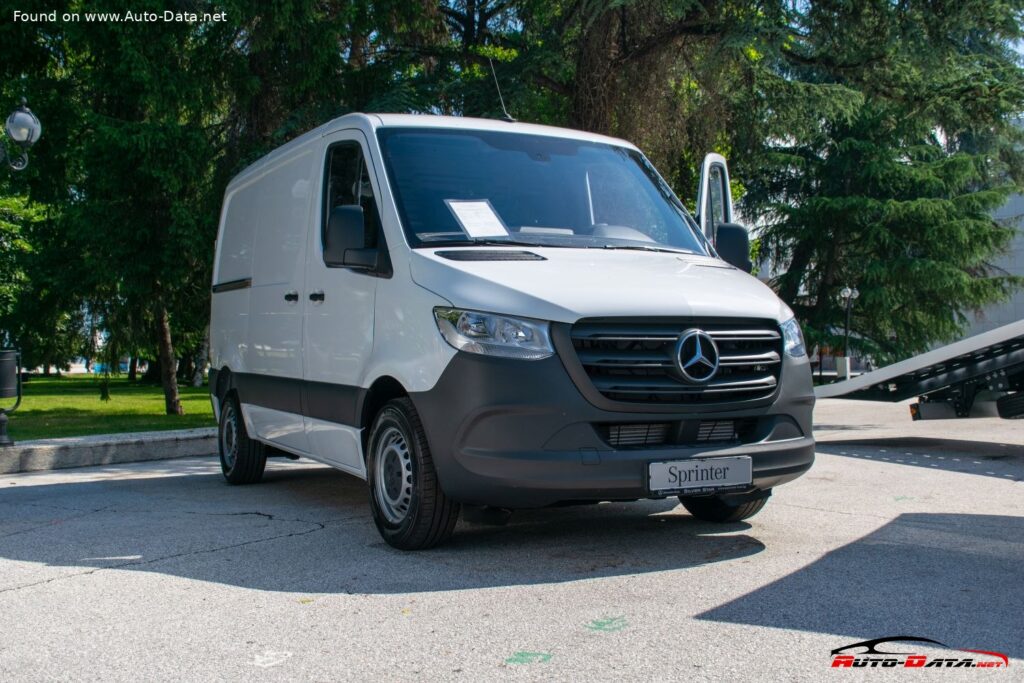
The Mercedes-Benz Sprinter Panel Van Compact (W907/W910) 414 CDI (143 Hp) W910 9G-TRONIC stands as a testament to Mercedes-Benz’s enduring commitment to the light commercial vehicle segment. Launched in 2018, this particular iteration of the Sprinter, part of the W907/W910 generation, emphasizes efficiency, technological advancement, and adaptability for a wide array of commercial applications. As a compact panel van, it targets businesses requiring a balance of cargo capacity and maneuverability, particularly suited for urban delivery and service roles. Its powertrain architecture, centered around an internal combustion engine, is paired with a sophisticated automatic transmission, reflecting modern demands for driver comfort and operational economy in the demanding world of logistics and trade.
The Mercedes-Benz Sprinter Panel Van Compact (W907/W910): A Modern Workhorse for Global Logistics
The Mercedes-Benz Sprinter has long been a benchmark in the commercial van sector, renowned for its build quality, reliability, and versatility. The W907/W910 generation, introduced in 2018, brought significant enhancements in terms of connectivity, safety, and powertrain options. This specific variant, the 414 CDI (143 Hp) W910 9G-TRONIC, represents a popular configuration within the Sprinter lineup, particularly in European and other global markets where diesel powertrains and compact dimensions are highly valued. While the Sprinter nameplate is well-established in the USA, this particular “Compact” panel van specification with its distinct diesel engine and 9G-TRONIC automatic transmission caters to specific market needs, offering a compelling blend of power, fuel efficiency, and a robust cargo solution for businesses ranging from last-mile delivery services to skilled trades.
Engine & Performance
At the heart of the Mercedes-Benz Sprinter Panel Van Compact (W907/W910) 414 CDI lies the venerable OM 651 engine, a 2.1-liter (2143 cm³) inline four-cylinder diesel unit. This engine is engineered for both durability and efficiency, producing a respectable 143 horsepower at 3800 rpm. Its power per liter stands at 66.7 Hp/l, indicative of a well-optimized commercial engine designed for sustained output rather than peak performance. More crucial for a commercial vehicle, however, is its torque output. The 414 CDI delivers a robust 330 Newton-meters (243.4 lb.-ft.) of torque across a broad and usable rev range, from 1200 to 2400 rpm. This wide torque band ensures strong pulling power from low engine speeds, essential for navigating urban traffic, carrying heavy loads, and maintaining momentum on inclines without constant gear changes.
Fuel delivery is managed by a Diesel Commonrail injection system, which, combined with a turbocharger and intercooler, ensures efficient combustion and responsiveness. The engine’s compliance with the Euro 6 emission standard signifies its commitment to environmental responsibility, featuring a particulate filter as part of its advanced engine systems. This level of emission control is vital for market access in many regions with stringent environmental regulations.
Power is channeled to the front wheels via a sophisticated 9G-TRONIC automatic transmission with nine gears. This advanced gearbox is a significant upgrade, offering smoother shifts, improved acceleration, and enhanced fuel economy compared to previous generations. The numerous ratios allow the engine to operate within its most efficient speed range for longer periods, whether cruising on the highway or navigating stop-and-go city traffic. The fuel economy figures underscore this efficiency: combined (NEDC) consumption is rated at 8.1-8.2 l/100 km, which translates to an impressive 29-28.7 US mpg. Urban consumption is listed at 8.6 l/100 km (27.4 US mpg), while extra-urban figures are even better at 7.9-8.1 l/100 km (29.8-29 US mpg). These figures highlight the Sprinter’s cost-effectiveness for businesses that cover significant mileage.
Design & Features
The Mercedes-Benz Sprinter Panel Van Compact (W907/W910) is designed first and foremost for functionality and utility. As a panel van, its primary purpose is cargo transport, and the “Compact” designation indicates its shorter wheelbase and overall length compared to other Sprinter variants, making it more agile in congested urban environments. It features a five-door configuration, typically with two front doors, two sliding side doors, and a rear barn-door setup, providing excellent access to the cargo area. The cabin is configured for three occupants, catering to a driver and two passengers, suitable for work crews or apprentices.
In terms of dimensions, the van measures 207.36 inches (5267 mm) in length, 79.53 inches (2020 mm) in width (92.32 inches or 2345 mm including mirrors), and stands 92.76 inches (2356 mm) tall. Its wheelbase is 128.31 inches (3259 mm), contributing to a minimum turning circle of 42.65 feet (13 meters), which is commendable for a vehicle of its size and crucial for urban maneuverability. The cargo area is substantial, offering a maximum trunk space of 275.45 cubic feet (7800 liters), capable of accommodating a wide range of goods and equipment.
The vehicle’s robust construction allows for a maximum load of 4739.94 lbs (2150 kg) on top of its kerb weight of 4299.01 lbs (1950 kg), bringing its maximum gross weight to 9038.95 lbs (4100 kg). Practical features include a 17.17 US gallon (65 liter) fuel tank, a 5.81 US gallon (22 liter) AdBlue tank for emission control, and a significant maximum roof load capacity of 661.39 lbs (300 kg). It also boasts impressive towing capabilities, with a permitted trailer load of 4409.25 lbs (2000 kg) with brakes and 1653.47 lbs (750 kg) without brakes.
Safety and stability are paramount for commercial vehicles. The Sprinter comes equipped with an Anti-lock Braking System (ABS) as a standard assisting system. The drivetrain architecture is front-wheel drive, which offers advantages in terms of cargo floor height and potentially better traction in certain load conditions. Suspension comprises leaf springs at the front and a combination of hydraulic elements and leaf springs at the rear, designed to handle heavy loads and provide a stable ride. Braking is handled by disc brakes on both the front and rear axles. The van rides on 225/65 R16 tires mounted on 6.5J x 16 wheel rims, providing a good balance of load-bearing capacity and ride comfort.
Technical Specifications
| Brand | Mercedes-Benz |
| Model | Sprinter |
| Generation | Sprinter Panel Van Compact (W907/W910) |
| Type (Engine) | 414 CDI (143 Hp) W910 9G-TRONIC |
| Start of production | 2018 year |
| Powertrain Architecture | Internal Combustion engine |
| Body type | Van |
| Seats | 3 |
| Doors | 5 |
| Performance Specs | |
| Fuel consumption (economy) – urban (NEDC) | 8.6 l/100 km (27.4 US mpg, 32.8 UK mpg, 11.6 km/l) |
| Fuel consumption (economy) – extra urban (NEDC) | 7.9-8.1 l/100 km (29.8 – 29 US mpg, 35.8 – 34.9 UK mpg, 12.7 – 12.3 km/l) |
| Fuel consumption (economy) – combined (NEDC) | 8.1-8.2 l/100 km (29 – 28.7 US mpg, 34.9 – 34.4 UK mpg, 12.3 – 12.2 km/l) |
| CO2 emissions (NEDC) | 213-216 g/km |
| Fuel Type | Diesel |
| Emission standard | Euro 6 |
| Weight-to-power ratio | 13.6 kg/Hp, 73.3 Hp/tonne |
| Weight-to-torque ratio | 5.9 kg/Nm, 169.2 Nm/tonne |
| Engine Specs | |
| Power | 143 Hp @ 3800 rpm |
| Power per liter | 66.7 Hp/l |
| Torque | 330 Nm @ 1200-2400 rpm (243.4 lb.-ft. @ 1200-2400 rpm) |
| Engine layout | Front, Transverse |
| Engine Model/Code | OM 651 |
| Engine displacement | 2143 cm³ (2.1 l, 130.77 cu. in.) |
| Number of cylinders | 4 |
| Engine configuration | Inline |
| Number of valves per cylinder | 4 |
| Fuel injection system | Diesel Commonrail |
| Engine aspiration | Turbocharger, Intercooler |
| Engine oil capacity | 11.5 l (12.15 US qt, 10.12 UK qt) |
| Coolant | 9.5 l (10.04 US qt, 8.36 UK qt) |
| Engine systems | Particulate filter |
| Space, Volume and Weights | |
| Kerb Weight | 1950 kg (4299.01 lbs) |
| Max. weight | 4100 kg (9038.95 lbs) |
| Max load | 2150 kg (4739.94 lbs) |
| Trunk (boot) space – maximum | 7800 l (275.45 cu. ft.) |
| Fuel tank capacity | 65 l (17.17 US gal, 14.3 UK gal) |
| AdBlue tank | 22 l (5.81 US gal, 4.84 UK gal) |
| Max. roof load | 300 kg (661.39 lbs) |
| Permitted trailer load with brakes (12%) | 2000 kg (4409.25 lbs) |
| Permitted trailer load without brakes | 750 kg (1653.47 lbs) |
| Dimensions | |
| Length | 5267 mm (207.36 in.) |
| Width | 2020 mm (79.53 in.) |
| Width including mirrors | 2345 mm (92.32 in.) |
| Height | 2356 mm (92.76 in.) |
| Wheelbase | 3259 mm (128.31 in.) |
| Front track | 1759 mm (69.25 in.) |
| Rear (Back) track | 1770 mm (69.69 in.) |
| Front overhang | 1012 mm (39.84 in.) |
| Rear overhang | 996 mm (39.21 in.) |
| Ride height (ground clearance) | 143 mm (5.63 in.) |
| Minimum turning circle (turning diameter) | 13 m (42.65 ft.) |
| Drivetrain, Brakes and Suspension Specs | |
| Drivetrain Architecture | The Internal combustion engine (ICE) drives the front wheels of the vehicle. |
| Drive wheel | Front wheel drive |
| Number of gears and type of gearbox | 9 gears, automatic transmission G-TRONIC |
| Front suspension | Leaf spring |
| Rear suspension | Hydraulic elements, Leaf spring |
| Front brakes | Disc |
| Rear brakes | Disc |
| Assisting systems | ABS (Anti-lock braking system) |
| Tires size | 225/65 R16 |
| Wheel rims size | 6.5J x 16 |
Legacy & Market Impact
The Mercedes-Benz Sprinter has carved out an indelible legacy in the commercial vehicle market since its inception, establishing itself as a global leader in the large and medium van segments. The W907/W910 generation, including the Mercedes-Benz Sprinter Panel Van Compact (W907/W910) 414 CDI (143 Hp) W910 9G-TRONIC, continues this tradition by offering a refined, technologically advanced, and highly customizable platform. Its reputation for robust engineering, driver comfort, and comprehensive safety features has made it a preferred choice for a vast array of businesses, from couriers and logistics companies to construction firms and emergency services.
In its primary markets, particularly Europe, the Sprinter faces stiff competition from other well-established players like the Ford Transit, Volkswagen Crafter, Renault Master (and its rebadged variants), and the Fiat Ducato (also rebadged as Ram ProMaster in North America). However, the Sprinter consistently distinguishes itself through its premium brand image, superior interior quality, and cutting-edge technology. The introduction of features like the 9G-TRONIC automatic transmission and advanced driver-assistance systems (ADAS, though not explicitly detailed in the provided data, are characteristic of this generation) further solidify its competitive edge.
The 414 CDI variant, with its efficient diesel engine and front-wheel-drive architecture, is particularly impactful for businesses focused on operating costs and urban maneuverability. Its Euro 6 compliance ensures it meets strict environmental regulations, allowing access to low-emission zones increasingly common in European cities. The “Compact” body style addresses the critical need for vehicles that can navigate narrow city streets and tight parking spaces while still offering substantial cargo volume. This makes it an ideal solution for last-mile delivery services, plumbers, electricians, and other tradespeople who operate predominantly in urban and suburban environments.
The Sprinter’s widespread adoption has also fostered a thriving aftermarket for conversions and upfitting, allowing businesses to tailor the van precisely to their specific needs, whether it’s specialized shelving, refrigeration units, or mobile workshops. This adaptability contributes significantly to its market impact and long-term value. Overall, the Mercedes-Benz Sprinter Panel Van Compact (W907/W910) 414 CDI (143 Hp) W910 9G-TRONIC reinforces the Sprinter’s position as a versatile, dependable, and economically sensible choice for modern commercial operations, setting high standards for efficiency and functionality in the global light commercial vehicle sector.
