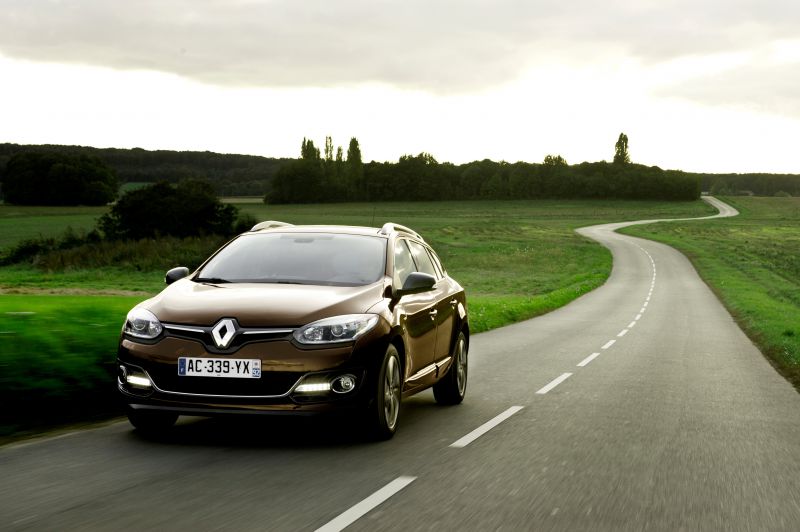
The Renault Megane III Grandtour (Phase III, 2014) 1.5 dCi (110 Hp) ECO2 represents a significant offering in the highly competitive European C-segment, specifically targeting buyers in the station wagon (estate) market. Launched as part of the third generation’s final iteration, or “Phase III,” this model, produced between 2014 and 2015, underscored Renault’s commitment to efficiency, practicality, and modern diesel technology. While not sold in the United States, the Megane Grandtour was a staple in markets like France, Germany, the UK, and Italy, providing a compelling blend of spaciousness, fuel economy, and a comfortable driving experience tailored for European roads and regulations.
General Overview of the Renault Megane III Grandtour (Phase III, 2014) 1.5 dCi (110 Hp) ECO2
The Renault Megane has long been a cornerstone of the French automaker’s lineup, serving as its primary contender in the compact family car segment. The third generation, introduced in 2008, received a series of updates throughout its lifecycle, with the “Phase III” model arriving in 2014. This particular variant, the Grandtour, denoted its station wagon body style, emphasizing increased cargo capacity and versatility compared to the standard hatchback. The “1.5 dCi (110 Hp)” refers to its advanced diesel engine, a popular choice across Europe for its blend of performance and exceptional fuel efficiency. The “ECO2” badge further highlighted Renault’s ecological initiatives, signifying that the vehicle met stringent environmental criteria, including low CO2 emissions and a high recyclability rate. This combination of practicality, economical operation, and a refreshed design made the 2014 Megane Grandtour a strong proposition for families and fleet operators seeking a reliable and cost-effective daily driver.
Engine and Performance: The Efficient 1.5 dCi Powertrain
At the heart of the Renault Megane III Grandtour (Phase III, 2014) 1.5 dCi (110 Hp) ECO2 was the renowned K9K engine, a 1.5-liter (1461 cm3 or 89.16 cu. in.) inline four-cylinder diesel unit. This engine was a testament to Renault’s expertise in common rail direct injection diesel technology, widely praised across the continent for its robust nature and impressive efficiency. Producing 110 horsepower at 4000 rpm, it delivered adequate power for most driving scenarios, from urban commutes to highway cruising. More importantly for its market, the engine generated a substantial 240 Nm (177.01 lb.-ft.) of torque at a low 1750 rpm. This ample low-end torque provided strong pulling power and flexibility, reducing the need for frequent gear changes and contributing to a relaxed driving experience.
The powertrain architecture featured a front, transverse engine layout driving the front wheels through a precise 6-speed manual transmission. This setup was optimized for efficiency, helping the Grandtour achieve remarkable fuel economy figures. The combined fuel consumption was rated at an impressive 4.4 liters per 100 km, translating to approximately 53.5 US mpg (64.2 UK mpg). In extra-urban driving, this figure could drop to 4.0 l/100 km (58.8 US mpg or 70.6 UK mpg), making it an ideal long-distance cruiser. Urban consumption stood at 5.1 l/100 km (46.1 US mpg or 55.4 UK mpg).
Performance-wise, the Megane Grandtour 1.5 dCi was no sports car, but it was perfectly capable for its segment. It accelerated from 0 to 60 mph in a respectable 10.9 seconds (0-100 km/h in 11.5 seconds) and reached a top speed of 118.06 mph (190 km/h). The engine’s efficiency was further bolstered by a turbocharger and intercooler, ensuring optimal air intake and combustion. Emissions were kept in check by a particulate filter and adherence to Euro 5 emission standards, with CO2 output at a low 114 g/km. The engine’s design featured two valves per cylinder and a compression ratio of 15.2:1, optimized for diesel combustion. With a kerb weight of 2883.65 lbs (1308 kg), the weight-to-power ratio was 11.9 kg/Hp, indicating a balanced approach to performance and economy.
Design and Features: Practicality and European Styling
The Renault Megane III Grandtour (Phase III, 2014) maintained the elegant and contemporary styling introduced with the third generation, enhanced by subtle revisions for its Phase III update. As a 5-door station wagon, its design prioritized practicality without sacrificing aesthetic appeal. The exterior featured sleek lines, a distinctive front grille, and updated lighting signatures typical of Renault’s design language at the time. Its dimensions were carefully considered for European roads, with a length of 179.49 inches (4559 mm), a width of 71.02 inches (1804 mm), and a height of 59.96 inches (1523 mm). The wheelbase of 106.42 inches (2703 mm) contributed to a stable ride and generous interior space.
Inside, the Grandtour offered comfortable seating for five occupants, making it an excellent family vehicle. The true highlight, however, was its cargo capacity. The trunk (boot) space provided a substantial 18.5 cu. ft. (524 liters) with the rear seats in place, expanding to a cavernous 56.33 cu. ft. (1595 liters) when the rear seats were folded down. This flexibility was crucial for families, hobbyists, and those needing to transport larger items, positioning it strongly against competitors in the estate segment. The maximum payload capacity was 1225.77 lbs (556 kg), and it could tow a braked trailer up to 3306.93 lbs (1500 kg), further underscoring its utility.
Underneath, the Megane Grandtour featured an independent McPherson front suspension and a torsion beam rear suspension, a common and effective setup for balancing ride comfort with predictable handling. The braking system comprised ventilated discs at the front and solid discs at the rear, augmented by an Anti-lock Braking System (ABS) for enhanced safety. Steering was managed by an electric power steering rack and pinion system, providing light and responsive control, particularly useful in urban environments. The vehicle was typically fitted with 195/65 R15 or 205/55 R16 tires on 15 or 16-inch wheel rims, offering a good balance of grip and ride comfort. Key features also included a standard particulate filter for emission control, a 15.85 US gallon (60 liter) fuel tank for extended range, and a minimum turning circle of 36.25 ft (11.05 m) for maneuverability.
Technical Specifications of the Renault Megane III Grandtour (Phase III, 2014) 1.5 dCi (110 Hp) ECO2
| Category | Specification | US Equivalent |
|---|---|---|
| General Information | ||
| Brand | Renault | |
| Model | Megane | |
| Generation | Megane III Grandtour (Phase III, 2014) | |
| Type (Engine) | 1.5 dCi (110 Hp) ECO2 | |
| Start of production | 2014 year | |
| End of production | 2015 year | |
| Powertrain Architecture | Internal Combustion engine | |
| Body type | Station wagon (estate) | |
| Seats | 5 | |
| Doors | 5 | |
| Performance Specs | ||
| Fuel consumption (economy) – urban | 5.1 l/100 km | 46.1 US mpg |
| Fuel consumption (economy) – extra urban | 4 l/100 km | 58.8 US mpg |
| Fuel consumption (economy) – combined | 4.4 l/100 km | 53.5 US mpg |
| CO2 emissions | 114 g/km | |
| Fuel Type | Diesel | |
| Acceleration 0 – 100 km/h | 11.5 sec | |
| Acceleration 0 – 62 mph | 11.5 sec | |
| Acceleration 0 – 60 mph (Calculated) | 10.9 sec | |
| Maximum speed | 190 km/h | 118.06 mph |
| Emission standard | Euro 5 | |
| Weight-to-power ratio | 11.9 kg/Hp | 84.1 Hp/tonne |
| Weight-to-torque ratio | 5.5 kg/Nm | 183.5 Nm/tonne |
| Engine Specs | ||
| Power | 110 Hp @ 4000 rpm | |
| Power per litre | 75.3 Hp/l | |
| Torque | 240 Nm @ 1750 rpm | 177.01 lb.-ft. @ 1750 rpm |
| Engine layout | Front, Transverse | |
| Engine Model/Code | K9K | |
| Engine displacement | 1461 cm3 | 89.16 cu. in. |
| Number of cylinders | 4 | |
| Engine configuration | Inline | |
| Cylinder Bore | 76 mm | 2.99 in. |
| Piston Stroke | 80.5 mm | 3.17 in. |
| Compression ratio | 15.2:1 | |
| Number of valves per cylinder | 2 | |
| Fuel injection system | Diesel Commonrail | |
| Engine aspiration | Turbocharger, Intercooler | |
| Engine oil capacity | 4.5 l | 4.76 US qt |
| Coolant | 6.5 l | 6.87 US qt |
| Engine systems | Particulate filter | |
| Space, Volume and Weights | ||
| Kerb Weight | 1308 kg | 2883.65 lbs. |
| Max. weight | 1864 kg | 4109.42 lbs. |
| Max load | 556 kg | 1225.77 lbs. |
| Trunk (boot) space – minimum | 524 l | 18.5 cu. ft. |
| Trunk (boot) space – maximum | 1595 l | 56.33 cu. ft. |
| Fuel tank capacity | 60 l | 15.85 US gal |
| Max. roof load | 80 kg | 176.37 lbs. |
| Permitted trailer load with brakes (12%) | 1500 kg | 3306.93 lbs. |
| Permitted trailer load without brakes | 685 kg | 1510.17 lbs. |
| Permitted towbar download | 75 kg | 165.35 lbs. |
| Dimensions | ||
| Length | 4559 mm | 179.49 in. |
| Width | 1804 mm | 71.02 in. |
| Width including mirrors | 2037 mm | 80.2 in. |
| Height | 1523 mm | 59.96 in. |
| Wheelbase | 2703 mm | 106.42 in. |
| Front track | 1546 mm | 60.87 in. |
| Rear (Back) track | 1547 mm | 60.91 in. |
| Front overhang | 862 mm | 33.94 in. |
| Rear overhang | 994 mm | 39.13 in. |
| Ride height (ground clearance) | 120 mm | 4.72 in. |
| Minimum turning circle (turning diameter) | 11.05 m | 36.25 ft. |
| Drivetrain, Brakes and Suspension Specs | ||
| Drivetrain Architecture | The Internal combustion engine (ICE) drives the front wheels of the vehicle. | |
| Drive wheel | Front wheel drive | |
| Number of gears and type of gearbox | 6 gears, manual transmission | |
| Front suspension | Independent type McPherson | |
| Rear suspension | Torsion | |
| Front brakes | Ventilated discs | |
| Rear brakes | Disc | |
| Assisting systems | ABS (Anti-lock braking system) | |
| Steering type | Steering rack and pinion | |
| Power steering | Electric Steering | |
| Tires size | 195/65 R15; 205/55 R16 | |
| Wheel rims size | 15; 16 | |
Legacy and Market Impact in Europe
The Renault Megane III Grandtour (Phase III, 2014) 1.5 dCi (110 Hp) ECO2 played a crucial role in maintaining Renault’s strong presence in the highly competitive European C-segment. In markets where diesel engines and station wagons are immensely popular, this model carved out a significant niche. Its primary competitors included established players such as the Volkswagen Golf Variant, Ford Focus Estate, Peugeot 308 SW, and Opel Astra Sports Tourer. Against these rivals, the Megane Grandtour consistently offered a compelling package, especially for those prioritizing fuel efficiency and cargo versatility.
The 1.5 dCi engine, in particular, was a cornerstone of its appeal. Known for its remarkable economy and respectable torque delivery, it made the Grandtour an attractive option for both private buyers and large corporate fleets across Europe. The ECO2 designation reinforced Renault’s commitment to environmental responsibility, appealing to a growing segment of buyers conscious of their carbon footprint and operating costs. Its low CO2 emissions and excellent fuel economy translated directly into lower taxes and running expenses in many European countries, further boosting its market desirability.
The Megane Grandtour’s legacy is one of a practical, dependable, and efficient family car. It was lauded for its comfortable ride, decent handling dynamics, and its ability to swallow vast amounts of luggage, making it a favorite for long road trips and everyday family duties. While it may not have achieved the same iconic status as some of its German counterparts, its consistent sales performance and widespread use across various European nations cemented its reputation as a reliable workhorse