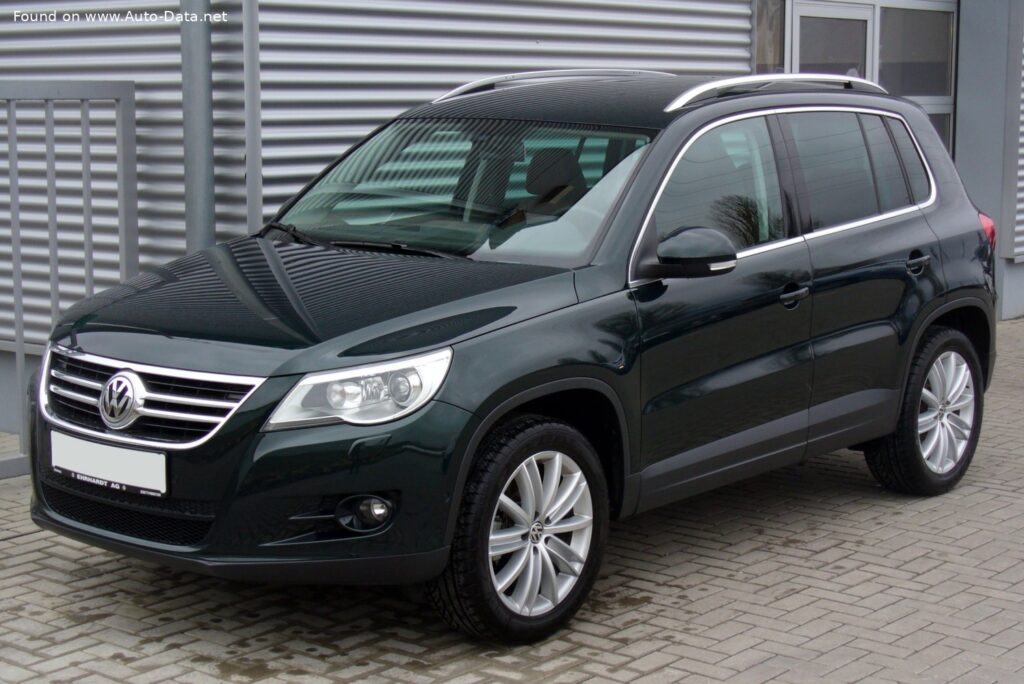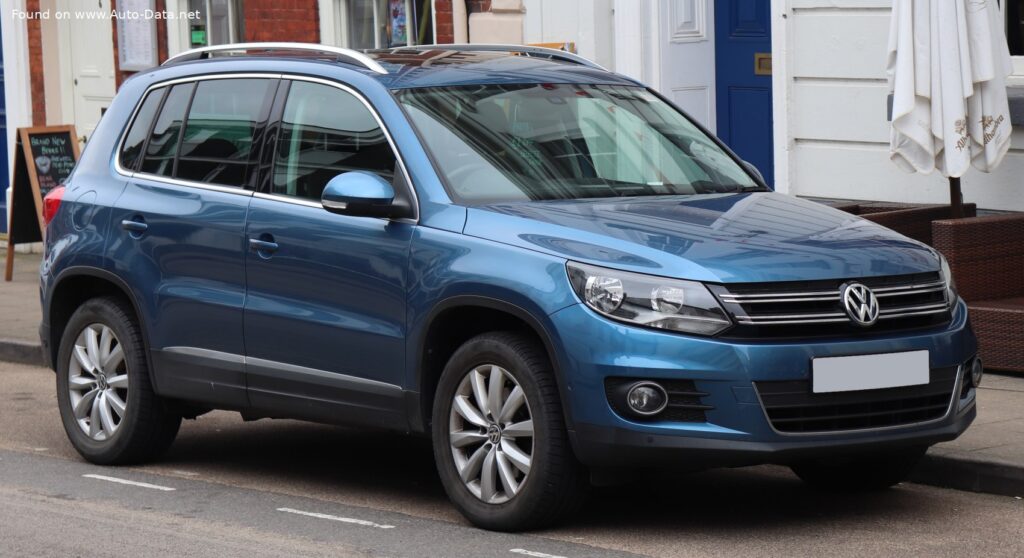
The Volkswagen Tiguan I (facelift 2011) 2.0 TDI (140 Hp) 4MOTION represents a significant iteration of Volkswagen’s popular compact SUV, a segment where it carved out a substantial niche, particularly in the European market. Unveiled as part of the first-generation Tiguan’s mid-cycle refresh, this specific variant, produced from 2011 to 2015, combined an efficient diesel powertrain with Volkswagen’s renowned 4MOTION all-wheel-drive system, offering a compelling blend of practicality, performance, and fuel economy. While this particular 2.0 TDI engine option was not extensively marketed in the United States during this period, its global presence underscored Volkswagen’s commitment to advanced diesel technology and its role in meeting stringent European emission standards. The facelift brought subtle yet effective design enhancements and technological updates, ensuring the Tiguan remained competitive against a rapidly growing field of compact SUV rivals.
The Volkswagen Tiguan I (facelift 2011): A European Compact SUV Standard
The first-generation Volkswagen Tiguan, introduced globally in 2007, quickly established itself as a benchmark in the burgeoning compact SUV segment. Its 2011 facelift, encompassing the variant under review, served to modernize its aesthetics and refine its mechanical and technological offerings. This update brought the Tiguan’s styling closer to Volkswagen’s contemporary design language, seen across models like the Golf and Passat, featuring sharper lines, revised headlights with optional LED daytime running lights, and a refreshed grille. More than just a cosmetic update, the facelift also introduced new features and improved efficiency across its powertrain lineup, reaffirming its position as a sophisticated and capable family vehicle.
Positioned as a versatile five-door, five-seat SUV, the Tiguan was designed to balance urban maneuverability with genuine off-road capability, particularly in its 4MOTION variants. Its robust build quality and refined driving dynamics were hallmarks of Volkswagen engineering, appealing to a broad spectrum of buyers seeking a premium feel in a compact package. In its primary European market, the 2.0 TDI engine was a cornerstone of its appeal, offering a potent combination of torque and fuel efficiency that was highly valued by consumers facing higher fuel prices and stricter emission regulations. The integration of advanced safety features and a comfortable, well-appointed interior further solidified its reputation as a thoughtful and well-engineered vehicle.
Powertrain and Performance
At the heart of the Volkswagen Tiguan I (facelift 2011) 2.0 TDI (140 Hp) 4MOTION lies a highly regarded 2.0-liter (1968 cm³, 120.09 cu. in.) inline four-cylinder diesel engine. This unit, part of Volkswagen’s EA189 family and identified by codes such as CBAB, CLJA, or CFFB, was a testament to the brand’s expertise in diesel technology. It delivered a robust 140 horsepower at 4200 rpm, complemented by a substantial 236.02 lb.-ft. (320 Nm) of torque available across a broad rev range from 1750 to 2500 rpm. This wide torque band ensured excellent drivability, offering strong acceleration from low speeds and effortless cruising capabilities.
The engine’s architecture featured a DOHC (Dual Overhead Camshaft) valvetrain with four valves per cylinder, optimizing airflow for combustion efficiency. Fuel delivery was managed by a sophisticated Commonrail direct injection system, which precisely controlled fuel atomization for cleaner and more complete combustion. Further enhancing its performance and efficiency was a turbocharger coupled with an intercooler, which boosted intake air density, resulting in greater power output and improved throttle response. This advanced setup allowed the Tiguan to accelerate from 0 to 60 mph in a respectable 9.7 seconds, reaching a maximum speed of 115.58 mph.
Fuel economy was a key strength of this TDI variant. According to NEDC (New European Driving Cycle) figures, the combined fuel consumption was an impressive 39.2 US mpg (6 liters per 100 km). Urban driving yielded 31.4 US mpg (7.5 l/100 km), while extra-urban conditions saw it achieve an outstanding 46.1 US mpg (5.1 l/100 km). These figures, combined with a 16.91 US gallon (64-liter) fuel tank, provided an excellent cruising range. The engine met Euro 5 emission standards, emitting 157 g/km of CO2, and was equipped with a particulate filter to reduce harmful emissions, underscoring its environmental consciousness for its time.
Power was delivered to all four wheels via Volkswagen’s 4MOTION all-wheel-drive system, paired with a smooth-shifting 6-speed manual transmission. The 4MOTION system intelligently distributed power, primarily driving the front wheels and engaging the rear wheels via an electrically or mechanically operated clutch only when necessary, such as during slippage or spirited driving. This adaptive approach optimized fuel efficiency while providing enhanced traction and stability in varying road conditions, whether tackling challenging weather or light off-road terrain.
Design, Utility, and Driving Dynamics
The Volkswagen Tiguan I (facelift 2011) maintained its compact SUV proportions, measuring 174.25 inches in length, 71.22 inches in width (80.35 inches including mirrors), and 67.05 inches in height. Its wheelbase of 102.52 inches contributed to a stable ride and generous interior space for five occupants across its five doors. The design, while refreshed, remained unmistakably Volkswagen – understated, functional, and timeless. The facelift introduced more angular headlamps and a revised grille, giving it a more assertive and contemporary face.
Inside, the Tiguan boasted a cabin renowned for its ergonomic layout, high-quality materials, and exceptional build quality. The five-seat configuration offered ample headroom and legroom for adults, making it suitable for both daily commutes and longer journeys. Practicality was a strong suit, with a minimum trunk space of 16.6 cubic feet (470 liters) that could expand significantly to 53.33 cubic feet (1510 liters) with the rear seats folded, facilitating the transport of larger items. A maximum payload capacity of 1441.82 lbs (654 kg) and a substantial towing capacity of 4850.17 lbs (2200 kg) with brakes further highlighted its utility for families and adventurers alike.
Driving dynamics were refined, offering a comfortable yet engaging experience. The independent McPherson strut front suspension with coil springs and an anti-roll bar, combined with an independent multi-link rear suspension with a stabilizer, provided a balanced ride and competent handling. Stopping power was ensured by ventilated disc brakes at the front and disc brakes at the rear, complemented by an Anti-lock Braking System (ABS) for enhanced safety. The electric power steering system offered precise control and ease of maneuverability, particularly in urban environments, with a minimum turning circle of 39.37 feet (12 meters).
Beyond its on-road prowess, the 4MOTION Tiguan also offered decent off-road capabilities for a compact SUV. With a ground clearance of 7.87 inches (200 mm), an approach angle of 18 degrees, a departure angle of 25 degrees, and a ramp-over angle of 20 degrees, it could confidently tackle unpaved roads and moderate trails. The range of tire and wheel options, from 215/65 R16 to 255/40 R19, allowed owners to customize their vehicle for aesthetics or specific driving conditions. Overall, the Tiguan I (facelift 2011) 2.0 TDI (140 Hp) 4MOTION stood as a well-rounded and highly capable compact SUV, embodying Volkswagen’s commitment to engineering excellence and practical design.
Technical Specifications of the Volkswagen Tiguan I (facelift 2011) 2.0 TDI (140 Hp) 4MOTION
| Brand | Volkswagen |
| Model | Tiguan |
| Generation | Tiguan I (facelift 2011) |
| Type (Engine) | 2.0 TDI (140 Hp) 4MOTION |
| Start of production | 2011 year |
| End of production | 2015 year |
| Powertrain Architecture | Internal Combustion engine |
| Body type | SUV |
| Seats | 5 |
| Doors | 5 |
| Fuel consumption (economy) – urban (NEDC) | 31.4 US mpg (7.5 l/100 km) |
| Fuel consumption (economy) – extra urban (NEDC) | 46.1 US mpg (5.1 l/100 km) |
| Fuel consumption (economy) – combined (NEDC) | 39.2 US mpg (6 l/100 km) |
| CO2 emissions (NEDC) | 157 g/km |
| Fuel Type | Diesel |
| Acceleration 0 – 100 km/h | 10.2 sec |
| Acceleration 0 – 62 mph | 10.2 sec |
| Acceleration 0 – 60 mph (Calculated) | 9.7 sec |
| Maximum speed | 115.58 mph (186 km/h) |
| Emission standard | Euro 5 |
| Weight-to-power ratio | 11.3 kg/Hp, 88.3 Hp/tonne |
| Weight-to-torque ratio | 5 kg/Nm, 201.8 Nm/tonne |
| Power | 140 Hp @ 4200 rpm. |
| Power per liter | 71.1 Hp/l |
| Torque | 236.02 lb.-ft. @ 1750-2500 rpm. (320 Nm) |
| Engine layout | Front, Transverse |
| Engine Model/Code | EA189 / CBAB, CLJA, CFFB |
| Engine displacement | 2.0 liters (1968 cm³, 120.09 cu. in.) |
| Number of cylinders | 4 |
| Engine configuration | Inline |
| Cylinder Bore | 3.19 in. (81 mm) |
| Piston Stroke | 3.76 in. (95.5 mm) |
| Compression ratio | 16.5:1 |
| Number of valves per cylinder | 4 |
| Fuel injection system | Diesel Commonrail |
| Engine aspiration | Turbocharger, Intercooler |
| Valvetrain | DOHC |
| Engine oil capacity | 4.23 US qt (4 l) |
| Coolant | 8.45 US qt (8 l) |
| Engine systems | Particulate filter |
| Kerb Weight | 3496.53 lbs. (1586 kg) |
| Max. weight | 4938.35 lbs. (2240 kg) |
| Max load | 1441.82 lbs. (654 kg) |
| Trunk (boot) space – minimum | 16.6 cu. ft. (470 l) |
| Trunk (boot) space – maximum | 53.33 cu. ft. (1510 l) |
| Fuel tank capacity | 16.91 US gal (64 l) |
| Max. roof load | 220.46 lbs. (100 kg) |
| Permitted trailer load with brakes (8%) | 4850.17 lbs. (2200 kg) |
| Permitted trailer load with brakes (12%) | 4850.17 lbs. (2200 kg) |
| Permitted trailer load without brakes | 1653.47 lbs. (750 kg) |
| Permitted towbar download | 220.46 lbs. (100 kg) |
| Length | 174.25 in. (4426 mm) |
| Width | 71.22 in. (1809 mm) |
| Width including mirrors | 80.35 in. (2041 mm) |
| Height | 67.05 in. (1703 mm) |
| Wheelbase | 102.52 in. (2604 mm) |
| Front track | 61.77 in. (1569 mm) |
| Rear (Back) track | 61.85 in. (1571 mm) |
| Ride height (ground clearance) | 7.87 in. (200 mm) |
| Minimum turning circle (turning diameter) | 39.37 ft. (12 m) |
| Approach angle | 18° |
| Departure angle | 25° |
| Ramp-over (brakeover) angle | 20° |
| Drivetrain Architecture | ICE drives front wheels permanently; rear wheels driven through clutch if necessary. |
| Drive wheel | All wheel drive (4×4) |
| Number of gears and type of gearbox | 6 gears, manual transmission |
| Front suspension | Independent, type McPherson with coil spring and anti-roll bar |
| Rear suspension | Independent multi-link spring suspension with stabilizer |
| Front brakes | Ventilated discs |
| Rear brakes | Disc |
| Assisting systems | ABS (Anti-lock braking system) |
| Steering type | Steering rack and pinion |
| Power steering | Electric Steering |
| Tires size | 215/65 R16; 215/60 R17; 235/55 R17; 235/50 R18; 255/40 R19 |
| Wheel rims size | 6.5J x 16; 6.5J x 17; 7J x 17; 7J x 18; 8J x 18; 9J x 19 |