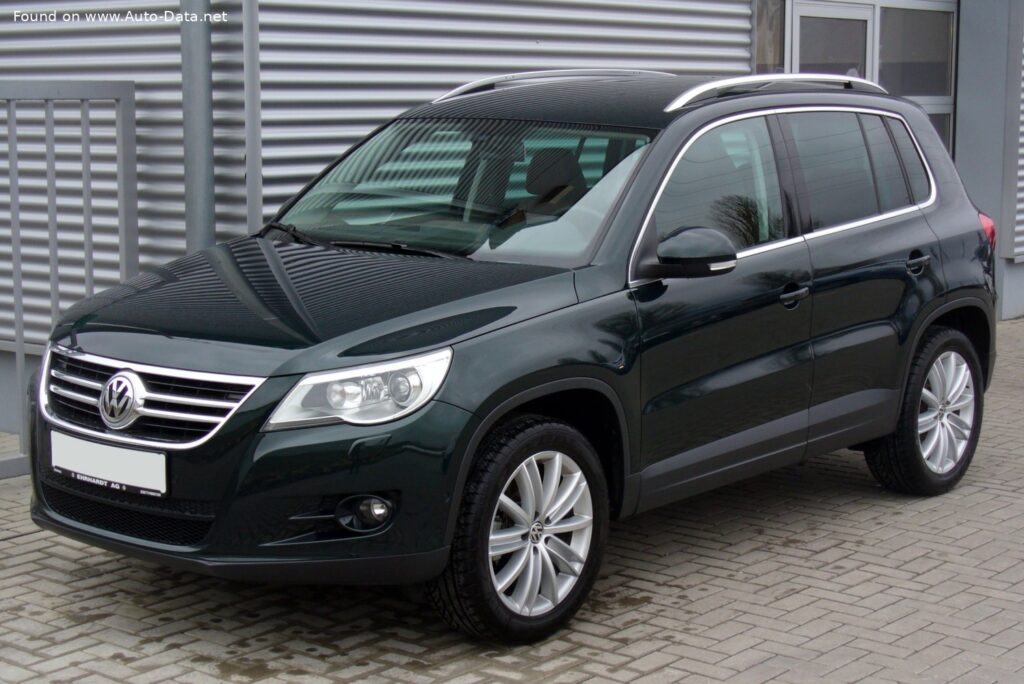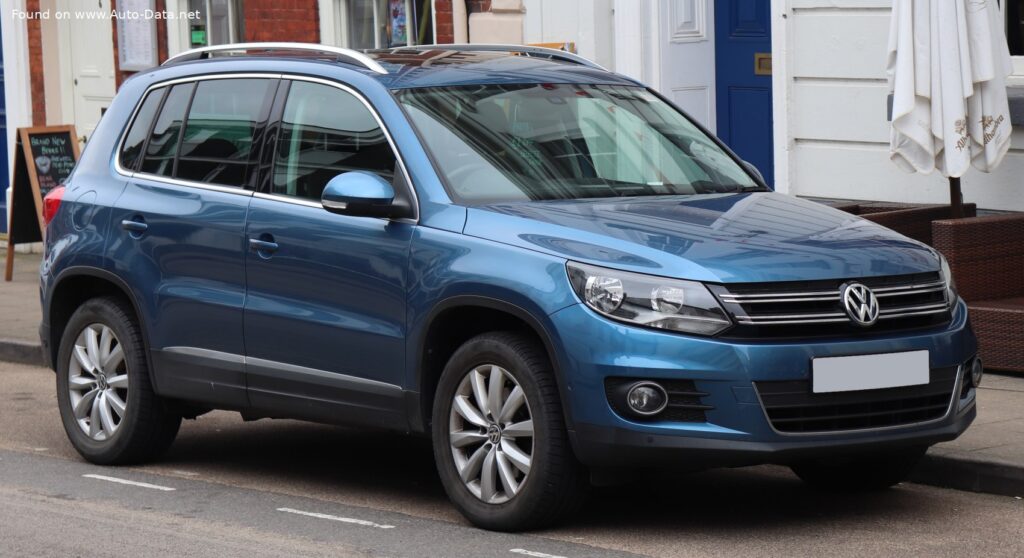
The Volkswagen Tiguan I, specifically the facelifted model introduced in 2011 and produced until 2015, represents a pivotal offering in the highly competitive compact SUV segment. This particular variant, the 2.0 TDI BMT (110 Hp), was strategically positioned within the European and international markets, emphasizing efficiency and practicality rather than outright performance. While the Tiguan nameplate is familiar to American consumers, this specific diesel powertrain, with its BlueMotion Technology (BMT), underscored Volkswagen’s commitment to fuel economy and reduced emissions, a characteristic particularly valued in regions with higher fuel costs and stricter environmental regulations than were prevalent in the United States at the time for diesel passenger vehicles. This first-generation Tiguan, with its robust engineering and refined driving dynamics, aimed to combine the versatility of an SUV with the agility and fuel efficiency typically associated with a compact sedan, making it a compelling choice for families and urban commuters alike.
Engine & Performance: The Efficient Volkswagen Tiguan I (facelift 2011) 2.0 TDI BMT (110 Hp)
At the heart of this particular Volkswagen Tiguan I (facelift 2011) model lies a highly efficient 2.0-liter TDI (Turbocharged Direct Injection) diesel engine, designated with codes like EA189 / CFFD or CUVE. This inline-four cylinder engine, configured transversally at the front, boasts a displacement of 1968 cubic centimeters (approximately 120.09 cubic inches). It features a DOHC (Double Overhead Camshaft) valvetrain with four valves per cylinder, a common characteristic of modern, efficient engines designed for optimal airflow and combustion. The engine’s fuel injection system utilizes a common rail design, which allows for precise control over fuel delivery, contributing significantly to both its efficiency and its relatively smooth operation for a diesel unit.
Further enhancing its performance and economy, the engine is equipped with a turbocharger and an intercooler. The turbocharger boosts air intake, increasing power output, while the intercooler cools the compressed air, improving its density and further optimizing combustion efficiency. Despite its modest output of 110 horsepower, delivered between 2750 and 4200 revolutions per minute, the engine excels in torque production. It generates a substantial 206.52 pound-feet of torque, available across a broad and accessible range from 1750 to 2750 rpm. This high torque figure at low engine speeds is characteristic of diesel engines and provides excellent drivability, particularly for urban commuting and highway cruising, allowing for strong acceleration from a standstill and effortless overtaking without needing to constantly downshift the standard six-speed manual transmission.
The “BMT” in its designation stands for BlueMotion Technology, a suite of features designed by Volkswagen to maximize fuel efficiency and minimize environmental impact. Key components of this technology include a Start & Stop System, which automatically shuts off the engine when the vehicle is stationary (e.g., at a traffic light) and restarts it seamlessly when the driver intends to move. Additionally, a Particulate Filter is integrated into the exhaust system to reduce harmful emissions. These technologies contribute to the vehicle’s impressive fuel economy figures: an estimated 37.9 to 37.3 US miles per gallon in urban driving, 50 to 49 US miles per gallon on the highway, and a combined average of 44.4 US miles per gallon. With CO2 emissions rated between 138-139 grams per kilometer, the Tiguan 2.0 TDI BMT met the Euro 5 emission standard, reflecting its environmentally conscious design for its era. Performance-wise, the Tiguan accelerates from 0 to 60 miles per hour in a respectable 11.3 seconds, reaching a top speed of 108.74 mph, making it perfectly adequate for daily driving and long-distance travel.
Design & Features: Practicality and Refinement
The Volkswagen Tiguan I (facelift 2011) maintained the robust yet understated design language characteristic of the brand, blending practicality with a touch of sophistication. As a compact SUV, it offered a versatile five-door body style with seating for five occupants, making it an ideal choice for small families or individuals seeking a capable daily driver. The facelift introduced subtle but effective updates, including revised headlights, a refreshed grille, and new bumper designs, aligning its aesthetics more closely with Volkswagen’s contemporary design philosophy seen in models like the Golf VI and Passat B7. These changes gave the Tiguan a sharper, more modern appearance without straying from its established, functional identity.
Dimensionally, the Tiguan stood at 174.25 inches in length, 71.22 inches in width (80.35 inches including mirrors), and 67.05 inches in height, with a wheelbase of 102.52 inches. These dimensions contributed to its maneuverability in urban environments while still providing a commanding driving position and ample interior space. The curb weight of 3236.39 pounds underscored its solid build quality, which also contributed to its stable ride.
Inside, the Tiguan offered a well-appointed cabin focused on ergonomics and utility. While specific trim levels varied by market, standard features often included climate control, a comprehensive infotainment system, and a suite of safety features typical for its time. The luggage capacity was practical, offering 16.6 cubic feet of trunk space with the rear seats in place, expandable to a generous 53.33 cubic feet when the rear seats were folded down, accommodating everything from groceries to sports equipment. The vehicle’s ground clearance of 7.87 inches, combined with approach, departure, and ramp-over angles of 18°, 25°, and 20° respectively, provided a degree of off-road capability, albeit primarily suited for light trails rather than serious rock crawling.
The Tiguan’s driving dynamics were further enhanced by its sophisticated suspension system. The front featured an independent McPherson strut setup with coil springs and an anti-roll bar, providing precise steering and good road holding. The rear utilized an independent multi-link spring suspension with a stabilizer, which contributed to a comfortable ride and excellent stability, particularly when cornering or on uneven surfaces. Braking performance was handled by ventilated discs at the front and solid discs at the rear, complemented by an Anti-lock Braking System (ABS) for enhanced safety and control during emergency stops. The steering system was a rack and pinion type with electric power steering, offering light effort at low speeds for easy parking and more feedback at higher speeds for confident highway driving. The standard front-wheel-drive architecture for this specific variant further emphasized its efficiency-focused design, though all-wheel-drive options were available on other Tiguan models.
Technical Specifications
| Brand | Volkswagen |
| Model | Tiguan |
| Generation | Tiguan I (facelift 2011) |
| Type (Engine) | 2.0 TDI BMT (110 Hp) |
| Start of production | 2011 year |
| End of production | 2015 year |
| Powertrain Architecture | Internal Combustion engine |
| Body type | SUV |
| Seats | 5 |
| Doors | 5 |
| Fuel consumption (economy) – urban (NEDC) | 37.9 – 37.3 US mpg |
| Fuel consumption (economy) – extra urban (NEDC) | 50 – 49 US mpg |
| Fuel consumption (economy) – combined (NEDC) | 44.4 US mpg |
| CO2 emissions (NEDC) | 138-139 g/km |
| Fuel Type | Diesel |
| Acceleration 0 – 60 mph | 11.3 sec |
| Maximum speed | 108.74 mph |
| Emission standard | Euro 5 |
| Weight-to-power ratio | 13.3 kg/Hp, 74.9 Hp/tonne |
| Weight-to-torque ratio | 5.2 kg/Nm, 190.7 Nm/tonne |
| Power | 110 Hp @ 2750-4200 rpm |
| Power per liter | 55.9 Hp/l |
| Torque | 206.52 lb.-ft. @ 1750-2750 rpm |
| Engine layout | Front, Transverse |
| Engine Model/Code | EA189 / CFFD, CUVE |
| Engine displacement | 2.0 liters (120.09 cu. in.) |
| Number of cylinders | 4 |
| Engine configuration | Inline |
| Cylinder Bore | 3.19 in. |
| Piston Stroke | 3.76 in. |
| Compression ratio | 16:1 |
| Number of valves per cylinder | 4 |
| Fuel injection system | Diesel Commonrail |
| Engine aspiration | Turbocharger, Intercooler |
| Valvetrain | DOHC |
| Engine oil capacity | 4.54 US qt |
| Coolant | 8.45 US qt |
| Engine systems | Start & Stop System, Particulate filter |
| Kerb Weight | 3236.39 lbs. |
| Max. weight | 4585.62 lbs. |
| Max load | 1349.23 lbs. |
| Trunk (boot) space – minimum | 16.6 cu. ft. |
| Trunk (boot) space – maximum | 53.33 cu. ft. |
| Fuel tank capacity | 16.91 US gal |
| Max. roof load | 165.35 lbs. |
| Permitted trailer load with brakes (8%) | 4409.25 lbs. |
| Permitted trailer load with brakes (12%) | 3968.32 lbs. |
| Permitted trailer load without brakes | 1653.47 lbs. |
| Permitted towbar download | 220.46 lbs. |
| Length | 174.25 in. |
| Width | 71.22 in. |
| Width including mirrors | 80.35 in. |
| Height | 67.05 in. |
| Wheelbase | 102.52 in. |
| Front track | 61.77 in. |
| Rear (Back) track | 61.85 in. |
| Ride height (ground clearance) | 7.87 in. |
| Minimum turning circle (turning diameter) | 39.37 ft. |
| Approach angle | 18° |
| Departure angle | 25° |
| Ramp-over (brakeover) angle | 20° |
| Drivetrain Architecture | Front-wheel drive (Internal Combustion engine drives front wheels) |
| Drive wheel | Front wheel drive |
| Number of gears and type of gearbox | 6 gears, manual transmission |
| Front suspension | Independent, type McPherson with coil spring and anti-roll bar |
| Rear suspension | Independent multi-link spring suspension with stabilizer |
| Front brakes | Ventilated discs |
| Rear brakes | Disc |
| Assisting systems | ABS (Anti-lock braking system) |
| Steering type | Steering rack and pinion |
| Power steering | Electric Steering |
| Tires size | 215/65 R16; 215/60 R17; 235/55 R17; 235/50 R18; 255/40 R19 |
| Wheel rims size | 6.5J x 16; 6.5J x 17; 7J x 17; 7J x 18; 8J x 18; 9J x 19 |