
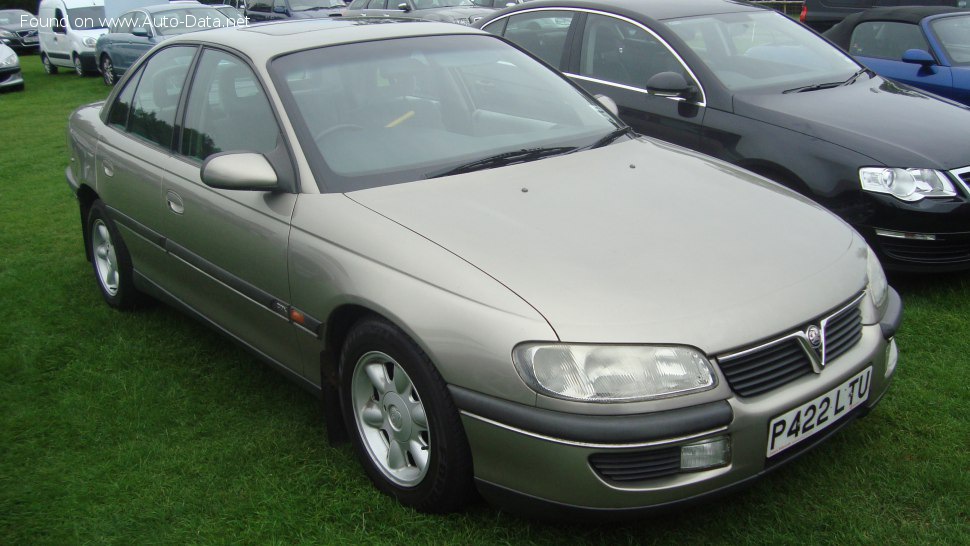
The Vauxhall Omega B 2.5i V6 24V (170 Hp) stands as a notable entry in the European executive car segment, representing the second generation of Vauxhall’s flagship sedan. Launched in 1994, the Omega B succeeded the original Omega (known as the Vauxhall Carlton in the UK and Opel Omega in mainland Europe) and aimed to offer a sophisticated, comfortable, and dynamically capable rear-wheel-drive platform for discerning buyers. While never officially sold in the United States, the Omega B, and its Opel counterpart, were highly regarded in their primary markets for their blend of traditional engineering, spacious interiors, and robust powertrains. This particular variant, equipped with a 2.5-liter V6 engine, positioned itself as a strong contender, balancing performance with the refined cruising characteristics expected of a full-size sedan during its production run from 1994 to 1999.
Engine and Performance of the Vauxhall Omega B 2.5i V6 24V (170 Hp)
At the heart of the Vauxhall Omega B 2.5i V6 24V (170 Hp) lies a meticulously engineered 2.5-liter V6 gasoline engine, identified by the internal code X25XE. This naturally aspirated powerplant was a hallmark of Opel/Vauxhall’s engineering prowess in the mid-1990s, renowned for its smooth operation and linear power delivery. With a displacement of 2,498 cubic centimeters (152.44 cubic inches), the V6 configuration, featuring a DOHC (Double Overhead Camshaft) valvetrain with 24 valves (four per cylinder), was optimized for both efficiency and a responsive driving experience. It generated a maximum output of 170 horsepower at a relatively high 6,000 revolutions per minute, translating to a power-per-liter rating of 68.1 horsepower per liter, which was competitive for its era.
Equally impressive was the engine’s torque output, peaking at 227 Newton-meters (167.43 pound-feet) at a more accessible 3,200 rpm. This broad torque band ensured strong acceleration from lower engine speeds, making the Omega B a capable cruiser on highways and responsive in urban driving conditions. Power was efficiently transferred to the rear wheels via a standard 5-speed manual transmission, offering an engaging driving experience for those who preferred manual control. The car’s performance figures included a top speed of 223 kilometers per hour (138.57 miles per hour), allowing it to comfortably keep pace with other executive sedans of its time. Despite its performance capabilities, the Omega B 2.5i V6 managed reasonable fuel economy for a vehicle of its size and engine capacity, with an urban consumption rate of approximately 11.6 liters per 100 kilometers (20.3 US miles per gallon).
The engine’s layout was front-mounted and longitudinal, a traditional arrangement that contributed to the car’s balanced weight distribution and handling characteristics. With a compression ratio of 10.8:1, the X25XE engine was designed for optimal combustion efficiency using standard unleaded gasoline. The robust cooling system held 9.7 liters (10.25 US quarts) of coolant, ensuring thermal stability under various driving conditions, while the engine oil capacity stood at 5.75 liters (6.08 US quarts). These specifications underscore the engineering focus on durability and performance that defined the Vauxhall Omega B’s powertrain.
Design and Features of the Omega B Sedan
The Vauxhall Omega B, a quintessential four-door sedan, presented a design that was both contemporary and understated, reflecting the automotive styling trends of the mid-1990s. Measuring 4,787 millimeters (188.46 inches) in length, 1,786 millimeters (70.31 inches) in width (1,960 mm or 77.17 inches including mirrors), and 1,455 millimeters (57.28 inches) in height, it commanded a significant road presence. Its wheelbase of 2,730 millimeters (107.48 inches) contributed to a stable ride and generous interior space, comfortably accommodating five occupants. The vehicle’s drag coefficient (Cd) of 0.29 was a testament to its aerodynamic efficiency, aiding both fuel economy and reduced wind noise at higher speeds.
Inside, the Omega B was designed with passenger comfort and practicality in mind. The spacious cabin offered ample legroom and headroom, making it suitable for long journeys. The trunk capacity was a substantial 530 liters (18.72 cubic feet), providing considerable storage for luggage, a key attribute for an executive sedan. Furthermore, the Omega B boasted a generous fuel tank capacity of 75 liters (19.81 US gallons), allowing for extended driving ranges between fill-ups. Practical features also included a maximum roof load of 100 kg (220.46 lbs) and impressive towing capabilities, with a permitted trailer load of 1,750-1,800 kg (3,858.09 – 3,968.32 lbs) with brakes, highlighting its versatility.
The kerb weight of the Omega B 2.5i V6 ranged from 1,454 to 1,585 kg (3,205.52 to 3,494.33 lbs), depending on specifications, with a maximum permissible weight of 2,065 to 2,095 kg (4,552.55 to 4,618.68 lbs). This robust construction, combined with its thoughtful interior design, made the Omega B a practical and comfortable choice for families and business users alike. Its elegant lines and functional design ensured it remained a competitive offering in a demanding market segment throughout its production lifespan.
Chassis, Drivetrain, and Safety Systems
The Vauxhall Omega B 2.5i V6 24V (170 Hp) was built upon a traditional rear-wheel-drive architecture, a choice that appealed to driving enthusiasts and contributed to the car’s balanced handling characteristics. This drivetrain layout, where the internal combustion engine drives the rear wheels, was a hallmark of executive sedans of its era, offering a distinct driving feel compared to front-wheel-drive alternatives. The standard 5-speed manual transmission further enhanced driver engagement, providing direct control over the engine’s power delivery.
For its suspension system, the Omega B employed an independent McPherson strut setup with coil springs and an anti-roll bar at the front, a configuration known for its balance of ride comfort and handling precision. The rear suspension featured an independent multi-link design, a more sophisticated arrangement that allowed for greater control over wheel alignment and improved ride quality, particularly over uneven surfaces. This combination provided a comfortable yet composed ride, characteristic of a vehicle designed for long-distance cruising.
Braking performance was ensured by a robust system featuring ventilated disc brakes at the front and solid disc brakes at the rear. This setup offered strong stopping power and resistance to fade, crucial for a vehicle of the Omega B’s size and performance. Standard assisting systems included ABS (Anti-lock Braking System), a critical safety feature for the time, which helped maintain steering control during emergency braking maneuvers. The vehicle rode on 205/65 R15 tires mounted on 6J x 15-inch wheel rims, providing a good balance of grip, comfort, and durability. The minimum turning circle of 10.2 meters (33.46 feet) demonstrated its surprising maneuverability for a car of its dimensions, making it relatively easy to navigate in urban environments.
Market Context and Legacy
The Vauxhall Omega B, and its Opel Omega counterpart, occupied a crucial position in the European automotive landscape. It served as the flagship offering for General Motors’ European operations, competing directly with established rivals such as the BMW 5 Series, Mercedes-Benz E-Class, and Ford Scorpio. While it might not have matched the premium badge appeal of its German competitors, the Omega B carved out a niche by offering a compelling package of space, comfort, traditional rear-wheel-drive dynamics, and value. Its robust construction and comprehensive feature set made it a popular choice for fleet managers, business executives, and families seeking a capable and spacious sedan.
The 2.5i V6 24V variant, with its 170 horsepower, struck a particularly sweet spot in the range, offering a significant upgrade in performance over the four-cylinder models without the higher running costs or complexity of the larger V6 or diesel options. Its smooth V6 engine and comfortable ride made it an excellent long-distance cruiser, embodying the traditional virtues of a grand touring sedan. Although its production concluded in 1999, paving the way for the Vectra to assume a more prominent role as Opel/Vauxhall shifted its focus, the Omega B left a lasting legacy. It is remembered as one of the last truly traditional large rear-wheel-drive sedans from a mainstream European brand, appreciated for its blend of classic engineering, understated elegance, and practical functionality. Its influence can still be seen in the design philosophies of subsequent large sedans, emphasizing comfort, space, and a refined driving experience.
Technical Specifications
| Brand | Vauxhall |
| Model | Omega |
| Generation | Omega B |
| Type (Engine) | 2.5i V6 24V (170 Hp) |
| Start of production | 1994 year |
| End of production | 1999 year |
| Powertrain Architecture | Internal Combustion engine |
| Body type | Sedan |
| Seats | 5 |
| Doors | 4 |
| Fuel consumption (economy) – urban | 11.6 l/100 km (20.3 US mpg, 24.4 UK mpg, 8.6 km/l) |
| Fuel Type | Petrol (Gasoline) |
| Maximum speed | 223 km/h (138.57 mph) |
| Weight-to-power ratio | 8.6 kg/Hp, 116.9 Hp/tonne |
| Weight-to-torque ratio | 6.4 kg/Nm, 156.1 Nm/tonne |
| Power | 170 Hp @ 6000 rpm. |
| Power per litre | 68.1 Hp/l |
| Torque | 227 Nm @ 3200 rpm. (167.43 lb.-ft. @ 3200 rpm.) |
| Engine layout | Front, Longitudinal |
| Engine Model/Code | X25XE |
| Engine displacement | 2498 cm3 (152.44 cu. in.) |
| Number of cylinders | 6 |
| Engine configuration | V-engine |
| Cylinder Bore | 81.5 mm (3.21 in.) |
| Piston Stroke | 79.6 mm (3.13 in.) |
| Compression ratio | 10.8:1 |
| Engine aspiration | Naturally aspirated engine |
| Valvetrain | DOHC |
| Engine oil capacity | 5.75 l (6.08 US qt | 5.06 UK qt) |
| Coolant | 9.7 l (10.25 US qt | 8.53 UK qt) |
| Kerb Weight | 1454-1585 kg (3205.52 – 3494.33 lbs.) |
| Max. weight | 2065-2095 kg (4552.55 – 4618.68 lbs.) |
| Max load | 510-611 kg (1124.36 – 1347.02 lbs.) |
| Trunk (boot) space – maximum | 530 l (18.72 cu. ft.) |
| Fuel tank capacity | 75 l (19.81 US gal | 16.5 UK gal) |
| Max. roof load | 100 kg (220.46 lbs.) |
| Permitted trailer load with brakes (12%) | 1750-1800 kg (3858.09 – 3968.32 lbs.) |
| Permitted trailer load without brakes | 750 kg (1653.47 lbs.) |
| Permitted towbar download | 75 kg (165.35 lbs.) |
| Length | 4787 mm (188.46 in.) |
| Width | 1786 mm (70.31 in.) |
| Width including mirrors | 1960 mm (77.17 in.) |
| Height | 1455 mm (57.28 in.) |
| Wheelbase | 2730 mm (107.48 in.) |
| Front track | 1514 mm (59.61 in.) |
| Rear (Back) track | 1528 mm (60.16 in.) |
| Rear overhang | 1140 mm (44.88 in.) |
| Drag coefficient (Cd) | 0.29 |
| Minimum turning circle (turning diameter) | 10.2 m (33.46 ft.) |
| Drivetrain Architecture | The Internal combustion engine (ICE) drives the rear wheels of the vehicle. |
| Drive wheel | Rear wheel drive |
| Number of gears and type of gearbox | 5 gears, manual transmission |
| Front suspension | Independent, type McPherson with coil spring and anti-roll bar |
| Rear suspension | Independent multi-link suspension |
| Front brakes | Ventilated discs |
| Rear brakes | Disc |
| Assisting systems | ABS (Anti-lock braking system) |
| Tires size | 205/65 R15 |
| Wheel rims size | 6J x 15 |
